Marketing Strategy,
Programmed.
The complete MCM methodology in print. 20 case studies. One decision-making system.
"Marketing is the only core business function without a shared operating system. This book provides one."
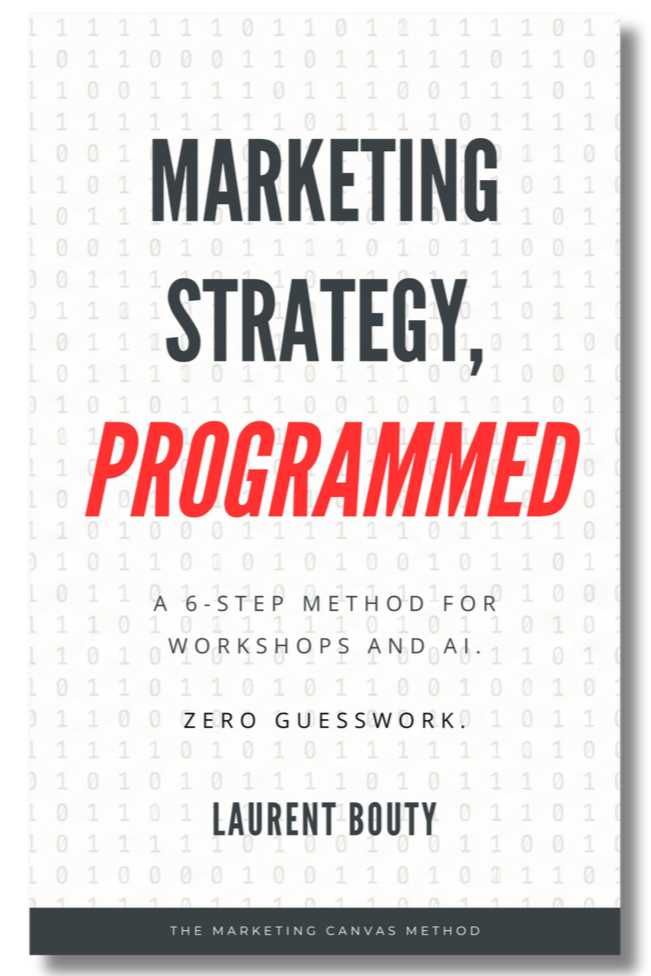
Five things you can do after reading this book.
Not theory. Not inspiration. Operational outcomes you can act on this week.
Score all 24 dimensions and understand exactly what's working and what isn't.
Use M3 × M4 + revenue goal to identify which of 9 archetypes fits your situation.
Facilitate a structured scoring session. Identify your fatal brakes and accelerators.
Three 4-month cycles with mandatory gates, budgets, and owners.
When your team speaks the same language, decisions get faster and alignment gets cheaper.
Real companies. Honest archetypes.
No flattering interpretations.
Tesla didn't compete in the car market. It competed for the car buyer's identity.
At Step 2, Tesla's combination of a growth market (M3), differentiation strategy (M4), and GET revenue goal produced a single archetype: A1 Disruptive Newcomer. The fatal brake wasn't product — it was Proof (340). The company's entire early marketing budget went into making people believe a battery-electric vehicle could be faster, more desirable, and more status-bearing than any combustion alternative. Not functional proof. Identity proof. The Roadster was never a car. It was a credential.
Patagonia's highest-performing marketing campaign told customers not to buy its product.
The "Don't Buy This Jacket" campaign in 2011 is the most concentrated expression of an A3 Brand Evangelist strategy ever executed. In MCM terms: dimension 230 (Values) is a Fatal Brake for A3 — it must be authentic or the tribe collapses. But the Primary Accelerators are Emotions (320) and Purpose (210), both grounded in dimension 120 (Aspirations). The customer's aspiration wasn't outdoor gear. It was to be the kind of person who makes responsible consumption decisions. Patagonia sold that identity. The jacket was incidental.
Sage's problem wasn't the software. It was that the software stopped feeling like it understood its customers.
A4 Stagnant Leader is the hardest archetype to accept — because the diagnosis is uncomfortable. Sage was still growing, still profitable, still dominant in its segment. But the Vital Audit told a different story: dimensions 110 (JTBD) and 420 (Experience) were both below −1. Customers weren't leaving. But they were staying without enthusiasm. And without enthusiasm, they were vulnerable to any credible alternative. The Sage case is a study in what happens when a company confuses customer inertia with customer loyalty.
Three parts.
One complete system.
Marketing's missing language. The problem with optimising everything simultaneously. Why "strategic noise" is the default state of most teams — and how a shared vocabulary changes that.
Each step covered in full detail. Every output defined. Every input specified.
Real companies mapped to real archetypes. What their vital dimensions were. What worked, what didn't, and why the archetype framework predicted it.
Complete glossary · Workshop facilitation guide · Common mistakes · The 24 dimensions in full detail · Everything you need to run MCM without external support.
Who this book is for?
CMOs & Marketing Strategists
You've run strategy workshops before. You've use frameworks. You've felt the gap between diagnosis and action. This book closes that gap with a method that connects every decision to evidence.
Founders & Entrepreneurs
You don't have a 20-person marketing team. You need a method that one person can run — with structured outputs you can present to investors, partners, or your own board.
MBA students & Academics
You need a method you can teach, learn, and apply in a case study setting. The 24 dimensions, 9 archetypes, and scoring system give you the precision to grade strategy, not just discuss it.
Ready to give your marketing strategy a language?
Available on Amazon in paperback and digital formats. Used by marketing leaders in Belgium, France, Netherlands, and across Europe.