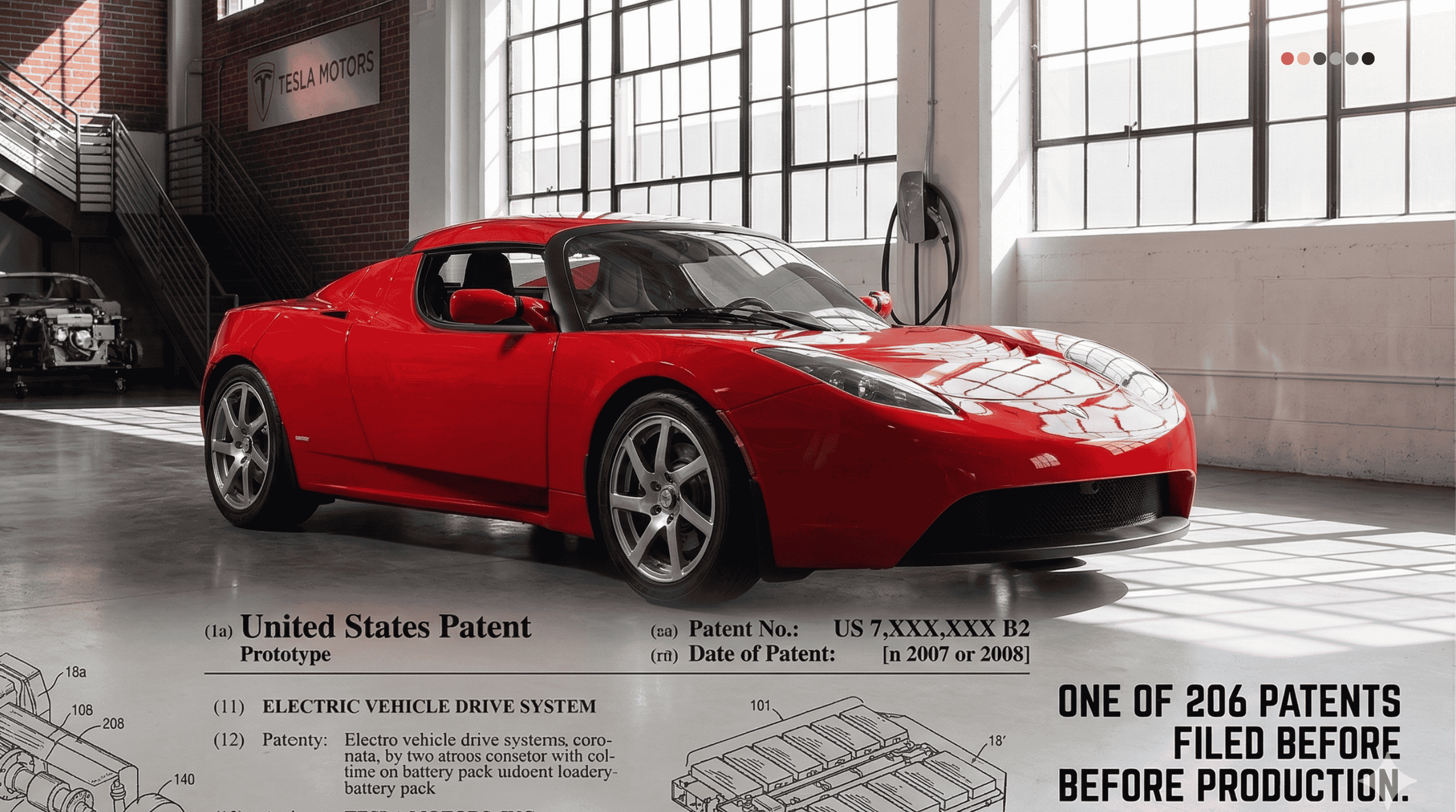
The Patent Empire That Almost Died Twice
The world remembers Tesla as the company that proved electric vehicles could be desirable. The balance sheet remembers it differently — as a company that survived two near-bankruptcies, was rescued once by a German automaker and once by the US government, outsourced its first car body to a British sports car manufacturer, and built its competitive moat not from a mission statement but from 206 patents filed before a single production vehicle reached a customer. The mission was real. But the mission alone would have placed Tesla in the same table as Fisker, Detroit Electric, and fourteen other EV startups that shared the same ambitions and none of the same IP. What separated Tesla from that table was sequenced, constraint-based R&D investment — and two strokes of luck that Elon Musk has never fully accounted for.
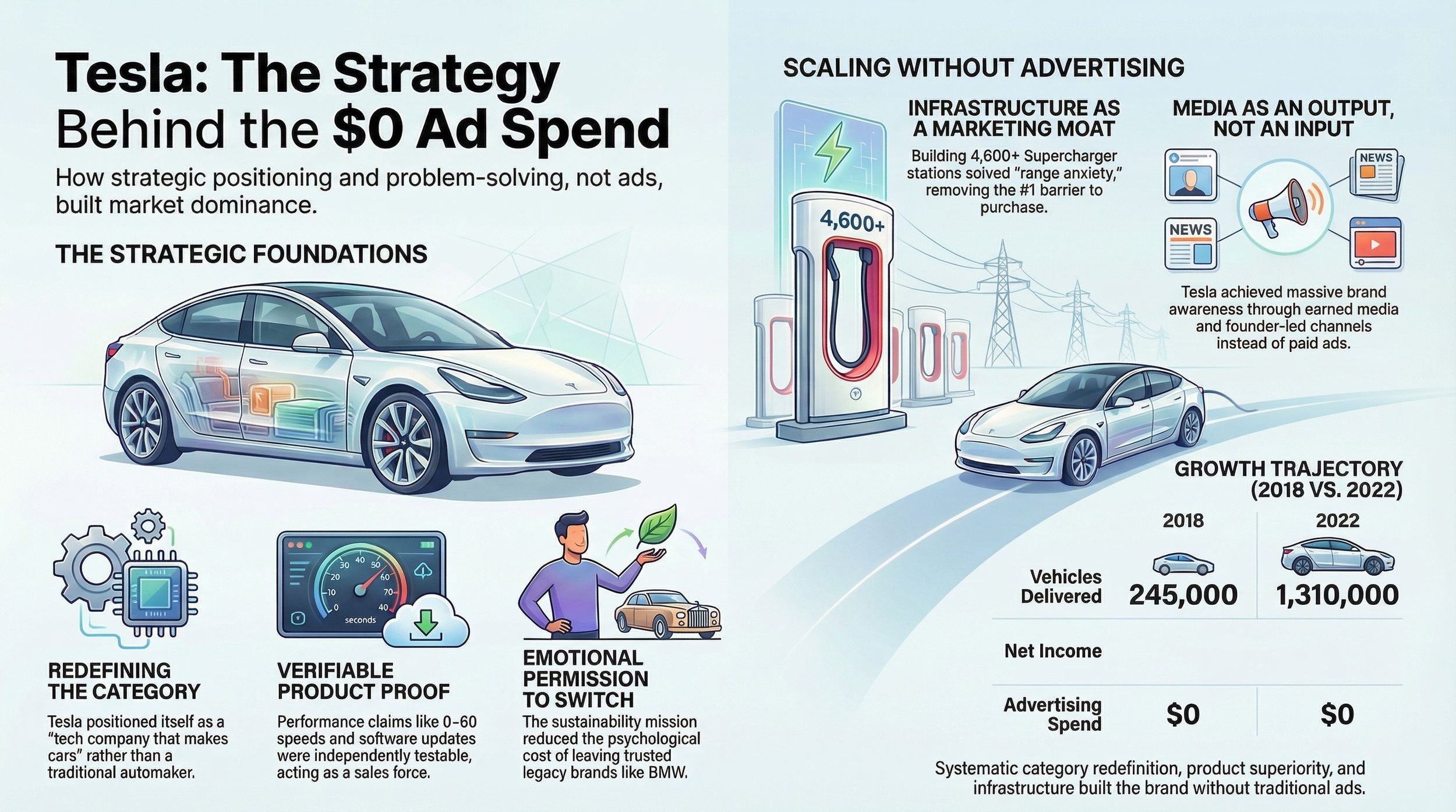
Tesla's A1 Position: What the Vital 8 Audit Shows — and What the Numbers Cannot Tell You
Tesla's zero-advertising story is the most retold marketing fact of the past decade. It is also, by itself, the least useful. The interesting question is not that Tesla spent $0 on advertising. It is why that was possible — and what structural conditions have to be simultaneously true for a company to generate that kind of earned media at that kind of scale.
The Marketing Canvas Method (MCM) — a 6-step strategic framework that classifies companies into one of nine strategic archetypes based on market context, customer segment, and revenue goal — produces a specific answer. Tesla between 2018 and 2022 achieved maximum scores on every dimension in its Vital 8 configuration, simultaneously. That is a rare event. Understanding how they produced it — and what threatens it — is more useful than the zero-ad headline.