Compass Quadrant Strategy: From Diagnosis to FIX/ALIGN/SCALE (5/7)
The MCM Sustainability Compass produces a position. That position is the start of a strategic conversation, not the end of one. What the Compass does not do automatically is tell you what to do next — because the right action depends on which quadrant you are in, which sustainability maturity stage you are at, and whether your current initiatives are sequenced to build sustainable competitive advantage or to create the appearance of one.
This article maps the strategic implications of each quadrant position, the FIX/ALIGN/SCALE priorities that follow from each, and the four-stage maturity model that sequences the work regardless of which quadrant you start from.
Q1 — Sustainable Leader: SCALE with proof protection
Commercial Score: HIGH | Sustainability Score: HIGH
The Q1 position has been earned. The company has demonstrated both commercial marketing effectiveness and genuine sustainability integration, scored across all five actionable meta-dimensions with verifiable evidence. In the sustainability megatrend typology, these are the Winners — companies that matched sustainability vision with execution capability.
The strategic dialogue for Q1 is not remediation but acceleration:
"You have real proof on both axes. The next question is sequencing: where can sustainability become a further commercial differentiator? Are your sustainability strengths visible enough in Positioning (225) and Stories (525) to convert them into competitive advantage?"
The FIX/ALIGN/SCALE priority is SCALE — leveraging proven sustainability strengths to drive revenue growth, expand into new segments, and deepen the brand's sustainability identity. The primary risk is not a gap between claimed and evidenced positions but complacency: early leaders in every major megatrend eventually face competitors who have closed the gap. The Proof dimension (345) is the leading indicator to monitor. When a company stops gathering new sustainability evidence and relies on existing credentials, the Integrity Gap begins to open from the other direction — not over-claiming, but under-innovating.
Archetype tendencies: A3 (Brand Evangelist), A9 (Category Creator), A5 (Pivot Pioneer) with sustainability as the central axis of the pivot.
Q2 — Purpose Pioneer: FIX the commercial engine first
Commercial Score: LOW | Sustainability Score: HIGH
The Q2 position reflects genuine sustainability commitment — often demonstrated through costly operational trade-offs — alongside a commercial engine that cannot yet support the scale of the ambition. The sustainability credentials are real. The commercial model is fragile. In the megatrend typology these are the Dreamers, and the label is precise: when sustainability vision consistently outpaces execution capacity, the company makes commitments it cannot honour. Even with authentic intent, unfulfilled sustainability commitments produce greenwashing accusations and reputational harm.
The strategic dialogue for Q2 addresses sequencing before ambition:
"Your sustainability credentials are real. The constraint is commercial execution. What is the lowest-scoring core dimension pulling your overall performance down? Fix that without compromising the sustainability architecture you've built — that's the sequencing challenge."
The FIX/ALIGN/SCALE priority is FIX core commercial brakes first, then ALIGN sustainability with the revenue engine. The structural path from Q2 to Q1 is the ambidextrous model: a dedicated sustainability innovation unit that continues developing new sustainability opportunities while the core commercial operation is stabilised. Merging sustainability and commercial functions under shared leadership accelerates the translation of sustainability commitments into viable revenue streams.
The most frequent bottleneck is the Pricing dimension (335). Purpose Pioneers commonly score well on Brand dimensions (215, 225, 235) but score poorly on 335 because genuinely sustainable pricing — which reflects the true cost of the offer — makes the product inaccessible at the scale required for commercial viability. Solving 335 without undermining the intrinsic sustainability motivation that drives the brand is the central design challenge for Q2 companies.
Archetype tendencies: A1 (Disruptive Newcomer) with sustainability-first positioning; early-stage A7 (Scale-Up Guardian) with strong values and an unproven commercial engine.
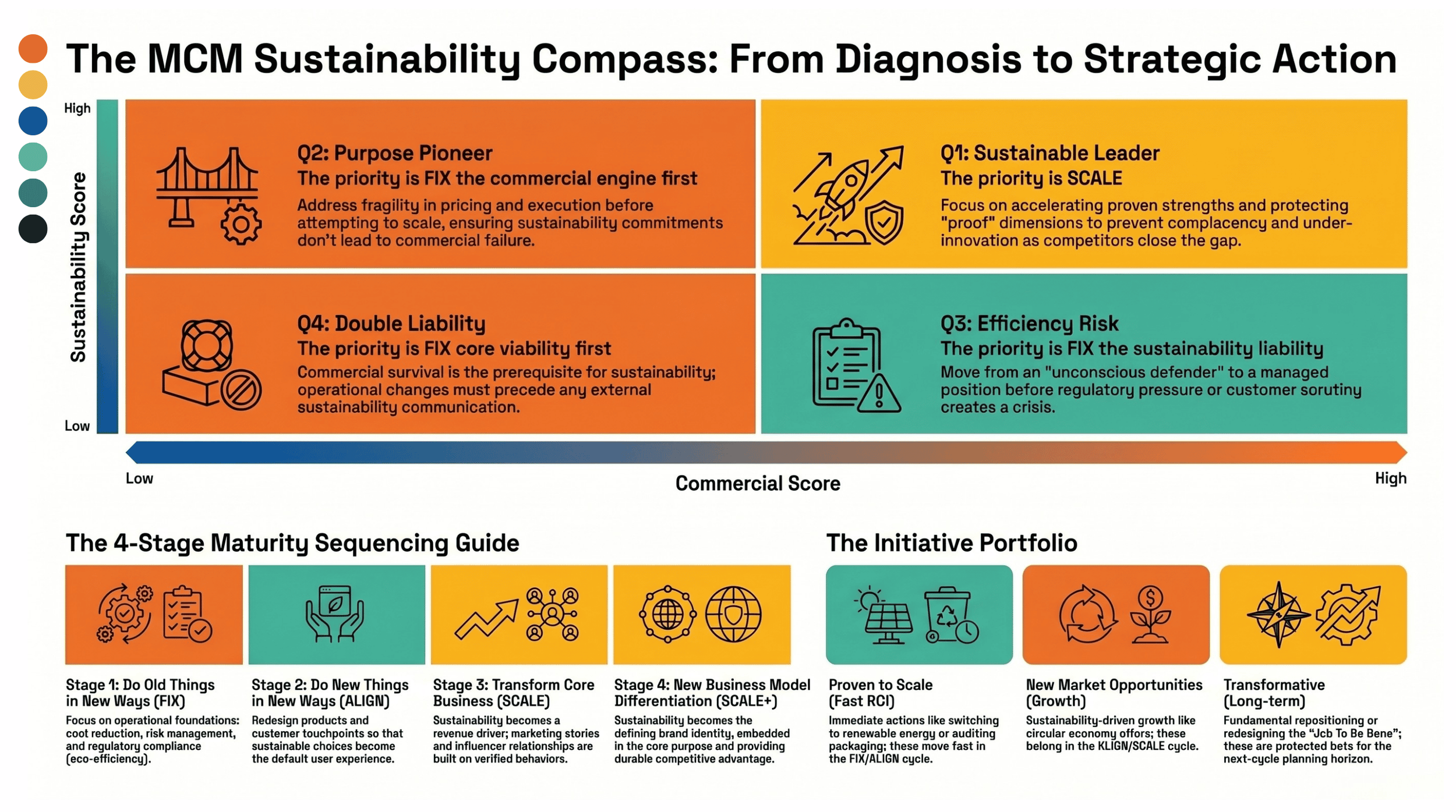
The MCM Sustainability Compass
Q3 — Efficiency Risk: FIX the liability before it becomes a crisis
Commercial Score: HIGH | Sustainability Score: LOW
The Q3 position requires an important distinction before any strategic prescription. Not all Q3 companies carry equal risk. The megatrend typology names this the Defenders position, and it separates into two fundamentally different situations.
A deliberate Defender has made a considered strategic choice to maintain a go-slow sustainability position — because the industry structure, competitive dynamics, regulatory environment, or environmental exposure of the business make it rational to do so at this point in time. This company knows its position, monitors the gap between its position and that of sustainability leaders in its category, and has a sequenced plan for when and how to close it. This is a legitimate, managed strategic risk.
An unconscious Defender has simply not engaged with the sustainability question seriously. It may be communicating about sustainability — often heavily — without genuine integration behind the communication. This is a different and more dangerous situation, because the company is accumulating reputational exposure it has not priced into its strategy.
The strategic dialogue for Q3 establishes which of these applies before prescribing action:
"Your Commercial Score is strong. But your Sustainability Score is a liability you are not currently pricing into your strategy. Look specifically at your participation-oriented scores — 145, 445, 515, 525. These are near zero. You are not asking customers to be partners in sustainability, which means you are bearing the entire risk of any sustainability failure alone. What would it take to shift from a Fertilizing posture to a Grafting one?"
The FIX/ALIGN/SCALE priority is FIX the sustainability liability before regulatory pressure, customer scrutiny, or a supply chain disclosure forces the issue. Then ALIGN brand claims with operational reality — the most dangerous variant of Q3 is a company with a LOW Sustainability Score that nonetheless communicates heavily about sustainability, producing the widest Integrity Gap in the framework.
Archetype tendencies: A4 (Stagnant Leader) and A6 (Value Harvester) with strong historical positions and low reinvestment in sustainability; A2 (Efficiency Machine) when cost discipline systematically crowds out sustainability consideration.
Q4 — Double Liability: FIX viability before sustainability
Commercial Score: LOW | Sustainability Score: LOW
The Q4 position requires the most direct strategic dialogue. Two distinct crises are present simultaneously, and the most available temptation — using a sustainability narrative as a commercial rescue strategy — is also the most dangerous move. Overlaying a sustainability claim on a weak commercial foundation compounds both problems: the commercial weakness remains unaddressed while greenwashing exposure is added.
The strategic dialogue for Q4 addresses both crises with separate diagnoses:
"Two distinct crises need two distinct diagnoses. First: what is the core commercial brake preventing viability? Identify and fix that. Second: which of the 19 sustainability dimensions can be adopted at low cost and high credibility as part of the commercial recovery — not as a narrative layer, but as genuine operational change?"
The FIX/ALIGN/SCALE priority is FIX core viability first. Commercial survival is the prerequisite for sustainability investment — a company that is not viable cannot fund a sustainability transformation. Once commercial stability is achieved, the sequencing moves to the lowest-cost, highest-credibility sustainability improvements, introduced before any external sustainability communication begins.
In the megatrend typology these are the Losers — and the historical precedent from previous megatrends is unambiguous. Companies that fail to respond to structural market transformations do not recover by communicating their way into relevance.
Archetype tendencies: Companies in early transformation, legacy businesses facing category disruption, or organisations where the marketing function has historically been under-resourced.
The four-stage maturity sequencing guide
The FIX/ALIGN/SCALE priorities by quadrant tell you the direction. The four-stage maturity model tells you the order within that direction. It applies across all quadrants and prevents the most common sequencing error in sustainability strategy: investing in Stage 4 brand differentiation before Stage 1 operational foundations are in place.
Stage 1 — Do old things in new ways (FIX) Priority XY5 cluster: 115, 315, 335 Cost reduction, risk management, regulatory compliance, eco-efficiency proof cases. The company makes its existing operations and core offer more sustainable without yet changing the customer experience or the brand architecture. A company that cannot evidence Stage 1 integration has no credible basis for any subsequent sustainability communication.
Stage 2 — Do new things in new ways (ALIGN) Priority XY5 cluster: 425, 435, 445 Widespread redesign of products, processes, and customer touchpoints. The customer experience is reengineered to make sustainable choices the default, the journey compatible with sustainability, and the moments of engagement genuinely rewarding. The company is no longer just optimising — it is redesigning.
Stage 3 — Transform core business (SCALE) Priority XY5 cluster: 515, 525, 535, 545 Sustainability becomes a genuine revenue driver and growth narrative. The company's voice of customer system captures sustainability signals. Content and stories communicate sustainability truthfully and effectively. Media strategy is designed to amplify rather than contradict the sustainability position. Influencer relationships are built on verified sustainable behaviour, not contractual alignment.
Stage 4 — New business model differentiation (SCALE+) Priority XY5 cluster: 215, 225, 235, 245 Sustainability becomes the defining identity of the brand — embedded in purpose, organising the positioning, expressed through all values, and accurately reflected in visual identity. This is the stage at which sustainability provides durable competitive advantage rather than temporary differentiation.
Translating the quadrant and stage into an initiative portfolio
The practical output of the Compass assessment is a portfolio of sustainability initiatives distributed across three buckets. Each bucket has a different resource profile and time horizon.
Proven to scale — initiatives with an acceptable ROI time frame that need deployment: switching to renewable energy tariffs, auditing packaging sustainability, updating influencer selection criteria. These move fast, in the FIX and early ALIGN cycle.
New market opportunities — sustainability-driven growth initiatives that expand the business: a sustainable product line, an ethical consumer segment play, a circular economy offer. These sit in the ALIGN and SCALE cycle, where the operational foundations of Stage 1 and 2 are in place to support them.
Transformative — long-term bets that may be commercially uncertain but signal strategic direction: redesigning the core Job To Be Done (115), fundamentally repositioning on sustainability (225). These belong in the SCALE and next-cycle planning horizon. Treating them with the same urgency and resource profile as proven initiatives is one of the most common causes of wasted sustainability investment.
The sequencing discipline — moving proven initiatives fast, protecting transformative ones from short-term ROI pressure — is what separates sustainability strategy from sustainability activity.
This is part of the series: Sustainability in Your Marketing Strategy.← Previous: The MCM Sustainability Score: 19 questions, one diagnostic→ Next: Purchase vs participation — the two modes of sustainable marketing
For the earlier-career version of this article — focused on reading your company's sustainability profile and knowing what to do about it — read the companion piece here.
Ready to map your Compass position and build the right initiative sequence? Book a session →
