Purchase vs Participation: Two Modes of Sustainable Marketing (6/7)
The most consequential distinction in sustainability marketing is rarely made explicit in strategy documents or creative briefs. It is the distinction between sustainability gains that accrue when a customer purchases the product, and sustainability gains that only accrue when a customer changes their behaviour.
These two mechanisms — purchase and participation — are not simply different points on a spectrum. They require fundamentally different strategy architectures, different XY5 scoring criteria, different evidence standards for the Sustainability Score (SS), and different risk profiles for greenwashing exposure. A company that treats them as the same is systematically misdiagnosing its own sustainability position.
The structural distinction
Sustainability via purchase places the responsibility for environmental or social outcomes with the company. Gains accrue when the customer simply buys the product. The improvements are embedded in product design, manufacturing processes, ingredients, supply chain decisions, and end-of-life engineering. The customer's role is passive. A reformulated product using plant-based ingredients is sustainable at the moment of purchase, regardless of how the customer uses, disposes of, or talks about it.
Sustainability via participation places shared responsibility with the customer. Gains depend on the adoption of new usage patterns — running an eco wash cycle, returning packaging to a take-back point, extending product lifetime through repair rather than replacement. The company must actively persuade, enable, and reward the changed behaviour. Without that participation, the sustainability claim is contingent or false. The product alone does not deliver the promise.
This distinction maps directly onto the 19 XY5 questions in the Sustainability Score. Some dimensions primarily reflect purchase-mode sustainability — the company's internal choices visible in its offer: 115 (JTBD compatibility), 215 (Purpose), 225 (Positioning), 235 (Values), 315 (Features), 335 (Prices), 425 (Experience), 435 (Channels). Others primarily reflect participation-mode sustainability — the company's ability to shift customer behaviour: 135 (Pains & Gains), 145 (Engagement), 245 (Visual Identity), 325 (Emotions), 345 (Proof), 445 (Magic), 515 (Listen To), 525 (Content & Stories), 535 (Media Strategy), 545 (Influencers).
A company with high purchase-oriented XY5 scores but low participation-oriented scores is a Fertilizing company — it has improved its offer but has not yet engaged customers as partners in sustainability outcomes. A company scoring well across both is operating at the Grafting or Hybridizing level — customers are actively co-creating the sustainability outcome. This purchase/participation profile adds substantial diagnostic precision to the Compass quadrant position.
The four sustainability brand modes
Fertilizing describes a company that adds a sustainability claim to its existing product without asking customers to change their behaviour. Adding recycled packaging, labelling a product "natural," switching to renewable energy in the manufacturing process — these are purchase-mode improvements. The customer role remains passive. Fertilizing is legitimate and valuable, but it is also the mode most vulnerable to greenwashing backlash: it requires minimal operational change and carries the highest risk that the sustainability claim exceeds the genuine impact.
Grafting describes a company that builds participation requirements onto an existing product or offer — adding a take-back programme, a refill system, a repair service. The core purchase remains, but sustainability gains now depend partly on whether customers use the participation mechanism. Grafting is where the intention-action gap becomes operationally consequential. A well-designed take-back programme with a 5% return rate is not achieving what it claims.
Hybridizing describes a company that has integrated both modes fully — the product itself generates sustainability gains at purchase, and the usage and end-of-life model generate additional gains through customer participation. The sustainability case is compounded across both. This is the mode associated with Q1 (Sustainable Leader) Compass positioning.
Pre-Fertilizing describes a company that has not yet made even basic product-level sustainability improvements. No purchase-mode or participation-mode sustainability exists. This is the Q4 (Double Liability) starting position. The risk of overlaying a sustainability claim without first establishing Fertilizing-level foundations is the highest greenwashing exposure in the framework.
Participation scoring criteria and the inflation risk
The participation cluster of XY5 questions — 145, 445, 515, 525, 535, 545 — is where the Sustainability Score is most commonly over-stated in self-assessment. The reason is systematic: the available metrics for these dimensions tend to be attitudinal (engagement rates, survey scores, social media reach) rather than behavioural (actions completed, behaviours changed, outcomes tracked over time). Attitudinal data measures the intention-action gap, not its closure.
The canonical evidence requirement for any participation-oriented XY5 scoring above neutral is unambiguous: behavioural outcome data, not attitudinal data. Specifically for each dimension:
145 — Engagement:Do you understand the role of sustainability in customer engagement and have you aligned your strategies accordingly? This requires demonstrated strategy alignment backed by behavioural metrics — specific engagement actions tracked over time, not survey data showing that customers report caring about sustainability.
445 — Magic:Have you minimized impact while making sustainable moments magical? The scoring ceiling requires two simultaneous conditions: a genuine reduction in social or environmental impact at the moment in question, and a designed experience that makes the sustainable choice feel rewarding rather than merely adequate. The behavioural markers are positive social visibility (the choice is seen by others), first meaningful commitment (the moment builds subsequent sustainable behaviour), and positive emotional register (pride, delight rather than obligation).
515 — Listen To:Does your VOC system capture customers' views on sustainability? The evidence required is structural: the VOC system must be explicitly designed to surface sustainability signals — through survey items, interview prompts, or feedback categories. Absence of sustainability data in the VOC is not evidence that customers are uninterested; it is evidence that the company has not asked.
525 — Content & Stories:Are your stories truthful and communicate about sustainability? Two dimensions to assess simultaneously: truthfulness (every sustainability claim is verifiable) and communication quality (the content uses hope and pride as primary emotional register, and gives customers concrete self-efficacy — specific actions with measurable, locally relevant impact). Content that uses primarily fear or anxiety, or that makes sustainability feel abstract and overwhelming, does not score at the ceiling even when truthful.
535 — Media Strategy:Is your media strategy compatible with sustainability? This covers both the environmental footprint of the media channels used and the alignment of the media strategy with the sustainability positioning. A media strategy that amplifies a sustainability position through channels with high carbon costs, or through relationships that contradict the positioning, scores below neutral.
545 — Influencers:Are you collaborating with sustainable influencers? The standard is peer modelling, not brand alignment. An influencer who has genuinely adopted the relevant sustainable behaviour and demonstrates it authentically is categorically more effective — and scores higher — than one whose values are described as "aligned with the brand's sustainability positioning" but whose actual content shows no sustainable practice.
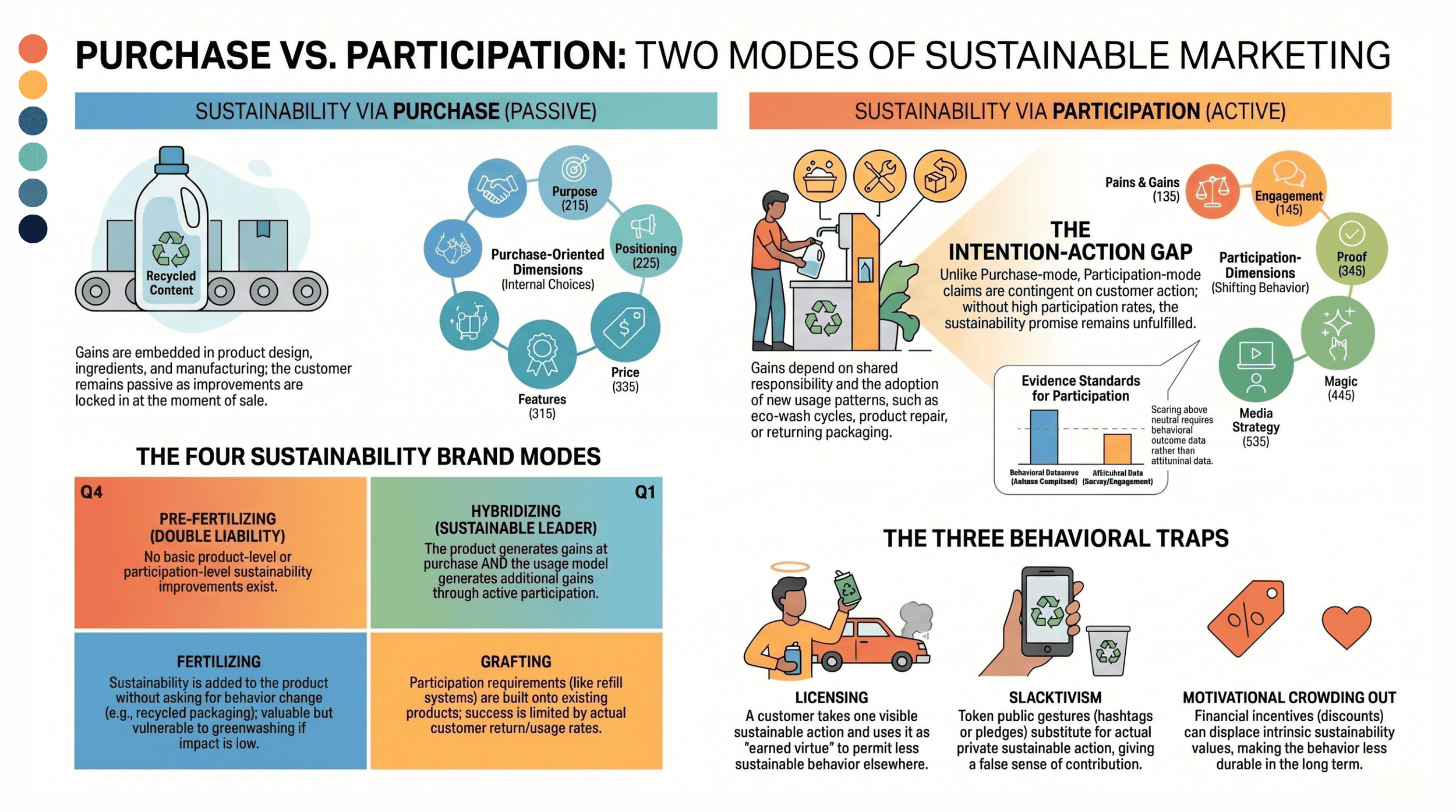
Three behavioural traps that compromise participation scoring
Licensing: When customers take one visible sustainable action, research shows they sometimes subsequently permit themselves to be less sustainable in other areas. The visible action generates a sense of earned virtue that reduces internal motivation for further sustainable behaviour. A company whose customers score highly on participation XY5 dimensions but whose net environmental footprint is unchanged or worsening may be inadvertently enabling licensing. The diagnostic question: is the sustainability engagement you are measuring changing net behaviour, or just redistributing it?
Slacktivism: Token public sustainability actions — signing pledges, sharing hashtags, joining social campaigns — reduce subsequent private sustainable behaviour. The public gesture signals to the individual that they are already a good person on this topic, reducing internal motivation for action. A company that builds its sustainability communication primarily around visible social participation mechanics may be generating the conditions that suppress actual behaviour change. The diagnostic question: did the engagement translate into measurable behaviour change, or did it substitute for it?
Motivational crowding out: Combining financial incentives with intrinsic sustainability appeals produces less sustainable preference than intrinsic appeals alone. The financial signal displaces the values-based motivation. A pricing strategy on dimension 335 that relies primarily on discounts and rebates to drive sustainable choices may be undermining the very motivation it is attempting to reinforce. The most durable sustainable pricing strategies reinforce identity and purpose, not cost savings. Long-term cost framing — total cost of ownership, lifetime environmental savings scaled to concrete reference points — outperforms upfront price comparison.
The critical practical implication: all three traps are invisible to standard marketing metrics. Licensing, slacktivism, and motivational crowding out do not show up in awareness scores, engagement rates, or sentiment analysis. They are visible only when you track actual behaviour over time — and only when you have designed the measurement system to detect them.
Using the purchase/participation profile in strategy
In an MCM sustainability assessment, the purchase/participation profile is a second-order diagnostic that enriches the Compass position. After plotting the company's Commercial Score and Sustainability Score, separating the SS into its purchase-oriented and participation-oriented components reveals the strategic nature of the gap.
A company with high purchase-oriented XY5 scores and low participation-oriented scores (a Fertilizing position) has done the operational work but has not activated the customer relationship as a sustainability lever. The strategic priority is Grafting — identifying which participation mechanisms can be layered onto the existing offer without requiring unsupported behaviour change, and designing them with the evidence standards that prevent greenwashing exposure.
A company with high participation-oriented XY5 scores but thin evidence for those scores has a Claimed SS significantly above its Evidenced SS. The Greenwashing Integrity Check will surface this immediately. The strategic priority is to either build the operational substance behind the participation claims, or to rebase the scores honestly and develop a roadmap for genuine Grafting over a realistic time horizon.
A company attempting Hybridizing without Fertilizing foundations has deployed participation mechanics before the product-level sustainability case is established. This is the Dreamer trap: the participation vision is clear, the purchase-mode foundation is not yet in place, and the combined sustainability claim exceeds what either the product or the customer relationship can actually substantiate.
This is part of the series: Sustainability in Your Marketing Strategy.← Previous: Compass quadrant strategy: from diagnosis to FIX/ALIGN/SCALE→ Next: The integrity check — scoring with evidence, not aspiration
For the earlier-career version of this article — focused on understanding the purchase/participation distinction and its implications for your daily work — read the companion piece here.
Ready to map your company's purchase/participation profile against the SS criteria? Book a session →
