The Sustainability Score is only as useful as the evidence behind each input. A self-assessed SS of +24 that reflects aspiration rather than verified operational reality does not place the company in Q1 — it places it at risk. The gap between what the company believes about its sustainability position and what it can demonstrate to a sceptical external assessor is not a communications problem. It is a strategic liability that the standard assessment process is structurally designed to conceal.
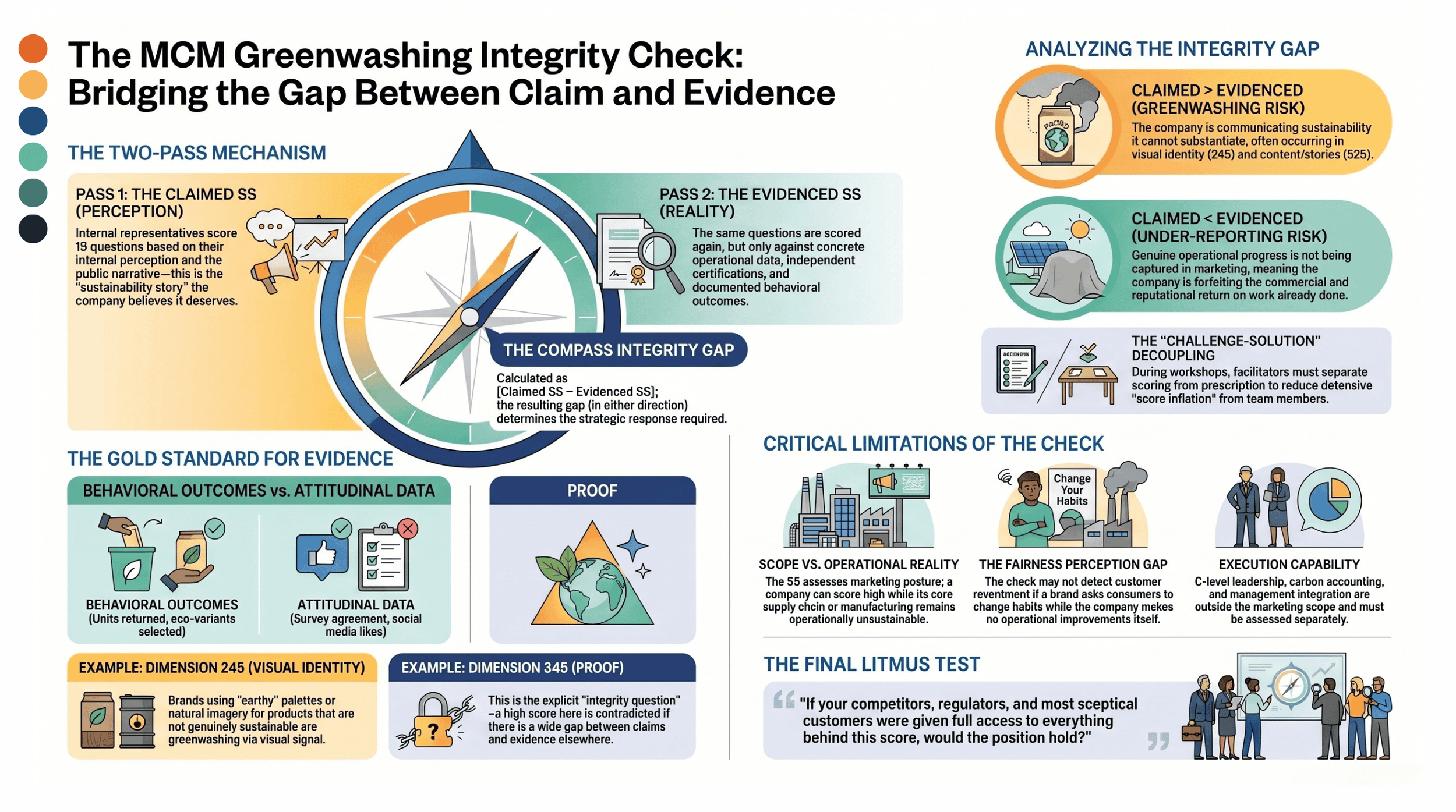
The MCM Greenwashing Integrity Check is the structural response to this problem. It runs the SS scoring twice and measures the distance between the two passes. The gap — in either direction — is the primary output.
The Integrity Check mechanism
Compass Integrity Gap = Claimed SS − Evidenced SS
Pass 1 — Claimed SS: The company's own representatives score all 19 XY5 questions based on their internal perception and public narrative. This is the score the company believes it deserves. It reflects the sustainability story as understood by the people building it.
Pass 2 — Evidenced SS: The same 19 questions are scored again, this time against concrete operational evidence. For each dimension, the question is no longer "does this describe us?" but "what specific, verifiable data supports this score?" Survey responses, brand tracking studies, social media engagement, and internal sentiment surveys do not count as evidence for participation-oriented dimensions. The evidence standard is behavioural outcome data: actions completed, behaviours tracked over time, certifications from independent third parties, operational metrics for which the methodology is documented and consistent.
The facilitation protocol for Pass 2 is explicit: any claimed score above +1 on a participation-oriented XY5 dimension (145, 445, 515, 525, 535, 545) must be backed by the answer to a single question — "What actual behaviour changed? What was measured, and how?" If that question cannot be answered with specific numbers for a defined time period, the evidenced score should not exceed neutral.
The two directions of the gap
The Integrity Gap runs in both directions. Both are strategically significant. Both require different responses.
Claimed SS > Evidenced SS — greenwashing risk
This is the direction most commonly discussed. The company is communicating sustainability it cannot substantiate. The gap is typically widest in Brand (215–245) and Conversation (515–545) dimensions — the most visible, communication-rich parts of the strategy, and therefore the most shaped by aspiration rather than evidence.
Research on sustainability assessments consistently confirms this pattern: evaluations based on publicly available information score significantly lower than assessments conducted with full inside access. Public-information-only scores are not an outlier or a methodology artefact. They reflect the reality of what external stakeholders — customers, regulators, investors — can verify.
The three specific dimensions where the greenwashing gap most often opens:
245 — Visual Identity: Does your brand visual identity accurately reflect the sustainable nature of your products or services? Visual identity is the most common site of greenwashing via signal: brands adopting sustainable aesthetics — earthy palettes, natural imagery, clean minimalism — whose products are not genuinely sustainable score negatively here. The greenwashing is in the visual claim, not in any specific verbal assertion.
525 — Content & Stories: Are your stories truthful and communicate about sustainability? High claimed scores on this dimension frequently rest on content volume and engagement metrics — reach, shares, sentiment — which do not constitute evidence of truthfulness or verifiability. The evidenced score requires confirming that each sustainability claim in the content can be substantiated with operational data, and that the emotional register of the content does not amplify claims beyond what is evidenced.
345 — Proof: Are you transparent in your claims, ensuring you avoid any perception of greenwashing? This dimension is the explicit integrity question of the Value Proposition meta-dimension. A company claiming +2 on Proof while simultaneously carrying a Claimed-exceeds-Evidenced gap elsewhere in the SS has an internal contradiction the Integrity Check surfaces directly.
Claimed SS < Evidenced SS — under-reporting risk
This direction is less discussed but equally consequential. The company has genuine sustainability progress — operational improvements, product reformulation, supply chain audits, verified environmental reductions — that is not captured in its external marketing posture or in the communication infrastructure that would allow external audiences to see and credit it.
Under-reporting is not greenwashing. But it is a strategic failure. Sustainability value that is not measured, systematised, and communicated does not drive competitive differentiation. It does not build stakeholder confidence. It does not create the verifiable track record that moves a company from Q3 (Efficiency Risk) toward Q1 (Sustainable Leader). A company whose internal sustainability programme is more advanced than its external sustainability narrative is forfeiting the commercial and reputational return on work it has already done.
The practical question for an under-reporting company is not whether to communicate more — it is whether the evidence infrastructure to support more rigorous external communication is in place. Companies often under-report precisely because the evidence infrastructure is not systematised: the data exists in silos, is not standardised across reporting periods, or has not been validated for external presentation. Building that infrastructure — systematised metrics, consistent methodology, third-party verification — is the prerequisite to closing the under-reporting gap without creating new greenwashing exposure.
The MCM Greenwashing Integrity Check
The participation score inflation warning
The participation cluster — the six XY5 questions that assess whether customers are actively co-creating sustainability outcomes (145, 445, 515, 525, 535, 545) — is where the Claimed SS is most systematically inflated relative to the Evidenced SS. The mechanism is structural: the metrics available for these dimensions during a self-assessment are almost universally attitudinal. Survey agreement scores, social media engagement rates, campaign awareness measures — all of these measure what people say and feel, not what they do.
The canonical evidence requirement is non-negotiable: any participation-oriented XY5 score above neutral requires behavioural outcome data. Units returned to a take-back programme. Percentage of customers selecting the eco product variant over the standard, tracked across multiple purchase occasions. Habits changed and tracked over time with documented methodology. These are evidence. Survey agreement is not.
The practical challenge for the workshop facilitator is that organisations instinctively resist scoring themselves low on participation dimensions, because low scores feel like admissions of failure. The facilitation protocol addresses this through what the framework calls challenge-solution decoupling: the diagnostic pass explicitly separates scoring from prescription. "Our job right now is to see clearly. Step 4 is where we decide what to do about it." This reduces the instinctive defensiveness that inflates scores.
Critical limitations the Integrity Check cannot detect
The Integrity Check improves the reliability of the SS by comparing claimed and evidenced positions. It does not resolve all of the SS's structural limitations. The following remain:
Scope — marketing posture versus operational sustainability: The SS assesses how sustainability is embedded in the marketing strategy. It does not assess operational sustainability — supply chain, manufacturing, product lifecycle, or carbon footprint. A company can score well across all 19 XY5 dimensions while its core JTBD and value chain remain operationally unsustainable. A high SS with low operational sustainability is the most sophisticated form of greenwashing: the marketing layer claims what the business model does not deliver. When facilitating, this boundary must be explicitly named.
Fairness perception is not captured: Participation-based sustainability strategies require customers to change their behaviour. Research shows that customers resist when they feel the brand is asking them to carry the sustainability burden while the company does little itself. A company scoring +3 on 525 (Content & Stories) through a recycling awareness campaign while making no operational improvements is failing a fairness test the SS cannot detect. The facilitation question to add explicitly: "Are you asking customers to do something you are not doing yourself?"
Equal weighting does not reflect impact depth: The SS treats all 19 inputs with equal weight. A company adding a recycled ingredient (+3 on 315 Features) is scored identically to one that has redesigned the entire end-of-life customer experience (+3 on 445 Magic). In terms of systemic sustainability impact, participation-mode improvements generally deliver greater gains than purchase-mode improvements alone. The purchase/participation profile from Article 5 should be read alongside the total SS to correct for this.
Stage 1 and Stage 2 companies are structurally under-scored: The SS rewards communication-rich, customer-facing sustainability — Brand (215–245) and Conversation (515–545) — which is characteristic of Stage 3–4 companies. A company doing genuine Stage 1 sustainability work (reducing waste, auditing supply chains, reformulating products) will score primarily on 115, 315, and 345 and may score low on total SS despite making real progress. A low SS in a Stage 1 company does not mean no sustainability — it means sustainability that has not yet reached the customer-facing layer. Practitioners should state this explicitly when working with Stage 1–2 companies to avoid misreading the diagnostic.
Execution capability is invisible to SS: C-level sustainability leadership, systematised measurement methods, management integration, and systematic reporting — the five execution capabilities that distinguish sustainability leaders — are entirely outside the marketing scope of the SS. A company with a mature Chief Sustainability Officer, rigorous carbon accounting, and sustainability embedded in compensation could score poorly on SS because it has not yet activated the customer-facing dimensions. SS should be read alongside an assessment of execution maturity.
The Integrity Check as a closing diagnostic
The Integrity Check is most powerful when run at the end of a full sustainability assessment — after the Compass position has been plotted, the purchase/participation profile has been mapped, and the FIX/ALIGN/SCALE sequence has been identified. Its function at that point is not to change the diagnosis but to test whether the diagnosis rests on evidence or on aspiration.
A company that scores Q1 on the Compass but carries a significant Claimed-over-Evidenced gap is not a Sustainable Leader. It is a Purpose Pioneer at risk of greenwashing accusations. The Integrity Check makes that visible before the strategy is built on the wrong foundation.
A company that scores Q3 on the Compass but carries a significant Evidenced-over-Claimed gap has more genuine sustainability progress than its Compass position suggests. The correct first action is not to accelerate sustainability investment but to build the evidence infrastructure and communication architecture that allows the operational reality to be reflected in the external position.
The final question the Integrity Check always poses — and the one that most reliably opens the highest-quality strategic conversation — is this: "If your competitors, your regulators, and your most sceptical customers were given full access to everything behind this score, would the position hold?"
If the honest answer is yes, the Compass position is real. If the honest answer is uncertain, the gap needs to be closed before the strategy is built on it.
Closing the series
This is the final article in the Sustainability in Your Marketing Strategy series. The full arc:
Article 1 established why sustainability marketing fails when measured against attitudinal rather than behavioural data. Article 2 introduced the two-axis framework — Commercial Score and Sustainability Score as independent variables. Article 3 mapped all 19 evidenced questions across the five actionable meta-dimensions. Article 4 translated each Compass quadrant into its canonical strategic dialogue and FIX/ALIGN/SCALE sequence. Article 5 drew the structural distinction between purchase-mode and participation-mode sustainability. This article closes the loop: a score is only as good as its evidence.
The consistent discipline across all seven articles is the same: separate what is claimed from what is evidenced, and build strategy on the latter.
Sources and references
This series synthesises five primary research sources integrated into the MCM Sustainability framework. Each source is listed with its specific contribution.
MCM foundational framework
Bouty, L. (2023). Marketing Canvas Method. The diagnostic framework underlying all six articles — the 24-dimension assessment, the Vital Audit, the nine strategic archetypes, the FIX/ALIGN/SCALE cycle, and the six-step process.
Giola, L. (2023). Sustainability Marketing: Integration of Sustainability into an Existing Conventional Marketing Framework. Mémoire de master en ingénieur de gestion, Solvay Brussels School, Université Libre de Bruxelles. Directed by Prof. Laurent Bouty.
The primary academic source for the MCM Sustainability layer: the 19 XY5 sustainability sub-questions mapped to MCM dimension codes, the Sustainability Score structure (−57 to +57), the two-axis Compass concept, and the baseline quadrant narratives.
HBR research
Visnjic, I., Monteiro, F. & Tushman, M.L. (2025). Sustainability as a Business Model Transformation. Harvard Business Review, May–June 2025, pp. 80–89.
Source for: the distinction between marketing-layer and operational sustainability, the three-portfolio roadmap (Proven to scale / New market opportunities / Transformative), the challenge-solution decoupling principle in workshop facilitation, the Scope 3 operational gap, and the three organisational tensions (strategy, organisational, collaboration) that determine whether sustainability commitments translate into business model change.
Challagalla, G. & Dalsace, F. (2022). Moving the Needle on Sustainability. Harvard Business Review, November–December 2022, pp. 130–137.
Source for: the purchase versus participation structural distinction, the Fertilizing / Grafting / Hybridizing brand strategy modes, the SDG impact-mapping pre-workshop step, and three SS limitations — purchase-mode invisibility, fairness perception gap, and equal-weighting impact depth.
White, K., Hardisty, D.J. & Habib, R. (2019). The Elusive Green Consumer. Harvard Business Review, July–August 2019, pp. 124–133.
Source for: behavioural science scoring criteria across eight XY5 dimensions, the Participation Score Inflation Warning, and three behavioural traps — the licensing effect, slacktivism, and motivational crowding out.
Lubin, D.A. & Esty, D.C. (2010). The Sustainability Imperative. Harvard Business Review, May 2010, pp. 42–50.
Source for: the Winners/Dreamers/Defenders/Losers typology cross-referenced to Compass quadrants, the deliberate versus unconscious Defender distinction in Q3, the four-stage sustainability maturity model sequencing the FIX/ALIGN/SCALE roadmap, and the two-directional Integrity Gap (over-claiming and under-reporting).
This is the final article in the series: Sustainability in Your Marketing Strategy.← Previous: Purchase vs participation: two modes of sustainable marketing→ Read the full series from the beginning: Series introduction
For the earlier-career version of this article — focused on building the professional habit of evidence-first sustainability — read the companion piece here.
Ready to run the two-pass Integrity Check for your company's sustainability position? Book a session →
