Marketing strategy that works
in the real world.
Framework deep-dives, archetype guides, and research analysis built on the 24 dimensions of the Marketing Canvas Method.
Don't know your archetype yet?
12 minutes. 24 dimensions scored on a forced-choice scale. You get your Strategic Archetype, your Vital 8 against target, and your Fatal Brakes flagged — before you read anything else.
Get the scoring worksheets.
6 printable A4 scoring grids for running the MCM assessment with your team — no screen required.
No sales emails. GDPR-compliant. Unsubscribe any time.

AARRR tells you retention is falling. It cannot tell you why.
Dave McClure called it Startup Metrics for Pirates. Metrics, not strategy. The funnel tells you retention is falling; it has no way to tell you whether the cause is the job you are serving, the experience after the sale, or the price. Six causes, one red number, and a one-in-six chance your fix is the right one.

The Digital Marketing Canvas gets it right. The next step is scoring it.
Jeremy Corman's Digital Marketing Canvas gets the hard part right: the fundamentals feed the funnel. What it cannot do is tell you whether your fundamentals are load-bearing or decorative. You write a sentence in the Value Proposition box in thirty seconds, and then spend four quarters optimising downstream of a claim nobody ever tested.
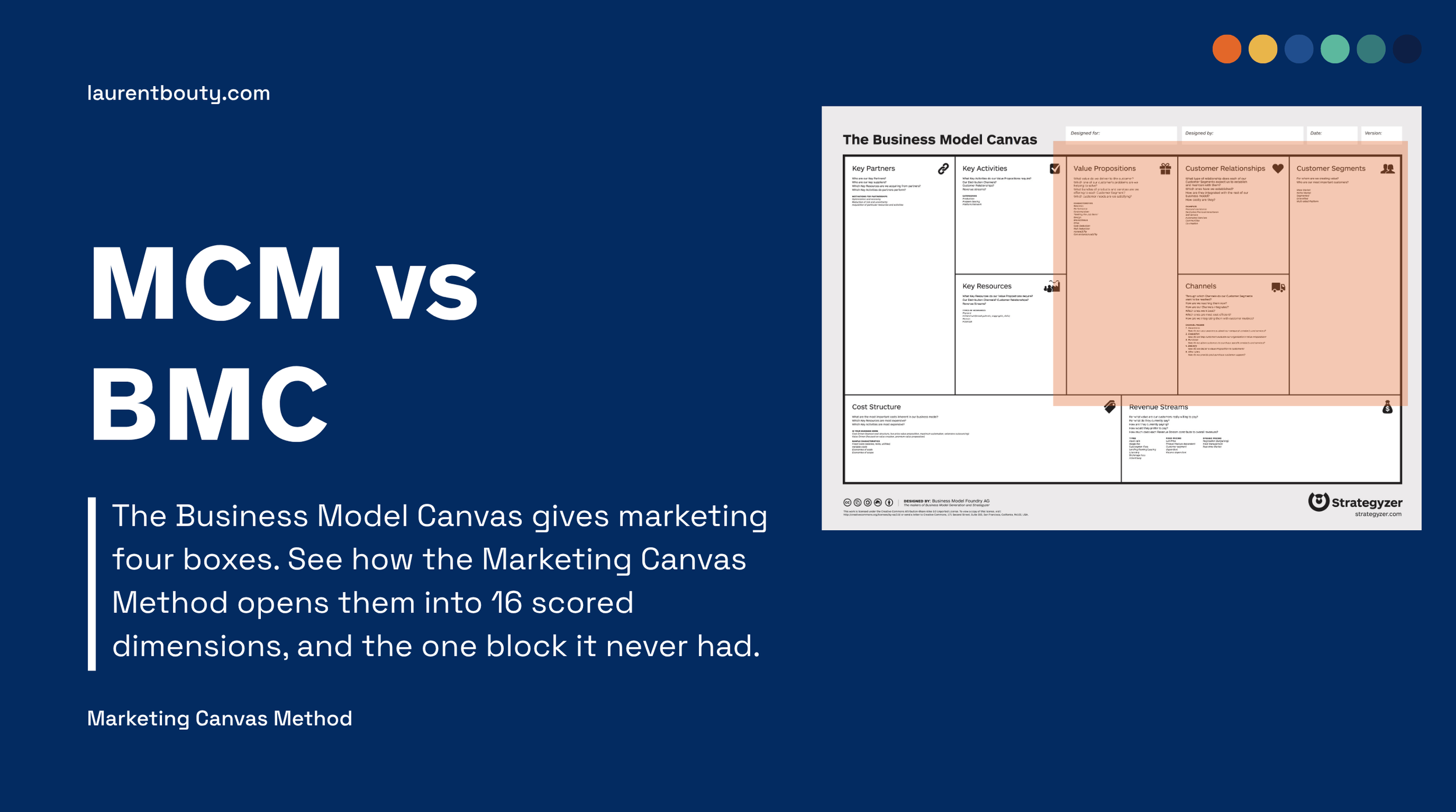
How the Marketing Canvas Method complements the Business Model Canvas
Osterwalder's canvas describes an entire business in nine boxes, and it does that better than anything else. Ask for the marketing strategy, though, and everyone points at the same two. Four of the nine are really marketing's, and a box is not a strategy. Where the BMC hands off, and what the Marketing Canvas Method does next.
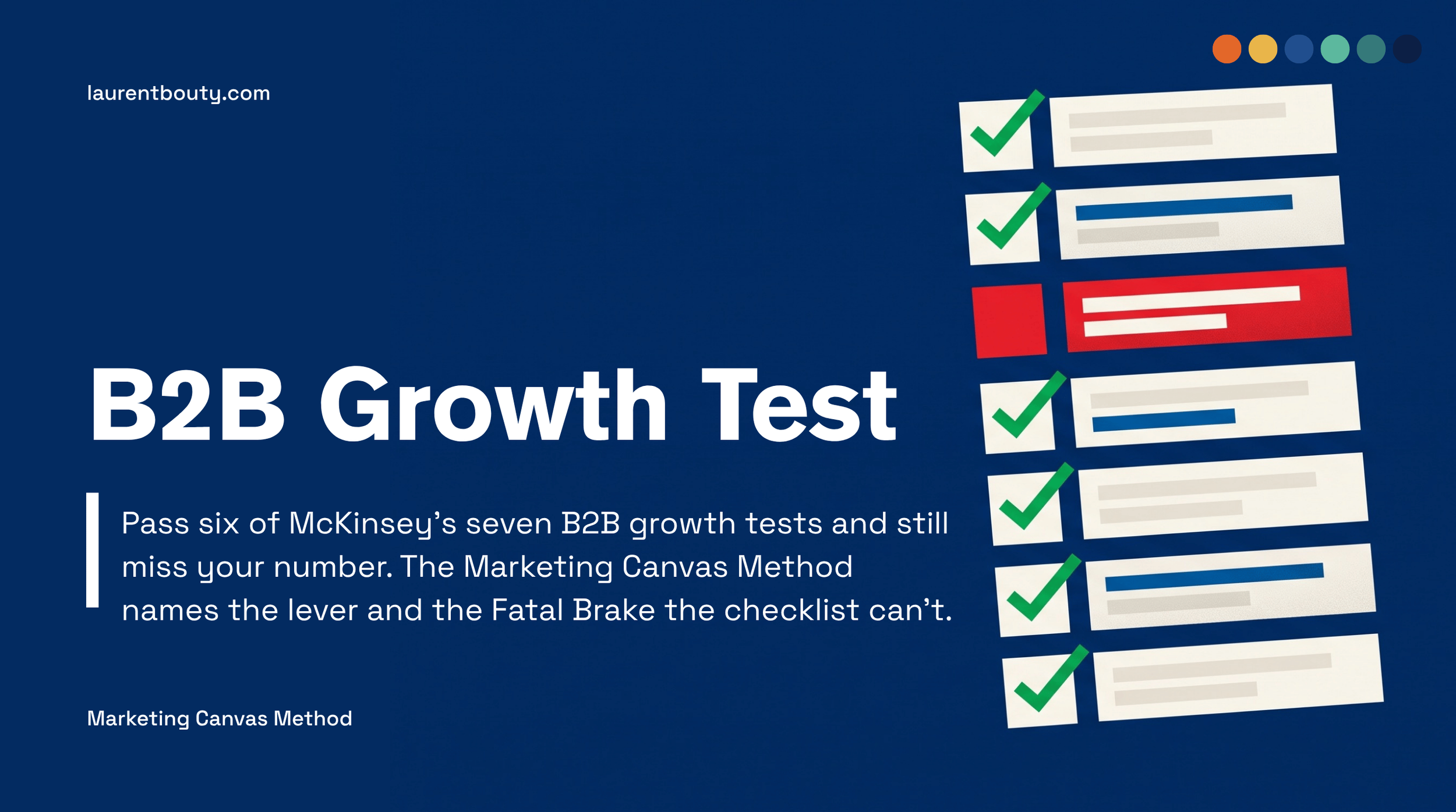
You can pass six of the seven growth tests and still miss the number
McKinsey's seven-test checklist for B2B growth is sound, but a checklist run in parallel is not a strategy. It hides which item is sinking your number. The Marketing Canvas Method shows which test is actually yours, and what order to fix them in, with Nokia, Nespresso, and Sage as proof.

The Marketing Canvas Method vs the 4Ps of Marketing: why it is time to evolve
Product, Price, Place, Promotion. Sixty-five years on, the marketing mix still covers exactly half the canvas, and the half it misses is the customer, the brand, and whether any of it worked. Why "be more customer-centric" was the right answer in 1990 and still fixed nothing, and what a marketing mix alternative has to do instead.
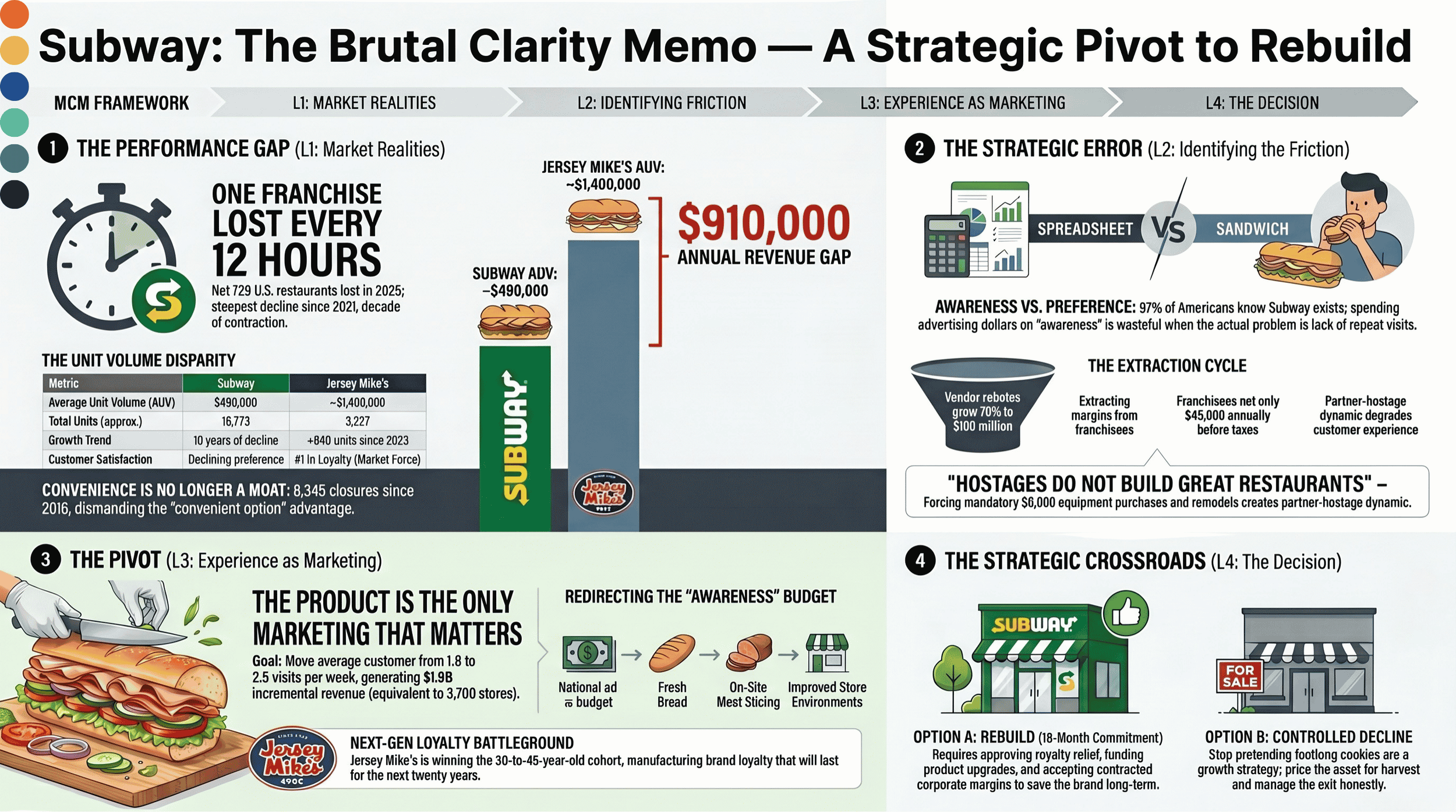
Subway Is Losing a Franchise Every Twelve Hours. Here Is the Memo That Says Why.
Subway is losing a franchise every twelve hours. Jersey Mike's makes three times the revenue per location with one-sixth the stores. The brand stands for nothing beyond cheap sandwiches. Roark Capital loaded $5.7 billion in debt onto a company that needs reinvestment, not extraction. None of this is hidden. So why does the Marketing Canvas Method memo land differently than a consultant's slide deck? Because the method constrains bad advice, makes every recommendation falsifiable, and fits the portfolio to what the organisation can actually execute. Here is how it works — and the memo itself.

Anthropic vs. the Three Competitive Axes
Most AI market commentary frames competition as a three-way race between Anthropic, OpenAI, and Google. The Marketing Canvas Method reveals a different picture: six players across four economic-value positions, running four different strategic archetypes, pressuring Anthropic along three axes simultaneously. The most consequential competitor is not who you think.
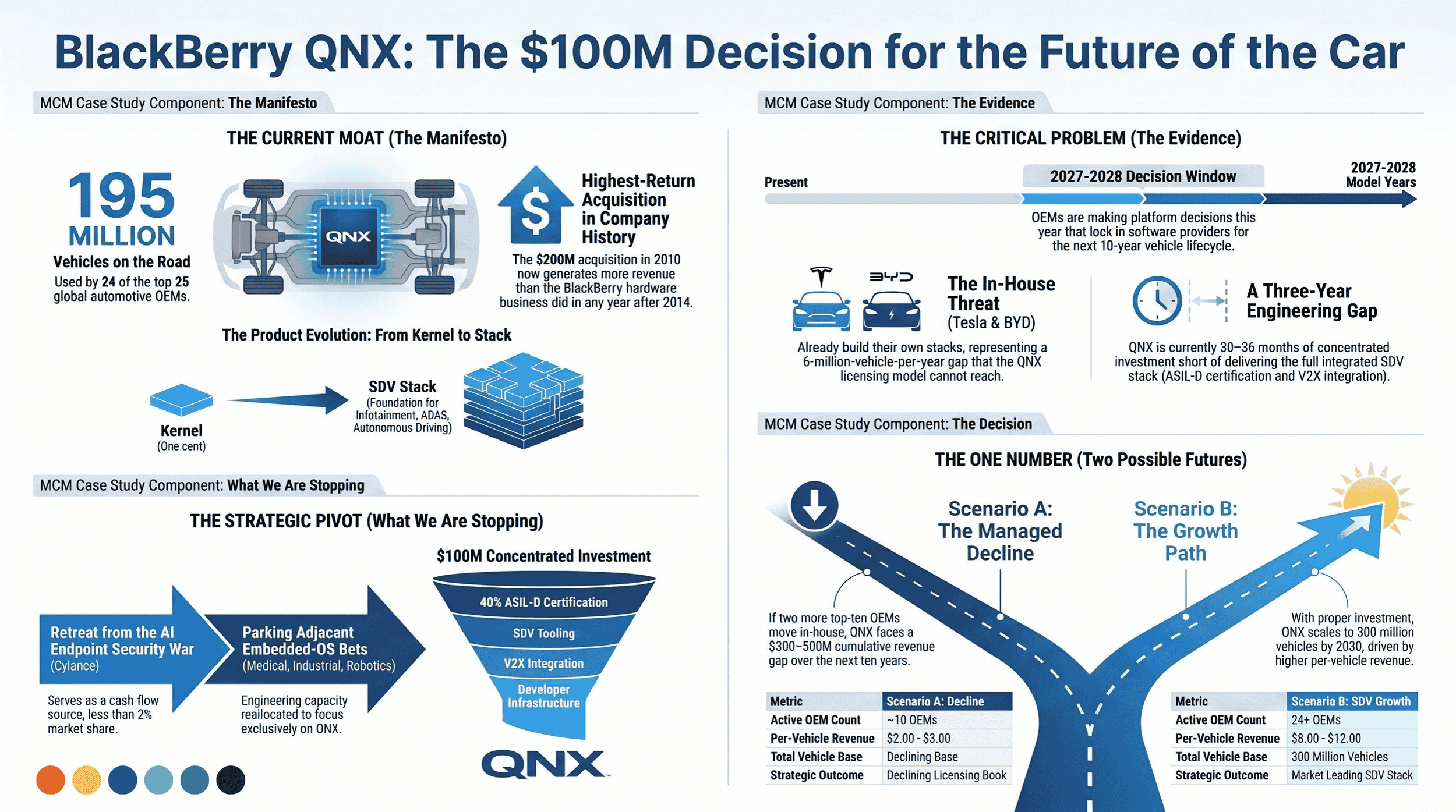
BlackBerry — A Brutal Clarity Memo on QNX
BlackBerry's QNX operating system runs in 195 million cars and is licensed by 24 of the top 25 automotive OEMs. Tesla and BYD chose to build their own. Three of the top ten OEMs are deciding right now whether to follow them. A two-page board memo on the $100M capital-allocation decision that cannot wait.
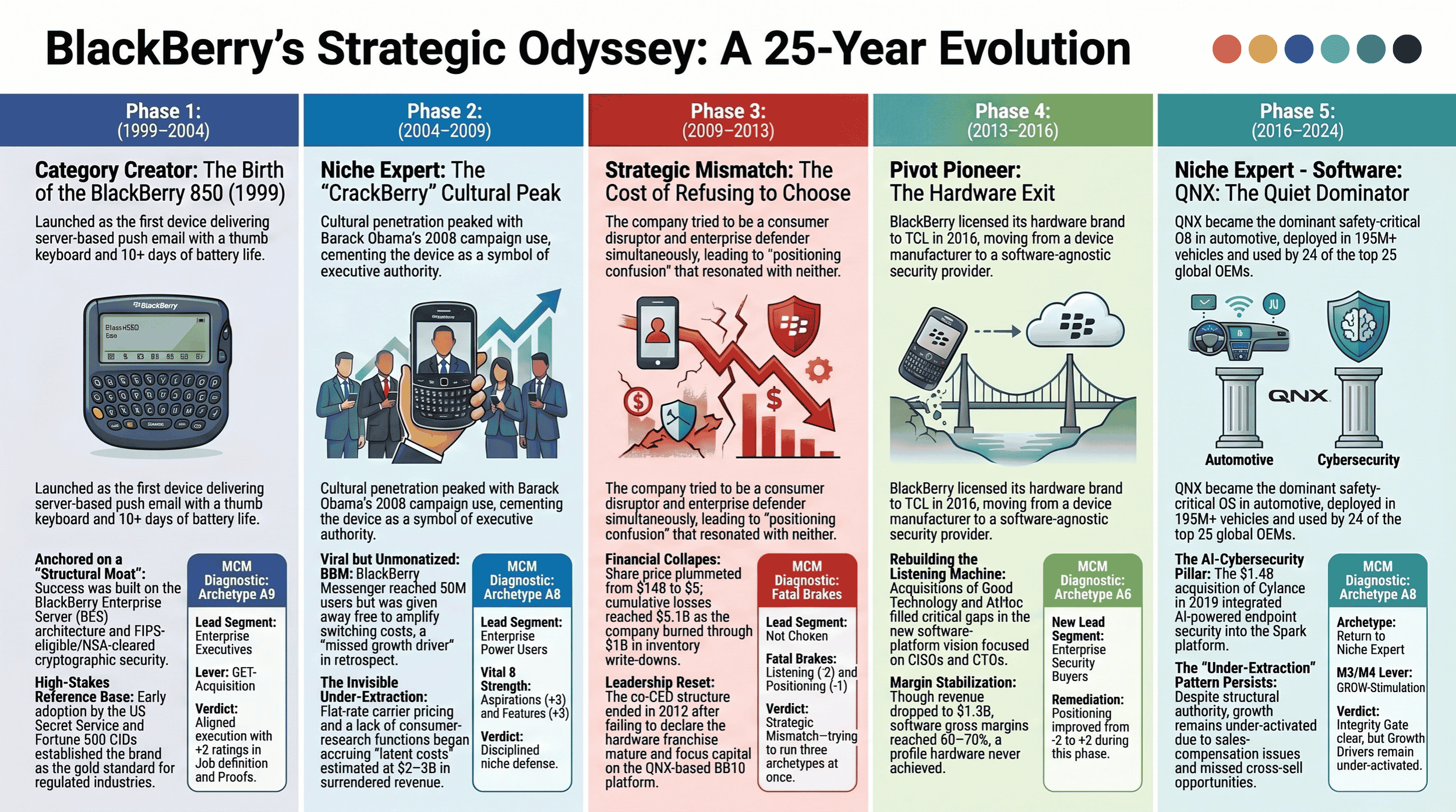
BlackBerry — A Strategic History Memo, 1999–2024
The complete v5.0 evidence base for BlackBerry's 25-year strategic evolution. Five archetype phases from 1999 to 2024 captured with Vital 8 scoring, Mechanism Maps, Operating Baseline reconstruction at three anchor moments, and falsifiable Step 4 anatomy. Q-tier sourcing throughout. For practitioners and auditors.
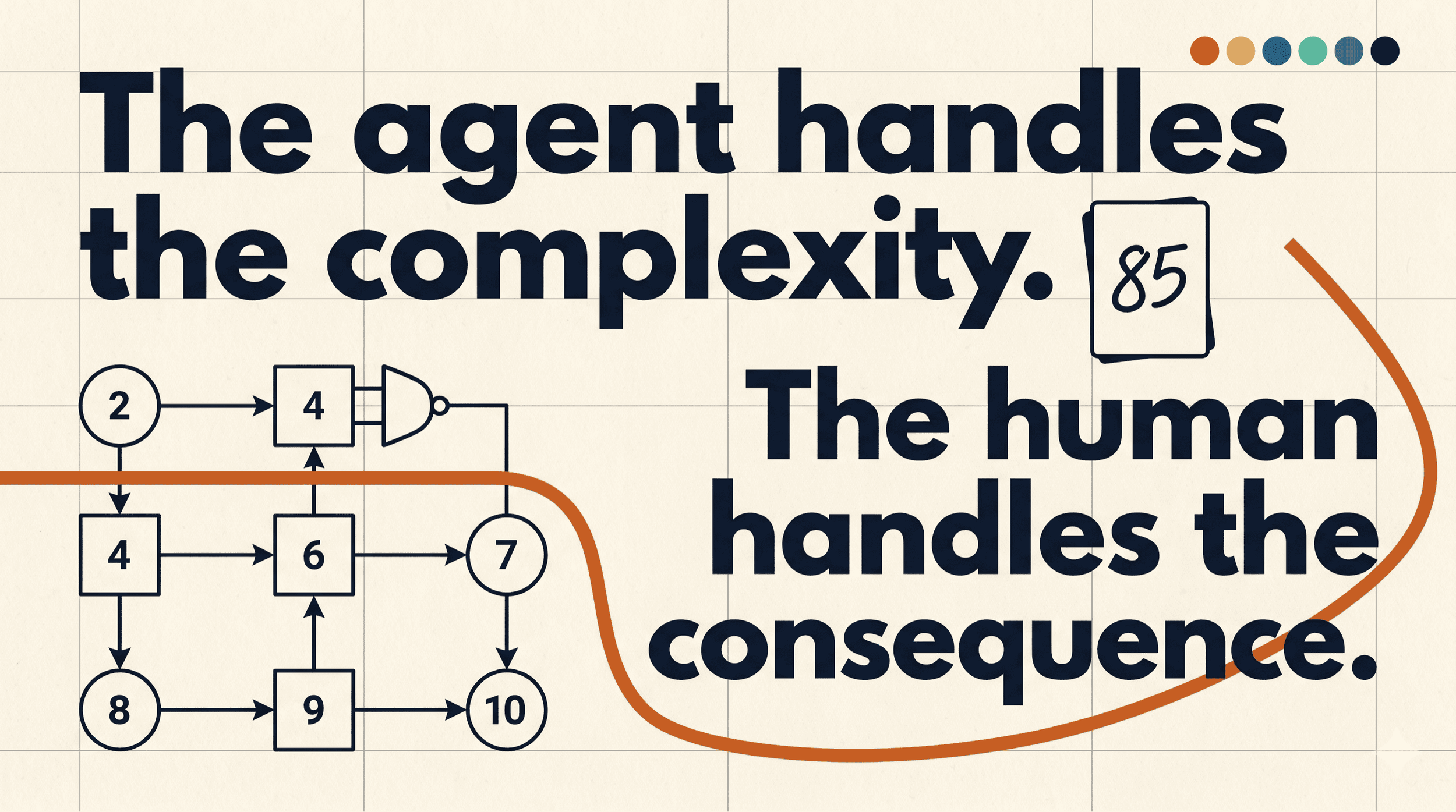
Marketing Strategy in an Agentic World
AI agents are now completing transactions on behalf of consumers — without visiting your website, reading your reviews, or seeing your ads. Your brand is being represented, recommended, or overlooked by systems you don't control. Most marketing frameworks weren't built for that. The Marketing Canvas Method was.

The Real Reason CMOs Don't Last
A recent HBR piece argues CMOs don't last because they can't speak the CFO's language. The prescription is sharp — and conditionally true. The same KPIs that save a McDonald's-style business break a Hermès-style one. Here's why archetype is the conversation that has to happen first.
Apple Is Facing Two Different Problems. Almost Everyone Thinks It's One.
Apple just had the best year of its life. Four hundred and sixteen billion dollars in revenue. A hundred and twelve billion in profit. Every analyst on Wall Street is reading the same statement and reaching the same verdict — Apple is winning.They are reading the wrong number. The number that matters sits buried in the product section. In the most important holiday quarter of 2025, Apple Vision Pro shipped roughly forty-five thousand units. The consensus story is execution. The consensus story is wrong.

Purchase vs Participation: Two Modes of Sustainable Marketing (6/7)
Purchase-mode and participation-mode sustainability demand different strategies, scoring criteria, and evidence standards. Here is the MCM framework for both.

Sustainability in Your Marketing Strategy (1/7)
Most companies have a sustainability story. Fewer can prove it. This series gives you a two-axis diagnostic to see the gap — and close it.
M5: How to Size Your Market and Know If Your Goal Is Realistic
A market sizing exercise that produces a number too large to use is not strategic analysis — it's optimism dressed as data. Here's how M5 works in the Marketing Canvas Method.
Value Harvester (A6): How to Extract Maximum Value From a Declining Asset
You have an asset that is declining. The question is not whether to fight the decline. The question is what to do with the cash it still generates — and how long the window stays open. Most companies get this wrong in the same direction.
Niche Expert (A8): Marketing Strategy for the Specialist Who Goes Deeper, Not Wider
Your market is narrow. Deliberately so. The Niche Expert is the most defensible position in any market — provided the depth is real and the moat is continuously deepened. Two dimensions determine whether it holds.
Efficiency Machine (A2): Marketing Strategy for Cost Leaders
Your customers don't love you. They don't need to. The Efficiency Machine is the most defensible position in a commodity market — provided you have done the structural work that makes your cost advantage impossible to replicate, not just difficult to match.
Scale-Up Guardian (A7): How to Protect What You Built While Everything Is Accelerating
You are growing fast. From the outside it looks like success. From the inside, things are starting to crack. The Scale-Up Guardian archetype is the operating system for exactly this moment — before the brand damage catches up with the reality.
Pivot Pioneer (A5): Marketing Strategy When Your Category Is Dying
Your market is shrinking. The customers who leave don't come back. You know you need to change direction — but the window is closing. The Pivot Pioneer archetype is the operating system for exactly this moment, and two dimensions determine whether you make it through.