The Real Reason CMOs Don't Last
It's Not the KPIs. It's the Archetype.
A recent Harvard Business Review piece argues that CMOs hold the shortest tenures in the C-suite because they can't connect marketing's impact to the outcomes finance and the board actually care about. Align both functions around shared KPIs — incremental ROI, range-based forecasts, joint goal-pacing reviews — and the trust gap closes. The CMO sticks around. The marketing budget grows. McDonald's "Accelerating the Arches" gets cited. So does AT&T.
The argument is operationally sharp and economically literate. It is also conditionally true and unconditionally presented.
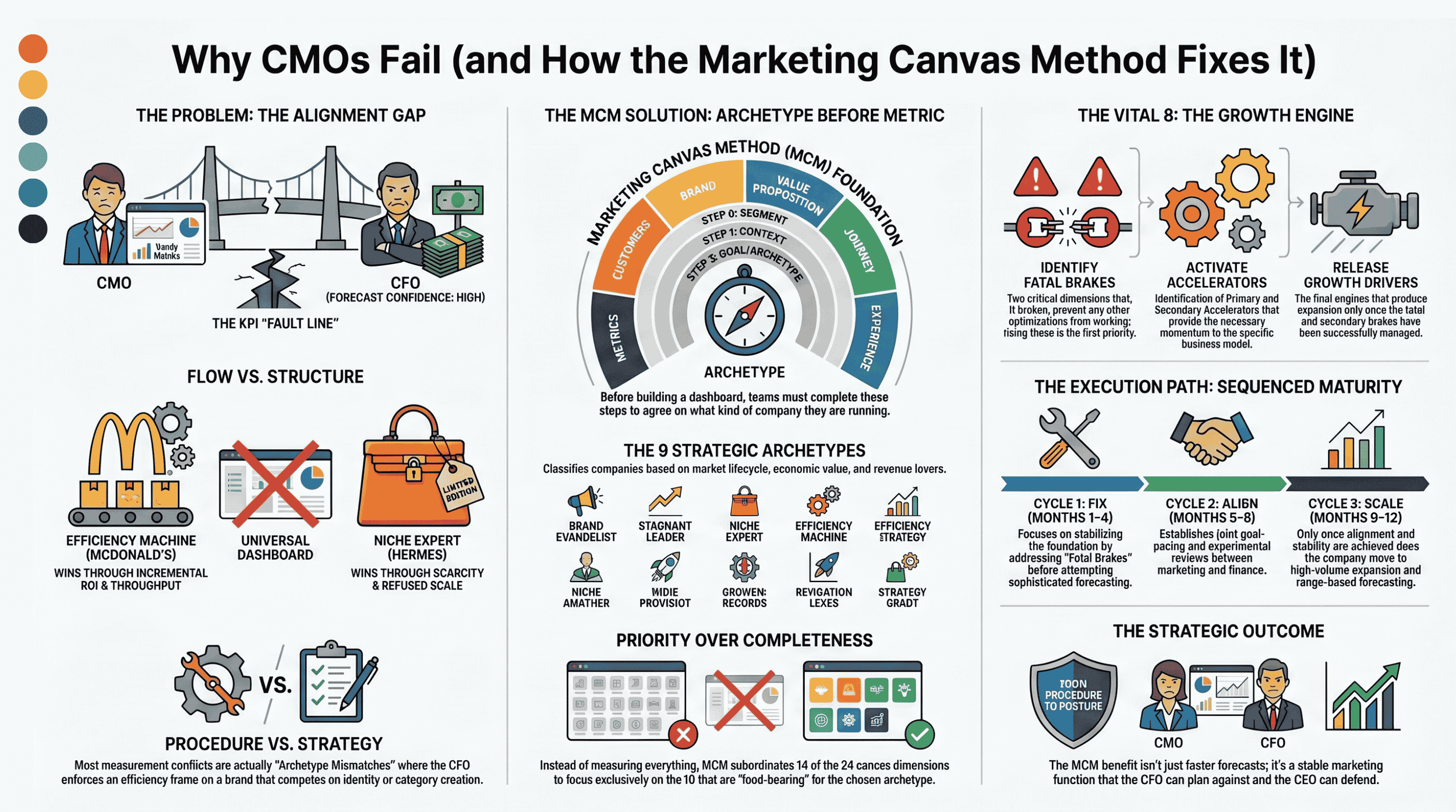
The same prescription that doubles a McDonald's-style mature service brand's marketing efficiency would, applied to Hermès, dismantle the moat the company is built on. Both are global brands. Both have CFOs who care about returns. Both invest serious money in marketing. The KPI conversation that saves one breaks the other. That is not an edge case. It is the fault line that runs through every framework that treats marketing measurement as a single discipline with one correct vocabulary.
CMOs aren't fired because they can't forecast. They are fired because they're forecasting the wrong things with high confidence — and a CFO who can't quite name what feels hollow about the numbers eventually replaces the person attached to them.
The fix isn't a better KPI dashboard. It is the discipline of asking, before the dashboard, what kind of company is being measured. The Marketing Canvas Method calls that question the archetype. Get it wrong, and every alignment exercise downstream is rigorous about the answer to the wrong question.
The Discipline Behind the Question
The Marketing Canvas Method — the strategic framework I've spent twenty years refining — classifies companies into nine archetypes based on three observable inputs: where the market sits in its lifecycle, what kind of value the company sells, and which revenue lever it has chosen to pull. Brand Evangelist (A3) is one of them. Stagnant Leader (A4) is another. Niche Expert (A8) and Efficiency Machine (A2) are two more. The combination is not preference. It is the structural posture the company is operating, whether anyone has named it or not.
Each archetype activates its own configuration of the Vital 8 — the ten dimensions out of the twenty-four available in the Canvas that actually matter for that posture. Two of those ten are Fatal Brakes: dimensions that, if broken, no amount of optimisation elsewhere compensates for. Two are Primary Accelerators. Two are Secondary Brakes. Two are Secondary Accelerators. Two are Growth Drivers — the engines that produce expansion once the brakes have been released.
Same dashboard, different archetypes, opposite verdicts. That is the entire fight.
Three Disciplines That Change the Conversation
The HBR prescription is intuitive because it sounds universal. MCM's discipline is uncomfortable because it refuses to be. The friction comes from three places.
Archetype before metric. Most measurement frameworks ask: what should we be measuring better? MCM asks first: what kind of company are we, and which ten dimensions therefore matter? McDonald's "Accelerating the Arches" reads as a Stagnant Leader play — defending a mature services position through experience optimisation, digital and delivery investment, and retention-driven loyalty. The CMO–CFO alignment described in the HBR piece fits the archetype because the archetype already runs on something close to incremental-ROI thinking. Customer Experience and Lifetime are its Fatal Brakes; budget ROI is a supporting concern, not the headline. Hermès reads as a Niche Expert. The archetype is built on craft scarcity, refused scale, and the deliberate non-commensurability of the product with mass-market measurement frames. Its Fatal Brakes are Features and Positioning; budget ROI doesn't appear in its priority dimension set at all. Importing the McDonald's review structure into Hermès doesn't sharpen the brand. It commodifies it.
Priority over completeness. The instinct of every analytical CMO is to measure more. MCM goes the other way. Of the twenty-four dimensions in the Canvas, only ten matter for any given archetype. The other fourteen aren't absent — they are correctly subordinated. A CMO who treats the archetype's ten priority dimensions as load-bearing, and the other fourteen as supporting infrastructure, produces a conversation the CFO can plan against. A CMO who measures all twenty-four with equal rigor produces a dashboard. There's a difference. The first is a strategic posture rendered in numbers. The second is a comprehensive monitoring system that explains everything in general and nothing in particular.
Sequenced maturity. Step 5 of the Method specifies three execution cycles — FIX (Months 1–4), ALIGN (Months 5–8), SCALE (Months 9–12) — with mandatory exit gates between them. The implication for measurement is structural. The reviews the HBR piece prescribes — joint experiments, range-based forecasts, ongoing goal-pacing — are Cycle 2 and Cycle 3 practice. They presume a measurement system whose Fatal Brakes have already been fixed. Companies that try to install ALIGN-stage review cadence on top of a Cycle 1 measurement system produce sophisticated forecasts of degrading metrics. The rigor is real. So is the slow accident it describes.
Two Companies, Two States of Matter
McDonald's runs on flow. Customer flow through drive-thrus, channel flow through the app, conversion flow from impression to sandwich. The competitive position is fluid: efficiency competitors press the margins, delivery platforms shift the channel mix, the menu rotates. The CFO's question — what will the next twenty million in marketing return? — is the right question because the archetype's defence is built on throughput. Range-based forecasts are not a foreign discipline; they are the operating model. Kaminsky's prescription, applied at McDonald's, accelerates what the archetype already does.
Hermès runs on structure. Crystalline, deliberate, geometrically refused-to-deform. The waitlist is the strategy. The apprenticeship pipeline is the strategy. The decision not to license, not to franchise, not to scale on demand — that is the strategy. The CFO's question is not what will the next dollar of marketing return? It is is the queue lengthening, is the secondary-market premium holding, is the apprenticeship pipeline staffed, are we approving the right ambassadors? Now imagine the Hermès CMO walking into a board review structured around incremental ROI ranges on advertising spend, attribution-driven channel reallocation, joint experimental cadence with finance. The exercise itself — even before the conclusions — would mark the brand as something it cannot be and remain Hermès.
The same logic generalises. Patek Philippe, Rolex, Brunello Cucinelli, Loro Piana — every recognisable Brand Evangelist or Niche Expert in luxury goods runs an alignment with finance that is structurally incompatible with incremental-ROI vocabulary. They have CFOs. They have measurement. They simply measure different things, because they are built differently. A framework that doesn't see the difference will produce expensive failures dressed in disciplined language.
This is the test universal frameworks fail. They prescribe the right answer to the wrong question. MCM's discipline is to make the wrong-question failure visible before it consumes the budget.
When the CMO–CFO Fight Is About Something Else
Here is the diagnostic move that earns its keep.
When a CMO and CFO can't agree on what to measure, the obvious read is that they have a measurement problem. Sometimes that's right. Often it isn't. Persistent measurement conflict — the kind that survives every shared-language workshop and every joint review — is frequently a symptom of an archetype mismatch upstream. The CFO is enforcing an Efficiency Machine measurement frame on a brand that is actually operating as a Brand Evangelist, or insisting on Stagnant Leader retention metrics in a business that is mid-pivot to Pivot Pioneer. The fight isn't about KPIs. It's about which strategic engine the company is running, and the two functions have made different unstated assumptions.
A measurement-language exercise will not resolve that. It will produce alignment on a vocabulary that papers over the disagreement and pushes the rupture six quarters out, which is approximately one CMO tenure.
The MCM benefit here is not faster forecasts. It is earlier diagnosis. The discipline of running Step 0 (segment), Step 1 (context), and Step 2 (goal and archetype) before installing the measurement system means the executive team agrees on what kind of company they are running before they argue about how to measure its progress. When that agreement holds, the KPI conversation becomes a translation exercise — straightforward and shared. When that agreement is missing, no measurement framework, however elegant, will compensate.
What This Means for the Reader
Three questions for any executive team currently rebuilding its CMO–CFO conversation.
First: have you named your archetype, or are you optimising on a frame inherited from someone else's playbook? If your CFO is enforcing incremental-ROI vocabulary and your brand competes on identity, scarcity, or category creation, the measurement problem isn't downstream of the dashboard. It's upstream of it.
Second: which ten dimensions does your archetype actually require you to score, and are those the ten you are reviewing monthly? If you are measuring everything with equal weight, you are measuring nothing with strategic priority. The Vital 8 isn't a shortcut. It is the structural reason your measurement effort either compounds or dissipates.
Third: have your Fatal Brakes been fixed, or are you running ALIGN-stage review cadence on top of an unstable foundation? Sophisticated forecasts of degrading metrics are not a measurement maturity signal. They are a Cycle 1 problem in Cycle 2 clothing.
What's Still Open
The HBR piece is correct that the CMO–CFO relationship is the highest-leverage measurement conversation in the C-suite. It is correct that vanity metrics — reach, impressions, engagement — fail the executive team. It is correct that backward-looking measurement creates distrust that compounds.
What it does not engage is the prior question. Which archetype is being measured? Until that question is answered, the alignment work is procedural — useful inside the band of archetypes the article's case companies happen to occupy, structurally inappropriate outside it.
CMO tenure rates won't fall because more CMOs learn to forecast TV ROI in confidence ranges. They will fall when more executive teams recognise that measurement is the second conversation, not the first. The first conversation is about which strategic engine the company is running. Get that right, and the KPI architecture writes itself. Get it wrong, and no amount of joint goal-pacing will rescue the CMO who has been hired to optimise the wrong machine.
That is the discipline. And the benefit, in the end, is simpler than most measurement frameworks promise: a marketing function whose CFO can plan against it, whose CEO can defend it, and whose own posture inside the company is finally stable enough to last more than two budget cycles.
