BLOG

A collection of article and ideas that help Smart Marketers to become Smarter

marketingcanvas.net Laurent Bouty marketingcanvas.net Laurent Bouty

Marketing Canvas Method vs. Other Marketing Canvases — What's Different

About the Marketing Canvas Method

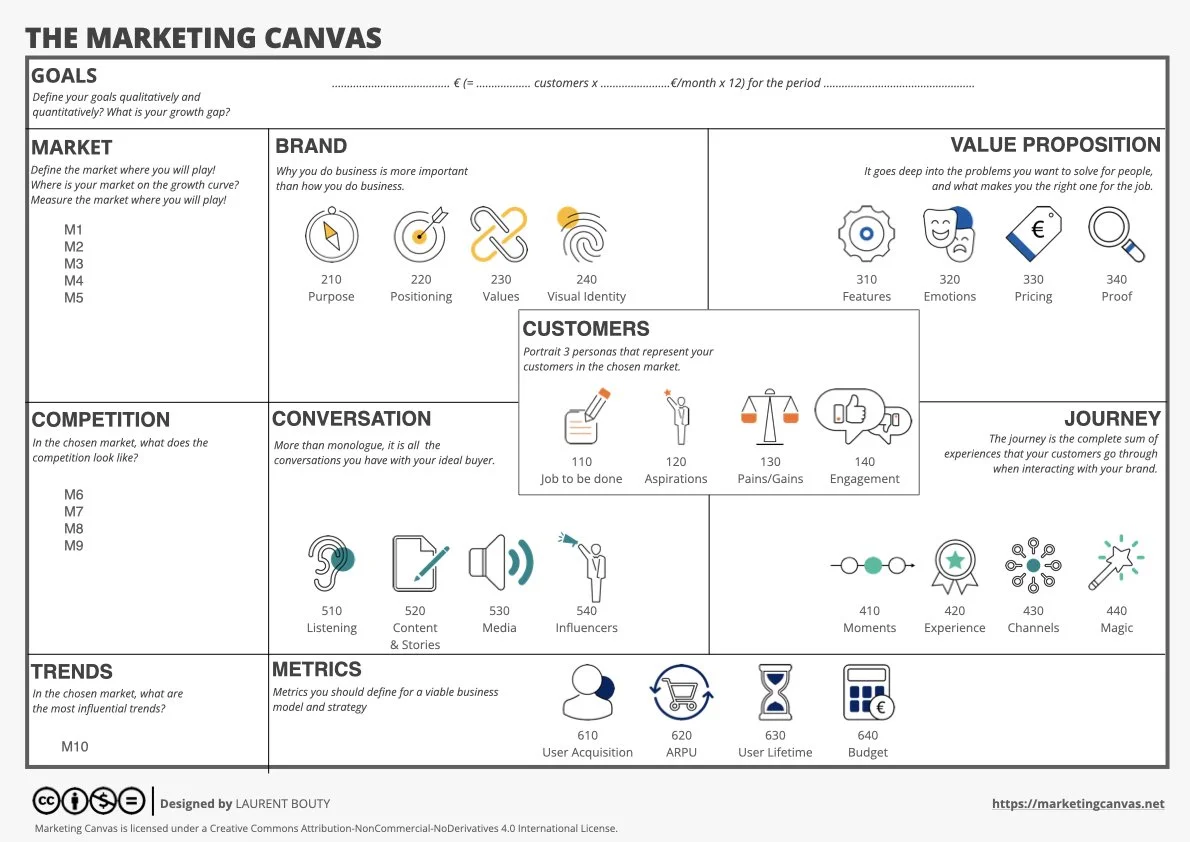
This article compares the Marketing Canvas Method against the Business Model Canvas, Lean Canvas, 4Ps, STP, SOSTAC, and brand positioning frameworks. The MCM structures marketing strategy across 6 meta-categories, 24 dimensions, and 9 strategic archetypes in a 6-step executable process.
Full framework reference at marketingcanvas.net →  ·  Get the book →

Reading time: ~10 min

You searched for a marketing framework. You found several. The Business Model Canvas. The Lean Canvas. SOSTAC. The 4Ps. Brand positioning tools. Maybe even a "marketing canvas" template floating around in a Notion gallery or Miro board.

They all promise to bring structure to marketing strategy. Most of them do — up to a point.

This article does one thing: it maps the landscape of the most widely used marketing frameworks honestly, explains what each one does well, identifies where each one stops, and then shows what the Marketing Canvas Method (MCM) does differently. Not to dismiss those tools — some of them inspired MCM directly — but because if you're choosing a framework for serious strategy work, you deserve a clear comparison, not marketing copy.

The Landscape at a Glance

← Scroll to see full table →

Framework Primary Use Depth Output
Business Model Canvas Business model design Medium Canvas snapshot
Lean Canvas Startup hypothesis testing Low – Medium Canvas snapshot
Marketing Mix (4Ps / 7Ps) Tactical marketing planning Low Checklist
STP Audience and positioning clarity Low – Medium Direction statement
SOSTAC Campaign planning Medium Plan document
Brand Positioning Canvas Brand identity definition Low – Medium Positioning statement
Marketing Canvas Method (MCM) Full strategic marketing program High Executable roadmap

The Business Model Canvas (Osterwalder & Pigneur)

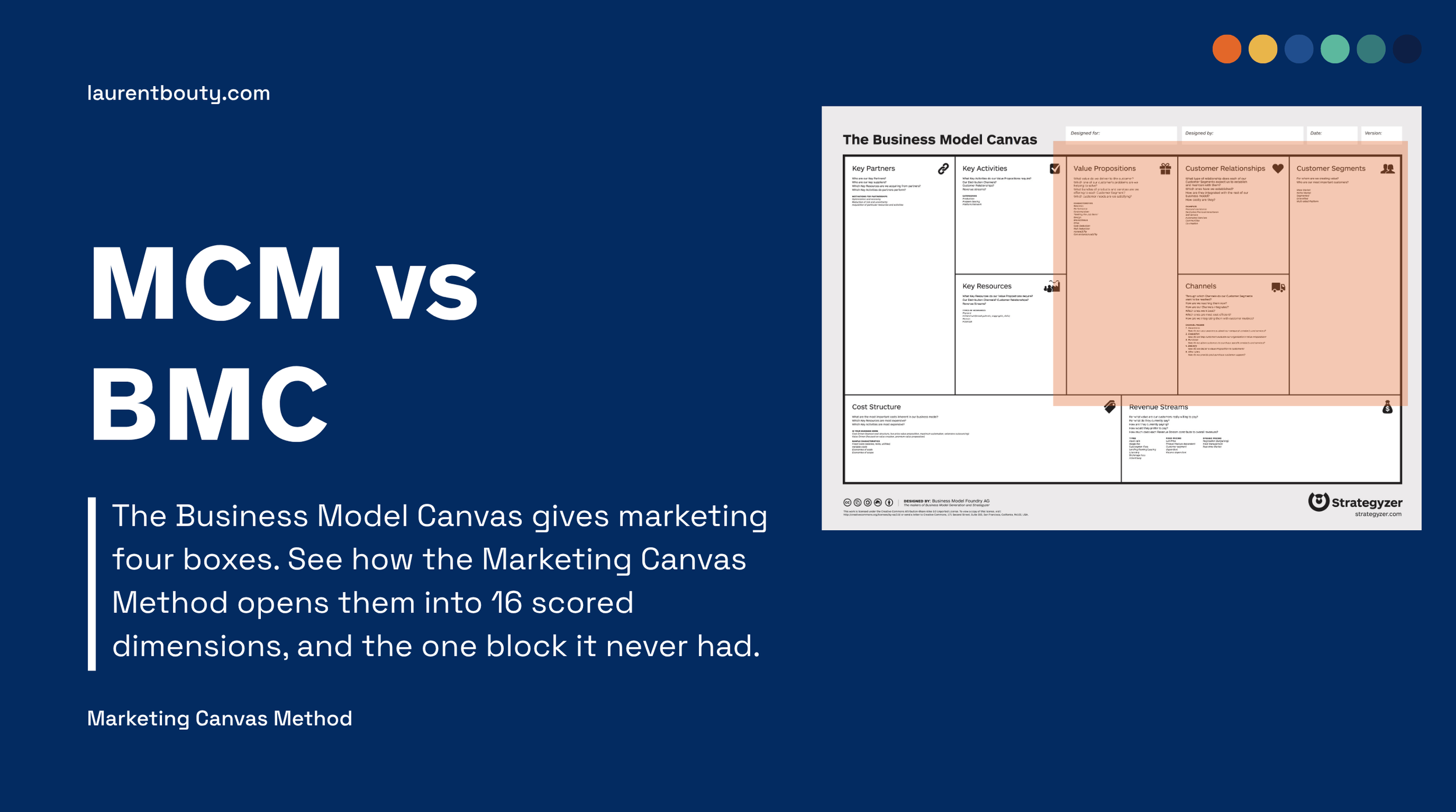
The Business Model Canvas — created by Alexander Osterwalder and Yves Pigneur — is one of the most important strategic tools of the past two decades. It deserves its reputation. By mapping nine building blocks (Customer Segments, Value Propositions, Channels, Revenue Streams, etc.) on a single page, it made business model thinking visual, collaborative, and accessible.

What it does well: Rapid business model prototyping. Helping cross-functional teams speak a common language. Comparing business models side by side.

Where it stops: The Business Model Canvas is a snapshot, not a program. It shows what your business model looks like right now. It does not tell you what's working, what's broken, or what to do next. There is no scoring system, no diagnostic logic, no sequence of actions, and no prioritization mechanism. "We filled out the canvas" is not the same as "we have a strategy."

The Marketing Canvas Method was explicitly inspired by the Business Model Canvas — Laurent Bouty credits Osterwalder and Pigneur in the book's preface — but was built to go further: "The Marketing Canvas started as an attempt to do for marketing what they did for business models. The first version had six boxes. It wasn't enough." The current version has 24 dimensions, 9 archetypes, and a 6-step method. It is a very different tool.

MCM vs. BMC in one sentence: The Business Model Canvas tells you what your business model looks like. The Marketing Canvas Method tells you what's broken in your marketing, which archetype you should be operating as, and what to do about it in sequence.

The Lean Canvas (Ash Maurya)

The Lean Canvas is a riff on the Business Model Canvas, adapted for early-stage startups. It replaces some BMC blocks with startup-specific ones: Problem, Solution, Unfair Advantage, Key Metrics. The goal is to validate assumptions quickly and cheaply before building.

What it does well: Forcing early-stage founders to articulate their problem-solution hypothesis. Facilitating fast, cheap learning loops. Excellent for pre-product ideation.

Where it stops: The Lean Canvas is a hypothesis document. It answers "what are we testing?" not "how do we grow?" Once you've achieved product-market fit, the Lean Canvas has little to offer. It has no competitive strategy logic, no market context analysis, no revenue decomposition, and no execution framework. It's a starting pistol, not a race plan.

MCM vs. Lean Canvas in one sentence: The Lean Canvas is the right tool for validating a business idea. The Marketing Canvas Method is the right tool for running the marketing strategy of a business you've already validated.

The Marketing Mix: 4Ps (and 7Ps)

The 4Ps — Product, Price, Place, Promotion — were introduced by E. Jerome McCarthy in 1960 and extended to 7Ps (adding People, Process, Physical Evidence) for service businesses. The 4Ps remain the most taught marketing framework in business schools worldwide.

What it does well: Providing a comprehensive checklist of the levers a marketer can pull. Its longevity is earned — most marketing decisions do touch at least one of the Ps.

Where it stops: The 4Ps are a vocabulary, not a method. They tell you what to think about, not how to think about it, which Ps matter most in your specific situation, or what order to address them. Two companies in very different competitive situations fill out the same 4Ps template and arrive at strategies that look structurally identical. The framework has no mechanism for context-sensitivity.

MCM vs. 4Ps in one sentence: The 4Ps describe the levers of marketing. The Marketing Canvas Method tells you which levers to pull, in which order, for your specific strategic situation.

STP: Segmentation, Targeting, Positioning

STP is the foundational academic model for marketing strategy. Segment the market, pick a target, establish your position. It underlies virtually every marketing strategy course taught in business schools, and with good reason — these three decisions genuinely do drive everything downstream.

What it does well: Bringing disciplined thinking to audience selection and competitive positioning. It's conceptually rigorous and has strong academic backing (think Kotler, Ries & Trout, and others).

Where it stops: STP is a conceptual framework, not an operational one. It produces a positioning statement — a direction — but no diagnostic, no scoring, no archetype, no initiative list, and no roadmap. It answers "who are we for and how are we different?" without answering "what's broken in how we deliver on that position right now, and what do we do about it?"

MCM vs. STP in one sentence: STP gives you strategic direction. The Marketing Canvas Method gives you a full diagnostic and execution program to actually deliver on that direction.

SOSTAC (PR Smith)

SOSTAC — Situation, Objectives, Strategy, Tactics, Actions, Control — is a campaign planning framework developed by PR Smith in the 1990s. It's widely used in digital marketing contexts, particularly for campaign planning and annual marketing plans.

What it does well: Providing a logical sequence for campaign or channel strategy. Widely adopted by digital marketing teams. Practical and teachable.

Where it stops: SOSTAC is a planning framework, not a diagnostic one. Its "Situation" analysis is open-ended — you can put anything in it. The framework doesn't prescribe how to assess your situation, doesn't route you to a specific strategy type based on your context, and doesn't score or prioritize. Its output is a structured plan document; it does not generate a strategic archetype, a Vital 8 dimension set, or a sequenced action engine. Two marketing directors using SOSTAC will produce very different outputs based entirely on their personal judgment, not the framework's logic.

MCM vs. SOSTAC in one sentence: SOSTAC structures a marketing plan. The Marketing Canvas Method generates one — deterministically, from your market data.

Brand Positioning Canvases (Various)

A category, not a single tool. Perceptual maps, brand onion models, brand essence diagrams, golden circle frameworks (Sinek's "Why/How/What"), positioning statement templates — these all aim to clarify what a brand stands for and how it's differentiated.

What they do well: They force teams to articulate the "why" and the differentiated claim. Tools like Simon Sinek's Golden Circle have brought important thinking to large audiences. Useful for brand strategy workshops.

Where they stop: Brand canvases address one dimension of marketing — Brand (the 200 meta-category in MCM terms). A complete marketing strategy also requires clarity on customers, value proposition, customer journey, communications, and financial metrics. A brand positioning exercise doesn't assess whether your pricing reflects your value, whether your channels reach your audience, or whether your budget is mathematically aligned with your goals.

MCM vs. Brand Canvases in one sentence: A brand canvas aligns your brand identity. The Marketing Canvas Method includes brand as one of six meta-categories — and connects it to the other five.

What Makes the Marketing Canvas Method Different

After the comparison above, four structural differences stand out.

1. It's a Linked Decision Chain, Not a Snapshot

Every other framework in this list produces a document or a visual. The Marketing Canvas Method produces a linked decision chain: the output of each step is the mandatory input for the next. The Lead Segment (Step 0) shapes the context analysis (Step 1), which unlocks the revenue options (Step 2), which selects the archetype, which determines the 10 dimensions you score (Step 3), which generates your initiatives (Step 4), which builds your roadmap (Step 5). Break any link, and the chain doesn't degrade gracefully — it fails. It's not a tool you fill out. It's a program you run.

2. It Kills the "Build a Strategy for a Company That Doesn't Exist" Problem

The most common failure in marketing strategy isn't bad tactics. It's teams designing plans for an idealized version of their company — one that's further along, better resourced, or in a more favourable market than reality supports. The BMC, the 4Ps, SOSTAC — none of them have a mechanism to stop this. The MCM does.

Feed in your market lifecycle (M3), your economic value model (M4), and your primary revenue goal, and the Archetype Selection Matrix returns one of nine Strategic Archetypes — a pre-specified growth recipe with its own Vital 8 dimensions, scoring targets, and revenue logic. Same inputs, same archetype, every time. The teams that accepted uncomfortable inputs — Sage accepting it was a Stagnant Leader, IBM accepting PCs were a commodity in decline — built strategies that worked precisely because they started from reality, not aspiration.

3. The No-Zero Scale Forces Hidden Disagreements Into the Open

Most organizations don't fail because the strategy is wrong. They fail because Sales, Product, and Marketing have different — and invisible — views of where the business actually stands. Those disagreements stay hidden behind polite consensus until the plan hits reality.

MCM's 6-point scoring system (−3 to +3, no zero) is the mechanism that surfaces this. There is no neutral option. Every dimension must be scored as either helping or hurting your strategic goal. When the head of Sales scores a dimension at −2 and the CMO scores it at +2, the disagreement is no longer invisible — it's on the table, arguable, and resolvable. The gaps feed directly into the Strategic Action Engine, which splits work into three streams: FIX (repair what's broken), ALIGN (close the parity gaps), GROWTH (leverage what's already strong).

4. You Cannot Scale a Broken Machine

Every framework in this comparison can be completed in a workshop and then ignored. The MCM has a structural safeguard against that: mandatory gates.

Execution is organized into three 4-month cycles — FIX → ALIGN → SCALE. Each cycle ends with a gate. The gate is not a review meeting. It is a binary check: is the foundation stable enough to justify increasing the marketing budget? If yes, you proceed. If no, you don't scale — you fix. This is the mechanism that prevents the most expensive mistake in marketing: pouring budget into a machine that isn't ready to convert it.

The Full MCM Architecture at a Glance

  • 24 Strategic Dimensions across 6 meta-categories: Customers (100), Brand (200), Value Proposition (300), Journey (400), Conversation (500), Metrics (600).

  • 9 Strategic Archetypes (A1 Disruptive Newcomer through A9 Category Creator), each selected deterministically from market context + revenue goal.

  • The Vital 8: 8 archetype-specific dimensions that form the backbone of your strategy, plus 2 Growth Drivers.

  • 6 Steps: Lead Segment Junction → Strategic Context Mapping → Revenue Ambition → Vital Audit → Strategic Action Engine → Strategic Cycle Roadmap.

  • 3 Execution Cycles (FIX → ALIGN → SCALE), each 4 months, each with a mandatory gate. You never scale a broken machine.

Which Framework Should You Use?

No tool is universally right for every job. Here's an honest decision guide.

Use the Business Model Canvas if you need to quickly align a team on your business model structure, or compare multiple business models side-by-side.

Use the Lean Canvas if you're pre-product and still validating your problem-solution hypothesis.

Use the 4Ps as a basic checklist to make sure you haven't forgotten a lever. Don't mistake filling it out for having a strategy.

Use STP when you need to clarify your target audience and competitive positioning — ideally as an input into a fuller strategy process.

Use SOSTAC when you're planning a specific campaign or channel initiative and need a structured document format.

Use the Marketing Canvas Method when you need a complete, sequenced, and executable marketing strategy — one that starts with who you're serving, identifies your strategic archetype, diagnoses what's broken, generates a prioritized initiative list, and builds a 12-month execution roadmap with mandatory gates.

The full framework is freely available at marketingcanvas.net. The book — The Marketing Canvas Method: Marketing Strategy, Programmed — walks you through all six steps with a complete fictional company case (Green Clean) and 20 real-company case studies.

The Bottom Line

Most marketing frameworks are good at one thing: making a complex topic visible. The Business Model Canvas makes your business model visible. STP makes your positioning visible. SOSTAC makes your campaign plan visible.

The Marketing Canvas Method makes your entire marketing strategy visible — and then tells you what's broken, which archetype to operate as, what to fix first, and how to sequence 12 months of work into three executable cycles.

That's the difference between a map and a GPS.

The Marketing Canvas Method is open-source and free to use. Full framework documentation, archetype references, and the 24-dimension cheat sheet are available at marketingcanvas.net. The book is available on Amazon.

Read More