M3 × M4: How Two Data Points Determine Your Entire Marketing Strategy
MCM FRAMEWORK NOTICE This article explains two parameters from the Marketing Canvas Method (MCM): M3 (Growth Curve) and M4 (Economic Value). Both are part of Step 1: Strategic Context Mapping — the first data-collection step of a structured 6-step marketing strategy process. You can explore the full method at marketingcanvas.net or in the book Marketing Strategy, Programmed.
Most marketing strategy mistakes are not execution problems. They are positioning problems — and positioning problems are usually caused by one thing: you applied the wrong strategic logic to your market context.
Two data points in the Marketing Canvas Method catch this error before it costs you. M3 (Growth Curve) tells you where your market sits on its lifecycle. M4 (Economic Value) tells you what your customers are actually buying. Together with your revenue goal, they determine which of the 9 MCM Strategic Archetypes applies to your situation — and therefore which actions are worth funding.
This article explains what each parameter measures, how to score them honestly, and exactly what happens when you combine them.
M3: Growth Curve — The Market's Clock
In a Nutshell
M3 · Step 1 · Market DNAM3: Growth Curve
"The market's clock."
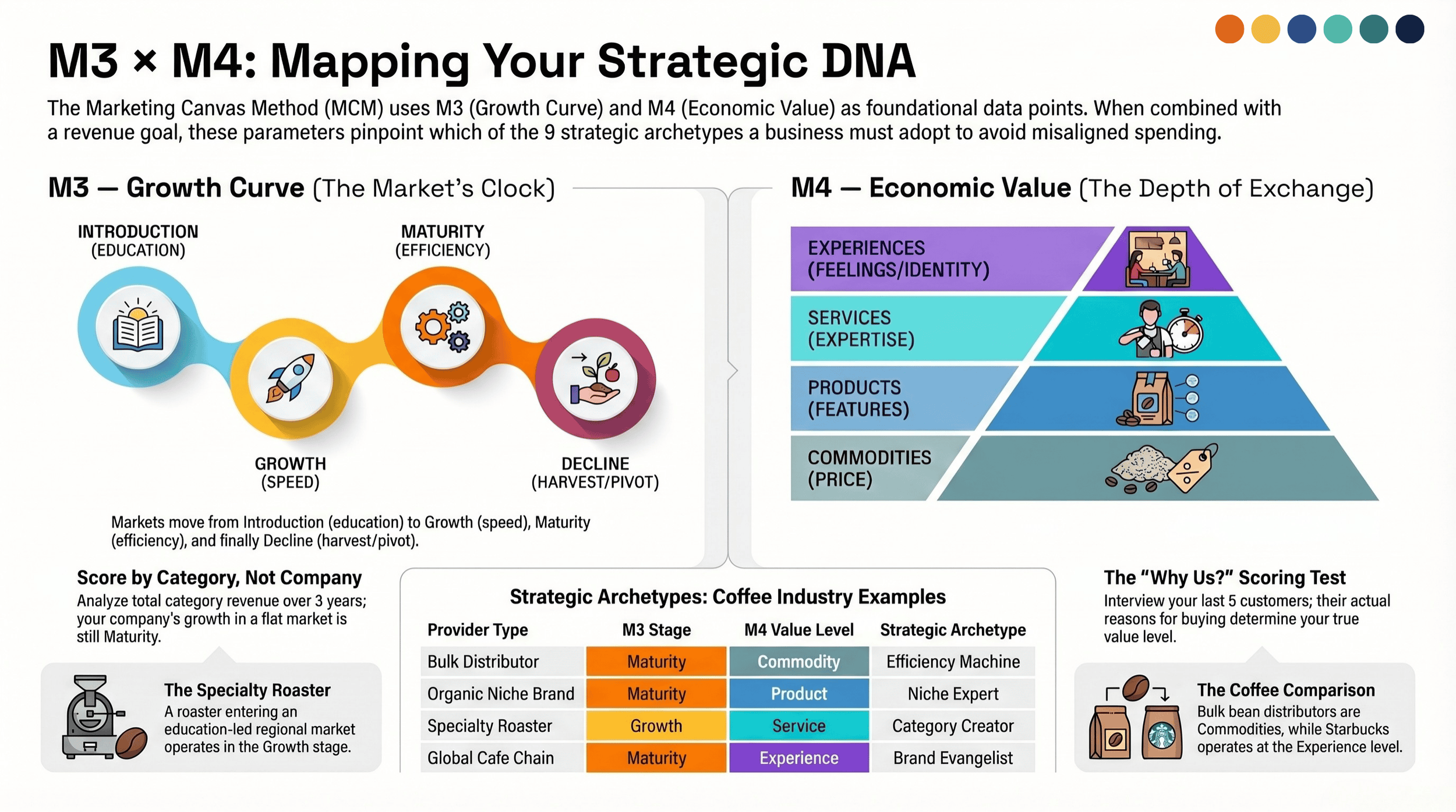
M3 measures the lifecycle stage of your market category — not your company. It tells you whether demand is being built, accelerating, plateauing, or contracting. The stage you are in determines which strategic moves are viable and which are structurally premature or too late.
M3 measures the lifecycle stage of your market category, not your company. The underlying model is Theodore Levitt's Product Life Cycle, first published in the Harvard Business Review in 1965. Four stages survive because they describe something mechanically real about how categories evolve.
Introduction — the category is new. Customers need education before they evaluate features. First-mover advantage is possible, but awareness is the bottleneck, not conversion.
Growth — demand is expanding. New entrants arrive weekly. Speed and differentiation drive outcomes. The strategic question is "How do we land as many customers as possible before the window closes?"
Maturity — demand is stable. Established players compete for share in a flat pool. Efficiency and retention often outperform acquisition investment at this stage.
Decline — demand is shrinking. Alternatives are replacing the category. The question shifts from "How do we grow?" to "Do we harvest this, pivot, or exit?"
Critical point: M3 is a market-level measurement, not a company-level one. A startup entering a mature market is still in a mature market. A dominant player in a growing market still operates under growth-market rules. Confusing your company's lifecycle with your market's lifecycle is one of the most common strategic errors I see in workshops.

M4: Economic Value — The Depth of the Exchange
In a Nutshell
M4 · Step 1 · Market DNAM4: Economic Value
"The depth of the exchange."
M4 classifies what your Lead Segment is actually buying from you — the nature of the value exchange, not the product category. It determines your competitive strategy, your pricing power, and which archetypes are structurally available to you. M4 is scored by how your customers perceive the exchange, not by how you classify yourself.
M4 classifies what your Lead Segment is actually buying from you. The model draws from Pine & Gilmore's "Welcome to the Experience Economy" (Harvard Business Review, 1998), adapted in the Marketing Canvas Method as a four-level strategic classifier.
Commodity — the offering is interchangeable. Customers buy on price because they see no meaningful difference between providers.
Products — the offering is differentiated by features. Customers compare specifications, reliability, or performance.
Services — the offering is differentiated by delivery, expertise, and the human interaction surrounding it.
Experience — the offering is differentiated by how it makes people feel. The emotional and sensory impact of the entire journey is the primary value.
The most important warning in this parameter: M4 is determined by how your Lead Segment perceives the value exchange — not by how you classify yourself internally. A restaurant that believes it sells "an experience" but whose customers are there for consistent food quality at a fair price is competing on Product terms, regardless of its interior design. A B2B software company that delivers implementation support, training, and a dedicated success manager is operating at the Service level even if it calls itself a "product company."
Overestimating M4 is the most common mistake. Most companies believe they operate one level higher than their customers perceive. Be honest.
Why These Two Parameters Matter More Than Any Single KPI
M3 and M4 are not analytical tools for their own sake. In the Marketing Canvas Method, they are two of three inputs that trigger Archetype Selection — the step where your specific strategic context gets matched to one of 9 tested strategic patterns.
The third input is your Step 2 Revenue Goal: Acquisition (grow the customer base), Retention (protect and deepen existing relationships), or Stimulation (increase revenue per existing customer).
The combination of M3 + M4 + Goal is deterministic. It does not produce a list of options to debate. It produces a single archetype — or flags a strategic mismatch before you spend anything.
◆ M3 × M4 × Goal → Archetype Selection Matrix
| M3 · Growth Curve & M4 · Economic Value | Step 2 Revenue Goal | |||
|---|---|---|---|---|
| M3 | M4 | Acquisition | Retention | Stimulation |
| Introduction | Commodity | ⚠ Mismatch No scale yet |
⚠ Mismatch No base yet |
⚠ Mismatch Zero base |
| Products | A1 Disruptive Newcomer | ⚠ Mismatch No base yet |
⚠ Mismatch Zero base |
|
| Services | A9 Category Creator | ⚠ Mismatch No base yet |
⚠ Mismatch Zero base |
|
| Experience | A9 Category Creator | ⚠ Mismatch No base yet |
⚠ Mismatch Zero base |
|
| Growth | Commodity | A2 Efficiency Machine | ⚠ Mismatch Price-seekers won't stay |
⚠ Mismatch Too early to squeeze |
| Products | A1 Disruptive Newcomer | A8 Niche Expert | ⚠ Mismatch Too early to squeeze |
|
| Services | A9 Category Creator | A4 Stagnant Leader | ⚠ Mismatch Too early to squeeze |
|
| Experience | A9 Category Creator | A7 Scale-Up Guardian | ⚠ Mismatch Too early to squeeze |
|
| Maturity | Commodity | A2 Efficiency Machine | A2 Efficiency Machine | A6 Value Harvester |
| Products | A8 Niche Expert | A8 Niche Expert | A8 Niche Expert | |
| Services | A4 Stagnant Leader | A4 Stagnant Leader | A4 Stagnant Leader | |
| Experience | A9 Category Creator | A3 Brand Evangelist | A3 Brand Evangelist | |
| Decline | Commodity | ⚠ Mismatch Capital destruction |
A2 Efficiency Machine | A6 Value Harvester |
| Products | ⚠ Mismatch Capital destruction |
A5 Pivot Pioneer | A6 Value Harvester | |
| Services | ⚠ Mismatch Capital destruction |
A4 Stagnant Leader | A6 Value Harvester | |
| Experience | ⚠ Mismatch Capital destruction |
A5 Pivot Pioneer | A6 Value Harvester | |
⚠ Strategic Mismatch = the combination is internally contradictory — the method flags it before you invest. · Marketing Canvas Method · marketingcanvas.net
Applied: The Coffee Industry Through MCM Lenses
The coffee market is a clean illustration because multiple M3 × M4 combinations exist simultaneously across different players.
A commodity coffee distributor supplying unbranded beans to bulk buyers operates at Maturity × Commodity. Their Goal is typically Retention (holding contracts) or Stimulation (margin extraction). The MCM match: A2 (Efficiency Machine) or A6 (Value Harvester). Their strategic focus belongs on operational cost, pricing structure, and volume contracts — not brand storytelling.
A packaged ground coffee brand competing on organic certification and origin differentiation operates at Maturity × Products with an Acquisition goal. The MCM match: A8 (Niche Expert). Their mission is to carve and own a specialized slice of a flat market through technical credibility and benefit lock-in.
A café chain like Starbucks — where customers are buying consistency, convenience, and identity — operates at Maturity × Experience with a Retention goal. The MCM match: A3 (Brand Evangelist). Their mission is not to serve the best coffee. It is to make leaving feel like a loss of identity.
A specialty coffee roaster entering a regional growth market — education-led, subscription-based, farm-to-cup storytelling — may operate at Growth × Services with an Acquisition goal. The MCM match: A9 (Category Creator). Their mission is to define what "serious coffee" means before the major chains copy the format.
Each of these businesses needs a completely different strategy. Four businesses in the "coffee industry." Four different archetypes. Four different sets of priorities. That is exactly what M3 × M4 × Goal is built to surface.
M3 x M4: Mapping your Strategic DNA
Three Questions to Score Your M3 and M4 Right Now
Question 1 — M3: When you look at your category's total revenue over the last 3 years, is it growing rapidly, growing slowly, flat, or declining? Do not look at your company's revenue — look at the category. That answer is your M3.
Question 2 — M4: Ask your 5 most recent customers why they chose you over the next best option. If the answers cluster around price or availability: Commodity. Around specific features or specs: Products. Around expertise, support, or relationship: Services. Around identity, values, or emotional fit: Experience. Their words determine M4, not yours.
Question 3 — The Honest Check: Now place yourself on the M3 × M4 grid. Does your current marketing budget, messaging, and team structure match the strategic archetype that combination suggests? If not, that gap is likely where your marketing spend is leaking.
◆ Practitioner's Tip
The double miscalibration — and how to catch it in ten minutes
In almost every Step 1 workshop I run, the same error appears twice in the same team. Someone places the company at Growth on M3 because the company has been growing. Then they place it at Experience on M4 because the brand team invested in customer experience last year. Both readings are about the company. Neither is about the market.
The M3 check takes one question: look at the category's total revenue over three years, not yours. If the category is flat and you are growing, you are taking share in a mature market — not riding a growth wave. Those require completely different strategies, and the matrix will give you a completely different archetype.
The M4 check takes five conversations. Call your five most recent customers and ask one question: "Why did you choose us over the alternative?" If the answers cluster around price or availability, you are at Commodity regardless of your product roadmap. If they mention a specific feature or specification, you are at Products. If they describe your team, your process, or your expertise, you are at Services. Only if they describe identity, values, or how the experience made them feel are you operating at Experience level.
Get both wrong and the matrix routes you to the wrong archetype. Get both right and the rest of the method — your Vital 8, your goal, your roadmap — becomes structurally coherent. The ten minutes you spend on these two checks are the highest-leverage ten minutes in Step 1.
M4 test: What do your last 5 customers say they bought — in their words, not yours.
What to Do With Your Answers
If you have scored M3 and M4 honestly, you are two-thirds of the way to archetype selection. The third input — your Step 2 Revenue Goal — is explained in this article on setting revenue targets.
Once you have all three inputs, the Marketing Canvas Method gives you a precise strategic archetype with a defined Vital 8 priority set: the 8 dimensions you should fix, protect, or accelerate before anything else. That is the structure of Steps 3 through 5.
The full 6-step process is detailed in Marketing Strategy, Programmed — the practical field guide to the Marketing Canvas Method. If you want to run this process with your team in a structured workshop, the Work With Us page shows what that looks like.
Laurent Bouty is the creator of the Marketing Canvas Method and author of Marketing Strategy, Programmed (2026). He teaches strategic marketing at Solvay Brussels School of Economics and Management and has applied the MCM framework with teams across Europe and beyond.
