BLOG
A collection of article and ideas that help Smart Marketers to become Smarter

Marketing Canvas - Experience
Navigating the complex landscape of customer experience can be a challenging task for brands. This article provides an in-depth understanding of 'Moments'— a crucial sub-dimension in the customer journey aspect of the Marketing Canvas, a strategic tool developed by Laurent Bouty. The piece highlights the importance of consciously orchestrating these moments and how they shape customers' perception of your brand. Using insights from Matt Watkinson's 'The Ten Principles Behind Great Customer Experiences,' the article outlines a structured approach to managing these interactions effectively. It also presents practical tools, evaluation methods, and improvement strategies to enhance these moments. With the aid of a case study on Green Clean, the reader will grasp the tangible application of these principles. This article is an invaluable resource for marketers, entrepreneurs, and anyone seeking to optimize their marketing strategy and create memorable customer experiences.
Last update: 03/12/2024
In a nutshell
The Experience sub-dimension in the Marketing Canvas emphasizes how your brand interacts with customers at each moment of their journey. It ensures that every response is tailored to customer identity, goal-oriented, consistent, clear, and aligned with sustainability. A well-designed experience fosters trust, loyalty, and satisfaction, creating a seamless connection between the customer and the brand.
For instance, Green Clean might ensure that every customer interaction—from website navigation to product use—reflects its commitment to eco-friendliness, customer care, and reliability.
Introduction
The Experience sub-dimension within the Journey category focuses on the quality and consistency of your brand’s interactions across all customer touchpoints. It ensures that your brand provides meaningful, goal-driven answers tailored to customer expectations and values. Delivering exceptional experiences is essential for building trust, enhancing satisfaction, and nurturing long-term relationships.
Experience goes beyond functionality; it aligns with customer identity, fulfills their objectives, and leaves a lasting impression.
What is experience?
Experience represents the totality of interactions customers have with your brand, encompassing:
Tailored Responses: Addressing customer needs and reflecting their identity.
Goal Fulfillment: Helping customers achieve their objectives at every touchpoint.
Consistency: Delivering the same level of quality and messaging across channels and moments.
Clarity and Reliability: Setting and meeting clear expectations for customers.
Sustainability Alignment: Demonstrating environmental and social responsibility throughout the customer journey.
For example:
Before Purchase: Providing clear, personalized guidance on choosing the right product.
During Purchase: Offering a smooth and intuitive buying process.
After Purchase: Following up with useful tips, support, and opportunities for feedback.
Experience: an in-depth perspective
To deliver a high-quality customer experience, brands must:
Adapt to Customer Identity: Understand and reflect customer values, preferences, and expectations in every interaction.
Focus on Customer Goals: Ensure that every response aligns with and supports customer objectives.
Ensure Consistency: Provide a seamless experience across all touchpoints, from marketing to post-purchase support.
Set and Meet Clear Expectations: Communicate what customers can expect and deliver consistently to build trust.
Embed Sustainability: Highlight and act on your commitment to sustainable practices at every stage.
For example:
Customer Identity: Green Clean recognizes that its customers value health and eco-friendliness and tailors messaging to highlight these benefits.
Goal Achievement: The brand ensures its products deliver effective cleaning without harmful chemicals, fulfilling customer expectations.
Consistency: Its eco-friendly mission is evident across packaging, advertising, and customer support.
Clear Expectations: Green Clean provides transparent product usage instructions and reliable delivery timelines.
Sustainability: All interactions reinforce the brand’s commitment to reducing environmental impact.
Translating experience into action
Creating exceptional experiences requires a structured approach:
Understand Customer Expectations: Use research and feedback to tailor responses to customer identity and goals.
Map the Customer Journey: Identify touchpoints and ensure consistent, goal-driven interactions.
Align with Sustainability: Integrate environmentally and socially responsible practices into every customer experience.
Questions to consider:
Are your brand responses tailored to your customers’ identity at each touchpoint?
Does your brand help customers achieve their goals in every interaction?
Are your responses consistent across time, channels, and moments?
Do you set clear expectations and deliver consistently to meet them?
How does your brand incorporate sustainability into the customer experience?
Statements for self-assessment
For a comprehensive evaluation of your understanding and application of the Experience concept, rate your agreement with the following statements on a scale from -3 (completely disagree) to +3 (completely agree):
For each moment, your brand answer has been adapted to your customers' identity.
For each moment, your brand answer has helped customers to achieve their goals.
For each moment, your brand answer is consistent in time and space, leaving nothing to chance.
For each moment, your brand answer has clear expectations and delivers it consistently.
For each moment, your brand answer is compatible with the concept of sustainability.
Interpretation of the scores
Negative scores (-1 to -3): Negative scores indicate significant gaps in the quality and consistency of your brand’s customer experience. This may result in confusion, unmet expectations, and weak customer relationships. Immediate efforts are needed to improve customer alignment, goal orientation, and sustainability integration.
A score of zero (0): A neutral score reflects partial execution or incomplete alignment of brand responses with customer expectations. While some aspects of the experience may be effective, inconsistencies or unclear messaging may hinder trust and satisfaction. Refinement is needed to ensure a cohesive and impactful experience.
Positive scores (+1 to +3): Positive scores suggest that your brand consistently delivers tailored, reliable, and sustainable experiences. This ensures that customers feel understood, supported, and aligned with your values, fostering trust, loyalty, and advocacy.
Case study: Green Clean’s experience
Misaligned understanding (-3, -2, -1): Green Clean fails to adapt its responses to customer identity or goals, providing inconsistent and unclear interactions. For instance, its advertising highlights sustainability, but product instructions lack clarity, creating confusion and mistrust.
Surface understanding (0): Green Clean delivers partially effective experiences. While its packaging reflects eco-friendliness, its website and customer support fail to align with these values consistently, leaving customers with mixed impressions.
Deep understanding (+1, +2, +3): Green Clean ensures that every touchpoint reflects its eco-friendly mission and supports customer objectives. Its website provides personalized product recommendations, packaging is fully sustainable, and customer support offers clear, consistent answers. These efforts create a seamless and satisfying experience that builds trust and loyalty.
Conclusion
The Experience sub-dimension is critical for ensuring your brand delivers consistent, meaningful, and sustainable interactions throughout the customer journey. By tailoring your responses to customer identity, supporting their goals, and maintaining clear and reliable messaging, you can enhance satisfaction and build stronger, lasting relationships with your audience.
Sources
Matt Watkinson, Book, The 10 Principles Behind Great Customer Experiences.
More on the Marketing Canvas














Marketing Canvas by Laurent Bouty

Marketing Canvas - Moments
This article offers an in-depth exploration of 'Moments' in the marketing journey - crucial touchpoints that define customers' interactions with your business. From discovering your product to post-purchase stages, these Moments shape customer perception and engagement. We delve into how to identify and understand these Moments, employing strategies like Google's SEE-THINK-DO-CARE framework. The piece also covers evaluation methods for your Moments strategy, offering a scoring system that helps businesses pinpoint areas of improvement. Through a real-world example, it illustrates how this concept can be applied practically, fostering effective, empathetic marketing strategies. This article is a must-read for marketers, entrepreneurs, and anyone eager to enhance their customer experience and overall business success.
Last update: 4/12/2024
In a nutshell
The Moments sub-dimension in the Marketing Canvas focuses on identifying and understanding the critical points in the customer journey before, during, and after engaging with your value proposition. These moments capture customer actions, thoughts, and emotions, revealing their objectives and pain points. Understanding these moments helps businesses design experiences that resonate with customers, foster loyalty, and improve satisfaction.
For example, Green Clean might analyze moments such as researching eco-friendly cleaning products, comparing options, purchasing a product, and using it at home. By understanding what customers think, feel, and do at each stage, Green Clean can tailor its messaging, support, and product experience.
Introduction
The Moments sub-dimension in the Marketing Canvas is part of the Journey category, focusing on mapping the customer’s experience with your brand. Moments are the key touchpoints where customers interact with your value proposition and form impressions of your brand. By understanding these moments in detail, you can align your strategies to meet customer expectations and create memorable experiences.
Unlike other elements that focus on broad strategies, Moments zooms into the specific instances that shape customer perceptions, ensuring that your value proposition delivers value consistently.
What are moments?
Moments are the specific instances in the customer journey where they engage with your brand or value proposition. These can occur before, during, or after a purchase, encompassing everything from initial awareness to post-purchase advocacy.
For example:
Before Purchase: Researching sustainable cleaning products online.
During Purchase: Comparing Green Clean to competitors and making a buying decision.
After Purchase: Using the product and deciding whether to repurchase or recommend it.
Moments are characterized by:
Customer Observations: Based on real customer behavior and feedback.
Actions, Thoughts, and Feelings: Capturing what customers do, think, and feel at each touchpoint.
Customer Objectives: Understanding the goals customers aim to achieve during each moment.
Moments: an in-depth perspective
Mapping moments requires detailed insights into customer behavior, focusing on:
Observations and Identity: Moments must reflect real customer behaviors and identities, gathered through interviews and observations.
Comprehensive Coverage: Identifying all relevant moments before, during, and after engaging with your value proposition.
Customer Emotions and Actions: Capturing the thoughts, feelings, and actions of customers at each stage.
Customer Objectives: Understanding what customers aim to achieve during each moment and aligning your strategy accordingly.
For example:
Observations: Green Clean might discover that customers feel overwhelmed by the variety of “eco-friendly” claims during research.
Emotions: Customers may feel relief when they find a transparent and trustworthy brand.
Actions: Comparing labels or searching for certifications like “EcoCert.”
Objectives: Finding a safe and sustainable cleaning solution for their family.

Mental Models - Moments in the Marketing Canvas
Translating moments into action
To enhance the customer experience, businesses must identify and refine the moments that matter most to their audience. This involves:
Mapping the Journey: Defining moments across all stages of the customer journey.
Aligning with Objectives: Ensuring each moment supports the customer’s goals and minimizes friction.
Optimizing Touchpoints: Improving interactions to meet customer expectations and create positive experiences.
Questions to consider:
Have you based your moments on real customer observations and interviews?
Have you identified moments before, during, and after the purchase?
Do you understand what your customers think, feel, and do at each moment?
Have you clearly identified the objectives your customers aim to achieve during each moment?
Statements for self-assessment
For a comprehensive evaluation of your understanding and application of the Moments concept, rate your agreement with the following statements on a scale from -3 (completely disagree) to +3 (completely agree):
Your moments have been defined based on customer observations and interviews. It reflects his/her identity.
You have identified all moments before, during, and after buying your value proposition.
For each moment, you have clearly identified what your customers think, feel, and do.
For each moment, you have clearly identified what are the customer objectives.
Interpretation of the scores
Negative scores (-1 to -3): Negative scores indicate a lack of understanding or incomplete mapping of customer moments. This may result in missed opportunities to address customer needs, leading to friction in the journey and reduced satisfaction. Immediate action is needed to observe, analyze, and map customer behaviors more effectively.
A score of zero (0): A neutral score reflects partial insights or an incomplete understanding of customer moments. While you may have identified some key touchpoints, gaps remain in addressing customer thoughts, feelings, or objectives. Further research and refinement are required to create a comprehensive journey map.
Positive scores (+1 to +3): Positive scores suggest that you have a thorough understanding of customer moments and have effectively mapped their actions, thoughts, feelings, and objectives. This deep insight allows you to create seamless, satisfying experiences that align with customer expectations and foster loyalty.
Case study: Green Clean’s moments
Misaligned Understanding (-3, -2, -1): Green Clean fails to map critical customer moments, focusing only on the purchase stage. The brand overlooks key interactions, such as research or post-purchase usage, resulting in a disconnected customer experience that fails to meet expectations.
Surface Understanding (0): Green Clean identifies some customer moments but does not fully capture customer thoughts, feelings, or objectives. For example, while the brand recognizes that customers compare products, it does not address the emotional stress of choosing among eco-friendly options.
Deep Understanding (+1, +2, +3): Green Clean comprehensively maps customer moments, from initial awareness to post-purchase advocacy. By identifying what customers think, feel, and do at each stage, the brand tailors its messaging, simplifies decision-making, and provides ongoing support. For instance, Green Clean offers an online guide to decoding eco-labels, addressing customer stress during the research phase and aligning with their objective of making informed choices.
Conclusion
The Moments sub-dimension is essential for understanding the key touchpoints that shape the customer journey. By observing real customer behavior, identifying actions, emotions, and objectives, and refining interactions, businesses can create seamless and satisfying experiences. A well-mapped journey fosters loyalty, trust, and advocacy, ensuring your value proposition resonates with customers at every stage.
Sources
Mental Models, Wikipedia, https://en.m.wikipedia.org/wiki/Mental_model
Google, Micro-Moments, https://www.thinkwithgoogle.com/marketing-resources/micro-moments/micro-moments-understand-new-consumer-behavior/
More on the Marketing Canvas

Marketing Canvas - Proofs
In this comprehensive guide, we explore the concept of "proofs" in marketing - the crucial elements that make your value proposition compelling and credible. We delve into various types of proofs such as studies, expert recognition, social proof, and certifications, demonstrating how each contributes to a solid marketing strategy. To illustrate this concept, we look at a real-world example of a company that successfully utilized proofs. The guide also includes a unique framework for evaluating and improving your proofs, helping you fine-tune your marketing strategy. Whether you're a seasoned marketer or an entrepreneur starting your marketing journey, this guide provides practical insights that can enhance your marketing effectiveness.
Last update: 8/11/2024
In a nutshell
The Proofs sub-dimension in the Marketing Canvas focuses on the evidence and validation that support your value proposition. Proofs help build trust and credibility by demonstrating how your offering delivers on its promises, reducing customer uncertainty and reinforcing your brand’s reputation. This evidence may include testimonials, case studies, certifications, third-party endorsements, and other trust-building tools.
For example, Green Clean might use certifications like "Certified Organic" or endorsements from environmental organizations to validate its claims of sustainability and safety, reassuring customers of its commitment to quality and eco-conscious practices.
Introduction
The Proofs sub-dimension is a vital element of the Value Proposition category in the Marketing Canvas. It addresses the need to substantiate your claims with clear and credible evidence. In an age of increasing skepticism, especially around sustainability claims, providing proof is critical to gaining customer trust, avoiding greenwashing, and reinforcing your brand's reputation.
Proofs help bridge the gap between what a brand promises and what customers believe, ensuring alignment and confidence in your value proposition.
What are proofs?
Proofs are the tangible and credible elements that validate your value proposition, providing customers with the confidence to trust and invest in your offering. These can include:
Operational Context: Demonstrations, examples, or case studies that show your value proposition in action.
Clarification Tools: Detailed explanations, technical specifications, or visual aids that reassure customers about your product or service.
Third-Party Endorsements: Recognized certifications, awards, or endorsements from trusted authorities.
Brand Reputation: References to your brand’s history, achievements, or well-known attributes.
Greenwashing Avoidance: Ensuring that your claims are transparent, accurate, and verifiable.
For instance, Green Clean might showcase customer testimonials, certifications like “EcoCert,” and its long-standing reputation for sustainable innovation to provide robust proof of its eco-friendly claims.
Laurent Bouty - Marketing Canvas Method - Proofs
Proofs: an in-depth perspective
To effectively reinforce your value proposition, your proofs must:
Show Operational Relevance: Provide real-world examples or demonstrations of how your product delivers value.
Reassure Through Clarity: Offer clear explanations or visualizations that address customer concerns.
Leverage Trusted Endorsements: Highlight third-party validations or certifications that strengthen credibility.
Reference Brand Reputation: Connect your value proposition to widely acknowledged elements of your brand’s history or achievements.
Maintain Integrity: Ensure your claims are truthful, avoiding exaggeration or greenwashing.
For example:
Operational Context: Green Clean shares a case study showing how its products helped a customer reduce household toxins by 80%.
Third-Party Endorsements: Certifications like “Leaping Bunny” verify its cruelty-free claims.
Reputation: Green Clean highlights its recognition as a leader in sustainable cleaning solutions.
Translating proofs into action
Providing proof requires an intentional strategy to communicate and display evidence across all customer touchpoints. From marketing materials to customer service, every interaction should reinforce your value proposition with credible and relevant proof points.
Questions to consider:
Have you demonstrated your value proposition in an operational context that customers can easily relate to?
Have you clarified how your value proposition works to reassure potential customers?
Are your claims backed by trusted third-party endorsements?
Do you reference widely acknowledged elements of your brand’s reputation to reinforce your value proposition?
Are you transparent in your claims, ensuring you avoid any perception of greenwashing?
Statements for self-assessment
For a comprehensive evaluation of your understanding and application of the Proofs concept, rate your agreement with the following statements on a scale from -3 (completely disagree) to +3 (completely agree):
You have presented your value proposition in an operational context that makes it possible to see the promised benefit(s).
You have provided elements to clarify exactly how the value proposition operates and reassure the customer.
Your value proposition is supported by means of a recognized third party: i.e., a celebrity ambassador, a label, or other trusted sources.
Your value proposition has made a direct reference to a widely acknowledged element of your brand's reputation.
Your value proposition avoids any form of Greenwashing.
Interpretation of the scores
Negative scores (-1 to -3): Negative scores indicate a lack of sufficient or credible proof to support your value proposition. Customers may be skeptical of your claims, leading to reduced trust and missed opportunities to build loyalty. Immediate steps are needed to integrate credible and transparent evidence into your messaging.
A score of zero (0): A neutral score reflects uncertainty or incomplete application of proof elements. While you may provide some evidence, it is not compelling or consistent enough to fully reassure customers. Further development of proof strategies is necessary to strengthen customer trust and confidence.
Positive scores (+1 to +3): Positive scores suggest that your value proposition is well-supported by clear, credible, and impactful proof elements. Your evidence reassures customers, leverages third-party endorsements, aligns with your brand’s reputation, and avoids greenwashing. This strengthens customer trust and reinforces your value proposition.
Case study: Green Clean’s proofs
Misaligned understanding (-3, -2, -1): Green Clean fails to provide sufficient proof to support its claims, relying only on vague or generic statements. Without tangible evidence, such as certifications or case studies, customers are left skeptical of its eco-friendly promises, weakening trust and reducing purchase intent.
Surface understanding (0): Green Clean offers some proof, such as basic product descriptions or minimal certifications, but lacks consistency or depth. Customers may perceive the brand as credible but not fully reassured, limiting the impact of its value proposition.
Deep understanding (+1, +2, +3): Green Clean provides robust proof points, including certifications like “EcoCert,” testimonials from satisfied customers, and endorsements from environmental organizations. These elements demonstrate operational relevance, clarify its value proposition, and highlight the brand’s reputation as a sustainability leader, building strong trust and loyalty.
Conclusion
The Proofs sub-dimension is essential for building trust and credibility in your value proposition. By demonstrating your claims through operational context, third-party endorsements, and references to your brand’s reputation, you reassure customers and strengthen their confidence in your offering. Transparency and honesty are critical to avoiding greenwashing and maintaining integrity, ensuring that your proofs reinforce long-term loyalty and advocacy.
Sources
Neil Patel, Dominate your Market, https://neilpatel.com/blog/dominate-your-market/
HubSpot, Principles of Persuasion, https://blog.hubspot.com/sales/cialdini-principles-of-persuasion
More on the Marketing Canvas
Marketing Canvas by Laurent Bouty

Marketing Canvas - Pricing
Discover how to effectively leverage the PRICING dimension in your Marketing Canvas strategy. This guide simplifies this complex topic, providing examples, tips, and a step-by-step approach to enhance your marketing success.
Last update: 24/11/2024
In a nutshell
The Pricing sub-dimension in the Marketing Canvas examines how your pricing strategy supports your value proposition, aligns with customer expectations, and reflects your brand positioning. Pricing is not merely a financial decision but a strategic tool that communicates value, differentiates your offering, and influences customer behavior toward sustainable choices.
For instance, a brand like Green Clean might emphasize pricing transparency and offer incentives for sustainable behaviors, such as discounts on refillable products, to align with its eco-friendly mission and customer expectations.
Introduction
The Pricing sub-dimension in the Marketing Canvas is critical to ensuring your value proposition is both competitive and aligned with your brand’s goals. A well-designed pricing strategy balances customer Willingness To Pay (WTP), perceived value, and cost structure while promoting sustainability. It ensures your offering creates more value than its cost and encourages customers to engage with your brand’s most impactful and sustainable options.
Pricing also reinforces brand positioning by reflecting the quality, exclusivity, or accessibility of your product or service.
What is pricing?
Pricing is the monetary expression of your value proposition, reflecting the worth of your product or service to customers. A strong pricing strategy:
Communicates Value: Ensures that customers perceive the benefits of your offering as exceeding its cost.
Reflects Willingness To Pay: Aligns with what customers are willing to pay for solving their problems.
Covers Costs: Accounts for the full costs associated with delivering your value proposition.
Supports Positioning: Aligns with your brand’s image and goals in the category.
Promotes Sustainability: Incentivizes customers to choose sustainable options.
For example, Green Clean might set a premium price for its eco-friendly cleaning solutions to reflect their unique value while offering subscription discounts for refills to encourage long-term sustainable behaviors.
Pricing: an in-depth perspective
PRICING is a pivotal element of your marketing strategy that requires meticulous analysis due to its complexity and profound impact on value creation. In the Marketing Canvas Method, PRICING goes beyond simply competing with market rates for similar offerings. Instead, it focuses on leveraging pricing as a strategic tool to create or preserve value, propelling your brand upward on the economic value curve.
Perceived Price and the Value Curve
At the core of effective PRICING is the concept of the Perceived Price—how customers interpret the value of your offering relative to its cost. Understanding the standard pricing unit in your market is critical to analyzing your position.
For instance:
In a supermarket, shampoos or soaps are typically priced per milliliter in Europe, while coffee is sold by weight.
In the service industry, consulting services are often charged per hour or day.
Once the reference pricing unit is established, you can calculate the perceived price of your offering compared to competitors using the formula:
24 / (E - C) * (M7 - C) - 12
Where:
E is the highest unit price in the market,
C is the lowest unit price,
M7 is your unit price.
This calculation helps determine your position on the value curve, indicating whether your PRICING strategy accelerates or impedes your business growth.
Example: Artisanal Coffee
Suppose your artisanal coffee beans are priced at $15 per pound (M7). In your market, the highest-priced coffee is $20 per pound (E) and the lowest is $10 per pound (C). Applying the formula provides insight into where your pricing strategy positions you on the value curve.
A strong position on the curve suggests your pricing reflects perceived value, while a weak position may signal the need for adjustment to better align with market conditions and customer expectations.
PRICING and Perceived Value
PRICING is intrinsically tied to how customers perceive the value of your product or service:
If your offering is seen as a commodity, customers will gravitate toward the lowest price.
Conversely, if your unique value proposition is clear, customers may accept higher prices that reflect this differentiation.
For example:
Starbucks customers willingly pay premium prices because they perceive value beyond the coffee itself—a unique experience.
A luxury fashion brand can command high prices because it offers a transformational experience, making cost secondary for its target audience.
Key Principles of an effective PRICING strategy
An effective PRICING strategy should adhere to the following principles:
Be Value-Based: Align your price with your position on the economic value curve.
Consider Market Conditions: Analyze competitor pricing and customer price sensitivity to ensure relevance.
Enhance Your Brand’s Purpose and Positioning: Reflect your brand identity. For instance, a disruptive brand might challenge market norms with innovative pricing.
Strengthen Your Value Proposition: Reinforce the unique aspects of your offering to justify the price.
Ignoring these principles can lead to a PRICING strategy that acts as a brake on your progress, rather than an accelerator.
Assessing your pricing strategy
To evaluate your pricing, consider a scoring scale from -12 to +12:
12 represents a low price that may correspond to a low perceived value.
+12 indicates a high price with a high perceived value.
For example:
If your artisanal coffee is priced above average market rates but customers appreciate its unique quality and sourcing, resulting in a high perceived value, your pricing might score a +8 or higher on this scale.
On the other hand, a low-priced coffee with limited differentiation might score closer to -8 or -12, reflecting a misaligned pricing strategy.
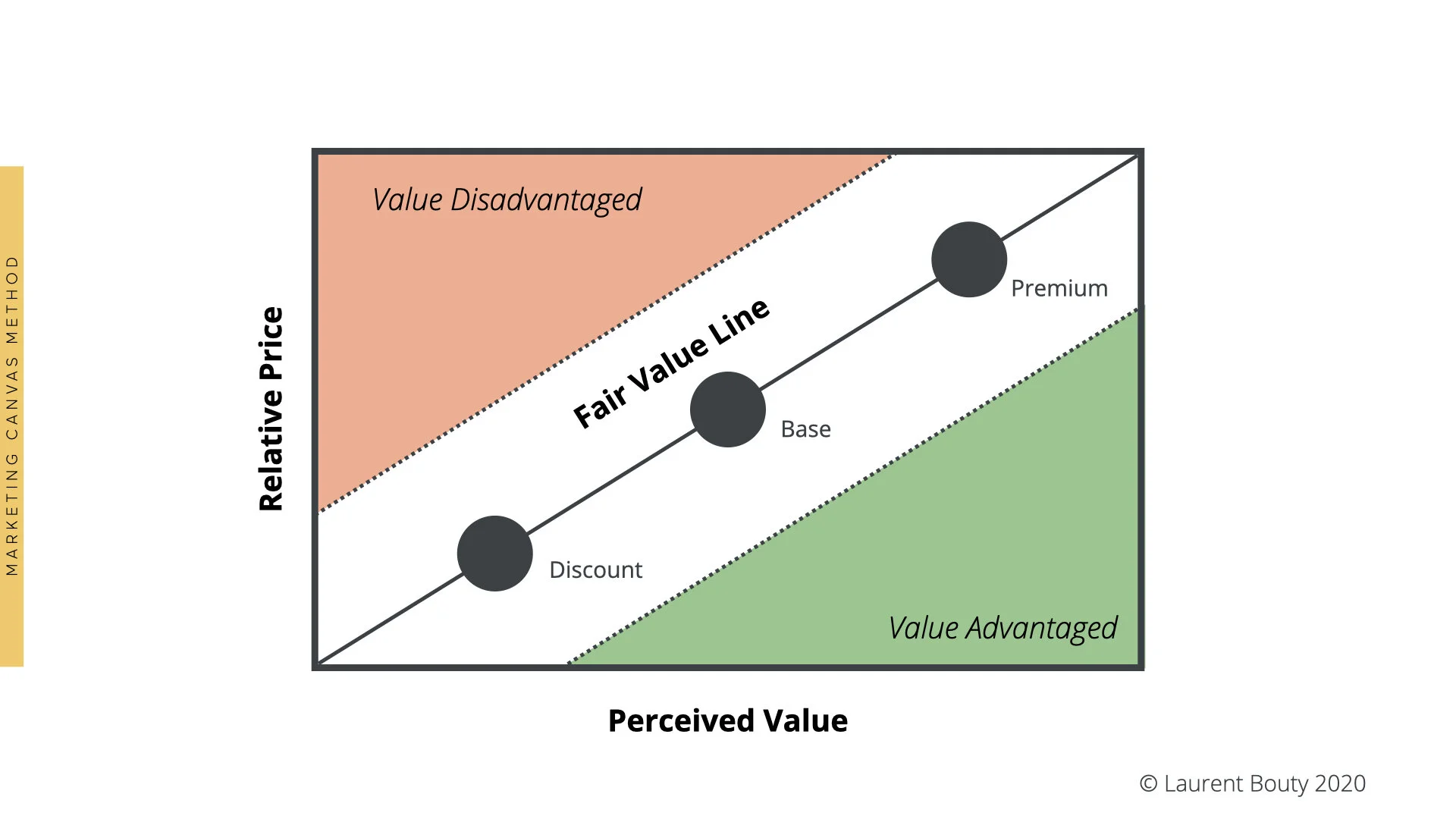
Value Map that helps you understand your current pricing situation
Translating pricing into action
A strong pricing strategy should consistently reflect your value proposition and support customer decision-making. Pricing decisions should be based on insights into customer behavior, cost structures, and competitive analysis, while integrating sustainability as a core principle.
Questions to consider:
Does your pricing strategy create more value than the cost for your customers compared to alternatives?
How well does your pricing align with your customers’ Willingness To Pay for solving their problems?
Does your pricing account for all costs associated with delivering your value proposition?
Is your pricing consistent with your brand positioning and category goals?
How does your pricing strategy encourage sustainable choices?
Method for self-assessment
For a comprehensive evaluation of your understanding and application of the Pricing concept, rate your agreement with the following statements on a scale from -3 (completely disagree) to +3 (completely agree):
Your value proposition is creating more value than the cost of the next best alternative for your customers.
Your pricing strategy is based on customer Willingness To Pay (WTP) for solving their problem.
Your pricing strategy takes into account all costs associated with your value proposition.
Your pricing strategy is aligned with your brand positioning and your goals for the category.
Your pricing strategy encourages customers towards the most sustainable option available.
Interpretation of the scores
Negative scores (-1 to -3): Negative scores suggest that your pricing strategy is misaligned with customer expectations, cost structures, or brand positioning. This can result in undervaluing your product, losing competitive advantage, or failing to support sustainability goals. Immediate action is required to reassess your pricing approach.
A score of zero (0): A neutral score reflects uncertainty or incomplete alignment in your pricing strategy. While some elements may be in place, such as cost coverage or WTP analysis, they lack cohesion or fail to drive sustainable behaviors effectively. Further refinement is needed to strengthen your strategy.
Positive scores (+1 to +3): Positive scores indicate that your pricing strategy effectively communicates value, aligns with customer WTP, covers costs, and supports brand positioning. Additionally, your pricing encourages sustainable choices, reinforcing your commitment to long-term impact and differentiation.
Case study: Green clean’s pricing
Misaligned understanding (-3, -2, -1): Green Clean’s pricing fails to reflect the value of its eco-friendly products, either undervaluing them compared to competitors or setting prices that exceed customer WTP. The lack of cost alignment and sustainability incentives weakens the brand’s positioning and reduces customer appeal.
Surface understanding (0): Green Clean’s pricing covers basic costs and aligns with industry averages but lacks differentiation or focus on sustainability. Customers may perceive value but are not incentivized to choose more sustainable options, limiting the brand’s impact and competitive edge.
Deep understanding (+1, +2, +3): Green Clean’s pricing highlights the value of its unique features, such as non-toxic ingredients and zero-waste packaging, while aligning with customer WTP. By offering subscription discounts and promoting refillable packaging, the brand encourages sustainable behavior. This strategy reinforces its eco-friendly positioning, builds customer loyalty, and ensures profitability.
Conclusion
The Pricing sub-dimension is a strategic tool for aligning your value proposition with customer expectations, brand positioning, and sustainability goals. By creating value beyond cost, basing pricing on WTP, and incentivizing sustainable choices, businesses can enhance their competitive edge, foster customer loyalty, and achieve long-term success.
Sources
Market and Economic Value, Laurent Bouty, https://laurentbouty.com/blog/2019/marketing-canvas-market-and-economic-value
Neil Patel - 5 Psychological Studies on Pricing That You Absolutely MUST Read, https://neilpatel.com/blog/5-psychological-studies/
The Ultimate Guide to Pricing Strategies, https://blog.hubspot.com/sales/pricing-strategy
Replyco, 23 Pricing Strategies Any eCommerce Seller Can Use to Increase Sales, https://replyco.com/brainery/23-pricing-strategies-for-ecommerce-sellers/
More on the Marketing Canvas
Marketing Canvas by Laurent Bouty

Marketing Canvas - Emotions
Today, differentiation comes through emotions and not functional features. Especially, if you look at it from the Experience Economy (from Gilmore and Pine) [1]. Do you know if you deliver the right emotional features? Can you leverage more the emotional dimensions in your value proposition for creating value? Answering yes means that you can create extra value through the emotional dimension of your value proposition
Last update: 06/11/2021
In a nutshell
The Emotions sub-dimension in the Marketing Canvas highlights the emotional benefits that define your value proposition. While functional benefits address practical needs, emotional benefits resonate with customers on a deeper level, fostering loyalty and long-term connections. A compelling emotional value proposition reflects your brand’s purpose, sets you apart from competitors, and aligns with evolving societal priorities like sustainability.
For example, a company like Green Clean might offer emotional benefits such as “peace of mind knowing your home is safe for your family and the planet.” This emotional resonance reinforces customer trust and loyalty, beyond the functional benefits of cleaning performance.
Introduction
The Emotions sub-dimension in the Marketing Canvas addresses the feelings and experiences customers associate with your value proposition. It explores how your brand elicits positive emotions, builds trust, and creates a lasting impact that goes beyond the product or service itself.
By understanding and delivering emotional benefits, brands can establish stronger connections with their target audience, inspire advocacy, and differentiate themselves in competitive markets.
What are emotional benefits?
Emotional benefits represent the intangible value customers derive from engaging with your brand. These benefits might include feelings of security, joy, pride, or belonging. Emotional benefits often serve as the deciding factor when customers choose between similar products or services.
For example:
Core Emotional Benefits: Address universal customer feelings such as trust or confidence.
Differentiating Emotional Benefits: Provide unique experiences or feelings that set your brand apart.
Unique Emotional Benefit: Create a singular emotional reason that makes your offering the preferred choice.
Green Clean’s emotional benefits might include:
Core Emotional Benefit: Trust in the safety and effectiveness of the product.
Differentiating Emotional Benefit: Pride in supporting a sustainable brand.
Unique Emotional Benefit: Peace of mind from creating a healthier, toxin-free home for loved ones.
Emotions: an in-depth perspective
To craft a powerful emotional value proposition, businesses must:
Meet Basic Expectations: Deliver on the emotional benefits expected within the category.
Differentiate Through Experiences: Offer unique emotional connections that competitors do not provide.
Focus on a Unique Emotional Appeal: Identify the single emotional benefit that defines your brand’s appeal.
Align with Purpose and Positioning: Ensure emotional benefits reflect the brand’s core mission and messaging.
Integrate Sustainability: Appeal to customers’ desire to make ethical and environmentally conscious choices.
For instance:
Alignment: Green Clean’s emotional benefits align with its eco-friendly mission, ensuring customers feel good about their choices.
Differentiation: By emphasizing its commitment to family health and environmental impact, Green Clean creates a unique emotional bond with its audience.
Sustainability: Features such as non-toxic ingredients and reusable packaging appeal to customers’ emotions tied to sustainability.
Translating emotions into action
To deliver emotional benefits effectively, brands must identify and consistently communicate the feelings they want to evoke across all customer touchpoints. Emotional benefits should be evident in marketing messages, customer experiences, and product interactions.
Questions to consider:
What emotional benefits are essential in your category, and how well do you deliver them?
How do your emotional benefits set your brand apart from competitors?
What is the unique emotional benefit that defines your value proposition?
Are your emotional benefits consistent with your brand purpose and positioning?
How do your emotional benefits reflect sustainability?
Statements for self-assessment
For a comprehensive evaluation of your understanding and application of the Emotions concept, rate your agreement with the following statements on a scale from -3 (completely disagree) to +3 (completely agree):
Your value proposition has all the core emotional benefits required by the category.
Your value proposition has few emotional benefits that set you apart from the competition.
Your value proposition has a unique emotional benefit that defines the single most reason for choosing you.
Your value proposition emotional benefits are consistent with your brand purpose and positioning.
Your value proposition has integrated sustainability in its emotional benefits.
Interpretation of the scores
Negative scores (-1 to -3): Negative scores indicate that your value proposition lacks clarity or fails to address the emotional benefits that customers expect. This may lead to weak differentiation, limited customer loyalty, and missed opportunities to create meaningful connections.
A score of zero (0): A neutral score reflects uncertainty or incomplete articulation of emotional benefits. While some benefits may exist, they lack depth, uniqueness, or alignment with your brand purpose. Further development and integration are needed to create a compelling emotional value proposition.
Positive scores (+1 to +3): Positive scores suggest that your emotional benefits are well-defined, unique, and consistently aligned with your brand purpose and sustainability goals. These benefits foster customer loyalty, emotional connections, and advocacy, strengthening your value proposition.
Case study: Green clean’s emotional benefits
Misaligned understanding (-3, -2, -1): Green Clean focuses only on functional benefits, failing to address the emotional needs of its customers. This oversight leads to weak emotional connections and limited differentiation, as customers do not feel a unique or lasting bond with the brand.
Surface understanding (0): Green Clean recognizes the importance of emotional benefits but lacks a cohesive strategy to articulate and deliver them. While customers may appreciate the eco-friendly mission, the emotional connection remains superficial and does not strongly influence their loyalty or advocacy.
Deep understanding (+1, +2, +3): Green Clean offers a well-defined emotional value proposition. Customers feel peace of mind knowing their cleaning products are safe and sustainable, pride in supporting an eco-conscious brand, and joy in contributing to a healthier environment. These emotional benefits align with the brand’s purpose and create a loyal customer base that advocates for the brand’s mission.
Conclusion
The Emotions sub-dimension is vital for creating value propositions that resonate deeply with customers. By delivering core emotional benefits, differentiating through unique experiences, and aligning these benefits with brand purpose and sustainability, businesses can build trust, foster loyalty, and inspire advocacy. A strong emotional value proposition complements functional benefits, making the overall offering more compelling and memorable.
Read Next
How to price your product? Read Marketing Canvas and Pricing
Sources
Market and Economic Value, Laurent Bouty, https://laurentbouty.com/blog/2019/marketing-canvas-market-and-economic-value
Harvard Business Review, 2015, The new science of customer emotions
Harvard Business Review, 2018, The B2B elements of Value
Marketing Journal, 2018, The elements of Value
More on the Marketing Canvas
Marketing Canvas by Laurent Bouty

Marketing Canvas - Features
Unlock the full potential of your product or service with compelling features. This comprehensive guide explores the importance of features in your value proposition, how they can make you stand out, and effective tools to enhance them. Create a unique selling proposition that resonates with customers.
Last update: 26/11/2024
In a nutshell
The Features sub-dimension in the Marketing Canvas examines the functional benefits that define your value proposition. These features are the tangible and measurable aspects of your offering that meet customer needs and differentiate you from competitors. A strong set of functional benefits ensures alignment with your brand purpose, positioning, and sustainability goals, making your value proposition more compelling and relevant.
For instance, a company like Green Clean might emphasize features such as “non-toxic cleaning agents” and “zero-waste packaging” as core elements of its value proposition. These features align with customer expectations for safety and sustainability while differentiating the brand from conventional cleaning products.
Introduction
The Features sub-dimension is a critical component of the Value Proposition category in the Marketing Canvas. It focuses on identifying the functional attributes that make your product or service valuable to customers. These features must not only meet category expectations but also include distinctive elements that set your offering apart and align with your brand purpose and sustainability goals.
By ensuring that your features are both relevant and unique, you enhance your value proposition and increase customer satisfaction and loyalty.
What are features?
Features represent the functional benefits of your product or service—the tangible elements that solve customer problems or meet their needs. These benefits range from basic requirements to unique attributes that provide differentiation in a competitive landscape.
For example:
Core Functional Benefits: The essential features expected by customers within a category (e.g., cleaning efficacy in a cleaning product).
Differentiating Functional Benefits: Features that provide added value and set your offering apart from competitors (e.g., hypoallergenic formulas or plant-based ingredients).
Unique Functional Benefit: A standout feature that makes your offering the preferred choice (e.g., 100% biodegradable packaging).
Green Clean’s value proposition might include:
Core Benefits: Effective cleaning performance.
Differentiating Benefits: Safe for children and pets.
Unique Benefit: Zero-waste packaging that appeals to eco-conscious consumers.

Features: an in-depth perspective
To create a compelling value proposition, the functional benefits of your product or service must:
Meet Basic Expectations: Deliver on the fundamental features required by the category.
Differentiate Your Offering: Include features that set you apart from competitors.
Provide a Unique Selling Point: Offer a feature that becomes the primary reason customers choose your product.
Align with Purpose and Positioning: Reflect your brand’s mission and values.
Integrate Sustainability: Address modern customer demands for environmentally responsible solutions.
For example:
Alignment: Green Clean’s focus on non-toxic and eco-friendly ingredients aligns with its brand purpose of promoting health and sustainability.
Differentiation: By offering a subscription model for refillable cleaning products, Green Clean stands out in a crowded market.
Sustainability: Features such as zero-waste packaging reinforce the brand’s commitment to sustainability.
Translating features into action
To successfully translate features into action, a customer-centric approach is essential. Features must not only meet customer expectations but also provide a seamless, intuitive, and meaningful experience. Achieving this involves several key steps:
Make Features accessible and understandable
Customers should easily grasp the value and functionality of the features your product or service offers. This can be achieved through:
Clear communication: Ensure features are well-highlighted in product descriptions, advertising, or sales materials.
User-friendly tools: Use explainer videos, user guides, or tutorials to simplify the adoption process.
Intuitive design: Incorporate thoughtful design to ensure ease of use, reducing any learning curve.
Integrate Features into the customer Journey
Embedding features into every touchpoint of the customer journey ensures that they are consistently experienced and appreciated. This includes:
Highlighting features during onboarding processes.
Showcasing their value in promotional materials or during customer interactions.
Demonstrating them in action through trial versions or interactive showcases.
Communicate Features effectively
Features must be prominently featured in marketing efforts to help customers understand their benefits. Consider:
Advertising: Highlight features in ads to attract attention and drive interest.
Product descriptions: Clearly articulate how features solve customer problems or enhance their experience.
Sales presentations: Use demonstrations or testimonials to showcase features in action.
Leverage customer feedback
Feedback is invaluable in refining features to better align with customer needs. Continuous engagement helps ensure that your features remain relevant, effective, and appreciated. Techniques include:
Surveys and polls: Gather structured feedback on specific features.
User tests: Observe how customers interact with features to identify pain points.
Social media interactions: Monitor conversations to uncover unfiltered opinions and suggestions.
Statements for self-assessment
For a comprehensive evaluation of your understanding and application of the Features concept, rate your agreement with the following statements on a scale from -3 (completely disagree) to +3 (completely agree):
Your value proposition has all the core functional benefits required by the category.
Your value proposition has a few functional benefits that set you apart from the competition.
Your value proposition has a unique functional benefit that is the primary reason for customers choosing you.
Your value proposition functional benefits align consistently with your brand purpose and positioning.
Your value proposition has integrated sustainability in its functional benefits.
Interpretation of the scores
Negative scores (-1 to -3): Negative scores indicate that your value proposition lacks clarity or fails to deliver the functional benefits required to meet customer expectations. This could result in weak differentiation, poor alignment with your brand purpose, or missed opportunities to address sustainability.
A score of zero (0): A neutral score reflects uncertainty or gaps in your understanding or delivery of functional benefits. While your value proposition may meet some basic expectations, it lacks distinctive or unique elements that make it compelling to customers. Further refinement and alignment with brand goals are needed.
Positive scores (+1 to +3): Positive scores suggest that your value proposition effectively delivers all the required functional benefits, includes distinctive and unique features, and aligns with your brand purpose and sustainability goals. This ensures strong differentiation, customer satisfaction, and alignment with modern market demands.
Case study: Green Clean’s features
Misaligned understanding (-3, -2, -1): Green Clean focuses only on basic cleaning performance, failing to address customer expectations for safety or sustainability. This limited scope leads to weak differentiation and a lack of alignment with the brand’s eco-friendly mission.
Surface understanding (0): Green Clean meets basic category expectations but lacks distinctive or unique features. While it recognizes the importance of eco-friendly products, its functional benefits are not fully articulated or aligned with customer priorities, limiting its value proposition.
Deep understanding (+1, +2, +3): Green Clean offers a well-rounded value proposition with core benefits (effective cleaning), differentiating benefits (non-toxic and safe for children), and a unique feature (refillable, zero-waste packaging). These functional benefits are consistently aligned with the brand’s purpose of promoting health and sustainability, setting Green Clean apart from competitors.
Conclusion
The Features sub-dimension is essential for defining the functional benefits that form the foundation of a compelling value proposition. By meeting core expectations, differentiating your offering, and providing unique benefits aligned with your brand purpose and sustainability goals, you can create a value proposition that resonates with customers, fosters loyalty, and stands out in a competitive market.
Sources
Strategyzer, Value Proposition, https://www.strategyzer.com/canvas/value-proposition-canvas
Bill Autlet, Disciplined Entrepreneurship
Wikipedia, USP, https://en.m.wikipedia.org/wiki/Unique_selling_proposition
More on the Marketing Canvas

Marketing Canvas by Laurent Bouty

Marketing Canvas - Visual Identity
Our article delves into the integral role of Visual Identity, a critical sub-dimension of the Marketing Canvas developed by Laurent Bouty. We begin with defining visual identity, as conceived by eminent industry figures like David Aaker and Jeff Bezos, and explain how it goes beyond merely a logo or graphic design. Exploring connections to other sub-dimensions such as Purpose, Positioning, and Values, we highlight its overall impact on your brand's strength. We break down the assessment process into a robust scoring system, identifying potential reasons for various scores and recommending improvement strategies tailored to each scenario. By synthesizing theory with real-world applications, this article offers valuable insights for anyone keen to strengthen their brand's visual identity. Whether you're a seasoned marketer, budding entrepreneur, or simply interested in understanding branding better, our guide aims to make the complex concept of visual identity easy to grasp and apply.
Last update: 03/06/2023
In a nutshell
Your visual identity is how you translate your purpose into visible elements. It can be defined as the collection of all brand elements that you create to portray the right image of your brand. While the Values will help your employees taking the right decisions and having the right behaviors, the Visual Identity will ensure your customers/clients to recognize (without any doubt) who you are and why you exist.
In the Marketing Canvas
The Marketing Canvas is a powerful tool for entrepreneurs and non-marketers to build a robust marketing strategy. It consists of six meta-dimensions, each with four sub-dimensions, for a total of 24 sub-dimensions defining your Marketing Strategy. One of these sub-dimensions is VISUAL IDENTITY, which falls under the BRAND meta-dimension
Enhancing and Understanding Visual Identity
Visual Identity is more than just a logo or a specific color palette; it's an amalgamation of all tangible elements that help consumers distinguish one brand from another. More importantly, it serves as a visual representation of a brand's core values, mission, and personality.
Consider a company operating in the clean, green, and sustainable business sector. Its visual identity may embody elements of nature, using earthy colors, and organic shapes, alluding to its environmental stewardship.
Brand is your logo and visuals, too. A great brand deserves a great logo and great graphic design and visuals. It can make the difference when the customer is choosing between two great brands. But these alone cannot make your brand great. [2]
Tools for Visual Identity
Crafting a resonant visual identity requires a deep understanding of a brand's core philosophy and aspirations. Subsequently, these insights are transformed into a coherent visual language. The tools for achieving this comprise of:
Logo: A well-crafted logo should be instantly recognizable, conveying the brand's ethos in a visually appealing manner.
Color Palette: Colors elicit emotional responses and help create brand associations. A well-chosen color scheme can enhance a brand's message and connection with its target audience.
Typography: Fonts often subtly communicate a brand's personality. For instance, a modern, clean typeface may suggest a forward-thinking, innovative brand.
Imagery: Consistency in the style of imagery used, whether it’s the use of photographs, illustrations, or graphics, adds another layer of depth to the brand identity.
Brand Guidelines: To ensure consistent application across all mediums, a comprehensive brand guideline document is necessary. It serves as a rulebook, detailing everything from logo usage to color codes and fonts.
Visual Identity and its Relationship with other Marketing Canvas Sub-dimensions
The real power of visual identity becomes apparent when viewed in context with the other sub-dimensions of the Marketing Canvas. All dimensions are interconnected, and each can impact the other.
Purpose and Values: These drive the creation of the visual identity. A brand with a purpose centered around sustainability will have a visual identity that reflects this commitment, possibly with green color schemes or nature-inspired logos.
Positioning: Your positioning in the marketplace should be echoed in your visual identity. If you're positioning yourself as a luxury brand, your visual identity should exude sophistication and elegance.
Experience: Visual identity plays a significant role in shaping customer experience. It helps in setting the right expectations and evoking desired emotions from customers, thereby influencing their overall experience with the brand.
Pricing : Your product and its pricing strategy can influence your visual identity. If you sell premium products at a higher price point, your visual identity should align with this to convey a sense of exclusivity.
Translating Visual Identity into Action
Translating visual identity into action requires consistency and strategic integration across all brand touchpoints:
Brand Consistency: All visual elements, from the website to packaging, should represent the brand accurately, fostering trust and recognition.
Strategic Partnerships and Collaborations: By aligning with like-minded brands, events, or influencers, you can further reinforce your brand's visual identity and expand your reach.
Product and Service Design: The design of the products or services should also resonate with the visual identity. For a green business, this could translate to sustainable materials in their product design or eco-friendly packaging.
Brand Evolution: As brands grow, their visual identity should also evolve to stay relevant and appealing, while still maintaining a connection to the original brand ethos.
Statements for self-assessment
The visual identity of your brand plays a crucial role in shaping how consumers perceive and connect with your brand. It extends beyond just a logo – it includes color schemes, typography, imagery, packaging, and even the layout of your physical or online presence. It should be consistent and aligned with your brand values, resonating with your target audience while differentiating you from competitors.
To evaluate the effectiveness of your visual identity, measure your agreement with the following statements on a scale from -3 (completely disagree) to +3 (completely agree):
Your brand identity is consistent throughout the customer touch points.
Your brand identity is in line with brand purpose, positioning and values.
Your brand identity characteristics are different from other competitive brands and are easily attributed to your brand.
Your brand identity has high like-ability rating with your target audiences.
Your brand identity accurately reflects the sustainable nature of your products or
services.
If you find yourself disagreeing with these statements, it's time for a reassessment. This might involve refining your logo, re-evaluating your color palette, redesigning your website or packaging, or even embarking on a complete rebranding journey.
Example: Suncharge
To elucidate this further, let's consider a practical example in the context of a clean, green, or sustainable business. Suppose we have a start-up that aims to revolutionize the renewable energy sector by introducing portable, solar-powered chargers for electric vehicles, named "SunCharge". The purpose of the start-up is clear: to promote sustainable energy usage and reduce reliance on non-renewable sources.
The creation of the visual identity for SunCharge, like any brand, starts with understanding its core values, target audience, and unique selling proposition. The brand aims to convey innovation, environmental responsibility, and reliability. With this in mind, the creation of visual assets, such as logos, color palettes, and typography, should all be aligned with these principles.
Logo: The logo is the most crucial aspect of visual identity. A logo should be unique and must encapsulate the brand's essence. For SunCharge, the logo could be a sleek, modern design combining a stylized sun and a charging symbol, hinting at the renewable energy source and its application.
Color Palette: The choice of colors significantly affects how a brand is perceived. Greens and blues are typically associated with environmental friendliness and trust, making them a good choice for SunCharge. Additionally, warm yellows or oranges could symbolize the sun, bringing a positive and energetic vibe to the brand.
Typography: This should reflect the brand's character. For a modern, innovative brand like SunCharge, clean and straightforward sans-serif fonts might be the best choice.
Images and Graphics: These should consistently follow the chosen aesthetic. This might include images of clean energy sources, modern technology, and graphics with a simple, modern design.
Brand Guidelines: This document ensures consistency across all visual aspects of the brand. It should define the logo usage rules, primary and secondary color palettes, typeface choices, and more. This will serve as a reference for anyone creating materials for the brand, ensuring a unified and coherent brand image.
Conclusion
In conclusion, a strong visual identity does more than making your brand look good. It communicates your brand's values and personality, creates a memorable impression, and fosters a deeper connection with your stakeholders. It's a demanding process, but when done right, the result is a brand that is not only visually appealing but also communicates its essence at a glance.
Sources
Woven Agency, https://woven.agency/blog/what-is-the-brand-identity-prism/
Harvard Business Review, A logo is not a Brand, https://hbr.org/2011/06/a-logo-is-not-a-brand
HowBrandsAreBuilt, https://howbrandsarebuilt.com/blog/2018/12/21/the-brand-identity-prism-and-how-it-works/
Inkbotdesign, https://inkbotdesign.com/kapferers-brand-identity-prism/
More on the Marketing Canvas

Marketing Canvas - Values
Your values are the translation of your purpose into key behaviors. Most of the commercial activities are delivered through behaviors (from people or from systems). When developing your marketing strategy, you should have Brand values that are fully amplifying your Brand Purpose. It will help your organization to translate your beliefs into action.
Last update: 25/12/2024
In a nutshell
The Values sub-dimension of the Marketing Canvas represents the core principles that define your brand’s identity and guide its actions. Brand values influence every decision, shaping how a brand interacts with customers, stakeholders, and society. Strong, clearly defined values help differentiate the brand from competitors, foster customer loyalty, and ensure consistency in behavior and messaging.
For example, a company like Green Clean might adopt values such as sustainability, transparency, and health. These values not only reflect the brand’s commitment to its mission but also resonate deeply with its eco-conscious customers.
Introduction
The Values sub-dimension in the Marketing Canvas plays a critical role in establishing a brand’s identity and aligning it with its purpose, positioning, and customer expectations. Brand values articulate what the brand stands for, serving as a compass for decision-making and a foundation for building trust and loyalty.
Values are not just words on a page—they are actionable principles that must be consistently demonstrated in the brand’s behavior, communications, and offerings.
What are values?
Brand values are the core beliefs and principles that define what your brand represents. They influence every aspect of your operations, from how you treat customers and employees to how you address societal and environmental challenges.
For example:
Sustainability might drive decisions about materials, suppliers, or packaging.
Integrity might ensure transparency in advertising and customer communications.
Customer focus might prioritize delivering exceptional service.
Green Clean’s values could include:
Sustainability: A commitment to eco-friendly practices and products.
Health: Ensuring safe, non-toxic cleaning solutions for families.
Transparency: Being honest and clear about the ingredients and processes used.
These values help customers understand what the brand stands for and why it matters to them.
Translating Beliefs into Values
Ideally, your Values should be a perfect reflection of your Purpose, or the fundamental beliefs that drive your organization. This consistency allows the values to amplify your brand's purpose, guiding its actions and decisions.
Consider, for example, a green, clean-focused company, which operates under the belief that sustainable practices are paramount to our future. Its core values may include sustainability, accountability, and innovation. These values are the bridge between its purpose - promoting environmental responsibility - and its day-to-day operations, whether it's in product development, supply chain management, or customer service.
Values: an in-depth perspective
Frabrikbrands proposes that effective core values should be Memorable, Unique, Actionable, Meaningful, Clear, Timeless (MUAMCT). This is not a mere acronym, but a mantra for brands to assess the strength and relevance of their values. Each attribute plays a crucial role:
Memorable: The values should resonate with your team and your target audience, making them easy to remember and internalize.
Unique: Your values should set you apart from the competition, demonstrating your unique perspective and approach.
Actionable: They should translate into concrete behaviors and processes within your organization.
Meaningful: The values need to be significant, appealing to the emotions and beliefs of your stakeholders.
Clear: Clarity avoids confusion. Your values should be understood by everyone.
Timeless: Despite market changes, your core values should remain constant, reflecting enduring principles.
For example:
Internal Alignment: Green Clean’s values guide employee behavior, ensuring all actions align with the brand’s mission.
External Perception: Customers see Green Clean’s values reflected in its products, marketing, and partnerships, reinforcing trust and loyalty.
When values are authentic and consistently upheld, they strengthen the emotional connection between the brand and its audience.
Translating values into action
Defining brand values is only the first step; the real impact comes from living those values every day. From product development and customer interactions to advertising and community involvement, values must be evident in every touchpoint.
Questions to consider:
Are your brand values clearly articulated and consistently communicated?
Do your values align with the current and future context of your industry?
How do your values differentiate your brand from competitors?
Are your values evident in your brand’s behavior and interactions?
How do your values reflect a commitment to sustainability?
Statements for self-assessment
Evaluating your values is as essential as defining them. Ask yourself: Are your brand's values helping you achieve your goals? Are they a reflection of your purpose? Are they incorporated into every aspect of your business?
To assess the effectiveness of your values, consider your agreement with the following statements on a scale from -3 (completely disagree) to +3 (completely agree):
Your brand values are well defined and clearly articulated.
Your brand values are relevant with respect to the context your brand is operating in.
Your set of brand values allows to differentiate what you stand for with compared to your competitors.
Your brand values are reflected in your brand behaviour and what you.
Your brand values are all focusing on sustainability
If you find yourself disagreeing with these statements, it's time to revisit your core values. This might involve a re-examination of your purpose, a re-interpretation of your values, or even a complete overhaul of your organization's culture. Remember, the relationship between your purpose and values should work as an accelerator, not a brake.
Interpretation of the scores
Negative scores (-1 to -3): Negative scores indicate a lack of clarity, relevance, or alignment in your brand values. This suggests that your values may not be well defined or communicated, leading to inconsistencies in behavior and customer perceptions. Without clear values, the brand may struggle to differentiate itself or build trust with its audience.
A score of zero (0): A neutral score reflects uncertainty or incomplete articulation of your brand values. While some values may be present, they lack depth, relevance, or alignment with customer expectations and sustainability goals. Further refinement and integration are needed to make values a meaningful part of your brand identity.
Positive scores (+1 to +3): Positive scores indicate that your brand values are clearly defined, relevant, and consistently demonstrated. Customers and stakeholders understand what the brand stands for, and its actions align with these principles. Strong values help differentiate the brand, inspire loyalty, and reinforce its commitment to sustainability.
Case study: Green clean’s values
Misaligned understanding (-3, -2, -1): Green Clean lacks clearly defined values or fails to articulate them effectively. Customers and stakeholders are unsure of what the brand stands for, leading to weak differentiation and limited trust. The absence of a focus on sustainability further disconnects the brand from its eco-conscious audience.
Surface understanding (0): Green Clean has a general sense of its values but does not consistently reflect them in its behavior or communications. While customers may recognize some alignment with sustainability or eco-friendliness, the values lack depth and differentiation, limiting the brand’s ability to build loyalty or stand out.
Deep understanding (+1, +2, +3): Green Clean has well-defined, relevant values centered on sustainability, transparency, and health. These values are consistently demonstrated across all touchpoints, from product design to customer service. By emphasizing its commitment to these principles, Green Clean differentiates itself from competitors and builds trust and loyalty with its eco-conscious audience.
Conclusion
Brand values are the foundation of a brand’s identity, guiding its actions and shaping customer perceptions. Clearly defined and consistently demonstrated values differentiate the brand from competitors, foster customer loyalty, and ensure alignment with societal and environmental priorities. By living its values, a brand can build meaningful, lasting relationships with its audience and create a positive impact in the world.
Sources
Harvard Business Review, 2002, Make your values mean something
Frabrikbrands, https://fabrikbrands.com/how-to-define-brand-values/
More on the Marketing Canvas

Marketing Canvas by Laurent Bouty

Marketing Canvas - Positioning
Demystify brand positioning with the Marketing Canvas methodology. Understand its significance, different types, and evaluation process. Enhance your brand's market presence with effective positioning strategies.
Last update: 29/05/2023
In a nutshell
The Positioning sub-dimension in the Marketing Canvas helps define how a brand is perceived by its target audience. Effective positioning differentiates the brand from competitors, conveys unique value, and aligns with the needs and aspirations of its customers. A strong positioning strategy shapes the brand’s identity, supporting its place in the market and creating a meaningful emotional connection with its audience.
For example, a company like Green Clean might position itself as “the eco-friendly cleaning solution prioritizing family health and environmental impact,” highlighting its unique benefits and commitment to sustainability.
Introduction
The Positioning sub-dimension is an essential element of the Brand category in the Marketing Canvas. It establishes how a brand is perceived compared to competitors, how it fulfills customer expectations, and the unique values it communicates. Positioning is more than a slogan or tagline; it’s an overall strategy that guides a brand’s communications, customer experience, and market identity.
A well-defined positioning strategy helps a brand build loyalty, stay relevant, and stand out in a crowded marketplace.
What is positioning?
Positioning represents the perception a brand creates in the minds of its target audience. It reflects what makes the brand unique and why customers should choose it over competitors. Successful positioning resonates with customers by emphasizing specific benefits and values that align with their needs and aspirations.
For instance, Green Clean’s positioning might emphasize its commitment to “safe and sustainable cleaning solutions,” appealing to customers who prioritize health and environmental responsibility. By clearly conveying its unique benefits, Green Clean establishes a distinct identity within the cleaning products market.
Positioning: an in-depth perspective
Positioning goes beyond words; it shapes a brand’s identity and influences how customers experience and remember it. A strong positioning strategy aligns with the brand’s core mission, resonates with its target audience, and clearly differentiates it from competitors.
For example:
Differentiation: Green Clean’s positioning emphasizes its eco-friendly values, setting it apart from traditional cleaning brands.
Relevance: By aligning with customer priorities like health and sustainability, Green Clean’s positioning appeals directly to its target audience, strengthening loyalty and trust.
When positioning is effectively implemented, customers can easily understand and identify with the brand’s unique purpose and value.
Positioning Types: Leader, Challenger, Disruptor
The 'Positioning' in the Marketing Canvas proposes three potential roles: Leader, Challenger or Follower, and Game Changer or Disruptor.
Leader Brand: This is the choice of mass consumers, often at the risk of losing early brand enthusiasts. These brands enjoy substantial mindshare and market share. They represent the category and dominate the space. For example, in the clean energy sector, a leader might be a company like NextEra Energy, known for its extensive wind and solar power production.
Challenger or Follower Brand: These brands turn leaders' strengths into their weaknesses. Recognized as viable alternatives to Leader brands, Challengers often leverage differentiation or provide cost-effective solutions. In the context of green energy, a challenger brand could be a new renewable energy startup offering innovative, localized energy solutions that large-scale leaders cannot provide.
Game Changer or Disruptor Brand: Disruptor brands find a 'Blue Ocean' market space for themselves, using a unique product, distribution channel, target market, or price point. For example, a clean energy disruptor might be a brand that creates a new technology for harnessing renewable energy, redefining the industry norms.
Translating positioning into action
Positioning is only effective when consistently applied across all aspects of a brand, from marketing and customer service to product development. Ensuring that all brand elements reflect its positioning strengthens its identity and reinforces customer expectations.
Questions to consider:
How does your brand’s positioning clearly differentiate it from competitors?
What unique value does your positioning highlight for customers?
Does your positioning align with customer values and long-term expectations?
Are you consistently reinforcing your positioning across all brand touchpoints?
Statements for self-assessment
For a comprehensive evaluation of your understanding and application of the Purpose concept, rate your agreement with the following statements on a scale from -3 (completely disagree) to +3 (completely agree):
You have a well defined and clearly formulated brand positioning.
Your brand positioning is very relevant in the company's current and future context, addressing all the influencing trends.
Your brand positioning is attainable taking into account resources and limitations.
Your brand positioning is aligned with your company culture and capabilities.
Every aspect of your positioning is in line with the concept of sustainability
Interpretation of the scores
Negative scores (-1 to -3): Negative scores suggest that you disagree or strongly disagree with the statements, indicating a lack of clarity, relevance, or alignment in your brand’s positioning. This can result in a weak brand identity, limited customer loyalty, and minimal differentiation from competitors.
A score of zero (0): A neutral score reflects uncertainty or incomplete understanding of your brand’s positioning. While some positioning elements may be present, they lack cohesiveness or fail to fully resonate with the target audience. Further refinement and alignment are necessary to strengthen the positioning.
Positive scores (+1 to +3): Positive scores indicate that you agree or strongly agree with the statements, suggesting a clear, well-defined positioning that aligns with customer expectations, differentiates the brand, and consistently communicates its unique value. This strengthens customer loyalty and brand perception.
Case Study: Green Clean’s positioning
Misaligned Understanding (-3, -2, -1): Green Clean lacks a clear, distinct positioning strategy, failing to differentiate itself from other cleaning brands. Without focused positioning, customers see Green Clean as generic and have little reason to choose it over competitors, leading to a diluted brand identity.
Surface Understanding (0): Green Clean has a general positioning related to eco-friendliness but does not fully leverage it to create a distinct identity. Although it acknowledges the importance of sustainability, the positioning is vague or inconsistently communicated, which limits customer engagement and weakens brand perception.
Deep Understanding (+1, +2, +3): Green Clean has a strong, clearly defined positioning centered on safe and sustainable cleaning solutions. This positioning is consistently reflected across all marketing, customer interactions, and product offerings. By emphasizing health and environmental responsibility, Green Clean builds a unique identity that resonates with eco-conscious customers, distinguishing it from conventional brands.
Conclusion
Positioning is essential for defining a brand’s unique place in the market and ensuring it resonates with the target audience. A well-defined and consistently communicated positioning strategy enables brands to stand out, build loyalty, and create emotional connections. By defining and reinforcing its unique value, a brand can establish a strong, memorable identity in the minds of its customers.
Sources
DKY, 2016, https://dkyinc.com/2016/06/brand-strategy-leader-vs-challenger
Beloved Brands, https://beloved-brands.com/2018/04/11/disruptor-challenger/
More on the Marketing Canvas
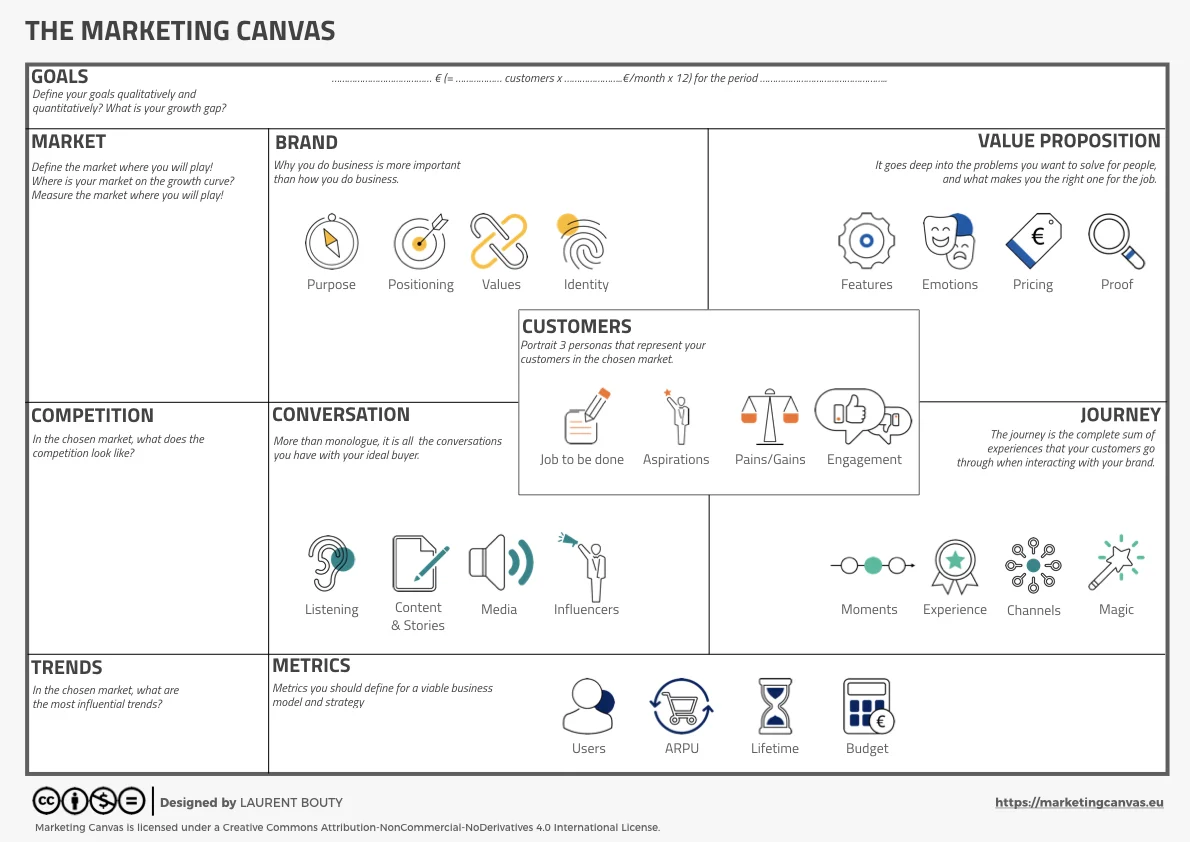
Marketing Canvas by Laurent Bouty

Marketing Canvas - Purpose
The Marketing Canvas is a tool to build a marketing strategy that consists of six categories, including PURPOSE, which identifies a brand's reason for being and contribution to the world. Purpose-driven brands are more successful in today's world as customers want to engage with brands that align with their values. By starting with the WHY and formulating a purpose-driven brand ideal, businesses can differentiate themselves and build a loyal following. TOMS Shoes and Ben & Jerry's are examples of purpose-driven brands. Having a clear purpose is a key driver of business success, according to a Deloitte survey. It is critical to identify and articulate a brand's purpose to guide its marketing strategy.
Last update: 11/11/2024
Purpose drives firms to find and create new forms of value (Jim Steingel)
In a nutshell
The Purpose sub-dimension in the Marketing Canvas delves into the core reason for a brand’s existence, beyond profit-making. A clear, meaningful purpose resonates with customers on a deeper level, guiding all aspects of the brand’s identity and actions. Purpose defines the why behind the brand, aligning its actions with values and goals that inspire both internal teams and customers.
For example, Green Clean's purpose might be “to promote healthier living through sustainable cleaning practices,” emphasizing not only clean homes but also environmental stewardship and well-being. This purpose aligns with customer values, driving trust and loyalty.
In the Marketing Canvas
The Purpose sub-dimension is foundational within the Brand category of the Marketing Canvas. It helps define the brand's core mission and guiding values, which shape everything from product offerings to customer engagement. A clear purpose enables a brand to stand out, offering not just products or services, but also a vision that inspires loyalty and advocacy.
Unlike functional goals, which focus on meeting specific customer needs, Purpose focuses on the brand’s larger role in the world and its impact on society and the environment.
What is purpose?
Purpose represents the core mission and values that drive a brand's existence. It goes beyond selling products and seeks to make a positive difference, whether through societal, environmental, or personal impact. A well-defined purpose strengthens the brand’s identity, uniting its internal team and resonating with customers who share the same values.
For example, Green Clean’s purpose might focus on environmental preservation, educating customers on sustainable practices, and providing safe, eco-friendly products. This purpose provides a shared goal that connects the brand with its customers and the broader community.
Purpose: an in-depth perspective
In today’s world, consumers are drawn to brands with a clear and compelling purpose beyond just making a profit. PURPOSE is about defining your brand’s reason for being and its contribution to the world—it goes beyond profit, which is simply a result. A clear PURPOSE allows you to articulate why you are in business.
Simon Sinek’s Golden Circle [1] illustrates that great leaders and brands always start with the WHY. Similarly, having a clear PURPOSE enables you to build a purpose-driven brand that inspires loyalty and connects with customers on a deeper level.
For example, Patagonia’s purpose is to help save the planet by offering high-quality outdoor clothing that is environmentally sustainable.

Patagonia Purpose
Jim Stengel [2], a businessman, author, and professor, proposes that having a purpose means that you have clearly identified and formulated a brand ideal for your activity that is the higher benefit your brand gives to the people. This can include eliciting joy, enabling connection, inspiring exploration, evoking pride, and impacting society broadly. Stengel argues that personal inspiration can come from the most trying times, as he shares the story of his brother Bob, a beloved physician known for his compassion and dedication towards his patients.
Eliciting Joy: Activating experiences of happiness, wonder, and limitless possibility
Enabling Connection: Enhancing the ability of people to connect with each other and the world in meaningful ways
Inspiring Exploration: Helping people explore new horizons and new experiences
Evoking Pride: Giving people increased confidence, strength, security, and vitality
Impacting Society: Affecting society broadly, from challenging the status quo to redefining categories
Your brand’s reason for being and contribution to the world. It goes beyond profit because that is a result.
In today's crowded marketplace, having a clear purpose can help your brand stand out from the competition. By identifying a purpose that resonates with your target audience, you can differentiate your brand and build a strong, loyal following. This can help you to outperform your competitors, as customers are increasingly looking for brands that align with their values and beliefs.
According to a survey conducted by Deloitte in 2014 [3], organizations having a strong sense of purpose are much more optimistic about their ability to stay ahead of industry disruptions and to outperform their competition. These organizations understand that a clear PURPOSE is a key driver of business success.
Best practices of purpose-driven companies
Sustainability: Consumers are increasingly demanding that companies take responsibility for their environmental impact. Purpose-driven brands can incorporate sustainable practices into their operations and communicate their efforts to their audience.
Social responsibility: Purpose-driven brands can also make a positive impact on society by supporting social causes, such as poverty alleviation, education, and healthcare. Consumers are more likely to support brands that demonstrate a commitment to social responsibility.
Ethical branding: Purpose-driven brands should ensure that their messaging and practices align with ethical values. This can include using fair labor practices, avoiding exploitative marketing tactics, and being transparent about their operations.
Authenticity: Consumers can easily detect when brands are engaging in purpose-driven marketing for the sake of profit. Purpose-driven marketing must be authentic and align with the brand's values and practices.
Employee engagement: Purpose-driven marketing can also be used to engage employees and build a positive company culture. Companies that prioritize their employees' well-being and work to make a positive impact on society can improve employee satisfaction and retention.
Storytelling: Purpose-driven marketing can be more effective when brands use storytelling to communicate their values and mission. Stories can create an emotional connection with the audience and help to communicate the brand's purpose in a compelling way.
Some examples
TOMS Shoes: TOMS Shoes is a great example of a purpose-driven brand. Their purpose is to improve lives by providing shoes, sight, water, and other basic needs to people in need. For every pair of shoes purchased, TOMS donates a pair to a child in need. This purpose has driven their marketing strategy, as they have built a loyal customer base who are inspired by their mission and values.
Ben & Jerry's: Another great example of a purpose-driven brand is Ben & Jerry's ice cream. Their purpose is to make the world a better place, through their commitment to social justice, environmental sustainability, and economic equality. This purpose has driven their marketing strategy, as they have built a loyal customer base who are passionate about their values and mission.
Translating purpose into action
Defining purpose is only the first step; the next is integrating it into every aspect of the brand. From marketing strategies to product design, purpose should guide decisions to create a brand experience that consistently reflects its mission.
Questions to consider:
How is your purpose clearly formulated and communicated?
Is your purpose aligned with current and future trends?
How does your purpose differentiate you from competitors?
Does your purpose inspire stakeholders and instill belief?
Is sustainability a core element of your purpose?
Statements for self-assessment
For a comprehensive evaluation of your understanding and application of the Purpose concept, rate your agreement with the following statements on a scale from -3 (completely disagree) to +3 (completely agree):
You have a well defined and clearly formulated purpose.
Your purpose is very relevant in the company's current and future context, addressing all the influencing trends..
Your purpose stands out from direct and indirect competitors.
Your main stakeholders are inspired by your purpose, they believe it.
Your company’s purpose is explicitly centered around sustainability.
Interpretation of the scores
Negative scores (-1 to -3): Negative scores indicate that you disagree or strongly disagree with the statements, suggesting that your purpose lacks clarity, relevance, or inspiration. This may result in weak brand identity, lack of stakeholder buy-in, and limited differentiation from competitors.
A score of zero (0): A neutral score reflects uncertainty or a basic understanding of the brand’s purpose. While purpose may exist, it lacks the depth and alignment needed to inspire stakeholders or differentiate the brand. Further clarity and relevance are needed to make purpose a central part of the brand’s identity.
Positive scores (+1 to +3): Positive scores indicate that you agree or strongly agree with the statements, meaning your brand’s purpose is well-defined, relevant to market trends, and able to inspire stakeholders. A strong purpose differentiates the brand and creates deeper customer and stakeholder connections, supporting long-term brand growth.
Case study: Green Clean’s purpose
Misaligned understanding (-3, -2, -1): Green Clean lacks a clear purpose, focusing solely on the functional benefits of cleaning products without a broader mission. This lack of purpose results in minimal differentiation and fails to inspire customers or stakeholders who seek brands with clear environmental or societal commitments.
Surface understanding (0): Green Clean has a general purpose related to eco-friendly cleaning but lacks the clarity or differentiation to set it apart. Although it recognizes the importance of sustainability, the purpose is not fully integrated or consistently communicated, limiting its impact on customer loyalty and brand identity.
Deep understanding (+1, +2, +3): Green Clean has a well-defined, relevant purpose centered on sustainable and healthy living. This purpose is clearly communicated across all customer and stakeholder interactions, and the brand’s commitment to environmental responsibility differentiates it from competitors. Green Clean’s purpose inspires trust, loyalty, and advocacy among customers and stakeholders who share similar values.
Conclusion
A strong, clearly defined brand purpose serves as the foundation for building lasting relationships with customers and inspiring internal alignment. By understanding and communicating a meaningful purpose, brands can go beyond transactional relationships, creating a community of loyal customers and committed team members. Integrating purpose into every aspect of the brand ensures that it resonates deeply with both employees and customers, fostering long-term engagement and advocacy.
Sources
Simon Sinek, Start with WHY, https://simonsinek.com
Jim Steingel, Purpose, https://www.jimstengel.com/purpose/
Deloitte, 2014, Culture of Purpose (pdf), https://www2.deloitte.com/content/dam/Deloitte/us/Documents/about-deloitte/us-leadership-2014-core-beliefs-culture-survey-040414.pdf
Deloitte, 2022, Unleashing Purpose Across Industries (pdf) https://www2.deloitte.com/content/dam/Deloitte/us/Documents/consulting/us-final-unleashing-purpose-across-industries.pdf
More on the Marketing Canvas

Marketing Canvas - Engagement
Explore the essence of customer engagement with the Marketing Canvas Method. Discover how to measure and improve it with tools like NPS. Drive your business growth by turning customer engagement into your success accelerator.
Last update: 30/10/2024
In a nutshell
Engagement sub-dimension in the Marketing Canvas focuses on how effectively a business can capture and sustain the interest of its customers. Engagement goes beyond simply attracting attention; it requires creating lasting connections that drive active participation, loyalty, and advocacy. By understanding the factors that influence engagement, companies can design marketing strategies that foster meaningful interactions with their audience.
For example, an eco-friendly cleaning brand like Green Clean might engage customers by sharing content on sustainable living, offering loyalty rewards, or creating a community around environmental responsibility. This level of engagement helps deepen customer relationships and build a strong brand community.
Introduction
Engagement sub-dimension, within the Customer category of the Marketing Canvas, focuses on building and maintaining a connection with customers that drives ongoing interest and involvement. This connection is based on a combination of communication, value delivery, and emotional resonance, which are key to keeping customers engaged over the long term.
While Pains and Gains look at addressing customer frustrations and needs, Engagement emphasizes the importance of continuous, active interaction, aiming to build loyalty and foster a community around the brand.
In the marketing canvas
The Marketing Canvas is a powerful tool for entrepreneurs and non-marketers to build a robust marketing strategy. It consists of six meta-dimensions, each with four sub-dimensions, for a total of 24 sub-dimensions defining your Marketing Strategy. One of these sub-dimensions is “Engagement”, which falls under the CUSTOMER category.
What is engagement?
Engagement represents the emotional and behavioral commitment a customer has with a brand. This commitment might manifest as repeat purchases, sharing positive feedback, participating in brand events, or advocating for the brand. Engaging customers requires understanding their interests, delivering consistent value, and encouraging them to participate in a shared experience with the brand.
For example, Green Clean might engage its eco-conscious customers by:
Providing resources on reducing household waste.
Offering loyalty rewards for repeat purchases of eco-friendly products.
Organizing community events focused on environmental sustainability.
Engagement is essential for building a brand community and transforming customers into advocates.
Engagement: an in-depth perspective
Engagement is about maintaining a two-way interaction between a brand and its customers. It requires businesses to understand what motivates their customers to stay connected and to respond proactively to their interests and feedback.
For example:
Active Engagement: A customer who frequently interacts with Green Clean’s social media content or attends brand-hosted events feels a personal connection with the company’s mission.
Passive Engagement: A customer may use Green Clean’s products without actively engaging with the brand’s content or events. Converting passive engagement into active participation can enhance loyalty and increase brand advocacy.
Understanding the depth and type of customer engagement helps businesses tailor their approaches to meet the specific preferences of their audience.
Tools for engagement: the NPS methodology
The NPS methodology segments customers into three groups based on their level of engagement: Promoters, Passives, and Detractors. Promoters are champions of your brand who will actively recommend your products or services. Detractors, on the other hand, may express dissatisfaction and may discourage others from interacting with your company. Passives fall in-between; they are neither actively promoting nor detracting from your brand.
The usefulness of NPS doesn't stop at categorizing customers. When you compare your NPS score with your competitors', you can gain valuable insights into your brand's standing in the market. This comparison can be achieved through an NPS study of your competitor's customer base or the broader market.

Translating engagement into action
To foster deep and lasting engagement, businesses should prioritize consistent, value-driven interactions that resonate with customer interests. Encouraging feedback, providing valuable resources, and fostering a sense of community can transform passive customers into loyal, actively engaged brand advocates.
Questions to consider:
How do your customers prefer to engage with your brand?
What types of content or interactions resonate most with your audience?
How can you create opportunities for customers to share their experiences and become advocates?
Statements for self-assessment
For a comprehensive evaluation of your understanding and application of the Engagement concept, rate your agreement with the following statements on a scale from -3 (completely disagree) to +3 (completely agree):
You have the right tools & systems at your disposal for measuring the engagement of your customer? e.g. NPS alike tools
The level of detractors amongst your customers is helping you achieve your goals.
The level of promoters amongst your customers is helping you achieve your goals.
You understand the role of sustainability in customer engagement and have aligned your strategies accordingly.
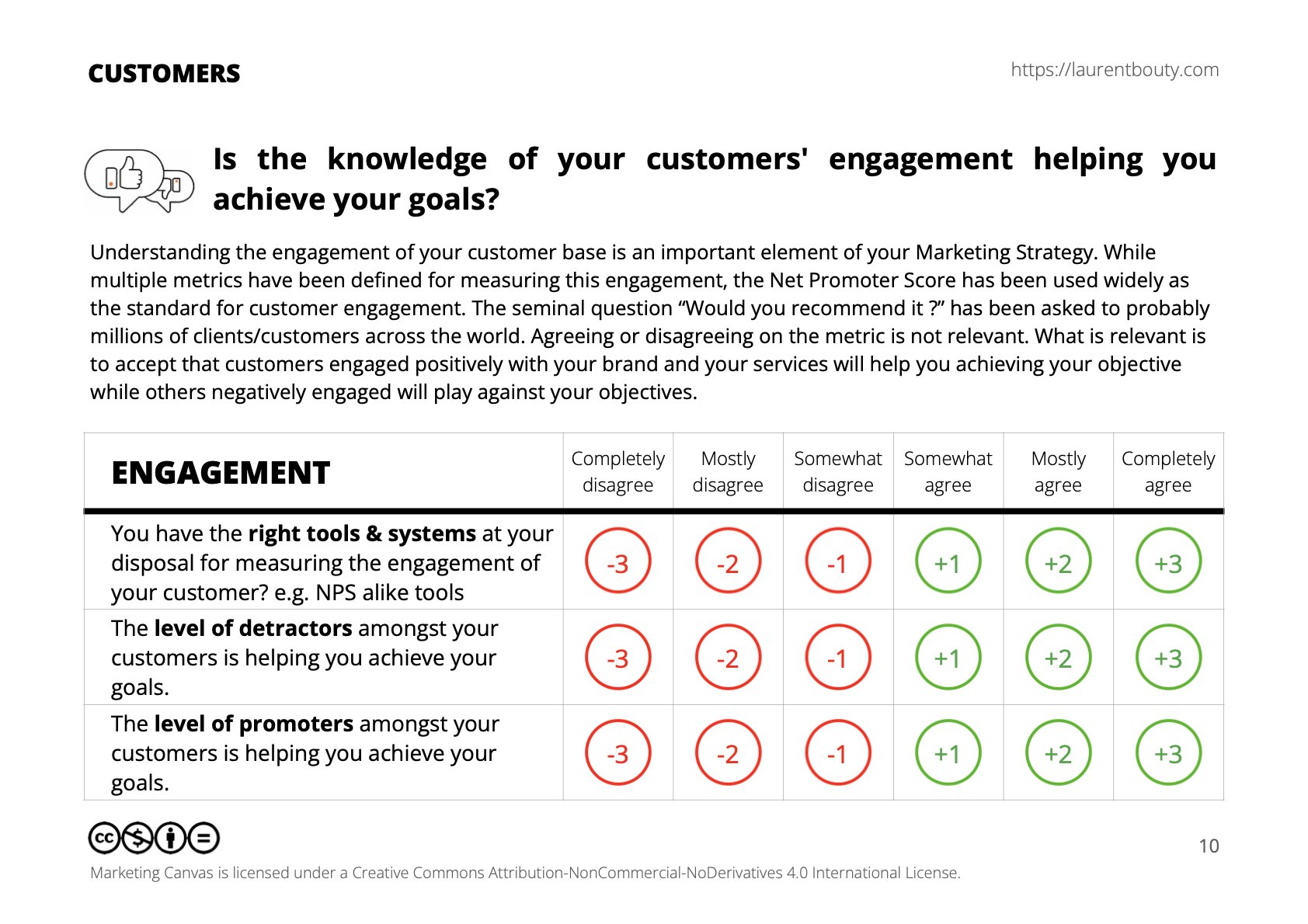
Marketing Canvas Method - Customers - Engagement by Laurent Bouty

Marketing Canvas Method - Customers - Engagement & Sustainability by Laurent Bouty
Interpretation of the scores
Negative scores (-1 to -3): Suggest significant gaps in measuring and managing engagement. Detractors may be impacting your goals negatively, and promoters may not be effectively leveraged. Engagement strategies may lack alignment with sustainability principles.
A score of zero (0): Reflects a functional but under-optimized engagement strategy. While tools and systems may exist, their use may not be systematic or effective, limiting overall impact.
Positive scores (+1 to +3): Indicate a strong engagement strategy. Detractors are addressed effectively, promoters are empowered, and engagement efforts align with sustainability, driving loyalty and advocacy.
Case study: Green Clean’s Engagement strategy
Misaligned understanding (-3, -2, -1): Green Clean lacks the tools to measure engagement and struggles to address customer dissatisfaction. Detractors outnumber promoters, harming the brand’s reputation, while sustainability efforts are absent from its engagement strategy.
Surface understanding (0): Green Clean uses basic tools like surveys but lacks a cohesive approach to managing detractors and empowering promoters. Sustainability is a peripheral concern, limiting its appeal to eco-conscious customers.
Deep understanding (+1, +2, +3): Green Clean leverages NPS and behavioral data to track engagement effectively. It proactively resolves detractor concerns, encourages promoters to share positive reviews, and integrates sustainability into its messaging, fostering strong customer relationships.
Conclusion
The Engagement sub-dimension highlights the importance of measuring and optimizing customer interactions to build loyalty, encourage advocacy, and align with sustainability. A thoughtful engagement strategy ensures that detractors are addressed, promoters are empowered, and the brand remains relevant in an eco-conscious market.
Sources
Harvard Business Review, 2003, https://hbr.org/2003/12/the-one-number-you-need-to-grow
Moving Beyond NPS, Medium, https://link.medium.com/OHO1Mz6IGY
Hubspot, The ultimate guide to your Net Promoter Score (NPS)
More on the Marketing Canvas

Marketing Canvas - Pains and Gains
The Pains and Gains sub-dimension in the Marketing Canvas focuses on identifying the constraints (pains) that block your customers from solving their problems and the delights (gains) that you can provide by addressing these constraints. By thoroughly understanding the pain points and potential gains, businesses can deliver solutions that resonate with customer needs and create a more positive overall experience.
Last update: 23/10/2024
The final edits focus on reviewing the scoring system and refining the Green Clean example.
In a nutshell
The Pains and Gains sub-dimension in the Marketing Canvas focuses on identifying the constraints (pains) that block your customers from solving their problems and the delights (gains) that you can provide by addressing these constraints. By thoroughly understanding the pain points and potential gains, businesses can deliver solutions that resonate with customer needs and create a more positive overall experience.
For example, Green Clean customers may experience pain from the use of harmful cleaning chemicals and the difficulty of finding eco-friendly options, but their gain would be the peace of mind that comes from knowing their home is clean and safe for both their family and the environment.
In the Marketing Canvas
The Marketing Canvas is a powerful tool for entrepreneurs and non-marketers to build a robust marketing strategy. It consists of six meta-dimensions, each with four sub-dimensions, for a total of 24 sub-dimensions defining your Marketing Strategy. One of these sub-dimensions is PAINS & GAINS, which falls under the CUSTOMER meta-dimension.
Introduction
The Pains and Gains sub-dimension is part of the Customer category in the Marketing Canvas. It focuses on understanding the constraints or barriers customers face when trying to accomplish their goals and the delights or positive outcomes they seek from resolving these pains. Identifying these elements helps businesses craft offerings that directly target customer frustrations while delivering satisfying results.
What is « pains & gains » ?
Pains are the blockers or frustrations that customers encounter when trying to achieve their goals. These pains can range from emotional concerns to practical obstacles that prevent progress.
Gains, on the other hand, represent the positive outcomes customers wish to achieve, including functional results (like efficiency or ease) and emotional or societal rewards (like feeling aligned with a cause or living up to their values).
For example, Green Clean customers may experience the following:
Pains: Concerns over the health risks of traditional cleaning products, or the frustration of spending too much time cleaning.
Gains: The peace of mind that comes from using eco-friendly products, or the satisfaction of contributing to a healthier environment.
Tools for Identifying Pains & Gains
Identifying your customer's Pains & Gains isn't a guessing game. Several tools and techniques can help you uncover these insights:
Customer Interviews & Surveys: Directly asking your customers about their experiences, frustrations, and delights related to your product or service is a simple yet effective way to identify Pains & Gains.
Focus Groups: This research method allows for an in-depth understanding of customer's perspectives. Hearing customers discuss their experiences can reveal Pains & Gains you might not have considered.
Customer Journey Mapping: This tool visualizes the process a customer goes through to achieve their JTBD, helping you identify potential Pains & Gains at each step.
Social Media Listening: Monitoring social media conversations about your brand or industry can yield insights into common complaints (Pains) and praises (Gains).
Feedback Analysis: Regularly review feedback from support tickets, product reviews, or any other customer touchpoint. This feedback often directly highlights Pains & Gains.
Let’s consider our example of Green Clean. Through a customer survey, Green Clean discovers that many customers are frustrated by the lack of clear instructions on how to responsibly dispose of the product packaging (a Pain). On the other hand, they find that customers appreciate the fresh, natural scent of their products (a Gain).
Translating Pains & Gains into Action
Addressing the pains that prevent customers from achieving their goals while also providing the gains they desire requires a comprehensive approach. Empathize with your customers’ experiences and remove the barriers standing in their way while ensuring your solutions offer clear benefits.
Questions to consider:
What constraints block your customers from solving their problems?
What annoys your customers during their interaction with your product or service?
What could delight your customers and turn their experience into something positive?
How can you measure your customers' engagement with sustainability goals?
Statements for self-assessment
For a comprehensive evaluation of your understanding and application of the Pains and Gains concept, rate your agreement with the following statements on a scale from -3 (completely disagree) to +3 (completely agree):
You have clearly identified constraints blocking your customer from solving their problem and feel comfortable addressing them.
You have clearly identified factors that annoy your customer during the job map and feel comfortable addressing them.
You have clearly identified factors that could delight your customer during the job map and feel comfortable addressing them.
Your identification method of factors that annoys or could delight your customers does explicitly assess sustainability. (NEW)
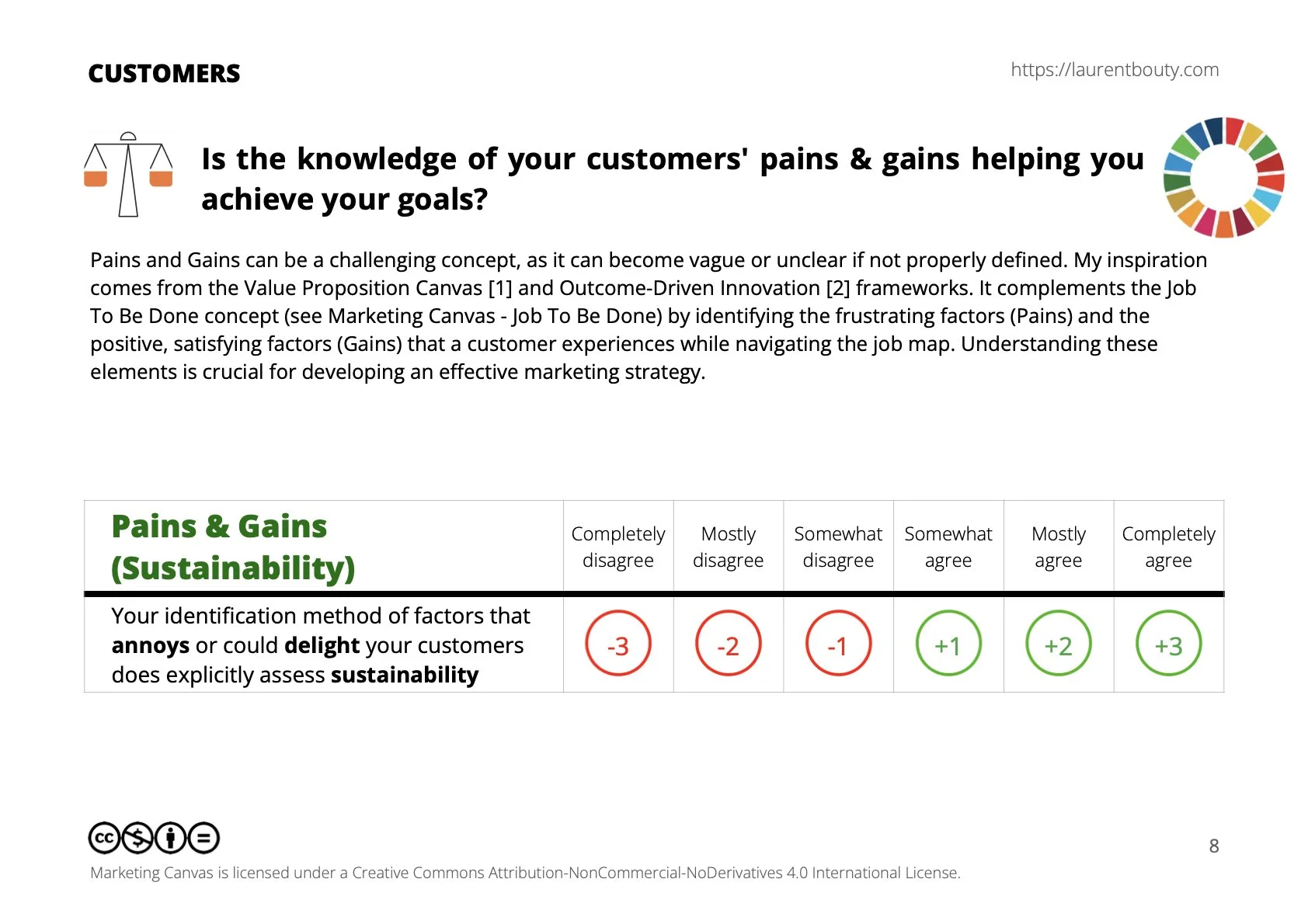
Interpretation of the scores
Negative scores (-1 to -3): A negative score suggests a disconnection in your understanding of the constraints or annoyances your customers face. This indicates a lack of insight into the barriers blocking their progress or the gains they seek, which may lead to ineffective solutions.
A score of zero (0): A neutral score reflects uncertainty or a basic awareness of your customers' pains and gains. While you may recognize that constraints and delights exist, you are not fully addressing them. More research is needed to develop a complete understanding.
Positive scores (+1 to +3): Positive scores indicate a clear and thorough understanding of your customers' constraints and delights. You are confident in identifying and addressing the key pain points and gains, and you have the tools in place to measure customer engagement, especially in areas like sustainability.
Case study: Green Clean’s pains and gains
Misaligned understanding (-3, -2, -1): Green Clean fails to recognize the core constraints or frustrations their customers experience, such as concerns over the environmental impact of cleaning products. As a result, their services fall short of addressing the fundamental needs of their eco-conscious customers.
Surface understanding (0): Green Clean has a partial understanding of customer pain points. While they acknowledge that customers want safer products, they do not fully grasp the extent of the annoyance or frustration customers feel about transparency in ingredients or sustainability claims. This limits their ability to fully delight their customers.
Deep understanding (+1, +2, +3): Green Clean deeply understands both the constraints their customers face and the gains they seek. They recognize that their customers are concerned about using harmful chemicals and value transparency, eco-friendliness, and health. By addressing these constraints and providing clear benefits like peace of mind and environmental contribution, Green Clean fosters a loyal customer base aligned with their values.
Conclusion
Identifying and addressing the pains and gains of your customers is essential for delivering products and services that resonate with them on a deeper level. By focusing on removing the constraints that block progress and delivering meaningful delights, you can create long-lasting customer relationships and positive outcomes that extend beyond functional benefits.
Source
Value Proposition Canvas by Strategyzer, https://www.strategyzer.com/canvas/value-proposition-canvas
Outcome-Driven Innovation, Medium, https://jobs-to-be-done.com/outcome-driven-innovation-odi-is-jobs-to-be-done-theory-in-practice-2944c6ebc40e
More on the Marketing Canvas

Marketing Canvas - Aspirations
Aspirations in the Marketing Canvas help businesses uncover the deeper, often emotional and social goals that customers strive to fulfill through their product or service. Aspirations move beyond functional needs and focus on the personal growth, societal impact, and environmental contribution that customers seek. Identifying these aspirations enables businesses to create stronger emotional connections and long-term relationships with their audience.
Last edit: 20/10/2024: The final edits focus on reviewing the scoring system and refining the Green Clean example.
In a nutshell
Aspirations in the Marketing Canvas help businesses uncover the deeper, often emotional and social goals that customers strive to fulfill through their product or service. Aspirations move beyond functional needs and focus on the personal growth, societal impact, and environmental contribution that customers seek. Identifying these aspirations enables businesses to create stronger emotional connections and long-term relationships with their audience.
For example, Green Clean customers likely aspire to more than just maintaining a clean home. They may also want to live a healthier life, reduce their environmental footprint, and contribute positively to their community. By understanding these aspirations, Green Clean can better align its marketing and service strategies with the values that resonate most with its customers.
In the Marketing Canvas
The Marketing Canvas is a powerful tool for entrepreneurs and non-marketers to build a robust marketing strategy. It consists of six meta-dimensions, each with four sub-dimensions, for a total of 24 sub-dimensions defining your Marketing Strategy. One of these sub-dimensions is ASPIRATIONS, which falls under the CUSTOMER meta-dimension.
Introduction
The Aspirations sub-dimension is part of the Customer category within the Marketing Canvas. It focuses on understanding the personal, societal, and environmental aspirations that customers have when interacting with a product or service. These aspirations often reflect the desire to improve themselves, their community, or the world around them.
While Jobs To Be Done helps identify what customers aim to accomplish in the short term, Aspirations delve into the long-term goals and ideal visions that shape their decisions.
The importance of defining Marketing aspirations
Aspirations are the personal dreams, social causes, and environmental goals that drive customers' choices. They represent the deeper values and long-term visions customers hold for themselves and the world. Unlike functional needs, aspirations are often intangible but highly influential in shaping behavior.
For example, Green Clean’s customers may aspire to:
Improve their health by maintaining a safe, non-toxic home environment.
Support environmental sustainability by reducing waste and using eco-friendly products.
Be role models in their community by setting a positive example of environmental responsibility.
These aspirations connect to broader societal and environmental movements, giving brands like Green Clean a pathway to build meaningful connections with their customers.
Aspirations: an in-depth perspective
Customers often seek products or services that align with their broader goals for personal growth, societal impact, or environmental contribution. They look for solutions that help them achieve not only immediate functional needs but also their vision for a better self or a better world.
For example, customers using Green Clean might aspire to:
Live more sustainably by choosing eco-friendly products that align with their environmental values.
Contribute positively to society by promoting sustainability and setting an example for others, reflecting their societal values.
Improve their personal well-being by creating a healthy, toxin-free living space, aligned with their personal values.
Understanding these deeper aspirations helps businesses tailor their marketing and offerings to align with the customer’s long-term goals.
How the Marketing Canvas aligns aspirations and strategy
To effectively connect with customer aspirations, businesses need to focus on the emotional, societal, and environmental goals of their target audience. Understanding aspirations allows companies to align their strategies with their customers' vision for the future, building loyalty and fostering deeper relationships.
Questions to consider:
What personal aspirations do your customers have that align with their values?
How does your product or service help them contribute to society or the environment?
How can your marketing reflect their vision for personal growth or impact on the world?

Aspirationals are defined by their love of shopping, desire for responsible consumption, and their trust in brands to act in the best interest of society [1]
Examples
Example 1: Patagonia
Patagonia, the outdoor clothing and gear company, has an audience whose aspirations go beyond just having quality outdoor clothing. Their customers aspire to protect the environment, which is why Patagonia's commitment to sustainability, ethical sourcing, and environmental activism resonates with them. Patagonia's alignment with these aspirations has helped them cultivate a highly loyal customer base.
Example 2: Tesla
Tesla's customers are not just buying a car; they are buying into a vision of a sustainable, technologically advanced future. Customers' aspirations here include reducing their carbon footprint, being part of cutting-edge technology, and the status associated with owning a Tesla. Elon Musk understood these aspirations and built Tesla's brand around them.
Example 3: Dove
Dove, a personal care brand, understood that their customers aspired to real, authentic beauty rather than the unattainable standards often portrayed in the media. Their "Real Beauty" campaign resonated deeply with customers worldwide, helping the brand build a strong emotional connection with its audience.
Statements for self-assessment
For a comprehensive evaluation of your understanding and application of the Aspirations concept, rate your agreement with the following statements on a scale from -3 (completely disagree) to +3 (completely agree):
You have clearly identified consumers' aspirations for improving themselves (personal values).
You have clearly identified consumers' aspirations for improving the world around them (societal values).
You have clearly identified consumers' aspirations for improving the world around them (environmental values).
Interpretation of the scores
Negative scores (-1 to -3): A negative score suggests that you disagree or strongly disagree with the statement, meaning you lack a solid understanding of your customers' aspirations, whether they are personal, societal, or environmental. This could result in your marketing and offerings being out of sync with the emotional and values-driven goals of your audience, weakening brand loyalty and connection.
A score of zero (0): A neutral score reflects uncertainty or only a surface-level understanding of your customers’ aspirations. You may recognize that aspirations exist but do not fully grasp how these emotional, societal, or environmental goals influence customer behavior. Further exploration is needed to deepen your understanding of their long-term aspirations.
Positive scores (+1 to +3): Positive scores indicate agreement with the statements, meaning you have a strong understanding of your customers' personal, societal, and environmental aspirations. You recognize how these aspirations shape decision-making and can align your product and marketing strategies with their broader goals. This deeper understanding helps you build a stronger emotional connection with your customers and reinforce their loyalty to your brand.
Case study: Green Clean's aspirations
Misaligned understanding (-3, -2, -1): Green Clean focuses only on functional needs (cleaning services) and does not recognize its customers' aspirations for personal, societal, or environmental improvement. By ignoring these deeper aspirations, Green Clean risks losing customers who value sustainability and seek brands that reflect their broader goals for positive change.
Surface understanding (0): Green Clean acknowledges that its customers have aspirations, such as wanting eco-friendly products, but it does not fully understand the emotional significance behind these aspirations. The company might see environmental responsibility as a secondary factor, without realizing how central it is to the customer's personal, societal, and environmental values. This limits their ability to connect deeply with their customers.
Deep understanding (+1, +2, +3): Green Clean fully understands its customers' aspirations for personal well-being, societal contribution, and environmental responsibility. The company aligns its services and marketing strategies with these aspirations by offering eco-friendly solutions, promoting sustainability, and helping customers achieve their vision for a healthier, more sustainable lifestyle. This deep understanding strengthens the emotional bond between Green Clean and its customers, making the brand a trusted partner in their long-term journey.
Sources
https://blog.globalwebindex.com/trends/why-aspirational-consumers-matter/
Report: https://globescan.com/five-human-aspirations-and-the-future-of-brands/
"Start with Why: How Great Leaders Inspire Everyone to Take Action" by Simon Sinek
"Building a StoryBrand: Clarify Your Message So Customers Will Listen" by Donald Miller
More on the Marketing Canvas
Hack: Marketing Canvas and Triple Bottom Line
As Marketers, we are not excused for being complaisant with the world around us. It should have been always the case but today the situation is so critical that we need to take action.
REVISIT STEP 2 - SET YOUR GOAL
The original approach at Step 2 was profit oriented. Indeed, during this step, we recommend to set a financial goal (revenue) before starting step 3 which is the assessment.
The triple bottom line approach (wikipedia) as proposed by John Elkington consists of extending the bottom line concept with sustainable elements. In addition to Profit, Elkington proposed to add Planet and People. The Marketing Canvas Method can be easily hacked for integrating the Triple Bottom Line concept by simply changing the way Goals are set during step 2.
HOW?
At Step 2, you can define goal for Profit (original approach) but also goal for Planet and People. It is not fully clear for me whether a standard framework exists with clear KPIs linking Marketing Strategy and Planet/People elements. You can chose the goals that would specifically work for you when discussing Planet and People topics. Based on a very quick desk research, I identified few topics that could be used for defining objectives for Planet and People. It would be interesting to have your point of views and make this list more robust. Don’t hesitate to comment this post.
LIST OF GOALS FOR PEOPLE AND PLANET
Energy Management: How could you reduce your energy consumption and use more renewable energy when executing your marketing strategy? Goal?
Resource Management: How could you make use of resources for your marketing strategy in such a way that our next generation or in future there are no effects on the resource? Goal?
Waste Management: How could you collect, transport, process or dispose of, manage and monitor various waste materials generated by your marketing strategy? Goal?
Employee Welfare: How could you reinforce employee welfare when executing your marketing strategy? Goal?
Fair Trade: How could you reinforce fairness in your marketing strategy through dialogue, transparency and respect, that seeks greater equity in international trade? Goal?
Cause Marketing: How can you better the society while executing your marketing strategy? Goal?
PROCESS
When you have defined these goals (e.g. CO2), you can apply the Marketing Canvas Method for assessing your current situation (STEP 3). Let’s take 2 examples from the 24 dimensions.:
JOB TO BE DONE (CUSTOMERS): Is the knowledge of your customers’ job to be done helping you from achieving your goals?
FEATURES (VALUE PROPOSITION): Are the features of your value proposition helping you achieve your goals?
By asking these questions, you have interesting discussions about your current ability to achieve these goals (like CO2) or not (Brake or Accelerator).
NEW TEMPLATE
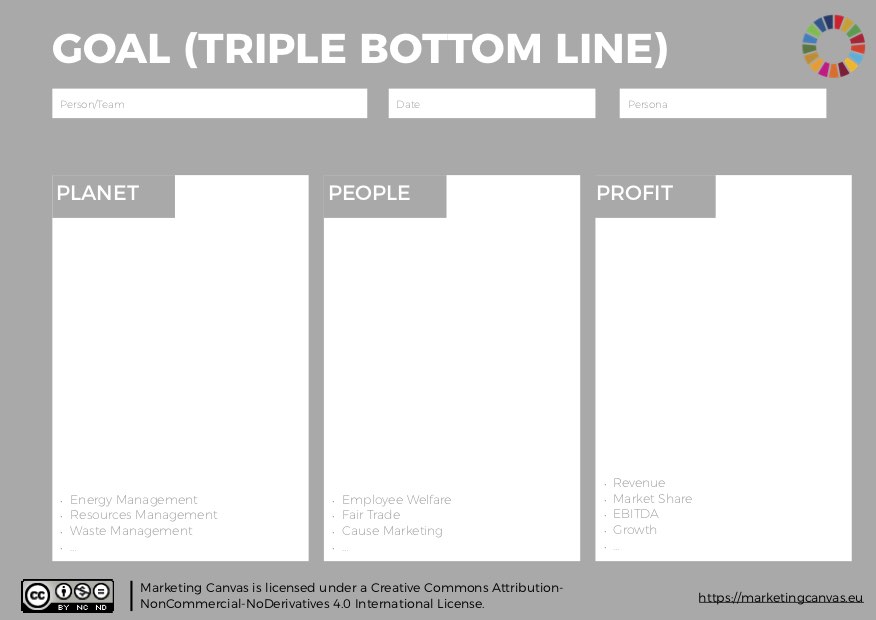
Marketing Canvas Method and Triple Bottom Line
Marketing Canvas - Market and Economic Value
Economic value can be described as a measure of the benefit from a good or service to an economic agent. It is typically measured in units of currency. Another interpretation is that economic value represents the maximum amount of money an agent is willing and able to pay for a good or service.
Economic value: what is it?
Economic value can be described as a measure of the benefit from a good or service to an economic agent. It is typically measured in units of currency. Another interpretation is that economic value represents the maximum amount of money an agent is willing and able to pay for a good or service. The economic value should not be confused with market value, which is the minimum amount a consumer will pay for a good or service. Thus, economic value is often greater than the market value. (Investopedia)
So in simple words, this notion of economic value will help you defining your price and indirectly your benefit. It is a subjective notion (except for past economists like Karl Marx) as it contains tangible and intangible value of the product. A coffee in beans as less value than drinking a coffee with your partner on a romantic place. Nespresso created more economic value by creating a new experience for coffee lover at home.
5 different economic values

Before deciding on your own marketing strategy, you should understand what the market is currently proposing to buyers! Based on the work done by Pine and Gilmore (HBR, The experience economy), we can identified 5 different types of offer:
Commodity: Buyers cannot differentiate between offers. It is often referred as commodity. The cheapest takes it all. I buy it because I need this (benzine, sugar, flour, …).
Product: Buyers have multiple offers that differentiate themselves on features (more of that, less of this, …) that can even create emotional differences for the buyer (make me younger, smarter, …). This is what we where and still use to see for fast moving consumer goods (chocolate, drinks, …) even if some brands are trying to elevate their product to experience by organising multiple stages (think about RedBull). I buy it because i use it.
Service: Buyers receive a service in addition to the product they bought. Competitors differentiate themselves with these services (after-sales, analytics, …). I buy it because I need it and they help me using it.
Experience: Buyers are going through stages which are personal and potentially sensational. Products and services becomes commodities (we can find similar offer everywhere). Competitors differentiate themselves with experience (before, during and after purchase). Most of the companies are trying to build experience but few are really successful to achieve long term sustainable differentiation on this. I enjoy buying and using it and it is the reason why I bought it.
Transformational: Experiences are elevated from mere enjoyment to actual personal transformation. Buyers are looking to be different after the purchase and use of it. I am not buying running shoes, I become a runner! I buy it because it helps me to become someone different.
What does it mean for the Marketing Canvas Method?
When you analyse the context, just define where the market is today. The higher the market is on this curve, the higher the economic value is. When looking at your context (please use Market cards):
Identify where your market is on the curve (1-5)
Identify if one competitor is trying to move upward (game changer, challenger)?
Identify where the market is on the product life cycle curve (Introduction to Decline)?
Curious
More on the method here
Buy our cards and discover our templates for your workshop here

Le Marché dans le Marketing Canvas
Dans l’enthousiasme de travailler sur sa stratégie marketing, on se précipite souvent et oublie l’importance de ce que je considère comme la première étape: la compréhension du marché dans lequel nous allons opérer (startup) ou nous opérons déjà (entreprise existante). Il y a 3 questions importantes à se poser lorsqu’on analyse le marché. C’est questions sont: …

Marketing Strategy Design Cards
Dans l’enthousiasme de travailler sur sa stratégie marketing, on se précipite souvent et oublie l’importance de ce que je considère comme la première étape: la compréhension du marché dans lequel nous allons opérer (startup) ou nous opérons déjà (entreprise existante).
Les questions qu’il faut se poser sont les suivantes:
Comment définir le marché?
Comment mesurer le marché?
Comment qualifier le marché?
Comment définir le marché?
Bien que la question puisse paraître simple et évidente, elle ne l’est pas.
Petit exemple: dans quel marché TESLA a-t-il décidé de se lancer avec son modèle S? La majorité des voitures électriques avant TESLA se situait dans un marché d’acheteurs urbains avec des petits déplacements. TESLA a privilégié le marché du luxe et plus particulièrement le marché des voitures sportives luxueuses dont la référence est … Porsche. En choisissant le marché, certaines constantes sont fixées telles que: le prix moyen (100k€ pour une voiture de sport de luxe) ou certaines caractéristiques clés du marché (performance, design, vitesse, …).
Comme illustré dans mon exemple, le marché conditionne certaines hypothèses de départ. On peut bien sur être un game changer et redéfinir ces règles toutefois elles restent pour l’acheteur un cadre de référence qu’il va utilisé pour comparer votre produit (lorsque vous louez une chambre chez AirbnB, vous comparez votre achat à une location dans un hotel, un gite ou un bed & breakfast).
Bien qu’il existe de nombreuses définitions d’un marché, celle que je préfère vient de Bill Aulet [1]. Il définit le marché en 3 règles:
Les clients dans le marché achètent tous des produits similaires.
Les clients dans le marché ont le même cycle d’achat et s’attendent à ce que les produits fournissent de la valeur d’une façon similaire.
Il y a du bouche à oreille entre les clients d’un même marché.
La première question est donc: Dans quel marché comptez-vous opérer?
Comment mesurer le marché?
Après avoir défini le marché dans le lequel vous allez opérer, il faut essayer de le mesurer afin de définir son potentiel et votre ambition. Une méthode provenant encore de l’entrepreneuriat s’appelle le TAM (pour Total Available Market), SAM (pour Serviceable Available Market) et SOM (Serviceable Obtainable Market) .
Derrière ces acronymes, ce cache des concepts assez simples:
Le TAM correspond au marché total possible. Si on prend l’exemple de Airbnb cela correspondrait à toutes les locations de chambres dans le monde pour une année.
le SAM correspond à la partie du marché où vous êtes actif (ou allez être actif si vous lancer votre activité). Le passage du TAM au SAM dépend de vos critères: géographique (là où vous êtes actifs), type de produit (ioS ou Android, premium ou cost), ...
le SOM est votre objectif en part de marché. Combien de % du SAM voulez vous obtenir?
la seconde question est donc: quelle est la taille du marché ?
Comment qualifier le marché?
Finalement, il vous reste à qualifier le marché. Qu’est ce que cela veut dire? Le marché a une vie et est dynamique comme un organisme vivant (il apparaît, grandit, se stabilise puis décline). Si vous ne comprenez pas l’etat du marché SAM dans lequel vous entrez, vous risquez de mal définir votre stratégie commerciale (le volume des ventes diffère entre chaque état).

Source: Wikipedia
La description ci-dessous provient de Wikipedia (https://fr.wikipedia.org/wiki/Cycle_de_vie_(commerce))
Stade de lancement: Introduction du produit sur le marché
coûts élevés de production et de développement
faible volume de vente
pertes pour l'entreprise
prix élevés
Stade de croissance
coûts réduits par les économies d'échelles
croissance importante des volumes de vente
profits croissants pour l'entreprise et marges élevées
prix assurant une large part de marché
début de simplification du marché: les grandes entreprises achètent les PME innovantes
Stade de maturité
marges réduites, disparition des compétiteurs incapables d'économies d'échelle (absorption, retrait, faillite, oligopoles, stabilisation des parts de marché)coûts de production faibles, mais coûts de promotion commerciale et de services à la clientèle élevés
maximum des volumes de vente
forte sensibilité à la conjoncture
profits encore très importants mais stagnants
fortes segmentations : les gammes de produits se sont diversifiées pour répondre à une demande exigeante
tendance à la baisse des prix en raison de la concurrence
anticipation de produits de remplacement par la recherche et le développement
Stade de déclin
diminution des ventes
diminution des profits
diminution des prix
apparition de produits de remplacement
La dernière question est: quel est l’état du marché ?
Conclusion
En répondant à ces 3 questions clairement, vous aurez plus facile lorsque vous définirez votre stratégie commerciale. L’étape suivante dans l’exercice du Marketing Canvas est de définir la compétition.
Référence
Bill Aulet, Disciplined Entrepreneurship : 24 Steps to a Successful Startup, John Wiley & Sons (30 août 2013)
Cycle de vie, Wikipedia

How to connect your ambition with your operations
I had an interesting discussion with @nicolasdebray (Semetis, Academic Director) about the Ambition in the Marketing Canvas Process…
I had an interesting discussion with @nicolasdebray (Semetis, Academic Director) about the Ambition in the Marketing Canvas Process. He made the following comment:
Having a high-level financial objective is definitely important but often people in the field have difficulties to link this high-level objective (generate a revenue growth of 5% thus 1M€ more) with what they could do!
There are multiple ways to potentially connect this ambition with your operations: (1) either you attract more users, (2) either you retain more users; they stay longer, (3) either they buy more often (ARPU) or (4) they buy more products and/or services. This is connected with the notion of Customer Lifetime Value (CLV).
The discussion you should have in the Marketing Canvas will help you to make this connection. How? By understanding which driver(s) could help you.
Q1 - Is your MARKET helping you to achieve your ambition?
For answering this question, we can refer to the product-lifecycle approach using the 4 stages definition of a market:
Market Development or Introduction: Personas are not yet used to buy this kind of product or service. They need a lot of explanations and trust is not installed on the market, yet the volume of potential buyers is huge as the market hasn’t been addressed. It is clearly an Accelerator because the market orientation is positive (growth of sales but not in terms of profit).
Growth: Personas are getting used to buy this kind of products/services. They now understand the benefits of the products/services and trust providers. There is still a huge volume of buyers available on the market and traction is high. It is definitely an Accelerator because the market orientation is positive (growth of sales and profit).
Maturity: This often means that your market will be saturated and you may find that you need to change your marketing tactics to prolong the life cycle of your product. It is a Brake as most of the market has already bought a solution to their problem. Sales are flat.
Decline: During the end stages of your product, you will see declining sales and profits. This can be fuelled by changes in consumer preferences, technological advances and alternatives on the market. It is a Brake as the market is declining.
Q2 - Is your Customer Acquisition helping you to achieve your ambition?
For answering this question, you can use 2 important concepts: Customer Acquisition Rate (CAR) and Cost of Customer Acquisition (COCA).
If Customer Acquisition Rate is below market average, then it is a Brake because it takes more time to get new customers than your competitors;
If Customer Acquisition Rate is above market average, then it is an Accelerator because you attract faster new customers than your competitors.
If COCA is above market average it is a Brake.
If COCA is below market average it is an Accelerator.
CAR has the priority on COCA and therefore the final status for User is defined by CAR; COCA is telling how effective you are.
Q3 - Is your users’ ARPU helping you to achieve your ambition?
For answering this question, you need to understand if you have an optimisation strategy in place for your ARPU:
If your ARPU is below market average, it means that you are either attracting low value customers and/or not fully stimulating existing customers. It is therefore a Brake.
If your ARPU is above market average, it means that you are either attracting high value customers and/or fully stimulating existing customers (recurrent revenue, up sell, cross sell). It is therefore an Accelerator.
Q4 - Is your users’ Lifetime helping you to achieve your ambition?
For answering this questionnaires, you need to understanding of you have a retention strategy in Place for your users:
If the lifetime is below market average, it means that you are not capable to keep your existing users as long as your competitors. It is a Brake.
If the lifetime is above market average, it means that you are capable to keep your existing users longer than your competitors. It is an Accelerator.
A second concept worth looking is the Cost of Customer Retention:
If COCR is above market average it is a Brake.
If COCR is below market average it is an Accelerator.
Conclusion
At the end of the exercise, you will have a better view on how you will achieve your ambition. It will also help your team in charge of the operation to understand what they have to do:
And/Or Getting more clients on board
And/Or Developing and/or selling more products to their existing client base
And/Or Keeping their clients longer (satisfaction, retention)
Definition
Customer Acquisition Rate (CAR)=Number of customer acquired/Length of time period.
Cost of Customer Acquisition (COCA)=All the costs spent on acquiring more customers (marketing expenses) by the number of customers acquired in the period the money was spent.

Marketing Canvas - Ambition
Dans le cadre d'une Marketing canvas, il est important de démarrer le processus à partir d'une question claire et simple basée sur l'ambition que vous souhaitez atteindre à l'aide de votre stratégie marketing. Une vidéo simple pour expliquer ce concept.
Dans le cadre d'une Marketing canvas, il est important de démarrer le processus à partir d'une question claire et simple basée sur l'ambition que vous souhaitez atteindre à l'aide de votre stratégie marketing. Une vidéo simple pour expliquer ce concept.

Marketing Strategy for Millennials from Marketing Cloud
Interesting Infographic from Marketing Cloud proposing 5 steps to creating your Marketing Strategy for Millennials. As you might have noticed, I am advocating the use of the Marketing Canvas for designing your Marketing Strategy. Let's check whether these steps fit into the process?
Interesting Infographic from Marketing Cloud proposing 5 steps to creating your Marketing Strategy for Millennials. As you might have noticed, I am advocating the use of the Marketing Canvas for designing your Marketing Strategy. Let's check whether these steps fit into the process?
- Step 1 is definitely a no-brainer. Data and customer knowledge will help you to be very specific when discussing canvas. Dimensions like Humans (if you want to uncover key insights and customer preferences), Journey (if you want to design great customer experience), Value proposition (if you want to design the most relevant offers) and conversation (if you want to be at the right place, right time with the right subject) will help you.
- Step 2 is clearly identified in the canvas: Channel (in Journey), Content & Stories (Conversation), Media (Shared and Earned) and finally the global topic of conversations.
- Step 3 is also covered in Engagement (word of mouth), Influencers (Conversations), Proofs (Value Proposition) and Moment of Truth (Journey)
- Step 4 mentions that technology is key for millennials. It is true and it will influence preferred Channels (Journey), Media (Conversation) and Features (Value Proposition) but don't forget that Job To Be Done is why they engage with you and what problem they are trying to solve.
- Step 5 is all about your Purpose (Brand) and Listening (conversation). I am not a fan about education as I believe we don't educate customers but we engage them.
The conclusion is that the Marketing Canvas fits perfectly with these steps and can be applied for Millennials. Finally, I would like to mention that in the Budget dimensions, they are 2 important topics (capabilities and people) where you should invest for having the required tools and skills in your company if you want to do all of this.

More on Marketing Cloud: https://www.salesforce.com/products/marketing-cloud/best-practices/millenial-marketing-strategy/
Marketing Canvas, some tips about the process
Canvas works really well if:
- Start with a clear ambition, S.M.A.R.T. and linked with the finance. One of the usual mistake when doing a marketing strategy exercise is to not properly link the marketing actions with the financial consequences. In the Marketing Canvas exercise, we genuinely start from the financial ambition for addressing this issue. This ambition is about growth and thus the canvas is about growth hacking your marketing strategy.
- Start with a clear persona representing a customer cluster sharing the same Job To Be Done (problem to be solved by your offer). It could happen that you can't achieve your ambition with your current persona/segment (in classical strategy, it corresponds to a cash cow or a future dog). If it is the case you should consider another segment with another job to be done.
- Assess the current situation of your marketing mix by asking the 28 questions as defined in the canvas. Define clearly if each dimension TODAY is helping you to achieve your ambition (it is an accelerator) or is not (then we define this dimension as a brake). Do this exercise in team as it will create a shared understanding of the situation and support your answers with facts.
- Backward thinking is a very powerful way of finding solutions to any problem. In this process, try to visualise/imagine how dimension(s) defined as BRAKES would look like if they would help you with your ambition. What is different? Could you describe it? Does it really help with your ambition? If yes, then you have one idea of potential solutions. Find as many ideas as possible.
- Having generated plenty of ideas (some could even be yellow ideas aka impossible ideas), you should prioritise it in order to finalise your preferred vision of this future where your ambition is achieved. What are the actions you should do to transform this future into a reality: Start Doing, Stop Doing, Do More, Do Less, Simplify, Magnify? Brainstorm as a team and list all actions.
You now have identified all actions for building your future but you have to organise it into a comprehensive and feasible roadmap. Some actions are low hanging fruits while others require more time and effort. One way to do this is to use these 2 criteria: contribution to the ambition and effort. Congratulations, you now have a roadmap and a marketing strategy.