
BLOG
A collection of article and ideas that help Smart Marketers to become Smarter

Mastering Market Definition and Key Benefits for Competitive Positioning
Defining your market and identifying the key benefits that matter to customers are foundational steps in building a competitive strategy. Knowing where your product or service fits ensures clarity about your audience and competitors, while understanding customer benefits—both functional and emotional—reveals opportunities for differentiation.
Where do you play, and what is your market situation? (focusing on M1 and M2)
Understanding your market is a critical first step in defining your business strategy. It involves answering two key questions:
What is your market? (Market Definition - M1)
What benefits matter most in your market? (Key Expected Benefits - M2)
This article explores these questions in detail and provides actionable insights to help you identify and leverage competitive positioning options.
What is your market? (market definition - M1)
Defining your market means understanding the boundaries of where you operate, who your customers are, and the nature of the competition. This is not just about naming an industry—it’s about identifying a specific space where your product or service plays a role.
Key Considerations:
Who are your target customers? Define their demographics, behaviors, and preferences.
What needs do you fulfill? Clearly articulate the problem your product or service solves.
What is the scope of your market? Determine the geographical and category boundaries that frame your competition.
Example: Eco-Friendly Cleaning Products If you’re in the eco-friendly cleaning products market, your target customers might be environmentally conscious homeowners. The need you fulfill is effective, sustainable home cleaning. Your market scope might include regional markets with high environmental awareness and disposable income.
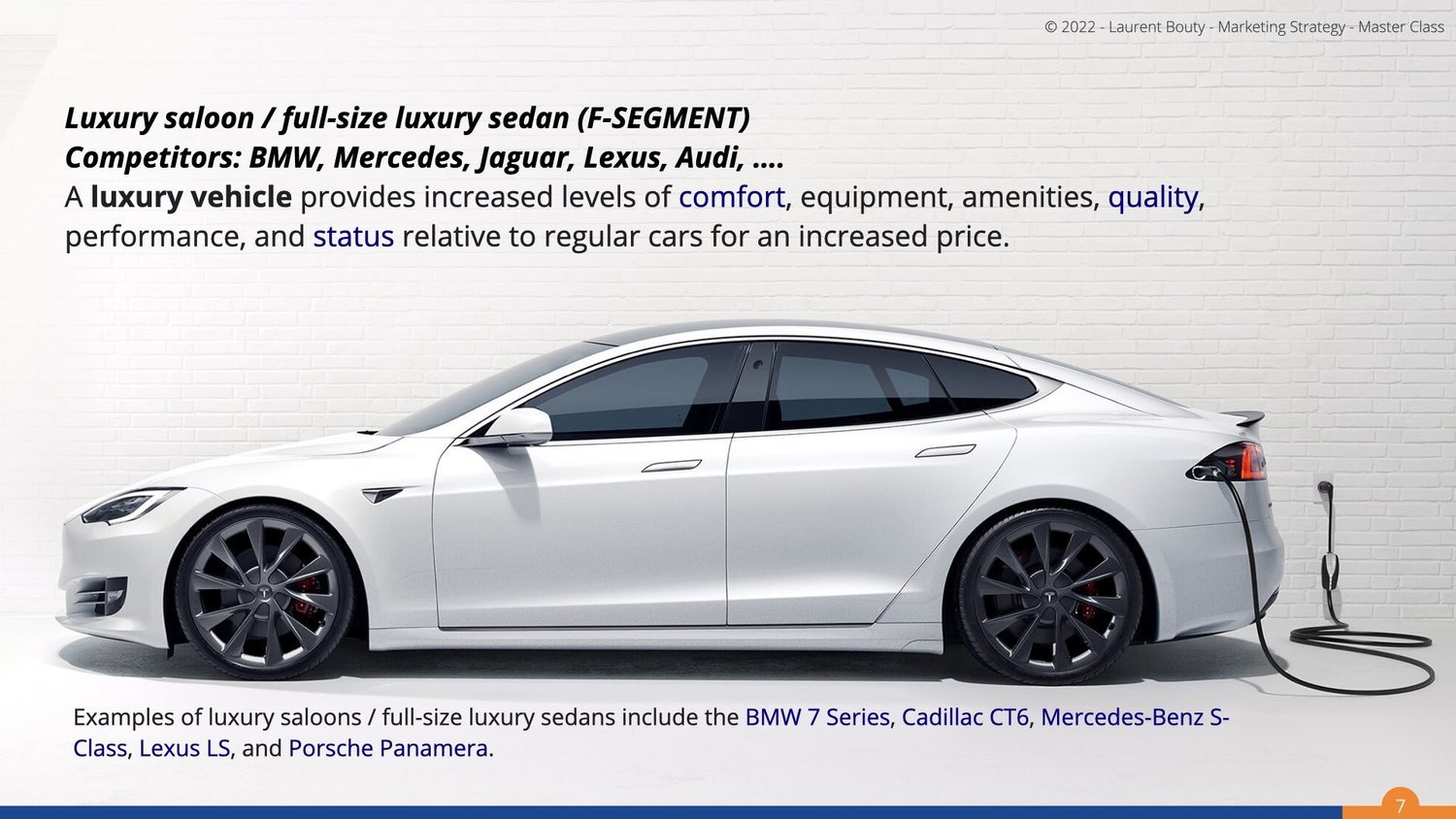
Example: Tesla Model S Consider the Tesla Model S. It belongs to the broad market of cars, but we can further narrow this down into sub-markets. A common mistake is to categorize the Tesla Model S under the market of electric cars. However, being electric is a feature, not a market. Although both a Toyota Prius and a Tesla Model S are electric cars (one being a hybrid), they do not belong to the same market. The Tesla Model S fits into the Luxury E automobile or Executive/Mid-size luxury market, which also includes vehicles like the Porsche Taycan or the BMW 5 series.
Watch More: Tesla Market Positioning
As we delve deeper, we'll discover that once we have identified the market where our value proposition will compete, it's crucial to understand and follow a set of rules to shape our commercial strategy. After identifying your company's competitive market, we need to delve into the specifics. Just like a painter cannot create art without understanding their canvas, a marketer cannot formulate a strategy without understanding their market.
What benefits matter most in your market? (key expected benefits - M2)
Every market revolves around a set of benefits that customers prioritize. These benefits can be divided into two categories:
Functional Benefits: Practical and measurable advantages your product or service provides.
Emotional Benefits: Intangible, psychological rewards customers experience.
These benefits form the basis for competitive positioning, as each player in the market may emphasize different combinations of these elements.
Example: Eco-Friendly Cleaning Products Market
Effectiveness (Functional): Products that clean thoroughly without compromising on eco-friendliness.
Health and Safety (Functional): Non-toxic ingredients that are safe for families and pets.
Convenience (Functional): Easy-to-use packaging and availability in local stores or online.
Environmental Impact (Emotional): Customers feel good about reducing their carbon footprint and supporting sustainability.
Brand Trust (Emotional): A sense of confidence in the brand’s authenticity and values.
Example: Tesla Model S
Performance (Functional): Exceptional acceleration and range compared to competitors.
Innovation (Functional): Cutting-edge technology, including autonomous driving capabilities.
Sustainability (Emotional): Pride in contributing to reducing carbon emissions.
Prestige (Emotional): Association with a high-status, forward-thinking brand.
Ownership Experience (Emotional): Access to a seamless, premium experience from purchase to service.
Each of these benefits represents an opportunity for differentiation. For example, Tesla emphasizes performance and innovation as key functional benefits while simultaneously building strong emotional connections through sustainability and prestige.
Final thoughts
Defining your market (M1) and understanding its key benefits (M2) are foundational steps in building a competitive strategy. These insights not only clarify your market position but also inform how you can differentiate your offering in a way that resonates with your audience.
Take the time to explore these two critical dimensions of your market. Doing so will set the stage for deeper strategic decisions and ultimately, greater success in your chosen space.

What are the trends influencing your market?
Understanding market trends is key to shaping your business strategy. By identifying trends as accelerators or brakes, you can align your goals with opportunities while mitigating risks. Learn how Tesla leverages trends like electric vehicle adoption and sustainability regulations to drive growth. Explore actionable methods to integrate trends into your strategic context and goal-setting.
This step focuses on identifying and evaluating the key trends shaping your market. By understanding these trends, you can determine their potential impact on your goals and define whether they act as accelerators or brakes.
Step 1: Identify five key trends
Trends can emerge from various domains, such as technology, society, the environment, economics, or politics. Begin by identifying the five most impactful trends relevant to your market.
Example categories of trends:
Technological Trends: Advancements in AI, automation, or digital transformation.
Social Trends: Changing consumer behaviors or demographic shifts.
Environmental Trends: Increasing focus on sustainability and green practices.
Economic Trends: Inflation, interest rates, or shifts in global trade.
Political/Regulatory Trends: New regulations or geopolitical events.
Step 2: Assess trend impact
For each trend, evaluate its influence on your market and goals. Trends can either:
Accelerate Ambitions (Accelerators): Trends that create opportunities and align with your goals.
Block Ambitions (Brakes): Trends that present challenges or barriers to achieving your objectives.
Example table: trends and their Impact

Step 3: connect trends to context and goals
Integrate the identified trends with the insights from Question 1 (Market Definition) and Question 2 (Competitor Analysis) to form a comprehensive market context.
Align Trends with Key Benefits:
Map trends to the benefits you identified earlier (e.g., performance, sustainability, trust) to see how trends influence your competitive positioning.
Example: Consumer Sustainability Focus supports brands with strong sustainability credentials like GreenClean but may hinder competitors with less sustainable practices.
Trend Impact on Goal Setting:
Accelerators: Set ambitious goals leveraging these trends (e.g., digital transformation to enhance efficiency).
Brakes: Adjust goals or create mitigation strategies to overcome barriers (e.g., adapting pricing strategies to inflation).
Step 4: visualize trends and their Influence
Create a summary visualization to help decision-makers clearly see the trend dynamics.
Example application: Tesla
Trends Influencing Tesla:
Electric Vehicle Adoption (Accelerator): Rapid adoption globally, driving demand for Tesla's products.
Raw Material Costs (Brake): Rising lithium costs impacting battery production expenses.
Autonomous Driving Innovation (Accelerator): Advances in AI bolster Tesla’s self-driving features.
Sustainability Regulations (Accelerator): Policies favoring EV adoption enhance Tesla’s market opportunities.
Geopolitical Tensions (Brake): Supply chain disruptions due to global conflicts.
Impact on Tesla's Goals:
Leverage accelerators like EV adoption to set ambitious revenue growth targets.
Address brakes like raw material costs through cost optimization or partnerships.
Final Thoughts
Identifying and assessing trends helps businesses future-proof their strategies. By understanding whether trends act as accelerators or brakes, you can:
Align your goals with external opportunities.
Mitigate risks to ensure sustainability.
Create a clear, actionable path toward achieving your objectives.
What trends are shaping your market? Share your thoughts and experiences in the comments!

Defining Your Goals: Turning Insights into Actionable Revenue Targets
Turn your market insights into actionable revenue goals with the Marketing Canvas process. Learn how to use the revenue formula—customers, transactions, and average price per transaction—to set clear, data-driven targets. Align your goals with market opportunities, competitor positioning, and emerging trends to create a strategy that delivers growth. Discover actionable examples and frameworks to guide your approach.
With insights from Question 1 (Market Definition), Question 2 (Competitor Analysis), and Question 3 (Trend Analysis), you now have a clear understanding of your market, competitors, and trends shaping your industry. The next step in the Marketing Canvas process is to translate this knowledge into financial hypotheses and set quantitative goalsthat serve as benchmarks for success.
Your goals will be rooted in the revenue equation:
Revenue = Customers × Transactions × Average Price per Transaction
Step 1: Define your financial hypotheses
Start by linking the insights from the three market questions to each growth lever in the revenue equation.
1. Customers
Question 1: How large is your addressable market (TAM/SAM/SOM)?
Example: If your SAM is growing, focus on acquisition (GET strategy).
Question 2: How does your offering compare to competitors in perceived benefits (M9)?
Example: If you’re a challenger, leverage your unique strengths to attract new customers.
Question 3: What trends influence customer behavior?
Example: Social trends like sustainability might help you acquire eco-conscious consumers.
2. Transactions
Question 1: How frequently do customers interact with your product/service?
Example: Subscription models or habitual usage patterns could encourage consistent purchases.
Question 2: Are competitors driving repeat transactions through cross-selling or upselling?
Example: Competitors may use targeted promotions to increase purchase frequency.
Question 3: What trends drive increased engagement?
Example: Digital transformation enables seamless reordering or auto-renewal subscriptions.
3. Average Price per Transaction
Question 1: What is the price sensitivity in your market?
Example: Luxury segments might allow for premium pricing, while mass-market segments may not.
Question 2: How does your perceived price (M8) compare to competitors?
Example: If you have a strong perceived benefits score (M9), you may justify a higher price point.
Question 3: What trends impact pricing?
Example: Economic trends like inflation or demand for premiumization could shape your pricing strategy.
Example Financial Hypothesis:
Based on these insights, a business might define the following hypothesis:
Increase the customer base by 15% using sustainability-driven acquisition campaigns.
Boost transaction frequency by 10% with loyalty incentives.
Raise average price by 8% through premium features and bundles.
Step 2: Set quantitative goals for revenue
Translate your financial hypotheses into measurable revenue targets, broken down into the components of the revenue equation.
Example: Revenue goal breakdown
Current revenue: €1,000,000
Target revenue: €1,300,000 (+30%)
Revenue Breakdown:
Customers: Increase from 10,000 to 11,500 (+15%)
Linked Insight: Your SAM indicates a potential for 20% growth.
Transactions per customer: Increase from 2.0 to 2.2 (+10%)
Linked Insight: Competitor analysis shows a successful subscription model driving higher frequency.
Average price per transaction: Increase from €50 to €54 (+8%)
Linked Insight: Trends highlight premiumization as an opportunity to increase price mix.
How Market Insights Drive Goal-Setting
Here’s how the three market questions guide your financial goals:
Market definition (Question 1):
Use TAM/SAM/SOM to understand potential customer acquisition targets.
Identify where your offering fits within the growth and experience curves (M3, M4).
Competitor analysis (Question 2):
Leverage perceived price (M8) and benefits (M9) to define customer acquisition and pricing strategies.
Use competitor insights to identify gaps and opportunities in transaction frequency or price mix.
Trend analysis (Question 3):
Align goals with accelerators and brakes.
Example: Sustainability trends might drive both customer acquisition and higher pricing.
Final Thoughts
Defining financial hypotheses and setting quantitative goals creates a solid foundation for aligning your strategy with market realities. By using insights from Questions 1–3, you ensure that your goals are not only ambitious but also achievable.
The next step will assess each dimension of your strategy to determine whether it helps or hinders your ability to achieve these goals.
What financial hypotheses are you setting for your business? Share your approach in the comments!

The Intersection of Growth Curve and Experience Curve: A Strategic Framework for Market Positioning
Understanding where your market stands and how your offerings align with customer expectations is critical to success. By merging the Growth Curve—which tracks a market's lifecycle through stages like Introduction, Growth, Maturity, and Decline—with the Experience Curve, you gain a clear roadmap for creating value.
In today’s fast-evolving business landscape, understanding where your market stands and how your offerings align with customer expectations is critical to success. Two powerful tools to guide this understanding are the Growth Curve and the Experience Curve. By combining these frameworks, businesses can better navigate their market’s lifecycle and create value in ways that resonate with their audience.
This blog post introduces a strategic table that merges the four stages of the Growth Curve (Introduction, Growth, Maturity, Decline) with the four stages of the Experience Curve (Commodity, Product, Service, Experience). Together, they offer a comprehensive map for positioning your product or service.
Understanding the growth curve
The Growth curve outlines the lifecycle of a market, illustrating how industries evolve over time. The four stages are:
Introduction: A new market emerges, requiring education and awareness.
Growth: Demand increases rapidly, and competition intensifies.
Maturity: The market stabilizes, with slower growth and higher saturation.
Decline: Demand decreases, and alternatives or innovations replace traditional offerings.
Understanding the experience curve
The Experience curve highlights how businesses evolve their value creation to meet customer needs. The four stages are:
Commodity: The market focuses on raw, undifferentiated materials.
Product: Goods are standardized and packaged to meet basic needs.
Service: Offerings expand to include convenience and personalized solutions.
Experience: Businesses create memorable, immersive experiences that go beyond the functional.
The combined framework: Growth Curve meets Experience curve
The table below demonstrates how the Growth Curve and Experience Curve intersect, offering insights into how businesses can position their offerings at each stage of market evolution.

Applying the framework to your business
This combined framework provides actionable insights depending on where your market stands on the Growth Curve and how your offering aligns with the Experience Curve. Here’s how you can use it:
Identify Your Market Stage on the Growth Curve
Determine whether your market is in Introduction, Growth, Maturity, or Decline. For example:
If you’re in the Growth stage, demand is expanding rapidly, and competition is heating up. This calls for scaling your offerings and differentiating yourself from competitors.
If you’re in the Maturity stage, focus shifts to efficiency, retention, and maintaining a loyal customer base.
Map Your Offering on the Experience Curve
Assess whether your current offering is at the Commodity, Product, Service, or Experience level. For example:
If you’re offering a Commodity, such as unbranded raw materials, you may face price pressure and need to move up the curve by creating a Product or Service.
If you’re already delivering a Service, explore how to elevate your offering to an Experience to drive emotional engagement and loyalty.
Align Your Strategy with Market Dynamics
Use the table to find the intersection of your Growth Curve stage and Experience Curve position, and shape your strategy accordingly:
Introduction + Product: Focus on education and awareness to establish your product’s value.
Growth + Service: Scale your service to meet rising demand while maintaining quality and consistency.
Maturity + Experience: Differentiate your brand through unique, immersive experiences that add emotional value.
Decline + Commodity: Consider diversifying or innovating to stay relevant in a shrinking market.
Example: the coffee industry
Let’s apply this framework to the coffee industry:
Introduction Stage + Commodity: Coffee beans are introduced as raw commodities in emerging markets, where price is the key driver.
Growth Stage + Product: Packaged ground coffee differentiates by quality (e.g., organic certification).
Maturity Stage + Service: Café chains offer convenience and standardized experiences, like Starbucks’ loyalty programs.
Maturity Stage + Experience: Specialty coffee shops create immersive events, such as coffee tasting sessions or farm-to-cup storytelling.
Decline Stage + Commodity: Traditional coffee markets face competition from substitutes (e.g., tea or energy drinks), requiring innovation or diversification.
Final thoughts
The combination of the Growth Curve and Experience Curve offers a powerful lens to evaluate your market and craft strategies that resonate with customers. Whether you’re navigating the early stages of a market or trying to differentiate in a mature industry, this framework helps you align your offerings with both market dynamics and customer expectations.
Take the time to map your business using this table. It will not only clarify where you stand but also illuminate the path forward, helping you stay competitive and relevant in a rapidly changing world.
What stage is your business in, and how are you creating value? Share your thoughts in the comments!

Why Sustainability should be at the heart of every Marketing Strategy?
In today’s business landscape, sustainability is no longer optional—it’s essential. Companies like Patagonia and Unilever have embedded sustainability into their core strategies, responding to consumer demand for ethical practices and building lasting loyalty. By using frameworks like the Marketing Canvas, brands can seamlessly integrate sustainability into every aspect of their marketing strategies, balancing profit with environmental stewardship.
In today’s business landscape, sustainability is no longer optional—it’s essential. Companies like Patagonia and Unilever have embedded sustainability into their core strategies, responding to consumer demand for ethical practices and building lasting loyalty. By using frameworks like the Marketing Canvas, brands can seamlessly integrate sustainability into every aspect of their marketing strategies, balancing profit with environmental stewardship.
1. The Rise of conscious consumers
Today’s consumers are more informed about sustainability and expect brands to align with ethical and environmental values. Patagonia’s “Don’t Buy This Jacket” campaign exemplifies how a brand can promote conscious consumption while strengthening its relationship with consumers. The Marketing Canvas helps examine customer bases to identify how sustainability can drive brand loyalty. Through its structured approach, the Marketing Canvas refines customer segmentation, better targeting sustainability-conscious audiences.
2. Sustainability as a differentiator
Unilever’s Sustainable Living Plan shows that sustainability can be a competitive advantage. Brands that integrate sustainability differentiate themselves in markets where competitors often focus on price or short-term gains. The Marketing Canvas allows brands to assess their Value Proposition, highlighting sustainability as a unique selling point. With its 24 dimensions, the Canvas explores how sustainability impacts not only products but also the brand journey and customer experience.
3. Long-Term business resilience
Companies focused on sustainability are more resilient in the long term. For example, Unilever’s sustainable brands grew 69% faster than the rest of its business, demonstrating how sustainable practices protect both profitability and future growth. The Marketing Canvas helps businesses integrate sustainability into key success metrics. By evaluating sustainability’s long-term impact on revenue, customer retention, and brand perception, companies can future-proof their strategies.
4. Building authentic brand stories
Brands like Tesla, which authentically communicate their sustainability efforts, build deeper connections with their customers. The Marketing Canvas highlights the importance of storytelling through the Conversation dimension, helping brands craft compelling narratives around sustainability. By aligning brand purpose with sustainability goals, businesses create consistent, credible messages that foster consumer trust and loyalty. The Marketing Canvas ensures sustainability is embedded in every touchpoint, from media strategy to influencer partnerships.
5. Future-proofing your business
Sustainability isn’t just a trend; it’s the future of business. Brands like IKEA, with their circular economy model, are setting new standards for future readiness. Using the Marketing Canvas, brands can map long-term sustainability goals alongside financial objectives and measure progress with tools like the Total Sustainability Score. This score, as highlighted in recent research, provides a clear metric to track how effectively sustainability is embedded in a marketing strategy, helping brands stay ahead of trends and regulatory requirements.
6. Complementing the Marketing Canvas with sustainability-focused evaluation statements
To fully integrate sustainability, we will complement existing Marketing Canvas evaluation questions with new sustainability-focused statements. These new questions will address product lifecycle, sustainable customer engagement, and environmental impact. In some dimensions, such as Environmental Trends and Social Factors, the existing questions already cover sustainability, so further additions may not be necessary.
By placing sustainability at the heart of your marketing strategy and using comprehensive frameworks like the Marketing Canvas, your brand can meet the demands of today’s conscious consumers while creating a resilient, future-proof business model that benefits both your bottom line and the planet.
Sources:
IKEA Circular Agenda: https://www.ikea.com/global/en/our-business/sustainability/our-circular-agenda/
Eccles, Robert G., Ioannis Ioannou, and George Serafeim. "The Impact of Corporate Sustainability on Organizational Processes and Performance." Management Science 60, no. 11 (November 2014): 2835–2857.
The sustainability imperative, https://nielseniq.com/global/en/insights/analysis/2015/the-sustainability-imperative-2/

Podcast on the Marketing Canvas Method (generated by NotebookLM)
A podcast generated by NotebookLM on the Marketing Canvas Method, based on the content of this website. I have to admit, I was pleasantly surprised by the quality of the result. It closely aligns with what I aim to propose with this method.
Above, you’ll find a podcast generated by NotebookLM on the Marketing Canvas Method, based on the content of this website. I have to admit, I was pleasantly surprised by the quality of the result. It closely aligns with what I aim to propose with this method.

Beyond the 4Ps: The Marketing Canvas Approach and the Power of Understanding Customer Aspirations
Explore the transformation of marketing strategies as we compare the traditional 4Ps approach with the customer-aspiration-focused Marketing Canvas. Discover how understanding customer dreams and ideals can lead to more effective marketing strategies and stronger customer relationships.
The classic 4Ps marketing approach (Product, Price, Place, Promotion), commonly associated with E. Jerome McCarthy rather than Michael Porter, offers a valuable framework for understanding the tactical side of marketing. It focuses on the product and its related aspects to satisfy customer needs and maximize profits.
However, the Marketing Canvas approach, with its emphasis on ASPIRATIONS and other dimensions, provides a more holistic and strategic perspective. It delves deeper into understanding customers’ motivations, dreams, and ideals—areas that the traditional 4Ps might not fully capture. Here are a few key differences:
Customer-Centricity
The Marketing Canvas places the customer at the center, focusing on their aspirations and the value they seek. In contrast, the 4Ps approach is more product-centric, concentrating on how the product meets the customer's needs.
Brand and Value Proposition
The Marketing Canvas also highlights the importance of the brand and its value proposition. It acknowledges that today’s customers don’t just buy products or services; they invest in a brand's values and mission.
Journey and Conversation
The Marketing Canvas takes into account the entire customer journey and ongoing conversations. It recognizes the significance of engagement, interaction, and relationship-building—elements the 4Ps framework may not explicitly address.
Metrics
Finally, the Marketing Canvas places a strong emphasis on metrics, allowing businesses to measure and track the effectiveness of their marketing strategies. This creates a more data-driven approach to decision-making.
In summary, while the 4Ps approach provides a solid foundation for marketing tactics, the Marketing Canvas offers a broader, more strategic view. It delivers a more comprehensive understanding of the customer and their aspirations, which can lead to more effective marketing strategies and stronger customer relationships.

Quick Assessment Guide
Happy to announce that a one-pager quick assessment guide is now available for download. Sometimes before doing a full assessment which is really what the method is all about, some persons or companies might appreciate a first quick assessment for opening the discussion. Even though we are missing the nuances provided by the full version, it can be a nice conversation starter.
Happy to announce that a one-pager quick assessment guide is now available for download. Sometimes before doing a full assessment which is really what the method is all about, some persons or companies might appreciate a first quick assessment for opening the discussion. Even though we are missing the nuances provided by the full version, it can be a nice conversation starter.


Marketing Canvas - Step 1 - Market Assessment
Explore the intricacies of the Marketing Canvas method through an in-depth guide, enhanced with a case study from the eco-friendly cleaning products industry. Ideal for marketers and entrepreneurs seeking to build a robust marketing strategy.
Last update: 12/05/2023
Introduction
Understanding the concept of a 'market' is fundamental to crafting a successful marketing plan. But what does 'market' truly mean in a marketing context?
When you introduce products or services to fulfill specific needs, there's a high probability that alternatives already exist. These alternatives set a frame of reference for customers, leading them to compare your offerings against what they know:
Is it more expensive or cheaper?
Does it offer more or less perceived benefits?
Why should they switch to your product?
Three Crucial Questions for Your Market
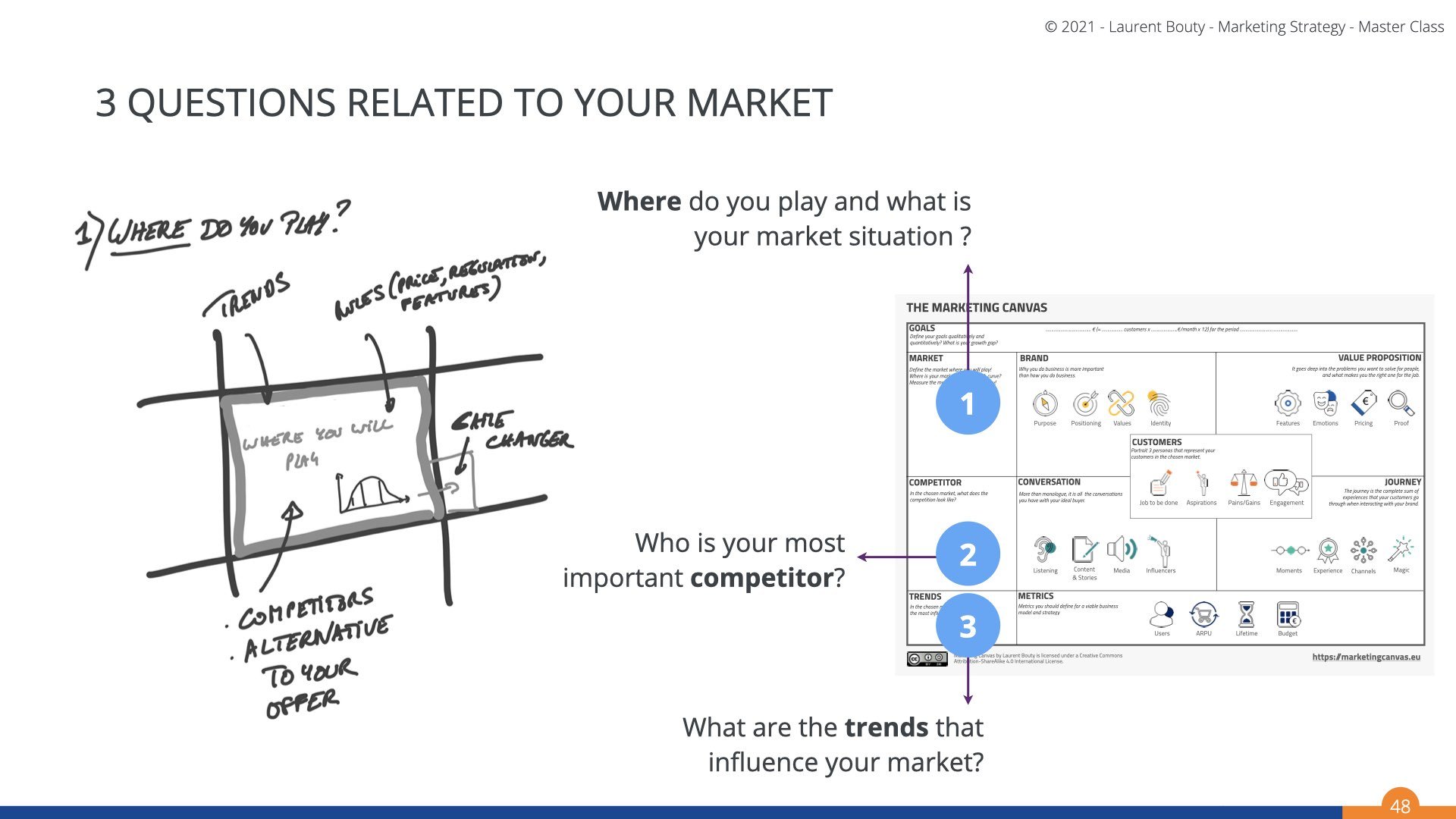
Question 1: What is your playing field, and how would you describe your market dynamics?
In marketing, we often segment territories into groups exhibiting similar characteristics, referred to as 'market segments' or 'markets'. This segmentation streamlines sales efforts, as your primary goal becomes convincing customers within your targeted market to choose and retain your value proposition.
I rely on Bill Aulet's definition (Excerpt From: Bill Aulet. "Disciplined Entrepreneurship") to clarify what constitutes a market:
Customers within the market purchase similar products.
Customers within the market exhibit similar buying behaviors and anticipate similar value from the products.
There's "word of mouth" among customers in the market, meaning they serve as high-value references for each other in making purchases.
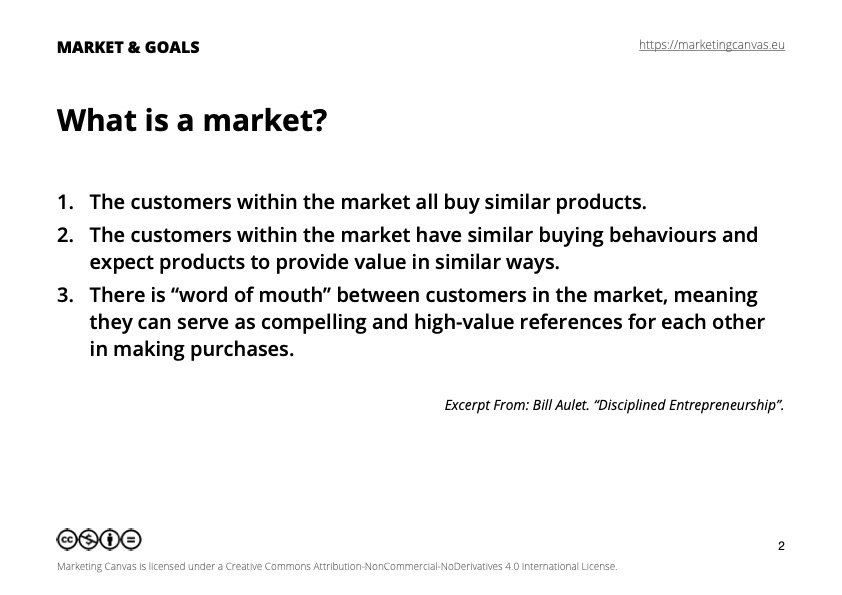
To illustrate, consider these examples:
Buying a car or a computer places you in the Car market and Computer market respectively. These markets align with Aulet's definition.
If you're a strategic consulting firm or a law firm, there likely exists a market for strategic consulting services and a market for legal services, respectively. Again, these markets align with Aulet's definition.
This concept of a market applies to both consumer and business services. Moreover, markets can be subdivided into sub-markets, providing a finer granularity to develop a marketing strategy. For instance, the Car market can be split into SUV and Sedan sub-markets, and the Computer market into Laptop and Desktop markets.
This subdivision forms a crucial step in devising a marketing strategy as it allows for an improved understanding of the context. The silver lining is that this work is often already accomplished, and markets are defined by the existing players. A wealth of data and statistics on different markets can be found on the internet, available free or for purchase.
Remark: you can compete in different markets, however the marketing canvas method has been designed for one market as competitors and conditions might change between markets. In case you would like to analyse multiple markets, you should do it one by one and then consolidate all the assessments in one strategy.
Case Study: Green Clean
Consider the eco-friendly cleaning products market. Companies like Method, Ecover, Seventh Generation, Mrs. Meyer's, and Green Clean offer alternatives to traditional cleaning products. They all compete within the eco-friendly cleaning products market, defined by customers' preference for environmentally conscious choices, similar buying behaviors, and the potential for word-of-mouth recommendations. These companies have different pricing strategies and perceived benefits, which customers will compare before making a decision.
CASE STUDY: Tesla Model S
Consider the Tesla Model S. It belongs to the broad market of cars, but we can further narrow this down into sub-markets. A common mistake is to categorize the Tesla Model S under the market of electric cars. However, being electric is a feature, not a market. Although both a Toyota Prius and a Tesla Model S are electric cars (one being a hybrid), they do not belong to the same market. The Tesla Model S fits into the Luxury E automobile or Executive/Mid-size luxury market, which also includes vehicles like the Porsche Taycan or the BMW 5 series.

As we delve deeper, we'll discover that once we have identified the market where our value proposition will compete, it's crucial to understand and follow a set of rules to shape our commercial strategy.
After identifying your company's competitive market, we need to delve into the specifics. Just like a painter cannot create art without understanding their canvas, a marketer cannot formulate a strategy without understanding their market.
1.1 Market Definition (M1)
To define your market, you must understand what product or service you are selling and who will likely buy it. For example, if you're selling eco-friendly cleaning products, your market might be environmentally conscious homeowners.
1.2 Key Expected Benefits (M2)
This involves identifying what the players in the market hope to gain. This includes both functional benefits (e.g., eco-friendly cleaning products that effectively clean the house) and emotional benefits (e.g., feeling good about contributing to environmental conservation).
1.3 Market's Position on Growth Curve (M3)
Every market undergoes stages: introduction, growth, maturity, and decline. Understanding where your market is on this curve helps you strategize accordingly. For instance, an emerging market might require more education and awareness efforts.
1.4 Experience Economy Curve of the Market (M4)
This refers to how the market evolves from selling simple commodities to providing sophisticated experiences. For instance, coffee can be sold as a commodity (beans), a product (packaged coffee), a service (brewed coffee in a cafe), or an experience (gourmet coffee tasting).
1.5 Total Available Market (TAM) and Serviceable Available Market (SAM) (M5)
TAM is the total market demand for a product or service, while SAM is the segment of TAM targeted by your company's products and services within your geographical reach. These metrics help assess the market size and opportunity.

Question 2: who is your main important competitors?
Identifying and analyzing your competitors is just as crucial as understanding your market.
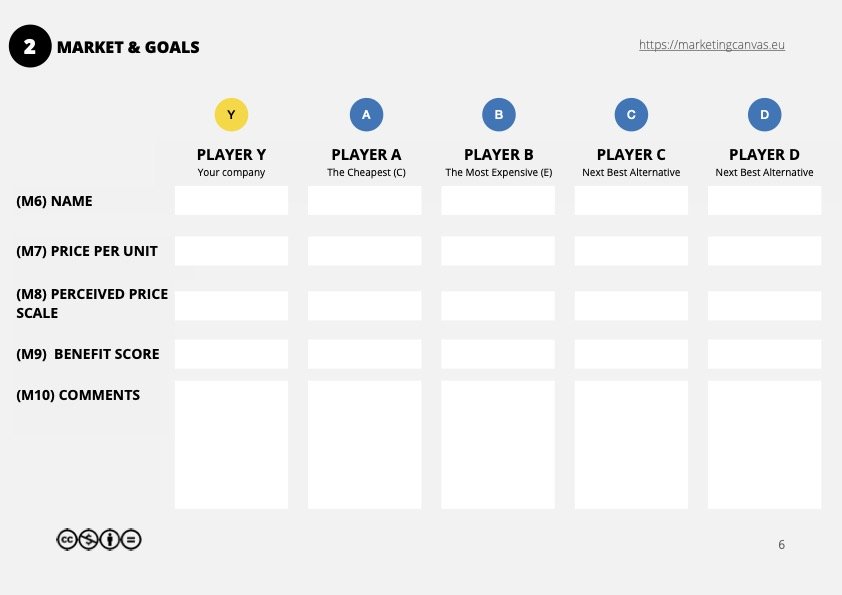
2.1 Competitors' Identification (M6-M10)
Identify up to five main competitors in your market. For each, identify the product price per unit (M7), perceived price (M8), perceived benefits (M9), and any additional remarks (M10).
2.2 Perceived Price (M8)
Perceived price is a metric that reflects how customers perceive your price relative to the competition. It is not always about the actual cost but rather the perceived value for money. The perceived price is calculated using a formula: M8 = 24/(E-C) * (M7-C) - 12.
Here, E is the maximum price per unit in the market, C is the lowest price per unit, and M7 is your product's price per unit. The calculation generates a score on a scale of -12 to +12, helping you understand your product's perceived price positioning in comparison to competitors.
Let's consider an example in the eco-friendly cleaning products market. We'll analyze five companies: GreenClean (our company), EcoPure, NatureFresh, Clean&Green, and BioWash.

Here's the calculation for GreenClean's perceived price:
M8 = 24/($15-$6) * ($10-$6) - 12 = 24/9 * 4 - 12 = 10.67 - 12 = -1.33
The same calculation is applied to find the perceived prices for the rest of the companies. This table helps you understand how your product's price is perceived relative to the competitors in the market.
In this case, GreenClean's price is perceived to be lower than most of its competitors, which can be an advantage if customers are price sensitive. However, you also need to ensure that the lower price doesn't lead customers to perceive it as lower quality.
2.3 Perceived Benefits (M9)
This is a measure of the benefits a customer perceives when interacting with a company. The perceived benefit score is calculated by summing up the scores of four questions related to the Brand, Value Proposition, Customer Journey, and Conversations offered by the company in the chosen market.
Here's how to handle each question:
Brand Perception: Ask yourself, "Is the company's brand the highest perceived amongst all the alternatives in the market?" This isn't just about brand recognition; it's about the positive associations customers make with your brand. It could be related to quality, trust, innovation, or social responsibility.
Value Proposition: Consider, "Is the company's value proposition the highest perceived amongst all the alternatives in the market?" The value proposition is the unique mix of product, price, placement, and promotion that the company offers. It answers why a customer should buy from you rather than your competitors.
Customer Journey: Query, "Is the company's customer journey the highest perceived amongst all the alternatives in the market?" The customer journey comprises all interactions between the customer and the company. It can include the ease of navigating your website, the clarity of product information, the efficiency of the checkout process, after-sales service, and more.
Conversation: Reflect on, "Is the company's conversation the highest perceived amongst all the alternatives in the market?" Conversations refer to the communication between the company and its customers. This could include advertising messages, social media interactions, customer service interactions, and more.

For each of the four questions, rate your agreement on a scale of -3 (completely disagree) to +3 (completely agree). Sum up these ratings to derive the Perceived Benefits score (M9).
This score gives you an understanding of your company's strengths and areas of improvement from the customer's perspective. It provides insights into how you can enhance your customers' experience, strengthen your value proposition, and ultimately, increase your market share.
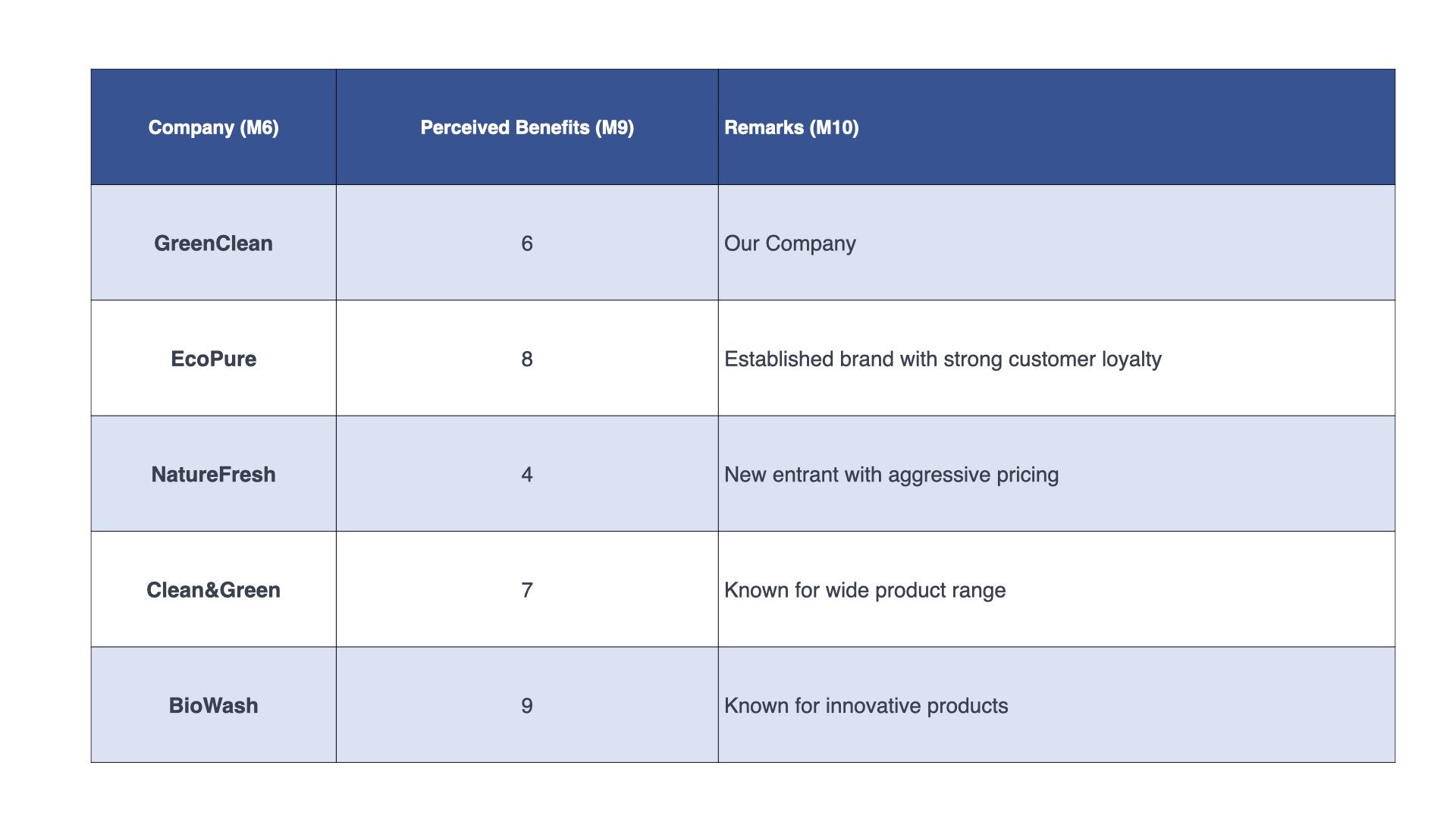
These perceived benefits scores indicate how each company's offerings are viewed in the market. GreenClean, for instance, scores fairly well, suggesting its customers appreciate its brand, value proposition, customer journey, and conversations. However, there's room for improvement, especially when compared to competitors like EcoPure and BioWash. This analysis can help guide strategic decisions to improve these areas and enhance customer perception.
question 3: what are the trends influencing your market?
This stage involves compiling all the information gathered above and creating a comprehensive view of your market.
Describe your chosen market, ensuring it aligns with the market definition of Bill Aulet.
Fill in a template (template #2) with information on your company and a maximum of 4 other companies.
Identify the average unit price for the company value proposition in the market (M7).
Map this average price for all companies using the formula: M8= 24/(E-C)*(M7-C)-12.
Calculate for each company the Perceived Benefits M9 by summing up the results of the 4 questions.
Map these results on a graph with perceived benefits (M9) on the horizontal axis (scale -12 to + 12) and perceived prices (M8) on the vertical axis (scale -12 to +12). This visualization (template #4) gives a clear picture of where each competitor stands in terms of value for money in the eyes of customers.

In conclusion, the market you're operating in, or planning to penetrate, defines the rules of the game. Understanding these rules, and how to play within them, will significantly influence your chances of success.
Whether it's the luxury electric car market or the eco-friendly cleaning products market, your marketing strategy should be rooted in a deep understanding of the market dynamics. This includes not only identifying your competitors but also comprehending the perceived price and benefits that your product or service brings to the table.

Marketing Canvas Method - Market Assesment Process
Tips for non-marketers and entrepreneurs
1. Stay Curious: Regularly research and keep up with trends in your market. It's not a one-time activity but a continuous process.
2. Talk to Customers: They can provide valuable insights that even the most sophisticated analysis might miss. Regular feedback from customers is a goldmine of information.
3. Keep an Eye on Competitors: Competitors can provide valuable lessons. Their successes and failures can provide insights for your own strategy.
4. Iterate: A marketing strategy is not set in stone. It evolves with your business, market trends, and customer preferences. Regularly revisit and update your strategy based on new data and insights.
Remember, understanding the context is just the first step in the marketing canvas method. It sets the foundation for the other steps in the process, guiding the direction of your marketing strategy.

Attention Economy
Attention Economy is an important concept that you should understand and integrate in your strategy. Are you ready?
While working on your Marketing Strategy, you should be aware of the attention economy concept. Why? Let’s first have a look at the definition proposed by Wikipedia [1] before answering this question:
Attention economics is an approach to the management of information that treats human attention as a scarce commodity, and applies economic theory to solve various information management problems. Put simply by Matthew Crawford, "Attention is a resource—a person has only so much of it.
Why should you care about this? because we are currently living in a society where buyers (B2B) or consumers (B2C) are overwhelmed by content and information about products, services, or experiences. What I call the snake dance (for capturing the attention) is applied by all brands but these days (unfortunately for brands), there are so many noises from all these songs that people are becoming deaf (don’t we say that people living close by train station are not hearing them anymore).
As attention economy becomes a very important concept for you when you are designing your marketing strategy, you should take care of it. Obviously, you could apply the good old concept of hitting them as much as needed until they understand it (Push Model). Or a more elegant approach would be to differentiate yourself (using the right Segmenting-Targeting-Positioning) and apply a pull approach (based on empathy and customer needs).
As rightly said by Nielsen Norman Group [2] “designers have a choice in this economy of attention: they can balance business needs — such as the need for new subscribers, advertising revenue, and profit — with respect for the best interests of their users.”
So! Do you integrate the attention economy in your strategy? Are you pushing or pulling?
Video
Source
https://en.wikipedia.org/wiki/Attention_economy#In_advertising
https://www.nngroup.com/articles/attention-economy/

Marketing Canvas and Customers
When working on the Customers part of the Marketing Canvas, you are trying to identify relevant and actionable triggers (you can also call it insights) that you will try to leverage through the other dimensions of the canvas. We have 4 dimensions you can play with for identifying these triggers (JTBD, ASPIRATIONS, PAINS & GAINS, ENGAGEMENT).
In a nutshell
When working on the Customers part of the Marketing Canvas, you are trying to identify relevant and actionable triggers (you can also call it insights) that you will try to leverage through the other dimensions of the canvas. We have 4 dimensions you can play with for identifying these triggers (JTBD, ASPIRATIONS, PAINS & GAINS, ENGAGEMENT). What matters at the end of this exercise is that you avoid fluffy (triggers), you have built a list of triggers, you have qualified them (functional or emotional), you have identified supporting evidence and you have rated the strength of each trigger.
In the Marketing Canvas
In the Marketing Canvas, we have identified 6 main categories for building your Marketing Strategy: Customers, Brand, Value Proposition, Journey, Conversation and Metrics. Each of these categories have 4 dimensions which means that a total of 24 dimensions (6 by 4) are defining your Marketing Strategy.
Customers is one of the 4 dimensions of the Metrics category. That category is composed of 4 dimensions.
How to use it?
What I have noticed during workshops is that people have difficulties to identify strong insights that could be used for building value propositions that rocks. They usually list insights that are very broad (even fluffy) like customers want quality (who doesn’t?) but could not describe what sort of quality customers are looking for. One example that could help you understand my point is the following:
When designing mobile phones, we know that these phones should be robust but what does it really mean. Glass manufacturer designed glass that could resist a drop from 10 meters but customers were looking for a phone that could resist multiple drops from 1 meter because it is what they are experiencing in real life. You see robustness could be very different!
When working on the 4 dimensions of CUSTOMERS, you can identify a list of triggers that could be functional (What the customer is expecting to get?) and emotional (What the customer is expecting to feel?). An interesting read on benefits/triggers is the article from the beloved brand web site (here).
I have not found a global list with all potential triggers (functional and emotional) that you could choose when working on a specific case. The most elaborated list I have found so far is the one developed by Bain Consulting for B2C and B2B. They have identified elements of value (30 for B2C and 40 for B2B) classified as functional, emotional, life-changing, and social impact.
In the Marketing Canvas, I have only considered 2 categories (functional and emotional), therefore if you are using Bain B2C triggers, you should consider emotional, life-changing and social impact as Emotional triggers.
What I also like in the Bain proposal is their B2B mapping which is something you don’t easily find. In the case of the B2B mapping, you should consider Table Stakes and Functional Values as Functional and Ease of doing business value, Individual value and inspirational value as Emotional for the Marketing Canvas method.
More on Bain can be found here: B2C elements of value and B2B elements of value.
Some Videos
Potential ideas
How to add intangible values to product?
Immediacy - priority access, immediate delivery
Personalization - tailored just for you
Interpretation - support and guidance
Authenticity - how can you be sure it is the real thing?
Accessibility - wherever, whenever
Embodiment - books, live music
Patronage - "paying simply because it feels good",
Findability - "When there are millions of books, millions of songs, millions of films, millions of applications, millions of everything requesting our attention — and most of it free — being found is valuable."
source: Wikipedia Attention Economy
Method
What you should do is the following:
Take each dimension and identify triggers that are either functional or emotional;
List evidence supporting each trigger;
Rate each trigger from weak to strong in the function of the importance of the customer (the more the customer is demonstrating that s.he is effectively in needs of this trigger through past behavior (doing more than saying), the stronger the trigger).
Take the top 10 triggers at the end of this exercise and complete the template below.
Template

Marketing Canvas Method - Customer Triggers Template

Marketing Canvas - Step 2 - Set Your Goals
In the Marketing Canvas Process, after having finalised your assessment, you should discuss potential scenarios that will help you achieve your goal(s). An interesting perspective for this phase is to use the scenarios proposed by Tiffani Boffa in her book Growth IQ.
The Marketing Canvas, developed by Laurent Bouty, is a powerful tool that provides a structured approach to crafting a robust marketing strategy. It's a co-creation method that intersects your environment (where you will play), your goals (what you would like to achieve), and your actions (what you will do). This article focuses on the second step of the Marketing Canvas Process - setting your goals. This step is vital as it serves as the reference point for the assessment phase.
Three Strategies for Growing Your Revenue:
In the Marketing Canvas Process, three strategies are highlighted for growing your revenue: GET, KEEP, and STIMULATE/MORE. These strategies focus on different aspects of customer interaction and are designed to help businesses increase their revenue.
GET: This strategy is all about customer acquisition. The primary idea is that your business can grow by attracting new customers. Tactics that can be employed include acquisition campaigns (welcome offers), channel incentives for new customers, "bring a friend" campaigns, and freemium models. For instance, a new restaurant might offer a "buy one get one free" deal to attract new customers.
KEEP: The second strategy emphasizes customer retention. The main idea here is that your business can grow by retaining existing customers. This strategy might seem defensive, but it is the cornerstone of customer experience and is essential for all businesses, including startups. Tactics include churn management, loyalty programs, brand and customer experience reinforcement, Net Promoter Score (NPS) programs for detractors, and below-the-line retention campaigns. For example, a software-as-a-service (SaaS) company might implement a loyalty program that offers exclusive features or discounts to long-term subscribers.
STIMULATE/MORE: The third strategy focuses on customer stimulation. The primary idea is that your business can grow by encouraging your customers to spend more and/or more often. Tactics include cross-selling, upselling, promotion campaigns for usage stimulation, bundling, upgrade programs, and premium features. For instance, a telecom company might offer a bundle that includes internet, cable, and phone services at a discounted rate, encouraging customers to spend more.
Green Clean Use Case:
To illustrate these strategies, let's consider a hypothetical company, Green Clean, a startup offering eco-friendly cleaning services.
For the GET strategy, Green Clean could offer a discounted first cleaning service to attract new customers. They could also implement a referral program where existing customers get a discount for each new customer they bring in.
For the KEEP strategy, Green Clean could develop a loyalty program where customers get a free cleaning service for every ten services purchased. They could also focus on providing excellent customer service to ensure customer satisfaction and reduce churn.
For the STIMULATE/MORE strategy, Green Clean could offer additional services like deep carpet cleaning or window cleaning, encouraging existing customers to spend more. They could also offer a premium subscription service that includes regular cleaning and maintenance services.
Conclusion
Setting your goals is a crucial step in the Marketing Canvas Process. It provides a clear direction for your marketing efforts and serves as a reference point for assessing your progress. The three strategies - GET, KEEP, and STIMULATE/MORE - offer different approaches to growing your revenue. By understanding these strategies and how to apply them, businesses can create a robust marketing strategy that drives growth and success.
Remember, the Marketing Canvas is a dynamic tool. As your business environment changes, you should revisit your goals and strategies to ensure they remain relevant and effective. Regular review and adaptation are key to maintaining a successful marketing strategy.
Whether you're a non-marketer, an entrepreneur, or a marketer looking to learn something new, the Marketing Canvas offersa structured yet flexible approach to developing a marketing strategy. It breaks down complex marketing concepts into manageable steps, making the process more accessible and less intimidating.
The Marketing Canvas is not just a tool, but a journey. It's a process of discovery, assessment, and reinforcement. It's about understanding your market, setting clear goals, and determining the actions you need to take to achieve those goals.
So, are you ready to embark on this journey? Are you ready to set your goals and grow your business? Remember, the journey of a thousand miles begins with a single step. In the case of the Marketing Canvas, that step is setting your goals.
Marketing Canvas - Market and Economic Value
Economic value can be described as a measure of the benefit from a good or service to an economic agent. It is typically measured in units of currency. Another interpretation is that economic value represents the maximum amount of money an agent is willing and able to pay for a good or service.
Economic value: what is it?
Economic value can be described as a measure of the benefit from a good or service to an economic agent. It is typically measured in units of currency. Another interpretation is that economic value represents the maximum amount of money an agent is willing and able to pay for a good or service. The economic value should not be confused with market value, which is the minimum amount a consumer will pay for a good or service. Thus, economic value is often greater than the market value. (Investopedia)
So in simple words, this notion of economic value will help you defining your price and indirectly your benefit. It is a subjective notion (except for past economists like Karl Marx) as it contains tangible and intangible value of the product. A coffee in beans as less value than drinking a coffee with your partner on a romantic place. Nespresso created more economic value by creating a new experience for coffee lover at home.
5 different economic values

Before deciding on your own marketing strategy, you should understand what the market is currently proposing to buyers! Based on the work done by Pine and Gilmore (HBR, The experience economy), we can identified 5 different types of offer:
Commodity: Buyers cannot differentiate between offers. It is often referred as commodity. The cheapest takes it all. I buy it because I need this (benzine, sugar, flour, …).
Product: Buyers have multiple offers that differentiate themselves on features (more of that, less of this, …) that can even create emotional differences for the buyer (make me younger, smarter, …). This is what we where and still use to see for fast moving consumer goods (chocolate, drinks, …) even if some brands are trying to elevate their product to experience by organising multiple stages (think about RedBull). I buy it because i use it.
Service: Buyers receive a service in addition to the product they bought. Competitors differentiate themselves with these services (after-sales, analytics, …). I buy it because I need it and they help me using it.
Experience: Buyers are going through stages which are personal and potentially sensational. Products and services becomes commodities (we can find similar offer everywhere). Competitors differentiate themselves with experience (before, during and after purchase). Most of the companies are trying to build experience but few are really successful to achieve long term sustainable differentiation on this. I enjoy buying and using it and it is the reason why I bought it.
Transformational: Experiences are elevated from mere enjoyment to actual personal transformation. Buyers are looking to be different after the purchase and use of it. I am not buying running shoes, I become a runner! I buy it because it helps me to become someone different.
What does it mean for the Marketing Canvas Method?
When you analyse the context, just define where the market is today. The higher the market is on this curve, the higher the economic value is. When looking at your context (please use Market cards):
Identify where your market is on the curve (1-5)
Identify if one competitor is trying to move upward (game changer, challenger)?
Identify where the market is on the product life cycle curve (Introduction to Decline)?
Curious
More on the method here
Buy our cards and discover our templates for your workshop here

Why you should be a Smart Creative Marketer?
In this new era where everything is accelerated by technological changes, Marketers are also deeply impacted. They can't stand still. They definitely have to reconsidered their job, their approach and finally their profession, Now. What should they do? How should they do that? While there is not one answer to this question, I use the label Smart Creative Marketers for defining what a future Marketer is! But what does it really mean, let me tell you.
Today we all live and work in a new era, the Internet Century, where technology is roiling the business landscape and the pace of change is accelerating. Eric Schmidt
In this new era where everything is accelerated by technological changes, Marketers are also deeply impacted. They can't stand still. They definitely have to reconsidered their job, their approach and finally their profession, Now. What should they do? How should they do that? While there is not one answer to this question, I use the label Smart Creative Marketers for defining what a future Marketer is! But what does it really mean, let me tell you.
Inspired by Google
"The only way for businesses to consistently succeed is to attract the best smart creatives and create an environment where they can thrive at scale."
In the book How Google Works, Google brilliantly identified the impact of technology on organisation and coined the term of Smart Creatives: someone that combines a technical way of thinking with never-ending ideas and ways to tackle complex issues. While this term was not specific to Marketers, I truly believe it fits very well for them. The Marketing practice is currently revolutionised by technology and competitive landscape where brands are operating. It requires new ideas and solutions to problems that didn't exit in the past.
Why Smart Marketers?
Smart can be defined as able to think quickly or intelligently in difficult situations. Following ORACLE (1), Marketers must move at light speed. They need to adapt on the fly and be agile and nimble. With 2.5 quintillion bytes of data being generated daily there really is no other choice.
You either adapt. Or die. It’s that simple.
I don't say that Marketers were not SMART in the past but they had to operate in a more stable world in terms of disruptions and changes. Today, they are facing several challenges:
They have less time for deciding what to do. Markets are moving fast and you can't wait too long otherwise it might be too late.
They have more data to analyse. Explosion of data due to the exponential increase of objects, people and systems is making situation analysis very complex.
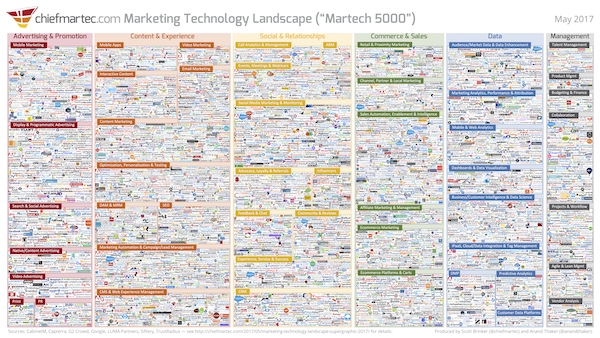
They have more systems to use. Increase of technology (MarkTech) is forcing Marketers to spend time learning and using systems that didn't exist 10 years ago. Below you can see the Marketing Technology Landscape representing more than 5000 solutions (3)
They have new competitors. GameChangers are appearing everywhere, disrupting classical models with no respect for existing codes and rules.

The classical 4Ps won't work anymore obviously. This is why Smartness is key for Marketers and they have to be smart in a digital world. IBM says (2): Marketers should increase their Digital Acumen. Best Marketers are using predictive and prescriptive analytics and cognitive computing to create richer customer experiences.
Marketers have to be able to analyse complex situations through complex data provided by complex systems and come with intelligent solutions, quickly. Wow! Looks like mission impossible, no?
Why Creative Marketers?
The word creativity might be overused and sometimes misused! I like the definition provided by Creativity at Work:
Creativity is characterised by the ability to perceive the world in new ways, to find hidden patterns, to make connections between seemingly unrelated phenomena, and to generate solutions. Creativity involves two processes: thinking, then producing.
This skills is fundamental today for any marketers because it implies 2 main actions: thinking differently, finding connections, hidden patterns AND turning these ideas into reality.
Interestingly enough, when following Marketing studies you either are very creative (art oriented school) or very productive (economical oriented school) but combining both is where the difficulty is.
Creativity is ranked by World Economic Forum as one of the top 3 skills you should have in the 4th industrial revolution.
Creativity will become one of the top three skills workers will need. With the avalanche of new products, new technologies and new ways of working, workers are going to have to become more creative in order to benefit from these changes.

In a fascinating study on The Conversation (7) by two Australian psychologists, creative people actually see the world differently. Their findings suggest that: "the creative tendencies of open people extend all the way down to basic visual perception. Open people may have fundamentally different visual experiences to the average person". In simple words, creative genius literally doesn't see the world the same way you do.
Some tips that might help you ...
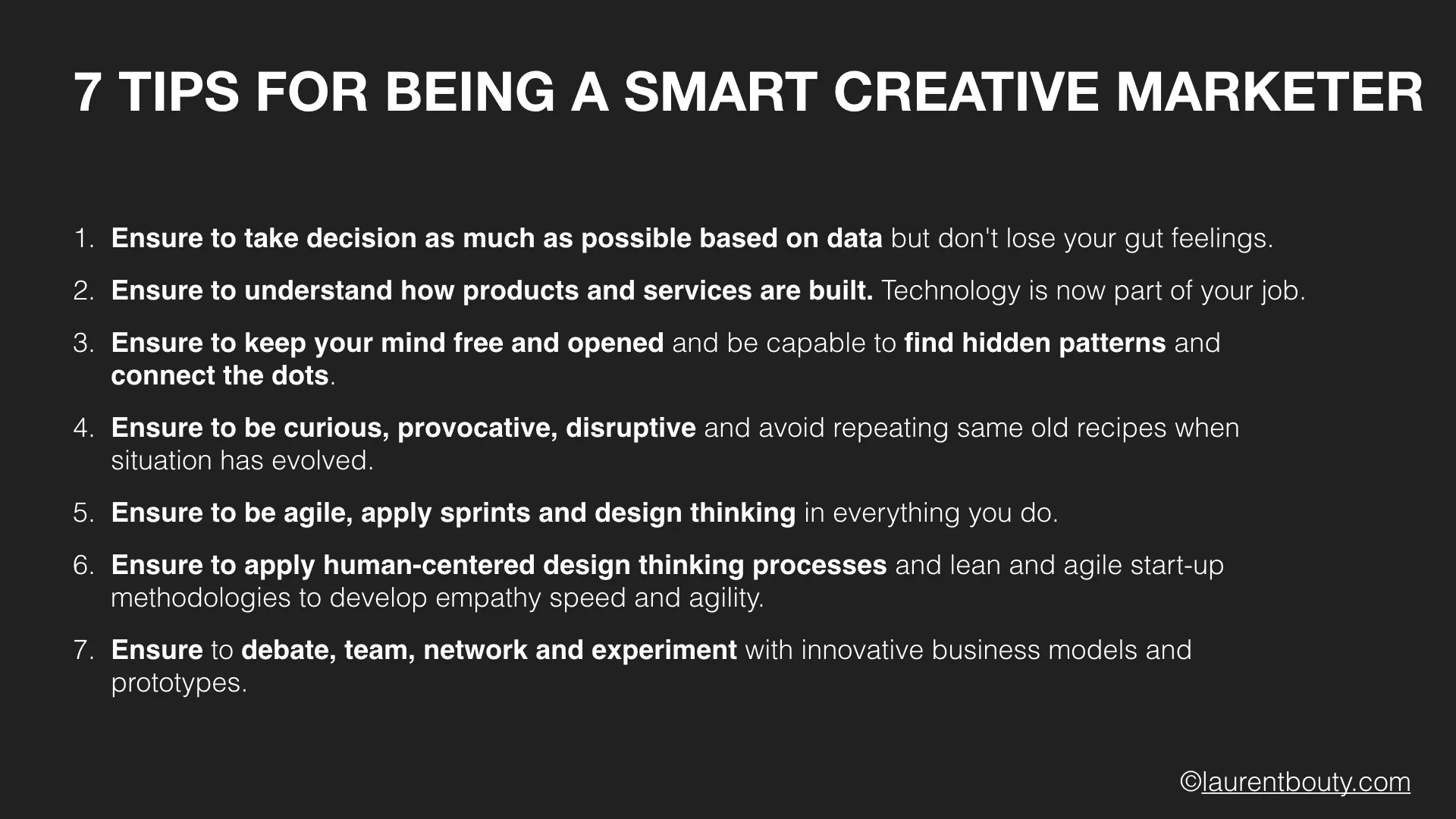
As a Marketer, you should be capable to explore data without fears and extract relevant insights and knowledge. Ensure to take decision as much as possible based on data but don't lose your gut feelings.
As a Marketer, you should be capable to build, change, rework systems as they are part of the value proposition and core to most of the current disruptions. Ensure to understand how products and services are built. Technology is now part of your job.
As a Marketer, you should have the flexibility to develop the capacity to think differently in multiple perspectives by operating from emergence, detachment and allowing. Ensure to keep your mind free and opened and be capable to find hidden patterns and connect the dots.
As a Marketer, you should be safe in ‘not knowing’ the answer or the solution but how to generate it through intentional disruption, provocation, and disagreement and through deep inquiry, listening, and debate. Ensure to be curious, provocative, disruptive and avoid repeating same old recipes when situation has evolved.
As a Marketer, you should be receptive and cultivate skills in the innovative thinking including divergent/convergent, critical, associative to ideate hypothetical solutions that may not have previously existed. Ensure to be agile, apply sprints and design thinking in everything you do.
As a Marketer, put always human in the center of what you do. Ensure to apply human-centered design thinking processes and lean and agile start-up methodologies to develop empathy speed and agility.
As Marketer, you cannot make it alone. Only team play and co-creation with customers will deliver solutions to your problems. Ensure to debate, team, network and experiment with innovative business models and prototypes.
Sources
- ORACLE (2017) - The Future of Modern Marketing: 2017
- IBM (2016) - Global C-Suite study - Redefining Markets: The CMO Point of View
- ChiefMarTec.com (2017) - http://chiefmartec.com/2017/05/marketing-techniology-landscape-supergraphic-2017/
- Creativity at work (2014) - What is creativity? - http://www.creativityatwork.com/2014/02/17/what-is-creativity/
- AdAge (2011) - The Habits of Highly Creative Marketers - http://adage.com/article/news/habits-highly-creative-marketers/229162/
- InnovationExcellence (2016) - The Rise of the Smart Creative (Lessons from Google) - http://innovationexcellence.com/blog/2016/05/23/the-rise-of-the-smart-creative-lessons-from-google/
- theconversation.com (2017) - People with creative personalities really do see the world differently - http://theconversation.com/people-with-creative-personalities-really-do-see-the-world-differently-77083