
BLOG
A collection of article and ideas that help Smart Marketers to become Smarter

Quick Assessment Guide
Happy to announce that a one-pager quick assessment guide is now available for download. Sometimes before doing a full assessment which is really what the method is all about, some persons or companies might appreciate a first quick assessment for opening the discussion. Even though we are missing the nuances provided by the full version, it can be a nice conversation starter.
Happy to announce that a one-pager quick assessment guide is now available for download. Sometimes before doing a full assessment which is really what the method is all about, some persons or companies might appreciate a first quick assessment for opening the discussion. Even though we are missing the nuances provided by the full version, it can be a nice conversation starter.

You need a SHARP Value Proposition
When developing your Value Proposition and Brand Positioning, it has to be S.H.A.R.P. What does it mean?
When developing your Value Proposition and Brand Positioning, it has to be S.H.A.R.P.
What does it mean?
SHARP stands for:
- S for Simple. At the end Simplicity is the winner. You have a doubt, have a look at the Simplicity Index
- H for Human-Centric. Being able to develop your strategy around the human will open new doors and untapped values. Be inspired by Human-Centered Design
- A for Ambitious. Your VP has to be ambitious if you want to stand out from the others.
- R for Relevant. You should build it with competitors and alternatives in mind.
- P for Purposeful. I am a strong believer in purpose driven strategy (reason why I created with friends thebeyonders.agency). Curious what it means, read this article on hbr.
Do you have a S.H.A.R.P. Value Proposition ?
Marketers, You Should Unlock The Next Decade
As CMOs gain more power in the boardroom — and over technology spend — it will be critical that they understand the factors that drive success.

Marketers, You should unlock the next decade
As CMOs gain more power in the boardroom — and over technology spend — it will be critical that they understand the factors that drive success. As Jerret West, vice president of Marketing at Netflix, said, “We have to look for ways to combine creativity and technology with an understanding of how the business fits into the overarching customer experience. We have to think and act like CEOs.”
This describes the new world of marketing we live in today. And in this new world, new rules apply. CMOs who get on board will find amazing growth potential. Those that keep repeating strategies from yesterday’s playbooks are bound to fall by the wayside. To avoid going down that path, here are five keys to get started...
More on CMSWIRE
AI is Changing Marketing
Excellent article from Andrew Stephen on Forbes about Artificial Intelligence and how it is changing Marketing. 4 main highlights (extracted from the article I invite you to read)
Excellent article from Andrew Stephen on Forbes about Artificial Intelligence and how it is changing Marketing.
4 main highlights (extracted from the article I invite you to read):
- Marketers have more insights-related tools at their disposal that facilitate true data-driven decision making but AI is needed to help integrate across tools, datasets and platforms.
- The nature of marketing work is changing, but not necessarily becoming completely technical and focused on data science. Instead, the infusion of AI into marketing work can aid decision making and automation can free up valuable executive time.
- Consumers are changing due to AI-powered tools and devices being involved in consumer search, choice set construction and purchase decision making, and as this becomes more widespread and feels normal to consumers, AI will start to automate certain consumer decisions.
- Visionary marketing leaders need to understand AI and how it impacts both marketers and consumers. Moreover, they must think broadly and creatively about the AI-powered future of marketing and take proactive steps to ready themselves and their organizations for the future that they (and their customers) are creating.

AI is changing Marketing
While I fully agree with everything said by Andrew, I believe this acceleration of Marketing smart digitalisation will create somehow a tsunami in Marketing departments and jobs because most of the "classical marketers" are not trained neither skilled for facing the complexity of AI. When AI will be fully in place, then marketers will be able to concentrate on more creative tasks while others will be working on Marketing Technologies.
Are you ready? If yes, what have you done? If not, what do you plan to do?
Full article on Forbes: here
Marketers, How Technology Enhances Creativity?
Technology does not quell creativity, in fact, there’s a great deal of evidence that suggests that technology enhances creativity. Certainly, we are expected to be more creative in our working lives than a generation ago. The truth is that by expanding possibilities and automating part of the creative process, we can all be more creative and productive.
Marketers, in a world of Big Data and AI, you will have to rely less on intuition and judgement.

in a virtual world of infinite abundance, only creativity could ever be in short supply
“Technology does not quell creativity, in fact, there’s a great deal of evidence that suggests that technology enhances creativity. Certainly, we are expected to be more creative in our working lives than a generation ago. The truth is that by expanding possibilities and automating part of the creative process, we can all be more creative and productive.”
5 actions should be taken:
- Defining The Creative Process
- Technology Eradicates Barriers To Creative Excellence
- Mixing And Remixing
- Simulating Failure
- The Rise of the Creative Class
More on Forbes: How Technology Enhances Creativity
Why you should be a Smart Creative Marketer?
In this new era where everything is accelerated by technological changes, Marketers are also deeply impacted. They can't stand still. They definitely have to reconsidered their job, their approach and finally their profession, Now. What should they do? How should they do that? While there is not one answer to this question, I use the label Smart Creative Marketers for defining what a future Marketer is! But what does it really mean, let me tell you.
Today we all live and work in a new era, the Internet Century, where technology is roiling the business landscape and the pace of change is accelerating. Eric Schmidt
In this new era where everything is accelerated by technological changes, Marketers are also deeply impacted. They can't stand still. They definitely have to reconsidered their job, their approach and finally their profession, Now. What should they do? How should they do that? While there is not one answer to this question, I use the label Smart Creative Marketers for defining what a future Marketer is! But what does it really mean, let me tell you.
Inspired by Google
"The only way for businesses to consistently succeed is to attract the best smart creatives and create an environment where they can thrive at scale."
In the book How Google Works, Google brilliantly identified the impact of technology on organisation and coined the term of Smart Creatives: someone that combines a technical way of thinking with never-ending ideas and ways to tackle complex issues. While this term was not specific to Marketers, I truly believe it fits very well for them. The Marketing practice is currently revolutionised by technology and competitive landscape where brands are operating. It requires new ideas and solutions to problems that didn't exit in the past.
Why Smart Marketers?
Smart can be defined as able to think quickly or intelligently in difficult situations. Following ORACLE (1), Marketers must move at light speed. They need to adapt on the fly and be agile and nimble. With 2.5 quintillion bytes of data being generated daily there really is no other choice.
You either adapt. Or die. It’s that simple.
I don't say that Marketers were not SMART in the past but they had to operate in a more stable world in terms of disruptions and changes. Today, they are facing several challenges:
They have less time for deciding what to do. Markets are moving fast and you can't wait too long otherwise it might be too late.
They have more data to analyse. Explosion of data due to the exponential increase of objects, people and systems is making situation analysis very complex.
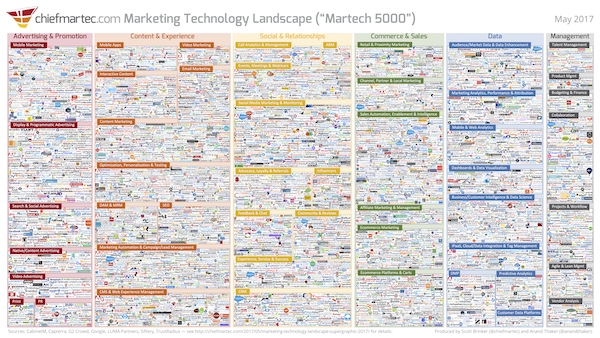
They have more systems to use. Increase of technology (MarkTech) is forcing Marketers to spend time learning and using systems that didn't exist 10 years ago. Below you can see the Marketing Technology Landscape representing more than 5000 solutions (3)
They have new competitors. GameChangers are appearing everywhere, disrupting classical models with no respect for existing codes and rules.

The classical 4Ps won't work anymore obviously. This is why Smartness is key for Marketers and they have to be smart in a digital world. IBM says (2): Marketers should increase their Digital Acumen. Best Marketers are using predictive and prescriptive analytics and cognitive computing to create richer customer experiences.
Marketers have to be able to analyse complex situations through complex data provided by complex systems and come with intelligent solutions, quickly. Wow! Looks like mission impossible, no?
Why Creative Marketers?
The word creativity might be overused and sometimes misused! I like the definition provided by Creativity at Work:
Creativity is characterised by the ability to perceive the world in new ways, to find hidden patterns, to make connections between seemingly unrelated phenomena, and to generate solutions. Creativity involves two processes: thinking, then producing.
This skills is fundamental today for any marketers because it implies 2 main actions: thinking differently, finding connections, hidden patterns AND turning these ideas into reality.
Interestingly enough, when following Marketing studies you either are very creative (art oriented school) or very productive (economical oriented school) but combining both is where the difficulty is.
Creativity is ranked by World Economic Forum as one of the top 3 skills you should have in the 4th industrial revolution.
Creativity will become one of the top three skills workers will need. With the avalanche of new products, new technologies and new ways of working, workers are going to have to become more creative in order to benefit from these changes.

In a fascinating study on The Conversation (7) by two Australian psychologists, creative people actually see the world differently. Their findings suggest that: "the creative tendencies of open people extend all the way down to basic visual perception. Open people may have fundamentally different visual experiences to the average person". In simple words, creative genius literally doesn't see the world the same way you do.
Some tips that might help you ...
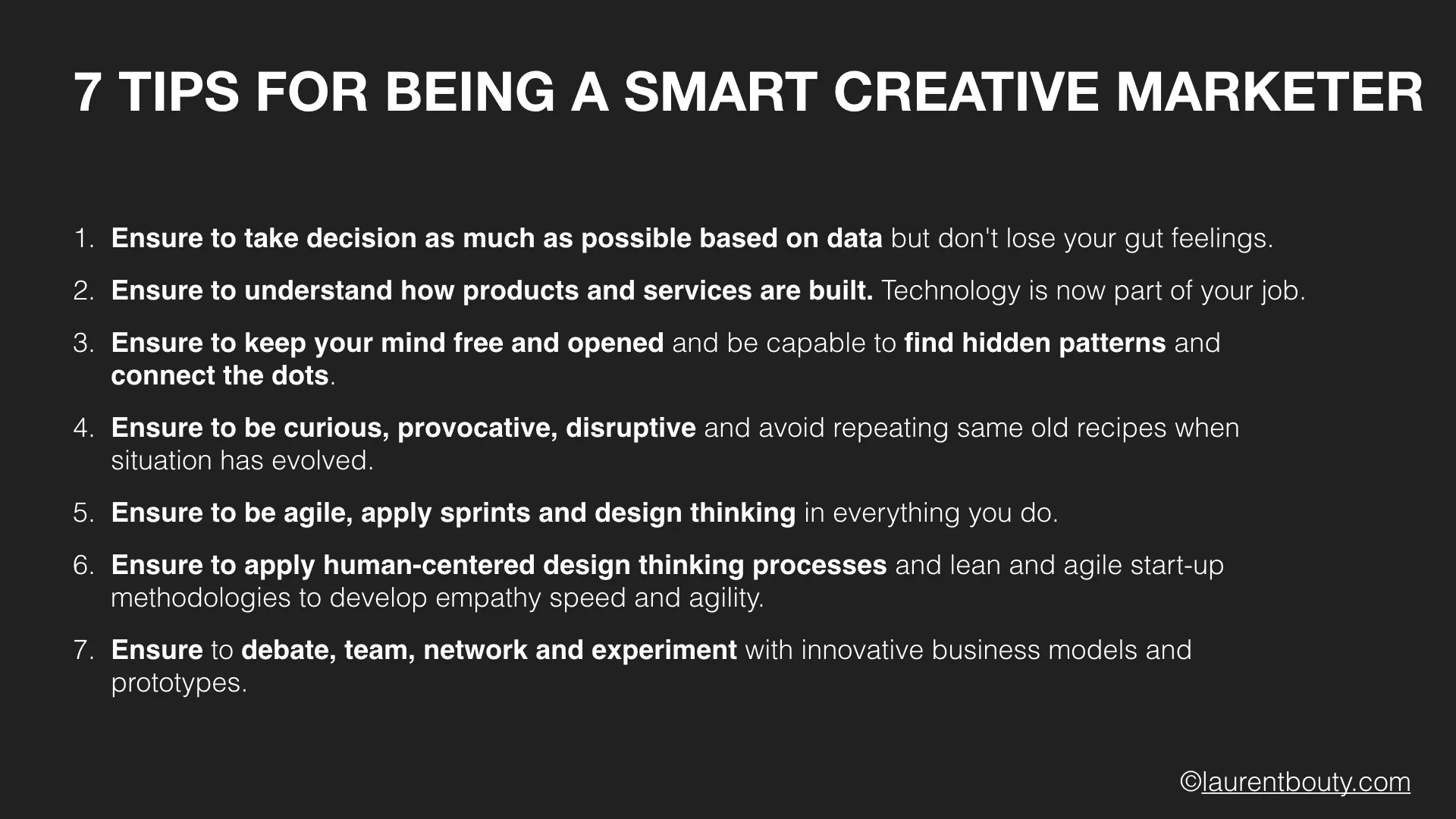
As a Marketer, you should be capable to explore data without fears and extract relevant insights and knowledge. Ensure to take decision as much as possible based on data but don't lose your gut feelings.
As a Marketer, you should be capable to build, change, rework systems as they are part of the value proposition and core to most of the current disruptions. Ensure to understand how products and services are built. Technology is now part of your job.
As a Marketer, you should have the flexibility to develop the capacity to think differently in multiple perspectives by operating from emergence, detachment and allowing. Ensure to keep your mind free and opened and be capable to find hidden patterns and connect the dots.
As a Marketer, you should be safe in ‘not knowing’ the answer or the solution but how to generate it through intentional disruption, provocation, and disagreement and through deep inquiry, listening, and debate. Ensure to be curious, provocative, disruptive and avoid repeating same old recipes when situation has evolved.
As a Marketer, you should be receptive and cultivate skills in the innovative thinking including divergent/convergent, critical, associative to ideate hypothetical solutions that may not have previously existed. Ensure to be agile, apply sprints and design thinking in everything you do.
As a Marketer, put always human in the center of what you do. Ensure to apply human-centered design thinking processes and lean and agile start-up methodologies to develop empathy speed and agility.
As Marketer, you cannot make it alone. Only team play and co-creation with customers will deliver solutions to your problems. Ensure to debate, team, network and experiment with innovative business models and prototypes.
Sources
- ORACLE (2017) - The Future of Modern Marketing: 2017
- IBM (2016) - Global C-Suite study - Redefining Markets: The CMO Point of View
- ChiefMarTec.com (2017) - http://chiefmartec.com/2017/05/marketing-techniology-landscape-supergraphic-2017/
- Creativity at work (2014) - What is creativity? - http://www.creativityatwork.com/2014/02/17/what-is-creativity/
- AdAge (2011) - The Habits of Highly Creative Marketers - http://adage.com/article/news/habits-highly-creative-marketers/229162/
- InnovationExcellence (2016) - The Rise of the Smart Creative (Lessons from Google) - http://innovationexcellence.com/blog/2016/05/23/the-rise-of-the-smart-creative-lessons-from-google/
- theconversation.com (2017) - People with creative personalities really do see the world differently - http://theconversation.com/people-with-creative-personalities-really-do-see-the-world-differently-77083

A quoi sert un responsable du Marketing?
Dans une étude publiée en 2013 sur le site Business Insider, le graduat en Marketing est considéré comme un des 10 diplômes les plus inutiles! C'est une vrai question que l'on peut se poser: Est-ce vraiment des études sérieuses? Est-ce que le métier du marketing est un métier qui apporte de la valeur à l'entreprise ou est-ce un métier dont on peut de débarrasser rapidement, un métier fourre-tout voir même un métier fluffy pour reprendre une expression anglaise difficilement traduisible.
Dans une étude publiée en 2013 sur le site Business Insider, le graduat en Marketing est considéré comme un des 10 diplômes les plus inutiles! C'est une vrai question que l'on peut se poser: Est-ce vraiment des études sérieuses? Est-ce que le métier du marketing est un métier qui apporte de la valeur à l'entreprise ou est-ce un métier dont on peut se débarrasser rapidement, un métier fourre-tout voir même un métier fluffy pour reprendre une expression anglaise difficilement traduisible.
En tant qu'Ingénieur Civil (ayant fait des études dites sérieuses) et ayant occupé des postes Marketing de hautes responsabilités dans des groupes internationaux et qui, de plus, dirige un Advanced Master en Créativité et Marketing au sein de Solvay Brussels School, cette question me laisse perplexe et me pousse à faire des recherches pour la valider ou l'invalider.
Qu'est ce que le Marketing ?
Le rôle du Marketing est très souvent mal compris et limité au support de la commercialisation des produits après leur développement. La perception générale est que le Marketing, c'est de la communication (les Mad Men de ce monde). Bien que la communication fasse souvent partie des prérogatives du Marketing, en aucun cas le Marketing ne se limite à la communication. Philip Kotler (1) qui a été un des précurseurs de la formalisation du Marketing, le défini comme suit:
Le Marketing est une Science et un Art pour explorer, créer et délivrer de la valeur pour satisfaire les besoins d'un groupe cible et générer du profit pour l'entreprise.
La tâche telle que décrite ci-dessus est donc massive et difficile en cette période turbulente. Explorer, Créer et Délivrer de la valeur pour une entreprise ne me semble pas une tâche ordinaire, simpliste voir modeste. Ce sont des défis et des enjeux permanents auxquels font face toutes les entreprises.
Comment se peut-il que des études qui vous préparent à Explorer, Créer et Délivrer de la valeur puissent être considérées parmi les diplômes les plus inutiles? Le mystère reste total! Cherchons plus loin.
L'évolution du rôle du Marketing dans une entreprise?
On pourrait penser que le rôle du marketer se limite à faire de la communication, participer à des études consommateurs dans des endroits sympathiques ou être présent sur des stands flamboyants dans des foires. Pour ma part, tout au long de ma carrière professionnelle, j'ai eu la chance d'observer et de travailler avec des marketers qui avaient des fonctions bien plus larges et complexes que celles décrites ci-dessus. De plus, de nombreuses études prédisent une augmentation des tâches liées au marketing et un renforcement des responsabilités de la fonction. Dans une étude publiée par Microsoft (3), le rôle du Marketing et de son leader (Chief Marketing Officer) est en croissance et se diversifie à travers l'entreprise. Il devient le plus gros consommateur d'investissement IT de l'entreprise (plus de 60% des investissements suivant Gartner en 2017).
J'entends déjà certains dire que l'expérience client, la digitalisation ou l'innovation ne fait pas partie du Marketing. Je les renvoie vers sa définition. On peut donner de nouveaux noms mais les fondamentaux restent: créer et capturer de la valeur.
Donc le rôle du Marketer devient de plus en plus important! Le métier grandit: en périmètre et en séniorité. Il a une place de plus en plus stratégique au sein de l'entreprise. Son leader (le CMO) est même pressenti comme le remplaçant potentiel du CEO. Pas de doute donc sur le métier, le problème vient donc des études.
Où est le problème dans les études Marketing?
Comment se fait-il que la perception que l'on a des études Marketing puisse être négative? Cela vient peut-être de la difficulté de combiner une approche scientifique formelle avec une approche créative nécessaire pour trouver de nouvelles solutions à de nouveaux problèmes et pour toucher le coeur des clients. L'ambigüitée est encore renforcée par le fait que la majorité des bacheliers en Marketing sont pauvres dans leur formation scientifique, se limitant généralement à un cours d'économie et un cours de statistiques. La conséquence de cette faiblesse est malheureusement double: cela attire des étudiants qui n'ont pas les fondamentaux pour appliquer une analyse scientifique à un problème (pré-requis dans un monde où la technologie et les données sont omniprésentes) et cela crée une perception que le Marketing se limite à la communication. N'interprétez-pas mal cette analyse! La communication reste une partie fondamentale du Marketing et mérite en tant que tel tout notre respect. Mais les sciences de la communication ne sont pas suffisantes pour aspirer à une fonction de leader dans le Marketing, pour être capable de faire une analyse rigoureuse de la situation d'une entreprise et pour décider de ses investissements technologiques.
Une autre filiale plus scientifiques semblerait plus appropriée. Elle est a toutefois de nombreuses lacunes sur la partie émotionnelle et empathique nécessaire au Marketing. Sans caricaturer, un ingénieur peut paraitre un peu robocop dans certaines situations. Voila donc un vrai vide à combler. Comment réconcilier les Arts et les Sciences au sein d'un curriculum complet. Ne se rapproche-t-on pas de la Renaissance? Les filières marketing ont besoin de refaire leur marketing!
Conclusions
Il n'y a aucun doute. Le métier reste et restera important pour une entreprise (petite, moyenne ou grande). Pour remplir sa fonction, Le Marketer doit savamment mélanger les Arts et Sciences. Il faut accorder autant d'attention pour ces deux disciplines. Malheureusement, les études actuelles nécessitent de faire un choix entre les Sciences et les Arts. Voici mes conseils basés sur mon expérience personnelle:
- Il est plus facile de démarrer par une filière scientifique. Bien que les sciences puissent paraitre rebutantes pour certains, un marketer doit être capable de gérer les enjeux stratégiques et technologiques d'une entreprise.
- Une filière scientifique n'est pas suffisante. Un marketer doit développer sa sensibilité émotionnelle, sa capacité à communiquer visuellement et verbalement ainsi que son intérêt pour les tendances sociétales.
- Il n'y a pas un seul chemin pour devenir un grand marketer. N'oublions pas le rôle important jouée par les entreprises et les premiers emplois qui souvent comblent les manquements des études. Faites des stages et beaucoup.
- Nous sommes dans un monde en mouvement. Une mise à jour permanente est donc nécessaire. Apprenez chaque année quelque chose de nouveau: une technologie, un art visuel, ...
- Faites ce métier. Il est passionnant, difficile, riche, plein de challenges mais jamais ennuyant ni décevant!
Sources
- Dr. Philip Kotler Answers Your Questions on Marketing. Source: http://www.kotlermarketing.com/
- CMO Council (2016), The CMO shift to gaining business lift
- Microsoft (2014), Future of the CMO. How Digital Technology Is Reshaping Marketing Organizations