
BLOG
A collection of article and ideas that help Smart Marketers to become Smarter

The Top 20 Modern Marketing Challenges Identified In 2016
From a discussion with 100 top CMO in 2016, Constellation Research based in Silicon Valley defined in 2016 the top 20 modern marketing challenges (not in order of importance). Do you agree? Do you have the same challenges? I would be interested in to know ho you are dealing with these challenges?
From a discussion with 100 top CMO in 2016, Constellation Research based in Silicon Valley defined in 2016 the top 20 modern marketing challenges (not in order of importance).
- Delivering on a creative to commerce vision
- Improving marketing automation and optimization
- Adjusting to fragmentation of channels, segments, and trends
- Investing in audience development
- Targeting with precision and less false positives
- Dealing with data driven approaches
- Building for intention driven design in customer experience
- Developing in-house ad networks and programmatic strategies
- Mastering data and data management platforms
- Re positioning the corporate brand for a digital world
- Empowering communities and audience development
- Attracting and retaining the right skill sets for digital marketing transformation
- Identifying new agency and consulting partners to augment efforts
- Improving internal employee engagement
- Building a culture of behind the brand promise
- Creating a P2P model
- Aligning marketing strategy with marketing technology
- Proving ROI
- Crafting compelling contextually relevant content
- Getting ahead of the latest disruptive technologies
QUESTION
Do you agree? Do you have the same challenges? I would be interested in to know how you are dealing with these challenges?
Original article:
https://www.constellationr.com/blog-news/four-personas-modern-cmo-digital-world
What is Positioning in Marketing Strategy?
As consumers or buyers are permanently exposed to commercial messages (sales, advertising, products, ...), your brand should clearly stand out of this clutter and deliver its promise. This is the big idea behind positioning. But how to do it? For a new product? For a new company? For a new line of business?
What's the big idea of POSITIONING?
Be clear where you play and how you play! A positioning statement is NOT a brand tagline or a Mantra!
Where do you play?
Where you Play means the category where your products and services will be sold. While the category is something originally designed for managing the relationship between retailer and supplier, the main idea is that you should define the environment where your products/services will be sold (discrete groups of similar products and services).
How do you play?
Positioning could be to make the brand virtually synonymous with the product category so that it is the brand that comes to mind when consumers think of the product. Examples include Xerox, Kleenex, and Scotch tape. Often the brand that stands for the category is the sales and profit leader in that category. In many cases, such a position is gained by being the first brand to aggressively advertise and promote within the product category.
The category is also referred to as frame of reference in the HBR article[4].
Brand positioning starts with establishing a frame of reference, which signals to consumers the goal they can expect to achieve by using a brand. In some cases, the frame of reference is other brands in the same category.
A good positioning statement makes it clear who the customer is and what business problem they need to solve. If you do a good job of defining the customer problem, you don’t need to describe your product. The customer will want to learn more in the next conversation. Harvard
Effective positioning should be simple, meaningful, and unique. Simple concepts such as "thickest ketchup" (Heinz), "easy to use" (Macintosh computers), and "tough off-road" (Jeep) are easier than more complex formulations for consumers to process and associate with the brand name.
Positioning must also be meaningful to the target audience. Positioning such as "comfortable jeans for women" (Lee jeans) and "inexpensive air travel" (Southwest Airlines) work well to the extent that these concepts strike a responsive chord with target customers.
A good positioning statement makes it clear who the customer is and what business problem they need to solve (HBR[3]). If you do a good job of defining the customer problem, you don’t need to describe your product. The customer will want to learn more in the next conversation
Finally, effective positioning should be unique within the product category. The positioning "reliable," for example, can be used in a number of product categories such as watches (Timex), appliances (Maytag), and automobiles (Honda). But within any single category, it is difficult for two brands to own the same concept in consumers' minds.
Rules of the Game
It is simple, memorable, and tailored to the target market.
It starts with the customer problem and not from the product.
It has a clear frame of reference.
It has clear points of parity with other brands from the same frame of reference.
It provides an unmistakable and easily understood picture of your brand that differentiates it from your competitors (points of difference).
It is credible, and your brand can deliver on its promise.
Your brand can be the sole occupier of this particular position in the market. You can “own” it.
It helps you evaluate whether or not marketing decisions are consistent with and supportive of your brand.
It leaves room for growth.
Template
For [insert Target Market], the [insert Brand] is the [insert Point of Differentiation] among all [insert Frame of Reference] because [insert Reason to Believe].
For [your target] who wants / needs [reason to buy your product/service], the [your product or service] is a [category] that provides [your key benefit]. Unlike [your main competitor], the [your product/service] [your key differentiator]
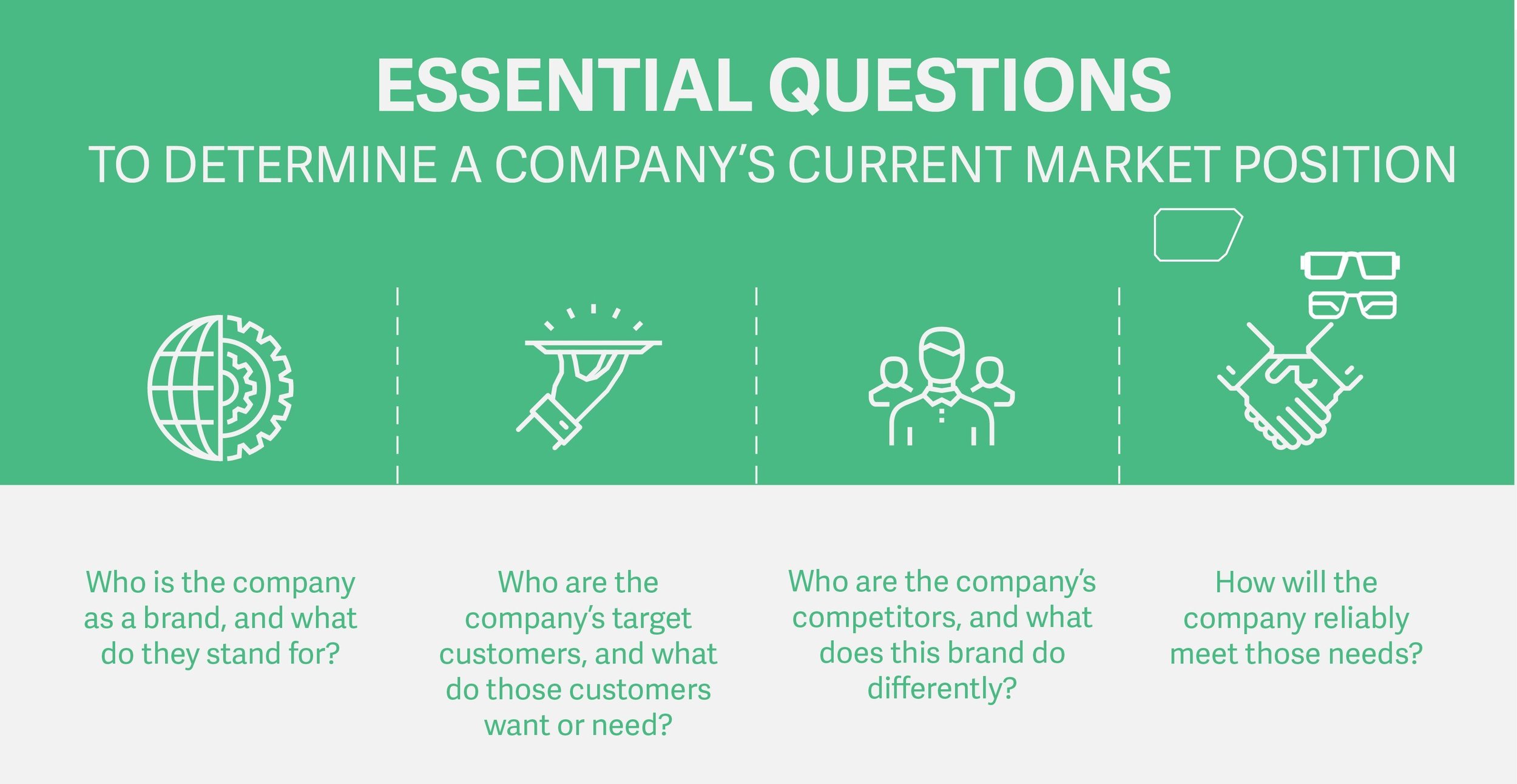
Questions you could ask
Examples
ZipCar: To urban-dwelling, educated techno-savvy consumers [target], when you use Zipcar car-sharing service instead of owning a car [competitive frame], you save money while reducing your carbon footprint [points of difference].
Gazelle: At Gazelle, we pay you for the cell phones, iPads, Macs,and other Apple devices you no longer need—helping you upgrade faster or just putting a little extra cash in your pocket.
Amazon (2001): For World Wide Web users who enjoy books, Amazon.com is a retail bookseller that provides instant access to over 1.1 million books. Unlike traditional book retailers, Amazon.com provides a combination of extraordinary convenience, low prices, and comprehensive selection.
Pitfalls as described in HBR[4]
1. Companies sometimes try to build brand awareness before establishing a clear brand position. You have to know who you are before you can convince anyone of it. Many dot-coms know this pitfall well. A number of them spent heavily on expensive television advertising without first being clear about what they were selling.
2. Companies often promote attributes that consumers don’t care about. The classic example: For years, companies that sold analgesics claimed their brands were longer lasting than others. Eventually, they noticed that consumers wanted faster relief more than sustained relief.
3. Companies sometimes invest too heavily in points of difference that can easily be copied. Positioning needs to keep competitors out, not draw them in. A brand that claims to be the cheapest or the hippest is likely to be leapfrogged.
4. Certain companies become so intent on responding to competition that they walk away from their established positions. General Mills used the insight that consumers viewed honey as more nutritious than sugar to successfully introduce the Honey Nut Cheerios product-line extension. A key competitor, Post, decided to respond by repositioning its Sugar Crisp brand, changing the name to Golden Crisp and dropping the Sugar Bear character as spokesman. But the repositioned brand didn’t attract enough new customers, and its market share was severely diminished.
5. Companies may think they can reposition a brand, but this is nearly always difficult and sometimes impossible. Although Pepsi-Cola’s fresh, youthful appeal has been a key branding difference in its battle against Coca-Cola, the brand has strayed from this focus several times in the past two decades, perhaps contributing to some of its market share woes. Every attempt to reposition the brand has been followed by a retreat to the former successful positioning. Brand positioning is a tough task. Once you’ve found one that works, you may need to find a modern way to convey the position, but think hard before you alter it.
In the Marketing Canvas
In the Marketing Canvas Process (more information here), you have to clarify your hypothesis for achieving your revenue goals.
You have 3 potential scenarios, non-exclusive for achieving this: GET, KEEP, and/or MORE (read our article on scenarios).
You should also define the underlying hypotheses of these scenarios: Your positioning as a player (leader, challenger, or game-changer), reasons to believe (brand, differentiation in VP), and your pricing position (cheaper, market price, premium).

A New Whole Brain Customer Experience
Reposted article from https://www.spencerstuart.com/research-and-insight/whole-brain-marketing
Author Sid McGrath, Chief Strategy Officer, Karmarama, discusses the importance of customer experience for brands.
Reposted from https://www.spencerstuart.com/research-and-insight/whole-brain-marketing
Sid McGrath, Chief Strategy Officer, Karmarama
A consequence experience
The customer experience for brands is driven by consequence: when customers have a good experience they continue to engage with the brand; if the experience is bad they disengage, often telling others about their disappointment and spreading a message of general discontent.
This makes for some pretty precarious brand relationships. However, the issue that so far no-one seems to be addressing is that the very notion of the customer experience is fundamentally flawed.
A disconnected, transactional experience
Marketing leaders see customer experience as their number one priority, but they are rarely in control of all of it, or even enough of it to make a difference. Recent focus on using digital technology to influence customer purchasing decisions is causing some companies to concentrate too narrowly on the customer’s interaction with a brand at the moment of sale. These ‘experiences’ can be relentlessly sales-focused and annoyingly interruptive. Organisations calling themselves customer experience experts encourage companies to increase the number of transactional messages, but is this really leading to better, worthwhile and relevant experiences for the customer? The fact is that global use of adblockers is rising while trust in brands is rapidly declining.
Reducing a person’s relationship to a brand solely to that of a ‘customer’ demonstrates a lack of understanding about the role that brands actually play in our lives. A transactional focus also shows a brand’s hand: their audience is perceived as a wallet ready to be picked or a purse ready to be opened, rather than a person to be understood, respected and served.
A human experience
What then is the answer? To start with, people must be respected as human beings with fairly low thresholds for unwanted buying messaging. This doesn’t mean no messaging; it means messaging that is empathetic to the individual and to the context. With this in mind the customer experience can then be reimagined as the human experience, from CX to HX, where a brand’s pathway into people’s lives is fully understood and delivered with relevance rather than persistence.
The transactional experience previously locked into consumption and category gives way to one that connects with culture and allows for meaningful, useful and relevant communication, with the selling left to the right place and the right time.
A fully-connected experience
If the human experience is the answer, how do we get there? Again, it’s about understanding how humans, and more specifically, how our brains, work.
The brain is an astonishingly connected piece of hardware. As much as we may try and separate it into left and right hemisphere, or occipital and frontal lobes, or neocortex and limbic system, every part of the human brain is connected to another part to improve its understanding and response towards any situation. This connection ensures an integrated response, a mix of logical and emotional consideration, instinct and intelligence.
The interconnectedness of the brain serves as a model for understanding how to create better, balanced and truly human experiences for brands. Approaching any experience with a whole-brain mentality means finding a way to connect everything with everything, from consumption to category to culture. This is how humans see their world — fully connected — so it stands to reason that it’s also how they should engage with their brands and how brands should engage with them.
Now consider once again the classic customer experience — an experience that ushers customers through the consumption and category phases of their relationship with a brand, but stops short of connecting to the culture of the wider life they lead.
Without the insight and intelligence required to understand the implications — the consequences — of the brand experience, the experience itself breaks or, worse, is biased towards buying rather than being. This is the fundamental reason why customer experiences are disconnected.
A meaningful experience
Once a brand is able to connect to a person’s wider life, understand and respect them as a human rather than a data point or part of an algorithm, and can connect that back to the category and consumption phase of the relationship, there emerges a new type of powerful, meaningful, connected human experience — one that people will actually want rather than one that will frustrate them.
So, paradoxically, we don’t live in the age of the customer; they are not “king”, “queen” or “the answer”. We need to move to the age of human, to human-centricity where what the human wants and needs can be fully, relevantly connected to the relationship that brands want to have.
Why you should be a Smart Creative Marketer?
In this new era where everything is accelerated by technological changes, Marketers are also deeply impacted. They can't stand still. They definitely have to reconsidered their job, their approach and finally their profession, Now. What should they do? How should they do that? While there is not one answer to this question, I use the label Smart Creative Marketers for defining what a future Marketer is! But what does it really mean, let me tell you.
Today we all live and work in a new era, the Internet Century, where technology is roiling the business landscape and the pace of change is accelerating. Eric Schmidt
In this new era where everything is accelerated by technological changes, Marketers are also deeply impacted. They can't stand still. They definitely have to reconsidered their job, their approach and finally their profession, Now. What should they do? How should they do that? While there is not one answer to this question, I use the label Smart Creative Marketers for defining what a future Marketer is! But what does it really mean, let me tell you.
Inspired by Google
"The only way for businesses to consistently succeed is to attract the best smart creatives and create an environment where they can thrive at scale."
In the book How Google Works, Google brilliantly identified the impact of technology on organisation and coined the term of Smart Creatives: someone that combines a technical way of thinking with never-ending ideas and ways to tackle complex issues. While this term was not specific to Marketers, I truly believe it fits very well for them. The Marketing practice is currently revolutionised by technology and competitive landscape where brands are operating. It requires new ideas and solutions to problems that didn't exit in the past.
Why Smart Marketers?
Smart can be defined as able to think quickly or intelligently in difficult situations. Following ORACLE (1), Marketers must move at light speed. They need to adapt on the fly and be agile and nimble. With 2.5 quintillion bytes of data being generated daily there really is no other choice.
You either adapt. Or die. It’s that simple.
I don't say that Marketers were not SMART in the past but they had to operate in a more stable world in terms of disruptions and changes. Today, they are facing several challenges:
They have less time for deciding what to do. Markets are moving fast and you can't wait too long otherwise it might be too late.
They have more data to analyse. Explosion of data due to the exponential increase of objects, people and systems is making situation analysis very complex.
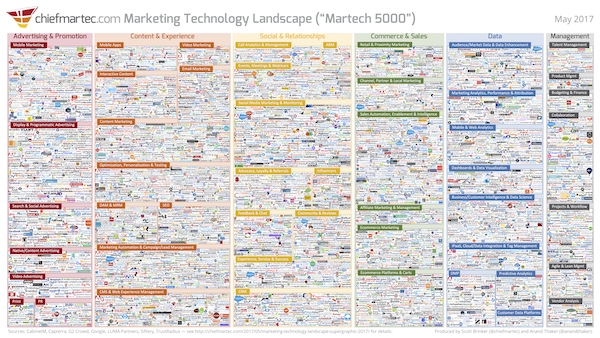
They have more systems to use. Increase of technology (MarkTech) is forcing Marketers to spend time learning and using systems that didn't exist 10 years ago. Below you can see the Marketing Technology Landscape representing more than 5000 solutions (3)
They have new competitors. GameChangers are appearing everywhere, disrupting classical models with no respect for existing codes and rules.

The classical 4Ps won't work anymore obviously. This is why Smartness is key for Marketers and they have to be smart in a digital world. IBM says (2): Marketers should increase their Digital Acumen. Best Marketers are using predictive and prescriptive analytics and cognitive computing to create richer customer experiences.
Marketers have to be able to analyse complex situations through complex data provided by complex systems and come with intelligent solutions, quickly. Wow! Looks like mission impossible, no?
Why Creative Marketers?
The word creativity might be overused and sometimes misused! I like the definition provided by Creativity at Work:
Creativity is characterised by the ability to perceive the world in new ways, to find hidden patterns, to make connections between seemingly unrelated phenomena, and to generate solutions. Creativity involves two processes: thinking, then producing.
This skills is fundamental today for any marketers because it implies 2 main actions: thinking differently, finding connections, hidden patterns AND turning these ideas into reality.
Interestingly enough, when following Marketing studies you either are very creative (art oriented school) or very productive (economical oriented school) but combining both is where the difficulty is.
Creativity is ranked by World Economic Forum as one of the top 3 skills you should have in the 4th industrial revolution.
Creativity will become one of the top three skills workers will need. With the avalanche of new products, new technologies and new ways of working, workers are going to have to become more creative in order to benefit from these changes.

In a fascinating study on The Conversation (7) by two Australian psychologists, creative people actually see the world differently. Their findings suggest that: "the creative tendencies of open people extend all the way down to basic visual perception. Open people may have fundamentally different visual experiences to the average person". In simple words, creative genius literally doesn't see the world the same way you do.
Some tips that might help you ...
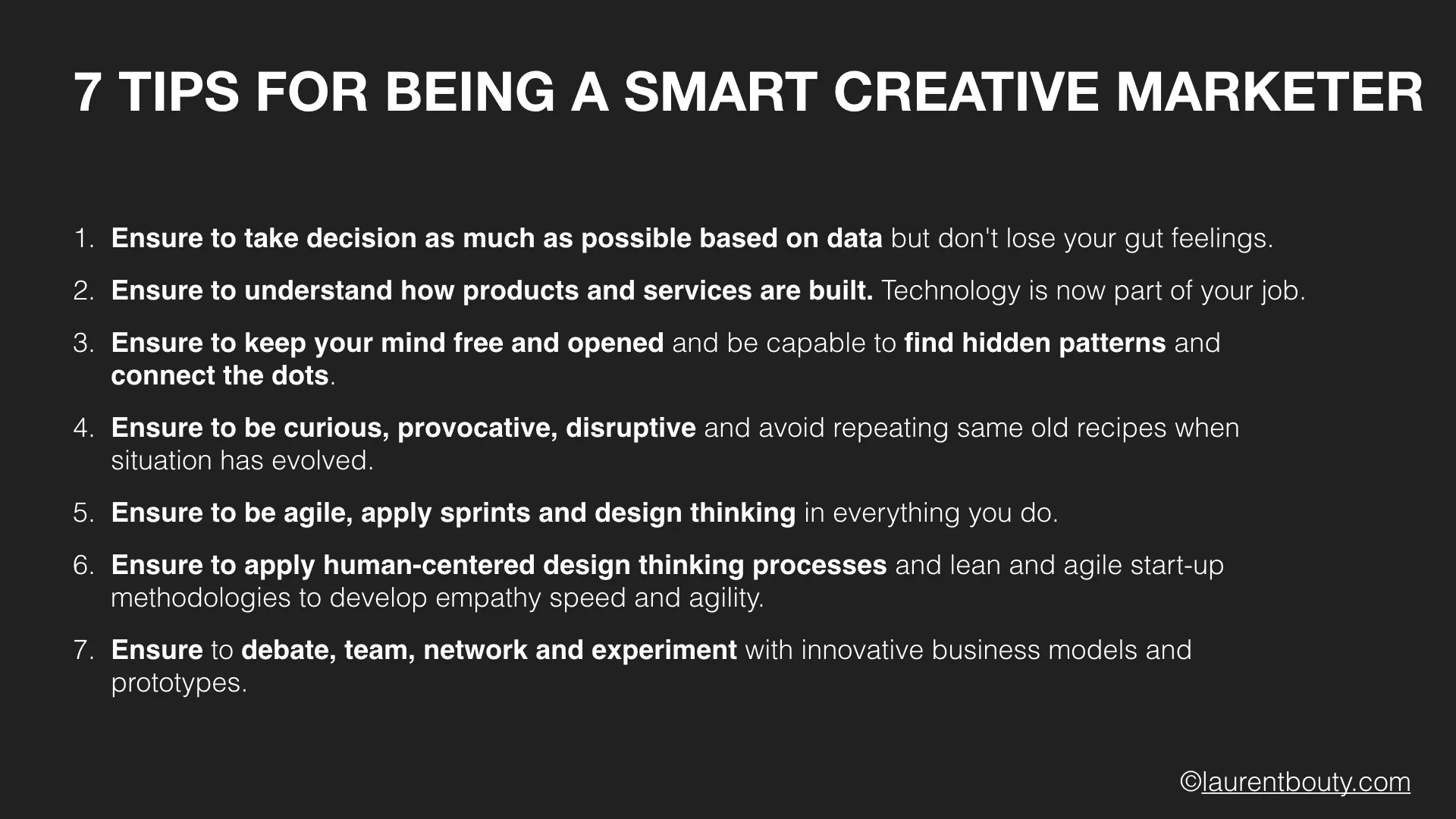
As a Marketer, you should be capable to explore data without fears and extract relevant insights and knowledge. Ensure to take decision as much as possible based on data but don't lose your gut feelings.
As a Marketer, you should be capable to build, change, rework systems as they are part of the value proposition and core to most of the current disruptions. Ensure to understand how products and services are built. Technology is now part of your job.
As a Marketer, you should have the flexibility to develop the capacity to think differently in multiple perspectives by operating from emergence, detachment and allowing. Ensure to keep your mind free and opened and be capable to find hidden patterns and connect the dots.
As a Marketer, you should be safe in ‘not knowing’ the answer or the solution but how to generate it through intentional disruption, provocation, and disagreement and through deep inquiry, listening, and debate. Ensure to be curious, provocative, disruptive and avoid repeating same old recipes when situation has evolved.
As a Marketer, you should be receptive and cultivate skills in the innovative thinking including divergent/convergent, critical, associative to ideate hypothetical solutions that may not have previously existed. Ensure to be agile, apply sprints and design thinking in everything you do.
As a Marketer, put always human in the center of what you do. Ensure to apply human-centered design thinking processes and lean and agile start-up methodologies to develop empathy speed and agility.
As Marketer, you cannot make it alone. Only team play and co-creation with customers will deliver solutions to your problems. Ensure to debate, team, network and experiment with innovative business models and prototypes.
Sources
- ORACLE (2017) - The Future of Modern Marketing: 2017
- IBM (2016) - Global C-Suite study - Redefining Markets: The CMO Point of View
- ChiefMarTec.com (2017) - http://chiefmartec.com/2017/05/marketing-techniology-landscape-supergraphic-2017/
- Creativity at work (2014) - What is creativity? - http://www.creativityatwork.com/2014/02/17/what-is-creativity/
- AdAge (2011) - The Habits of Highly Creative Marketers - http://adage.com/article/news/habits-highly-creative-marketers/229162/
- InnovationExcellence (2016) - The Rise of the Smart Creative (Lessons from Google) - http://innovationexcellence.com/blog/2016/05/23/the-rise-of-the-smart-creative-lessons-from-google/
- theconversation.com (2017) - People with creative personalities really do see the world differently - http://theconversation.com/people-with-creative-personalities-really-do-see-the-world-differently-77083

What are the Benefits of Simplicity in Marketing?
Do you think Simplicity is important for your Marketing? Is it a compulsory process for being successful with your Marketing? Why some Brands are capable to be extremely simple while others are complex, sometimes leading to confusion or frustration? Let's investigate.
Following Leonardo Da Vinci, Simplicity is the ultimate sophistication. It is not a given, it doesn't come like that, unfortunately. Some says that it is one of the most complicated skills.
Do you think Simplicity is important for your Marketing? Is it a compulsory process for being successful with your Marketing? Why some Brands are capable to be extremely simple while others are complex, sometimes leading to confusion or frustration? Let's investigate.
What do we mean by being Simple or Simplicity?
Before finding out if Simplicity is important, let's have a common understanding of what Simplicity is! Some external definitions could help us.
Quality or condition of being easy to understand or do (1)
Simplicity lies at the intersection of remarkably clear and unexpectedly fresh. Brands that deliver clear, human and useful experiences—win (2)
The question is then the following: Do we believe that being remarkably clear and easy to understand is impacting positively the efficiency and effectiveness of our Marketing actions? Differently said, if we are complex and unclear, do we have a worst ROI?
Some facts...
61% - The percentage of consumers who are more likely to recommend a brand because it provides simpler experiences and communications (2)
64% -The percentage of consumers willing to pay more for simpler experiences (2)
62% -Employees who can be considered Brand Champions in companies perceived to be simple (2)

© Crazyegg.com - Why is Apple’s Marketing Just So Darn Good?
The single biggest driver of stickiness, by far, was “decision simplicity”—the ease with which consumers can gather trustworthy information about a product and confidently and efficiently weigh their purchase options. What consumers want from marketers is, simply, simplicity. (3)
A recent A.T. Kearney analysis estimates that, on average, systematic complexity management can lead to an upturn in EBIT of 3 to 5 percentage points. A.T. Kearney estimates the additional EBIT potential for DAX companies alone to be worth more than €30 billion overall.
We can say that there is a consensus about the impact of simplicity on company performance (commercially and financially).
Now that we have validated the fact that Simplicity delivers Value, the question is what should I do for making it happen (just do it might not work without some help)?
Some tips that might help you...
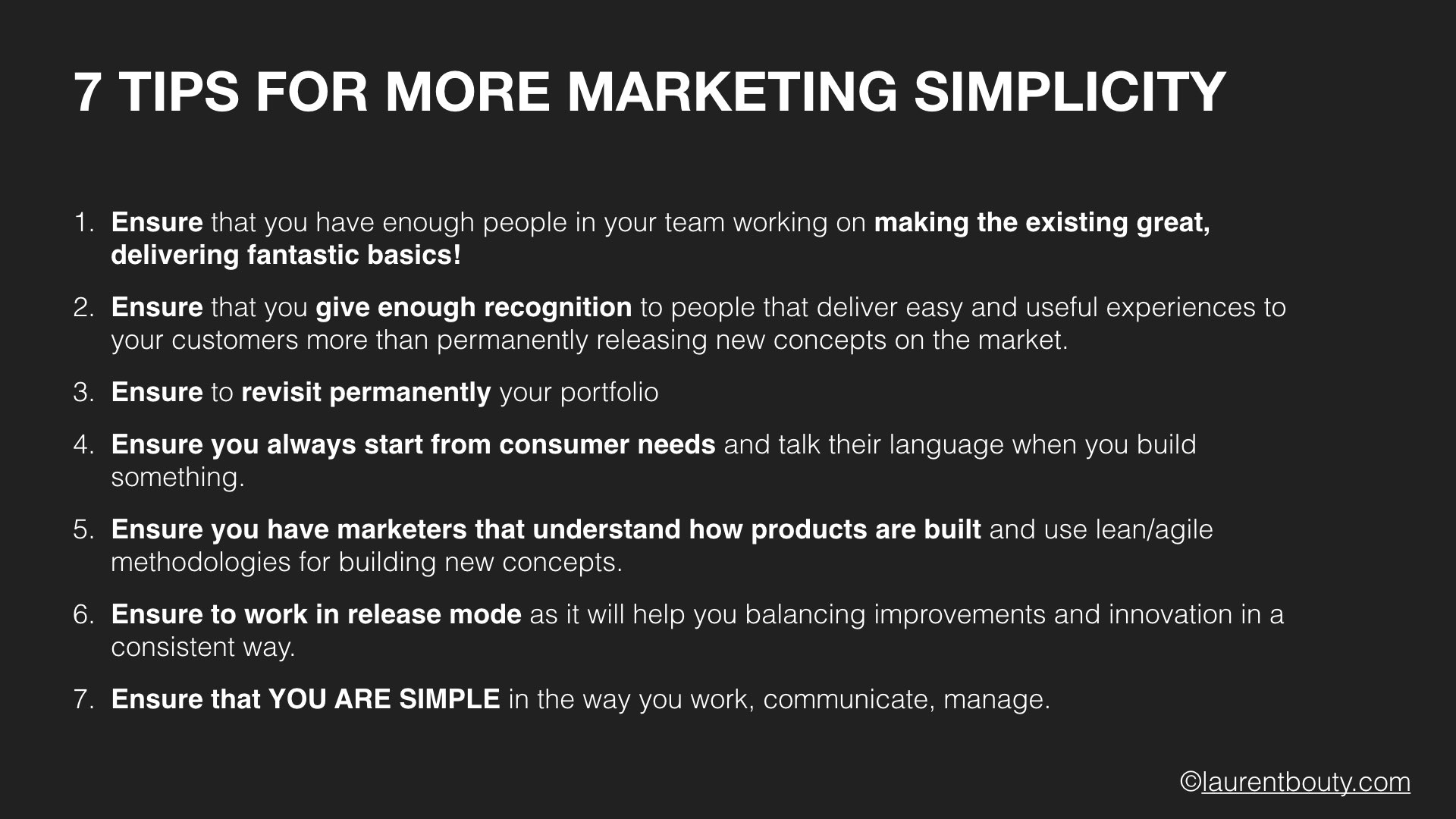
Simplicity doesn’t mean being boring. It is just being clear and consistent. I have noticed that marketers like to start new things but are easily bored when they have to manage existing business. This propensity to launch continuously new concepts might be a root cause for creating complexity and confusion. Let’s think about VW Golf. It is still the same concept but continuously improved. It gives a lot of confidence to customers and clients. It is clear and remarkably fresh because the concept is revisited at each new release. Ensure that you have enough people in your team working on making the existing great, delivering fantastic basics!
Management could be an issue as well. Team members want to demonstrate their creativity and leadership which push them to promote new things. It is good as long as we keep the consistency of the portfolio. Ensure that you give enough recognition to people that deliver easy and useful experiences to your customers more than permanently releasing new concepts on the market.
Be customer centric. We see it more and more hopefully but when you start from product features most of the times you are talking product and not consumer language. It is a real barrier to simplicity. Ensure you always start from consumer needs and talk their language when you build something.
Technology astuteness. Big issue is when Marketers have no clue how the concept will be built! This major gap between idea and technological feasibility leads to endless discussion between production and marketing teams. We see at the end of these discussions the creation of a Frankenstein, a monster product, something you would never do normally. Ensure you have marketers that understand how products are built and use lean/agile methodologies for building new concepts.
Ensure to revisit permanently your portfolio and ask yourself the following questions: how to make it effortless, more simple to understand, more easy to use, more easy to buy, what can we remove, what can we stop doing, …
Consider working in releases. What does it mean? You define 3 months release where you list a number of changes you would like to do on your product for improving it. It can be small changes or global revisit. This will help you structurally to manage the evolution of your product portfolio. Ensure to work in release mode as it will help you balancing improvements and innovation in a consistent way.
Finally, ensure that YOU ARE SIMPLE in the way you work, communicate, manage. Don’t forget LESS IS MORE.
Sources
- Cambridge dictionary
- Siegel+Gate (2017) - Global Brands Simplicity Index - http://simplicityindex.com/
- Harvard Business Review - Patrick Spenner, Karen Freeman - To keep your customers, keep it simple -
- ATKearney (2007) - How Much Does Complexity Really Cost?
Credit
photo from amazing unsplash.com, igor ovsyannykov

A quoi sert un responsable du Marketing?
Dans une étude publiée en 2013 sur le site Business Insider, le graduat en Marketing est considéré comme un des 10 diplômes les plus inutiles! C'est une vrai question que l'on peut se poser: Est-ce vraiment des études sérieuses? Est-ce que le métier du marketing est un métier qui apporte de la valeur à l'entreprise ou est-ce un métier dont on peut de débarrasser rapidement, un métier fourre-tout voir même un métier fluffy pour reprendre une expression anglaise difficilement traduisible.
Dans une étude publiée en 2013 sur le site Business Insider, le graduat en Marketing est considéré comme un des 10 diplômes les plus inutiles! C'est une vrai question que l'on peut se poser: Est-ce vraiment des études sérieuses? Est-ce que le métier du marketing est un métier qui apporte de la valeur à l'entreprise ou est-ce un métier dont on peut se débarrasser rapidement, un métier fourre-tout voir même un métier fluffy pour reprendre une expression anglaise difficilement traduisible.
En tant qu'Ingénieur Civil (ayant fait des études dites sérieuses) et ayant occupé des postes Marketing de hautes responsabilités dans des groupes internationaux et qui, de plus, dirige un Advanced Master en Créativité et Marketing au sein de Solvay Brussels School, cette question me laisse perplexe et me pousse à faire des recherches pour la valider ou l'invalider.
Qu'est ce que le Marketing ?
Le rôle du Marketing est très souvent mal compris et limité au support de la commercialisation des produits après leur développement. La perception générale est que le Marketing, c'est de la communication (les Mad Men de ce monde). Bien que la communication fasse souvent partie des prérogatives du Marketing, en aucun cas le Marketing ne se limite à la communication. Philip Kotler (1) qui a été un des précurseurs de la formalisation du Marketing, le défini comme suit:
Le Marketing est une Science et un Art pour explorer, créer et délivrer de la valeur pour satisfaire les besoins d'un groupe cible et générer du profit pour l'entreprise.
La tâche telle que décrite ci-dessus est donc massive et difficile en cette période turbulente. Explorer, Créer et Délivrer de la valeur pour une entreprise ne me semble pas une tâche ordinaire, simpliste voir modeste. Ce sont des défis et des enjeux permanents auxquels font face toutes les entreprises.
Comment se peut-il que des études qui vous préparent à Explorer, Créer et Délivrer de la valeur puissent être considérées parmi les diplômes les plus inutiles? Le mystère reste total! Cherchons plus loin.
L'évolution du rôle du Marketing dans une entreprise?
On pourrait penser que le rôle du marketer se limite à faire de la communication, participer à des études consommateurs dans des endroits sympathiques ou être présent sur des stands flamboyants dans des foires. Pour ma part, tout au long de ma carrière professionnelle, j'ai eu la chance d'observer et de travailler avec des marketers qui avaient des fonctions bien plus larges et complexes que celles décrites ci-dessus. De plus, de nombreuses études prédisent une augmentation des tâches liées au marketing et un renforcement des responsabilités de la fonction. Dans une étude publiée par Microsoft (3), le rôle du Marketing et de son leader (Chief Marketing Officer) est en croissance et se diversifie à travers l'entreprise. Il devient le plus gros consommateur d'investissement IT de l'entreprise (plus de 60% des investissements suivant Gartner en 2017).
J'entends déjà certains dire que l'expérience client, la digitalisation ou l'innovation ne fait pas partie du Marketing. Je les renvoie vers sa définition. On peut donner de nouveaux noms mais les fondamentaux restent: créer et capturer de la valeur.
Donc le rôle du Marketer devient de plus en plus important! Le métier grandit: en périmètre et en séniorité. Il a une place de plus en plus stratégique au sein de l'entreprise. Son leader (le CMO) est même pressenti comme le remplaçant potentiel du CEO. Pas de doute donc sur le métier, le problème vient donc des études.
Où est le problème dans les études Marketing?
Comment se fait-il que la perception que l'on a des études Marketing puisse être négative? Cela vient peut-être de la difficulté de combiner une approche scientifique formelle avec une approche créative nécessaire pour trouver de nouvelles solutions à de nouveaux problèmes et pour toucher le coeur des clients. L'ambigüitée est encore renforcée par le fait que la majorité des bacheliers en Marketing sont pauvres dans leur formation scientifique, se limitant généralement à un cours d'économie et un cours de statistiques. La conséquence de cette faiblesse est malheureusement double: cela attire des étudiants qui n'ont pas les fondamentaux pour appliquer une analyse scientifique à un problème (pré-requis dans un monde où la technologie et les données sont omniprésentes) et cela crée une perception que le Marketing se limite à la communication. N'interprétez-pas mal cette analyse! La communication reste une partie fondamentale du Marketing et mérite en tant que tel tout notre respect. Mais les sciences de la communication ne sont pas suffisantes pour aspirer à une fonction de leader dans le Marketing, pour être capable de faire une analyse rigoureuse de la situation d'une entreprise et pour décider de ses investissements technologiques.
Une autre filiale plus scientifiques semblerait plus appropriée. Elle est a toutefois de nombreuses lacunes sur la partie émotionnelle et empathique nécessaire au Marketing. Sans caricaturer, un ingénieur peut paraitre un peu robocop dans certaines situations. Voila donc un vrai vide à combler. Comment réconcilier les Arts et les Sciences au sein d'un curriculum complet. Ne se rapproche-t-on pas de la Renaissance? Les filières marketing ont besoin de refaire leur marketing!
Conclusions
Il n'y a aucun doute. Le métier reste et restera important pour une entreprise (petite, moyenne ou grande). Pour remplir sa fonction, Le Marketer doit savamment mélanger les Arts et Sciences. Il faut accorder autant d'attention pour ces deux disciplines. Malheureusement, les études actuelles nécessitent de faire un choix entre les Sciences et les Arts. Voici mes conseils basés sur mon expérience personnelle:
- Il est plus facile de démarrer par une filière scientifique. Bien que les sciences puissent paraitre rebutantes pour certains, un marketer doit être capable de gérer les enjeux stratégiques et technologiques d'une entreprise.
- Une filière scientifique n'est pas suffisante. Un marketer doit développer sa sensibilité émotionnelle, sa capacité à communiquer visuellement et verbalement ainsi que son intérêt pour les tendances sociétales.
- Il n'y a pas un seul chemin pour devenir un grand marketer. N'oublions pas le rôle important jouée par les entreprises et les premiers emplois qui souvent comblent les manquements des études. Faites des stages et beaucoup.
- Nous sommes dans un monde en mouvement. Une mise à jour permanente est donc nécessaire. Apprenez chaque année quelque chose de nouveau: une technologie, un art visuel, ...
- Faites ce métier. Il est passionnant, difficile, riche, plein de challenges mais jamais ennuyant ni décevant!
Sources
- Dr. Philip Kotler Answers Your Questions on Marketing. Source: http://www.kotlermarketing.com/
- CMO Council (2016), The CMO shift to gaining business lift
- Microsoft (2014), Future of the CMO. How Digital Technology Is Reshaping Marketing Organizations

Comment créer de la croissance dans la troisième révolution industrielle?
Changement de croissance, évolution des attentes, multiplication de la concurrence… Nous sommes au cœur d’une quatrième révolution industrielle qui oblige l’entrepreneur à revoir en profondeur sa copie. Laurent Bouty décrypte pour nous cette nouvelle révolution et les stratégies à adopter pour s’y imposer.
"La croissance digitale s’est imposée… Avec elle, de nouvelles équations ont vu le jour. Les résoudre n’est pas tâche facile et c’est aujourd’hui le véritable défi des entreprises."
Après s’être chargé du marketing de grandes entreprises, Laurent Bouty porte plusieurs casquettes. Il est Directeur académique à la Solvay Brussels School of Economics and Management où il dirige un Advanced Master in Creativity & Marketing, il est également partenaire d’une nouvelle agence qui accompagne les entreprises à penser leur futur (The Beyonders)… Il est donc, vous l’avez compris, particulièrement bien informé sur les nouvelles règles qui régissent notre économie et les méthodes incontournables pour les apprivoiser.
Nouveaux clients et dématérialisation
"La croissance, une fois qu’on y a goûté, on ne peut plus s’en passer ! Au cœur de notre monde capitaliste, on a pris l’habitude que, l’année suivante, on fera toujours mieux que l’année précédente. C’était une quête envisageable lorsque la population augmentait et que l’accessibilité aux produits n’était pas généralisée… Mais aujourd’hui, tous les produits sont accessibles à tout le monde et la population croît moins vite.".
À ce constat dressé par Laurent Bouty s’ajoute le fait que les clients ne sont plus les mêmes : "aspirationnels, ils mélangent matérialisme à des aspirations sociales et environnementales… Ils veulent l’abondance, mais plus de gaspillage. Ils veulent la vérité, on ne peut plus leur mentir. Ils recherchent la proximité avec le producteur, l’accès à tout. Et ils veulent que les marques leur fassent du bien, qu’elles limitent leur impact sur l’environnement par exemple." Si elles ne se conforment pas à ces exigences, les entreprises perdent des clients.
Ils veulent l’abondance, mais plus de gaspillage. Ils veulent la vérité, on ne peut plus leur mentir. Ils recherchent la proximité avec le producteur…
Vient s’y greffer une troisième révolution industrielle : si la transformation de la matière première était le moteur de la croissance du 20e siècle, elle fait place aujourd’hui à la dématérialisation. Cette capacité à passer du physique au non physique révolutionne, entre autres, l’énergie, les transports et les communications. Elle perturbe toute l’activité économique et place sur un piédestal les acteurs proposant un impact neutre sur la planète. "Ainsi, le succès du passé n’est plus une garantie du futur. Partout et à tout moment, des grandes marques annoncent leur disparition ou une baisse d’effectifs. Il faut se réinventer… Nous y sommes forcés !"
Partout et à tout moment, des grandes marques annoncent leur disparition ou une baisse d’effectifs. Il faut se réinventer…
Les cinq conseils pour sortir du lot
Un nouveau modèle économique s’impose, les entrepreneurs doivent le comprendre et s’adapter. D’autant qu’il a entraîné, dans pratiquement tous les domaines, une concurrence accrue issue des quatre coins de la planète, ainsi qu’une quasi-disparition de la pénurie. Si les entreprises disposent toujours des mêmes leviers pour interpeller et marquer les esprits (à savoir le prix, l’émotion et la nouveauté), elles sont aussi contraintes à se battre autrement.
Laurent Bouty conseille alors cinq armes qu’il est nécessaire de maîtriser pour sortir du lot :
- "Être sérieux face à ces changements, ne pas les prendre à la légère, et donc mettre les moyens humains et financiers pour les appréhender.
- Être clair, choisir précisément son modèle et son idéologie, se concentrer sur qui l’on est vraiment.
- La générosité paye ! Ce qui ne signifie pas forcément qu’il faut faire des cadeaux matériels aux clients… Leur permettre de gagner du temps et de se sentir utiles sont, par exemple, des présents très appréciés.
- Prendre en compte l’impact de son activité sur l’environnement au sens large… D’autant plus qu’aujourd’hui, tout se sait.
- Demain appartient à ceux qui le préparent aujourd’hui !"



Growth in a Digital World
By 2020 every business will become a digital predator or digital prey — which will your company evolve into? 5 attitudes you should have if you want to create growth in a this new digital world.
“By 2020 every business will become a digital predator or digital prey — which will your company evolve into?”
If you are reading this article, you might probably be interested in growing your business. While the question is easy to ask (I remember financial controllers asking me to find extra 3% revenue growth while my corporate building had been attacked by 2000 people and we suffered 50M$ damage), the answer is certainly not so obvious these days!
What growth means?
Before defining the solution, we need to understand the problem. If you want more revenue, you need to play with the following parameters of your revenue equation:
- More paid users than today with same number of transactions: you should have more clients on a yearly basis buying your product and services than last year. It can come from the market (population is growing, available market is important) and/or from your commercial actions (acquisition and retention).
- More transactions than today with same number of users: these clients should spend more on average for each commercial transactions they do with you. This can come from either (1) more products purchased during the transaction (e.g. menu versus separated items) and/or (2) an higher price paid for these products (discounted brand versus premium brand). Usually it comes from your commercial activity (stimulation).
- A positive mix of users and/or transactions: Usually the reality sits in a positive mix between users and transactions (we called it elasticity).

At the end, the combination between users and transactions should generate an higher revenue. This is the only way for generating growth. The last 20 years, we were palying with these combination by IMPROVING our commercial processes (doing better) or EXTENDING it (doing more). It did work primarily because population was growing, people economic power was growing and products were not fully available everywhere. Those days are unfortunately gone.
The thesis I am submitting to you is that for the next decade, it is not sufficient and we can only survive as a company if we CHANGE our commercial processes (new business model). Let's find out if my thesis is right.
Insight 1 - Consumers are Changing

People are changing and I am quite optimistic wth this trend. We can see this as a DES-INDUSTRIALISATION of their consumption habits.
They want abundance but they care about waste. They want you to be genuinely true. They want you to be closer. They want all options. And finally, they want you to positvely contribute to their life and world.
Insight 2 - Your World is Changing
In these days, the old habit of looking at what happened last year and extrapolating commercial figures from these data might not work because we are living in a turbulent period. If you are still doubting that we are living in a turbulent period, I really invite you to read Jeremy Rifkin on the Third Industrial Revolution.
The last century, 12,5% of economical growth can only explained by labour performance and machine capital. The rest (87.5%) was a mystery and commonly referred as "the mesure of our ignorance". After 25 years of investigations, a number of analysts concluded that economic growth could be explained by 3 factors: labour performance, machine capital and energy use. During the last 100 years, we have created economic growth thanks to the combination of electricity grid, telecommunications network, road system and fossil fuel energies. Maybe a little bit simplistic, but I would say: WE CREATED GROWTH BY BURNING THE PLANET.
The fantastic news is that we are entering in a third industrial revolution. This revolution is driven by free energy, automated transportation, internet and dematerialisation.
Insight 3 - You have new competitors

Insight 4 - How will you play the game?

5 Attitudes for creating Growth in a Digital World
If you are not taking this digital revolution seriously (dematerialisation, collaboration, distributed capitalism), you will be most probably a digital prey in the coming years.

As the attention of people is shrinking (we are in an Attention Economy), it is fundamental that you are clear about why people would buy and stay with you (What is your purpose? What job to be done are you in? How do you monetise your activities?).

People and companies are expecting you to be generous because we are in the OUTCOME ECONOMY era where you should help people save time and effort in their daily lives.

Peter Drucker rightly said: "Culture eats strategy at breakfast". It means that even if you have the smartest strategy, you will only be successful if you have the right people and culture for delivering it.

Remember the S-Curve! What you do today, will only generate real results in 2 to 3 years. Start early when you still have time to do it because it is much more difficult when you are running out of cash or profit.

Ne vendez pas un produit aux clients mais une expérience
Vous êtes-vous déjà demandé pourquoi tel ou tel client ne revenait jamais, bien qu’il ait semblé plutôt satisfait ? Ou peut- être avez-vous déjà vous-même quitté un magasin alors que vous aviez la ferme intention d’y acheter quelque chose ?
Article paru suite à ma conférence chez ING - La semaine de l'entrepreneur en Avril 2016.
Vous êtes-vous déjà demandé pourquoi tel ou tel client ne revenait jamais, bien qu’il ait semblé plutôt satisfait ? Ou peut- être avez-vous déjà vous-même quitté un magasin alors que vous aviez la ferme intention d’y acheter quelque chose ?
« Il y a de fortes chances que l’expérience client n’était pas satisfaisante », explique Laurent Bouty, Academic Director de la Solvay Brussels School of Economics and Management (SBS-EM-ULB). La différence entre vos produits et ceux de vos concurrents réside sans doute dans la manière dont votre marque est ressentie. Les expériences vécues par le client sont primordiales, mais le problème est que cette expérience est différente pour chacun. Pensez, par exemple, à la question du prix. Être plus cher que la concurrence n’est pas un problème en soi, à la condition que l’on puisse offrir au client une expérience agréable ou stimulante. Pourquoi certaines marques sont-elles devenues incontournables ? Parce qu’elles vendent en premier lieu des émotions. Et ces émotions deviennent la marque. Dans le cas de Harley Davidson, les gens n’achètent pas un moyen de transport, mais un ticket d’accès à un groupe qui aime l’aventure. Et pour appartenir encore davantage au groupe, il faut acheter en plus de la moto, les vêtements et les accessoires adéquats. Nike ne vend pas des chaussures de course, mais une expérience complète de running. Évidemment, il faut donner au consommateur ce qu’on prétend lui donner. Le produit doit être bon, il n’y a rien de pire qu’un bon marketing pour un mauvais produit. C’est la garantie de ne jamais revoir le client.
Quatre moments de vérité
La bonne nouvelle est qu’en tant que marque, vous avez le contrôle sur ce processus, en jouant sur quatre moments clés : en premier lieu, le consommateur doit avoir conscience que la marque existe (Awareness). Les clients font leurs recherches, en surfant sur l’Internet, en posant des questions à leurs amis. Le mode de recherche varie de produit à produit, de marque à marque. Pour un voyage, les gens s’informent différemment que pour de l’électronique, les marques doivent y réfléchir. Ensuite arrive le moment où le consommateur envisage d’acheter chez vous (Consideration) et puis vient l’acte d’achat en tant que tel (Purchasing). Votre client téléphone et tombe sur une téléphoniste mal lunée ? Ou il entre dans le magasin et a le sentiment que personne ne lui prête attention ?
Ce sont deux occasions manquées ! Enfin, il y a l’expérience du consommateur avec votre produit (Experiences). Si cette expérience est positive, il aura tendance à vouloir la partager sur Facebook. Ou réaliser une petite vidéo explicative. Ou mieux encore, envisager d’acheter des accessoires. Il est donc très important de bien aborder ces quatre moments et de proposer du « contenu » pour ces moments. Du contenu qui correspond à ce que représente la marque et en reflète les valeurs. Pourtant, ce qu’exprime la marque elle-même n’est pas le plus important. Ce qui compte, c’est ce que le client en dit. N’hésitez donc pas à demander au client ce qu’il a pensé d’un produit ou service. Il n’est pas nécessaire de faire de longues enquêtes, une ou deux questions su sent. Ou demandez seulement d’attribuer un score et de l’expliquer en quelques mots.
Être plus cher que la concurrence n’est pas un problème en soi, à la condition que l’on puisse offrir au client une expérience agréable ou stimulante. Professeur Laurent Bouty - ULB
Une offre réduite mais plus claire
Les clients, qu’ils soient des particuliers ou des entreprises, sont assommés d’informations. Il y a 20 milliards de sites web dans le monde, soit trois fois plus que d’humains sur terre. Et plus chacun hurle pour di user son information gratuitement, plus chacun ferme ses oreilles pour surtout ne rien entendre. Sauf si cela les intéresse très fort bien sûr. Nous avons par conséquent évolué vers une économie où l’attention est devenue une den- rée rare. Et que constatons-nous ? L’attention se dirige vers les entreprises et les marques qui parviennent à garder les choses simples et cohérentes. Ce n’est pas Carrefour qui s’en sort le mieux, mais Colruyt. Chez Colruyt, les choses sont simples. Dès qu’il entre dans le magasin, le client comprend qu’il ne paie pas pour l’esthétique du bâtiment, car l’entreprise a investi son argent ailleurs. Mais le meilleur exemple reste toutefois Apple : leur gamme est réduite et, dès lors, facile à comprendre. VOO également veut apporter de la simplicité à ses clients et a décidé de réduire son offre. Alexandra Guillot (@aguillot), Manager Brand & Sponsoring : « Nous nous distinguons de la concurrence avec une offre limitée à trois formules. En outre, nous nous adressons clairement à la famille d’aujourd’hui. La famille moderne est flexible et évolue en permanence, nous et nos formules aussi. Nous prêtons, par ailleurs, beaucoup d’attention à notre engagement en faveur d’un service après-vente de qualité. Le client sait que nous sommes là pour lui. Une fois que le contrat est signé, le client n’est pas abandonné à son sort. »
Connaissez votre client
Bien connaître le client est effectivement le principe de base de toute marque. C’est la seule façon d’anticiper les attentes du client. Il est donc vital qu’une entreprise se pose les bonnes questions : qui sont mes clients ? Quel est mon terrain d’action ? Qui sont mes concurrents ? Comment vais-je faire la différence ? Et de la réponse à ces questions découle tout le reste. Le fait que ce ne soit pas toujours si simple ressort du témoignage d’Alexandre Helson, Business Developer de la Maison Dandoy, à Bruxelles : « Notre public s’étend des écoliers, qui viennent acheter quelques biscuits, aux grands-mères qui n’achètent qu’un grand spéculoos pour la Saint-Nicolas.
Le dénominateur commun, c’est qu’ils aiment tous les biscuits. Grâce à notre campagne de rebranding, nous avons toutefois réussi à rajeunir notre image, même s’il y a encore du pain sur la planche pour accroître notre notoriété. Actuellement, nous sommes quasiment plus connus à Paris qu’en Flandre ou en Wallonie. À proprement parler, nous sommes les spécialistes des biscuits. Pour notre rebranding, nous avons fait appel à des professionnels externes. Nous avons dû nous habituer à leurs idées, mais quelques années plus tard, nous sommes fiers de ce travail en commun. »
Soyez inventif
Aujourd’hui, peu d’entrepreneurs ont un budget suffisant que pour faire impression avec de grandes campagnes publicitaires. Les entreprises doivent donc être créatives et mettre en œuvre des moyens digitaux pour attirer l’attention de leur public. Elles font ainsi en sorte que leurs clients fassent eux-mêmes la promotion de la marque. Pensez, par exemple, à Facebook, Instagram, les blogs, les lettres d’information, les concours et un service après-vente rapide et efficace. Alexandre Helson : « Nous disposons à peine d’un budget marketing. En tant que « créateur d’émotions », nous misons sur l’humour, par exemple sur notre page Facebook. Et parfois, on attire l’attention de façon involontaire, comme lors de notre dernière campagne pour la Saint-Valentin. Ce furent pour Dandoy et moi-même des semaines très intenses, mais nous osons espérer que notre notoriété en a bénéficié.