A customer journey that was never designed cannot be improved. If your team built the journey map in an internal meeting — without customer observations, without mapping what customers think, feel, and do at each moment — you have a process map, not a journey. This assessment scores the difference.
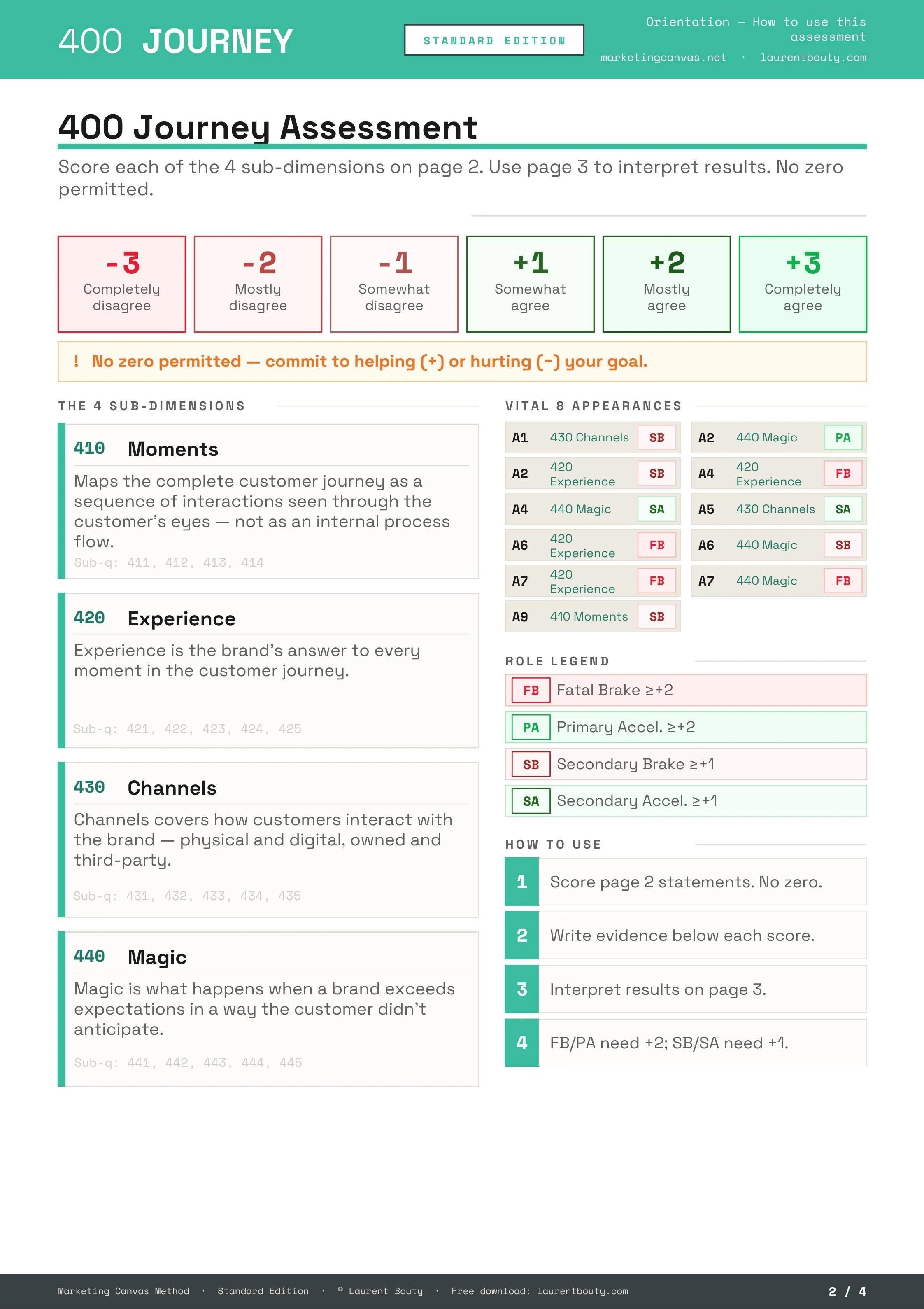
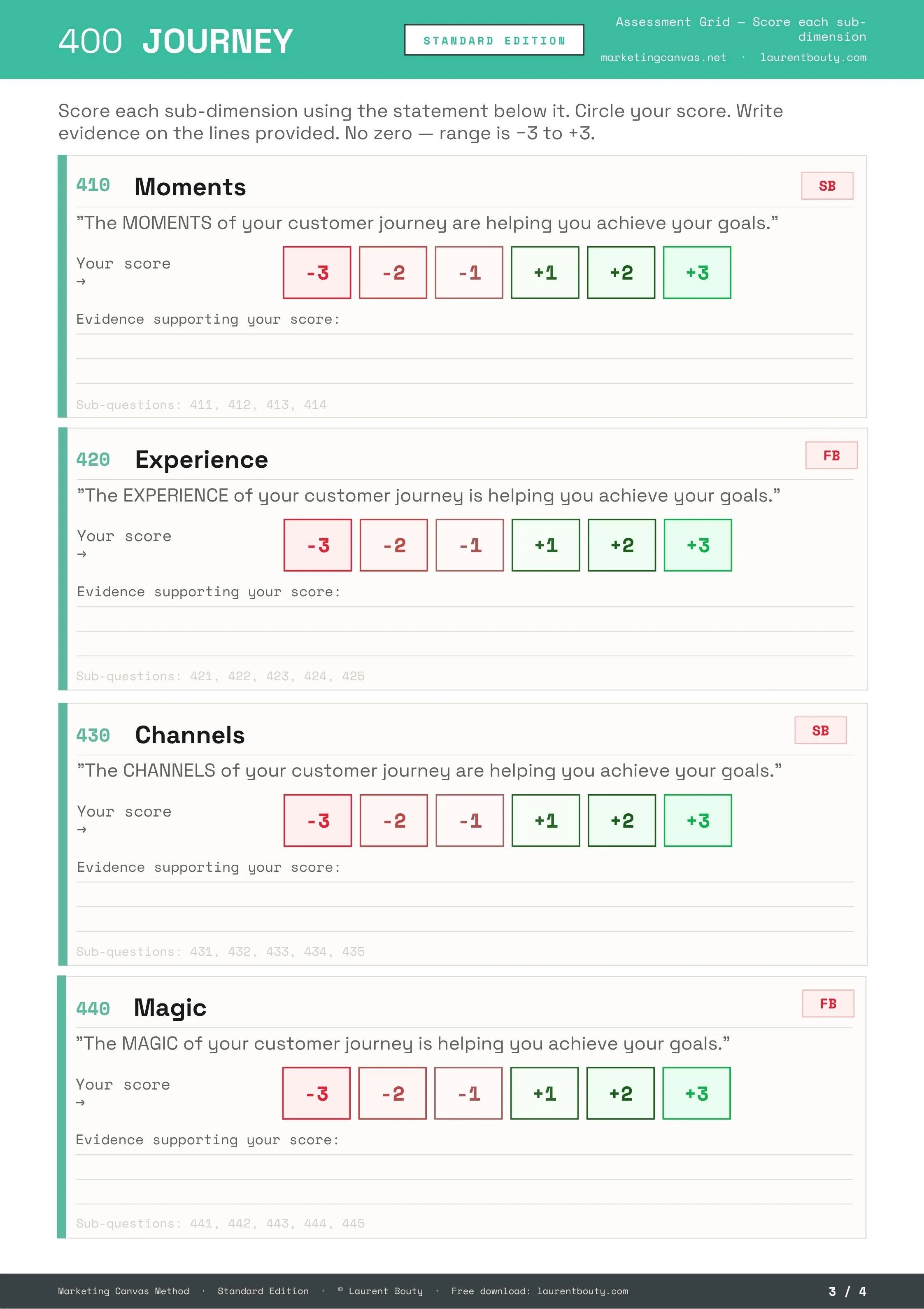
The 400 Journey Standard Assessment covers four sub-dimensions: Moments (410), Experience (420), Channels (430), and Magic (440). One statement per sub-dimension. A negative score on Experience (420) — the most common Fatal Brake in the method, appearing in 3 archetypes — means your brand's response to customer moments is actively driving churn. A negative score on Magic means your experience generates no word-of-mouth.
Use this if:
You are investigating why NPS is flat, why customers are churning despite a strong product, or whether your channel strategy is creating silos rather than seamless experiences.
What you'll know after completing it:
- Whether your customer journey is research-based or assumption-based
- Whether your experience is consistent across all moments — or just some of them
- Whether the magic in your journey is designed or accidental (and therefore unscalable)
WHAT'S INCLUDED
- 4-page A4 portrait PPTX (print-ready, editable)
- Page 2: Orientation — scoring scale, 4 sub-dimensions, all 11 Vital 8 Journey appearances (including SA roles), compact 2-column grid
- Page 3: Assessment Grid — one statement per sub-dimension, score boxes, evidence lines
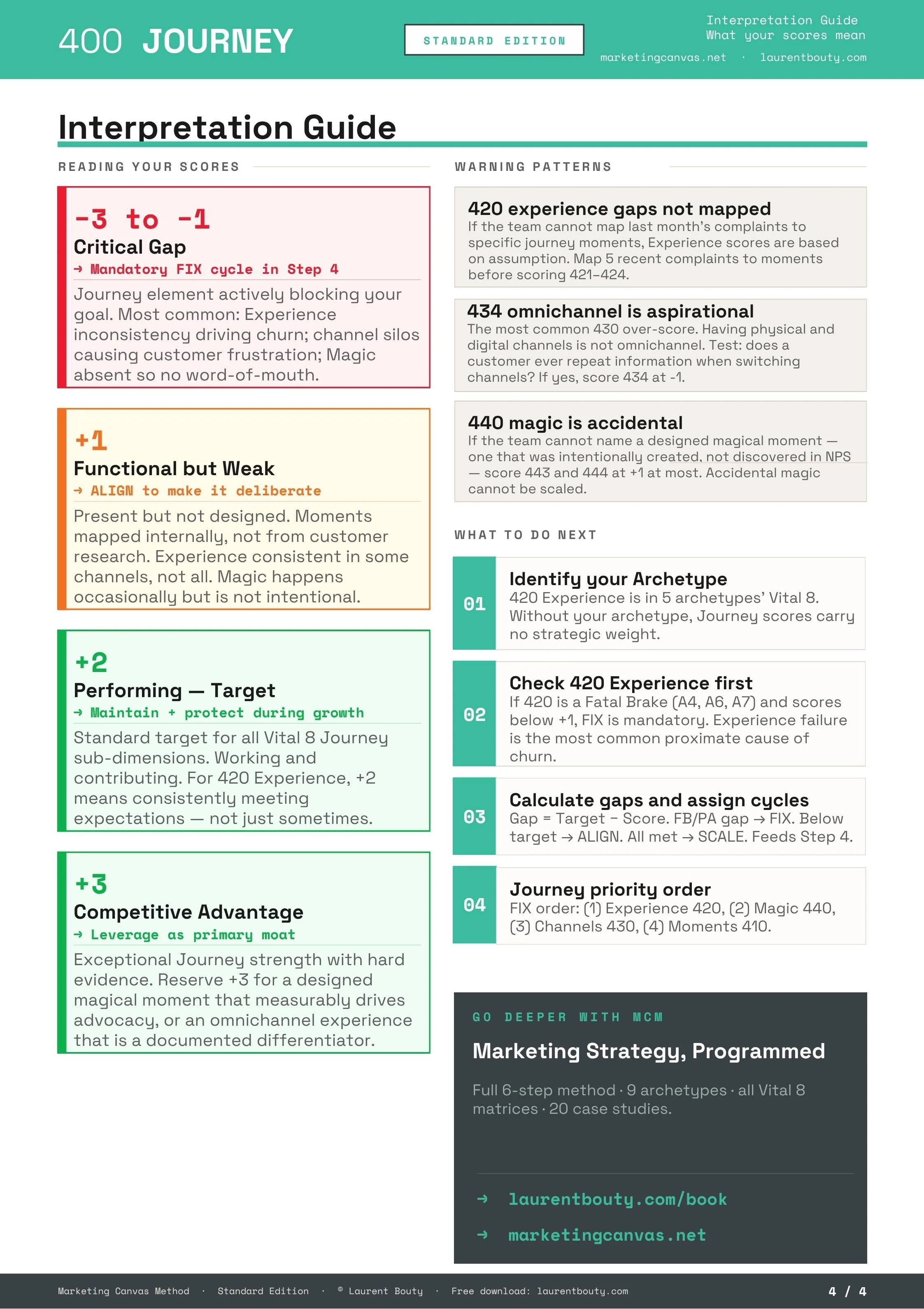
- Page 4: Interpretation Guide — score ranges, 3 Journey-specific warning patterns, next steps

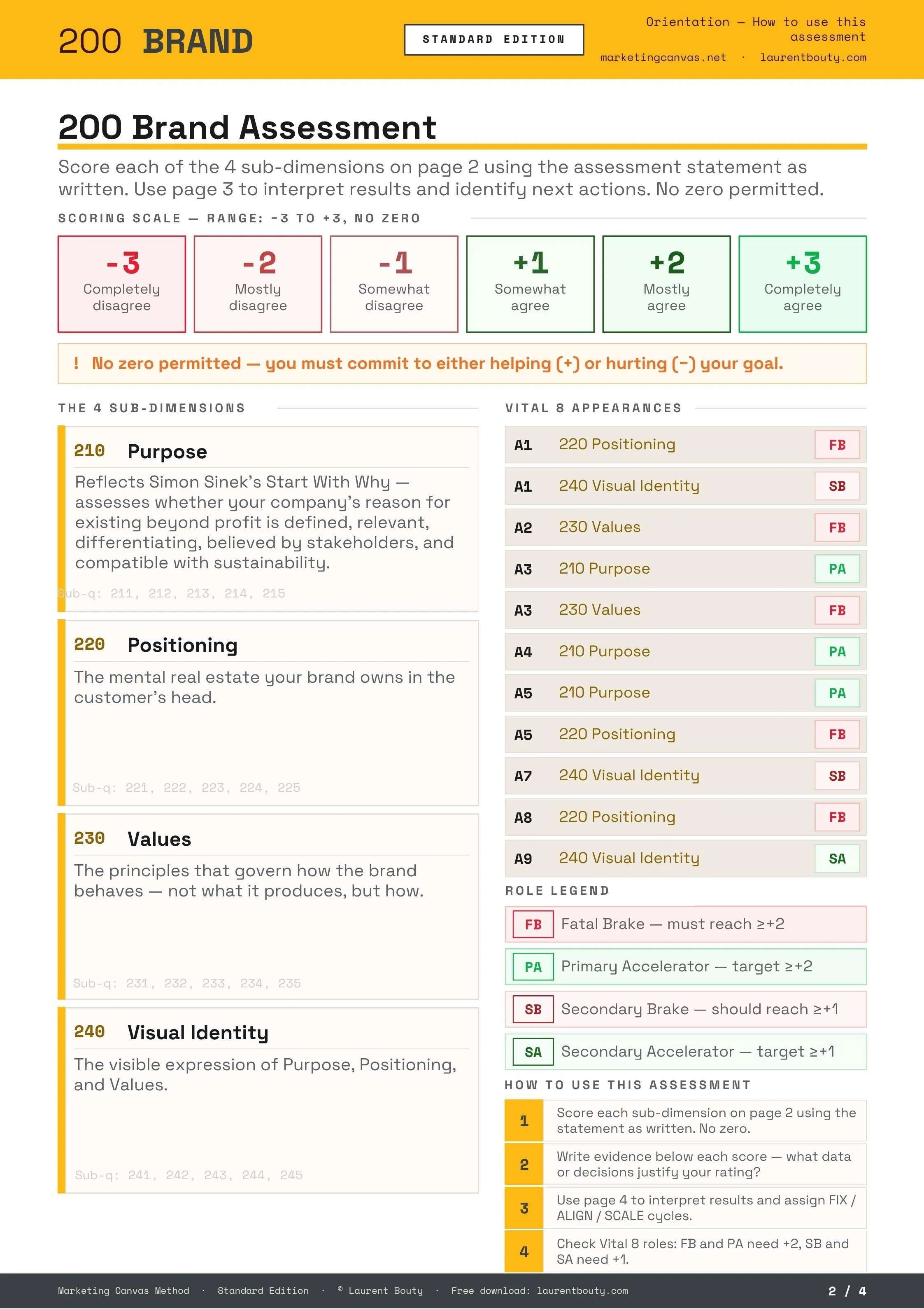
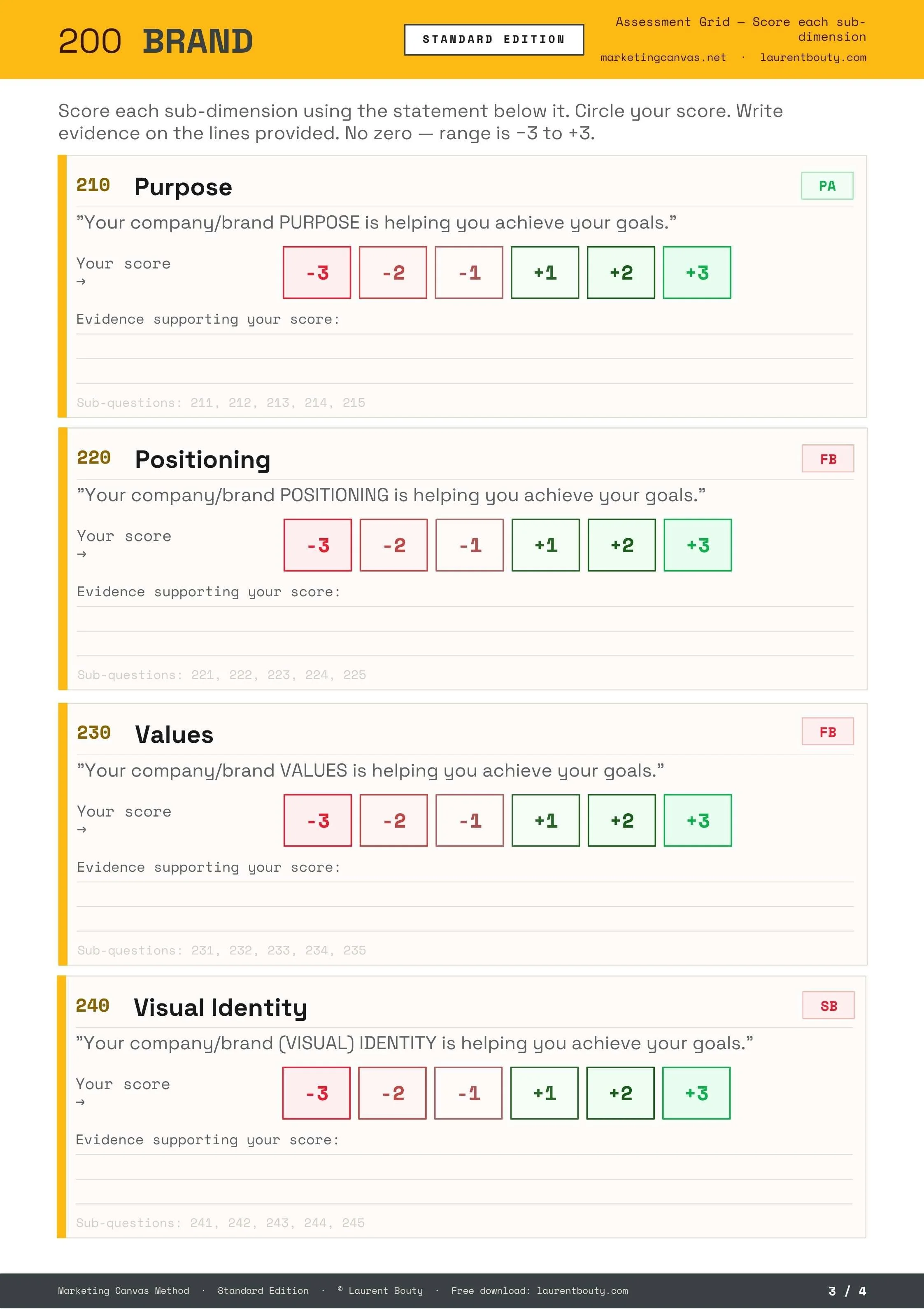
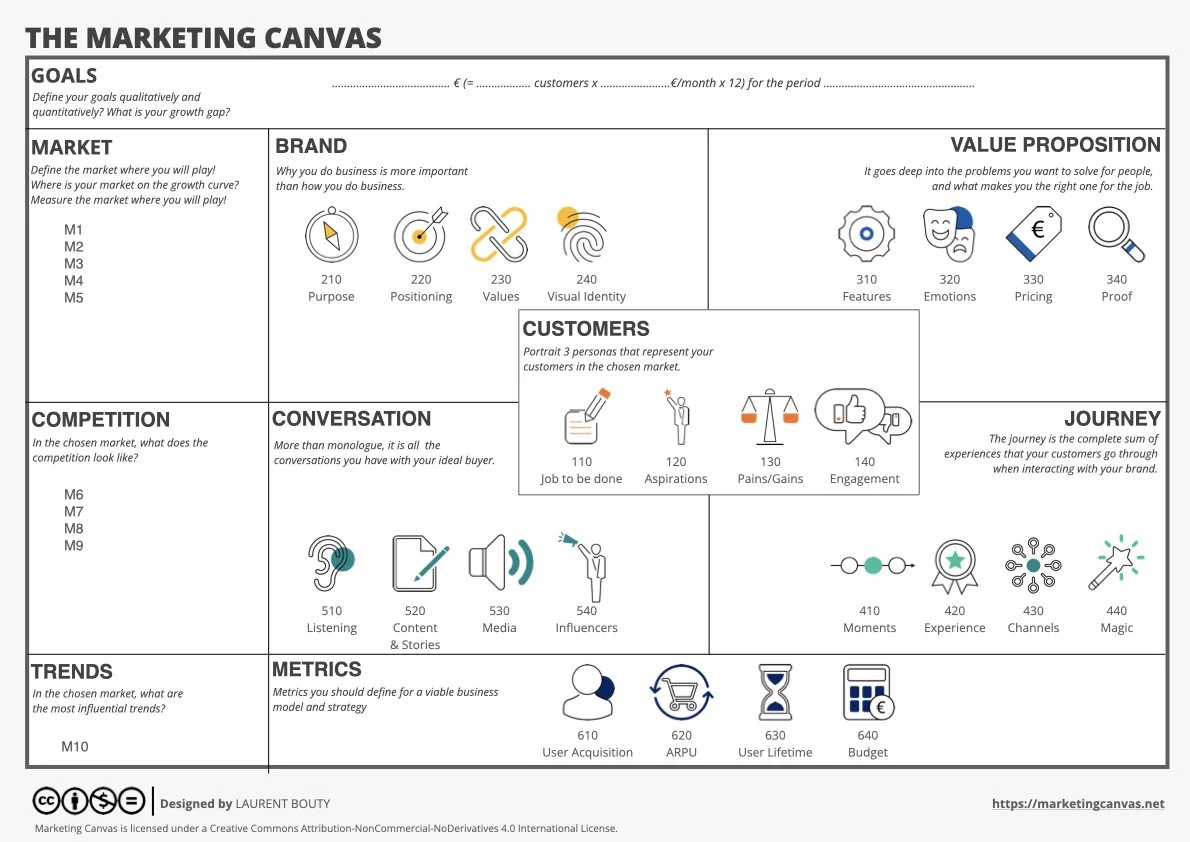
Brand is not a logo or a colour palette. In the Marketing Canvas Method, Brand is a strategic architecture: the system of decisions that determines why customers choose you over a competitor. This assessment scores whether that architecture is operational.
The 100 Brand Standard Assessment covers four sub-dimensions: Purpose (210), Positioning (220), Values (230), and Visual Identity (240). For each, you score one canonical statement on a −3 to +3 scale. The results are immediate: a negative score on Positioning means your brand occupies no specific mental real estate. A negative score on Values means your stated principles are wall decor, not decision-making tools.
Use this if:
You suspect your brand is not doing strategic work — or you want to validate that it is before investing in campaigns, a rebrand, or a new market entry.
What you'll know after completing it:
- Whether your Positioning is specific enough to exclude competitors, or generic enough for any of them to claim
- Whether your Values have changed at least one decision in the last 12 months
- Which Brand sub-dimension is most likely to be blocking your archetype's primary goal
WHAT'S INCLUDED
- 4-page A4 portrait PPTX (print-ready, editable)
- Page 2: Orientation — scoring scale, 4 sub-dimensions, all 11 Vital 8 Brand appearances, role legend
- Page 3: Assessment Grid — one statement per sub-dimension, score boxes, evidence lines
- Page 4: Interpretation Guide — score ranges, 3 Brand-specific warning patterns, next steps

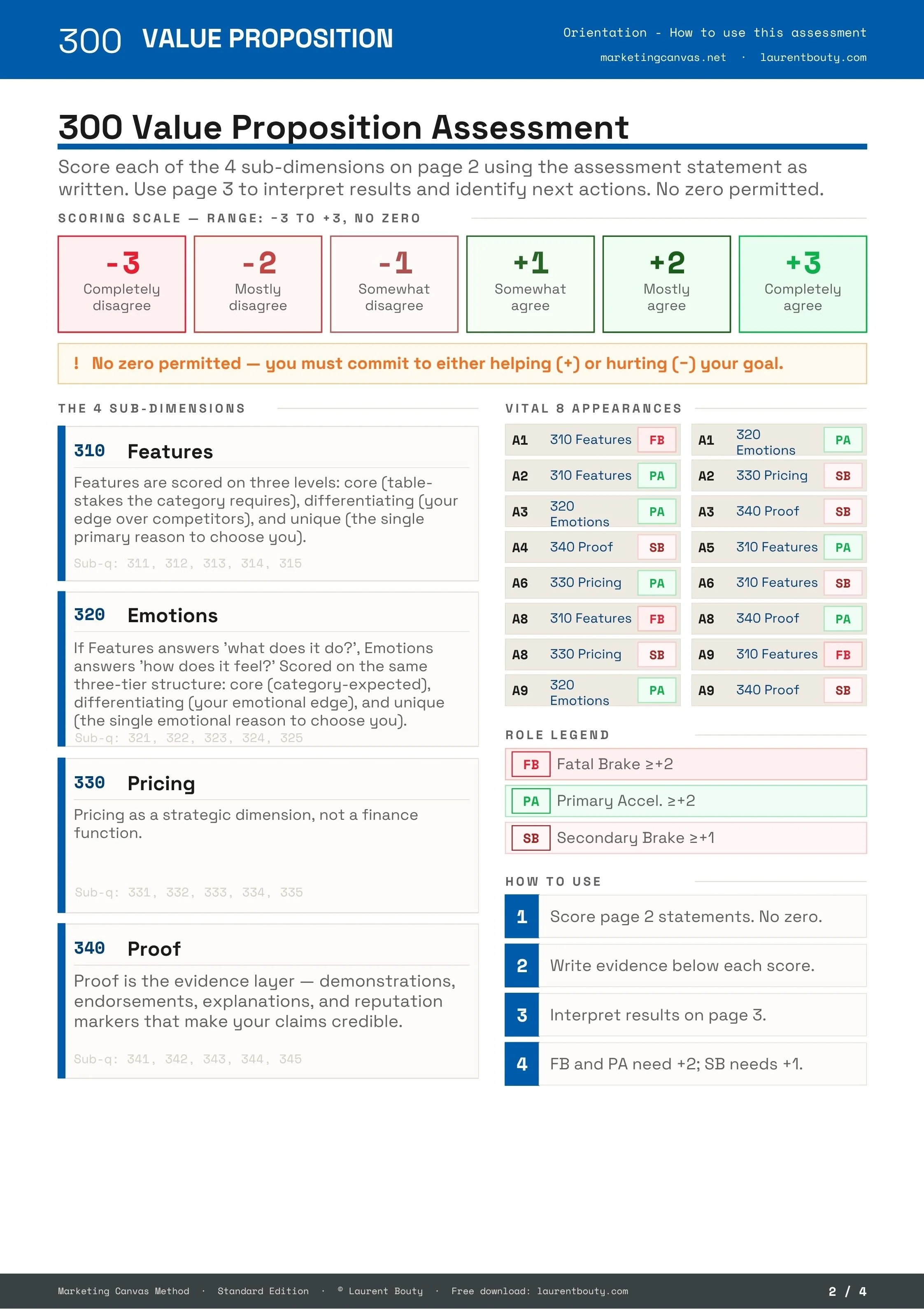
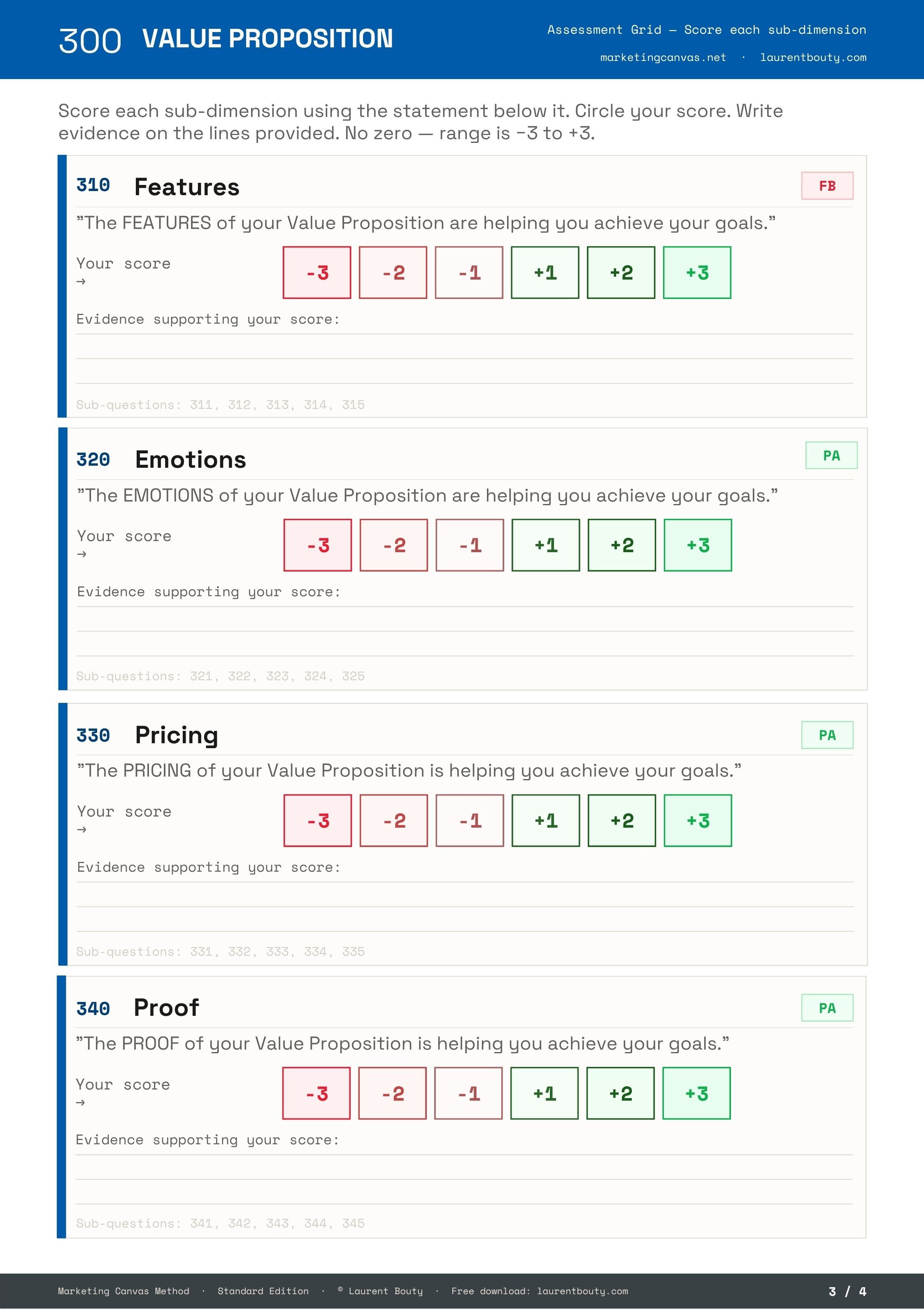
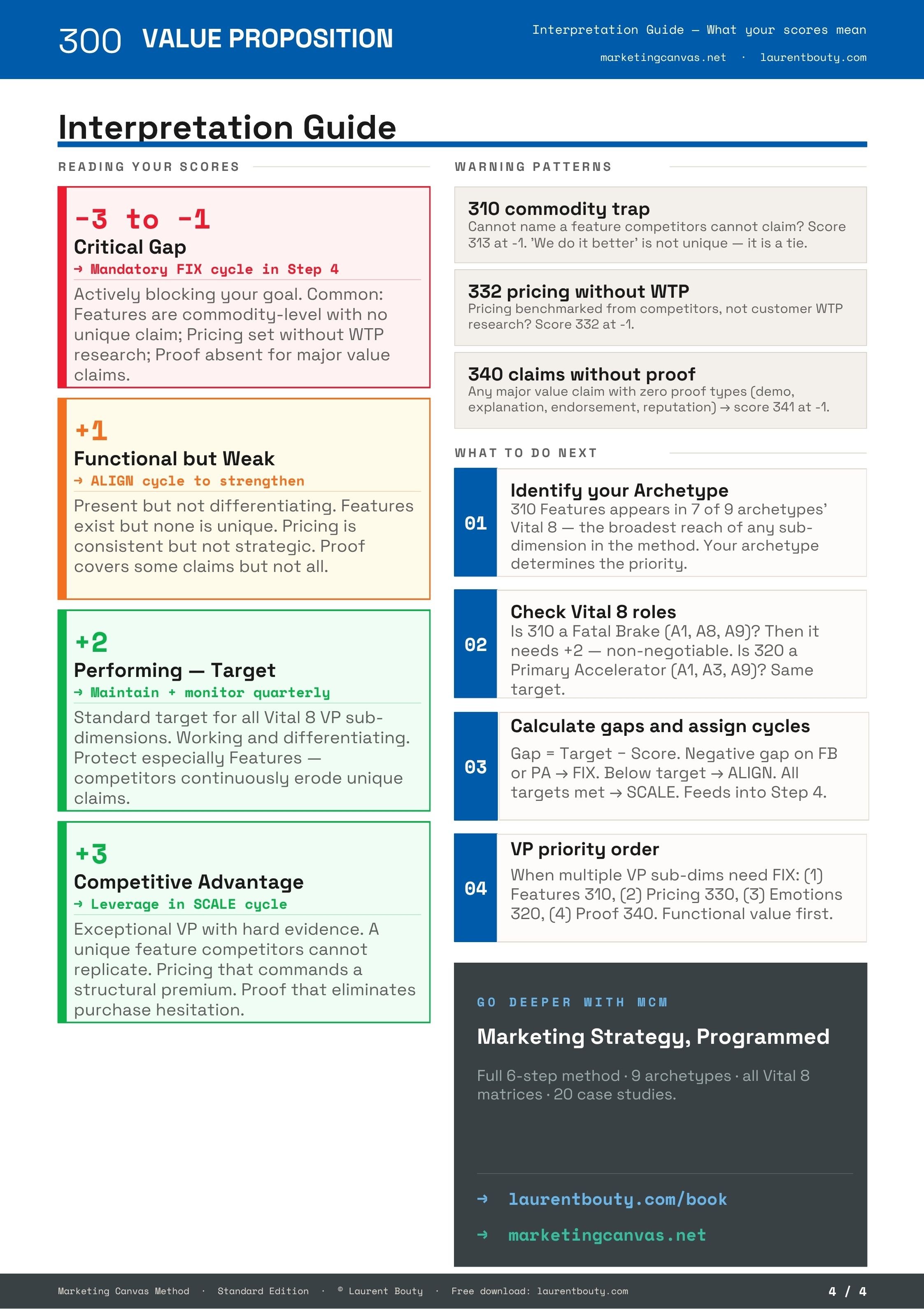
Having a Value Proposition is not the same as having a differentiating one. Most teams score their VP on presence — "we have features, we have pricing, we have testimonials." The Marketing Canvas Method scores on differentiation: do you have a unique feature competitors cannot claim? Is your pricing anchored to what customers are willing to pay, not what competitors charge? Can you prove your claims?
The 300 Value Proposition Standard Assessment scores four sub-dimensions: Features (310), Emotions (320), Pricing (330), and Proof (340). One canonical statement per sub-dimension. A score of +1 means functional but not differentiating. A score of +2 means you have a genuine edge. The gap between those two scores is the most common source of wasted marketing spend.
Use this if:
You are questioning why your marketing is not converting, why customers choose competitors despite similar features, or whether your pricing strategy is actually a strategy.
What you'll know after completing it:
- Whether you have a unique feature — not just differentiating ones — that eliminates the comparison decision
- Whether your pricing is based on customer Willingness To Pay or on what seemed reasonable internally
- Whether your claims are backed by proof types customers actually trust
WHAT'S INCLUDED
- 4-page A4 portrait PPTX (print-ready, editable)
- Page 2: Orientation — scoring scale, 4 sub-dimensions, all 16 Vital 8 VP appearances, compact 2-column grid
- Page 3: Assessment Grid — one statement per sub-dimension, score boxes, evidence lines
- Page 4: Interpretation Guide — score ranges, 3 VP-specific warning patterns, next steps

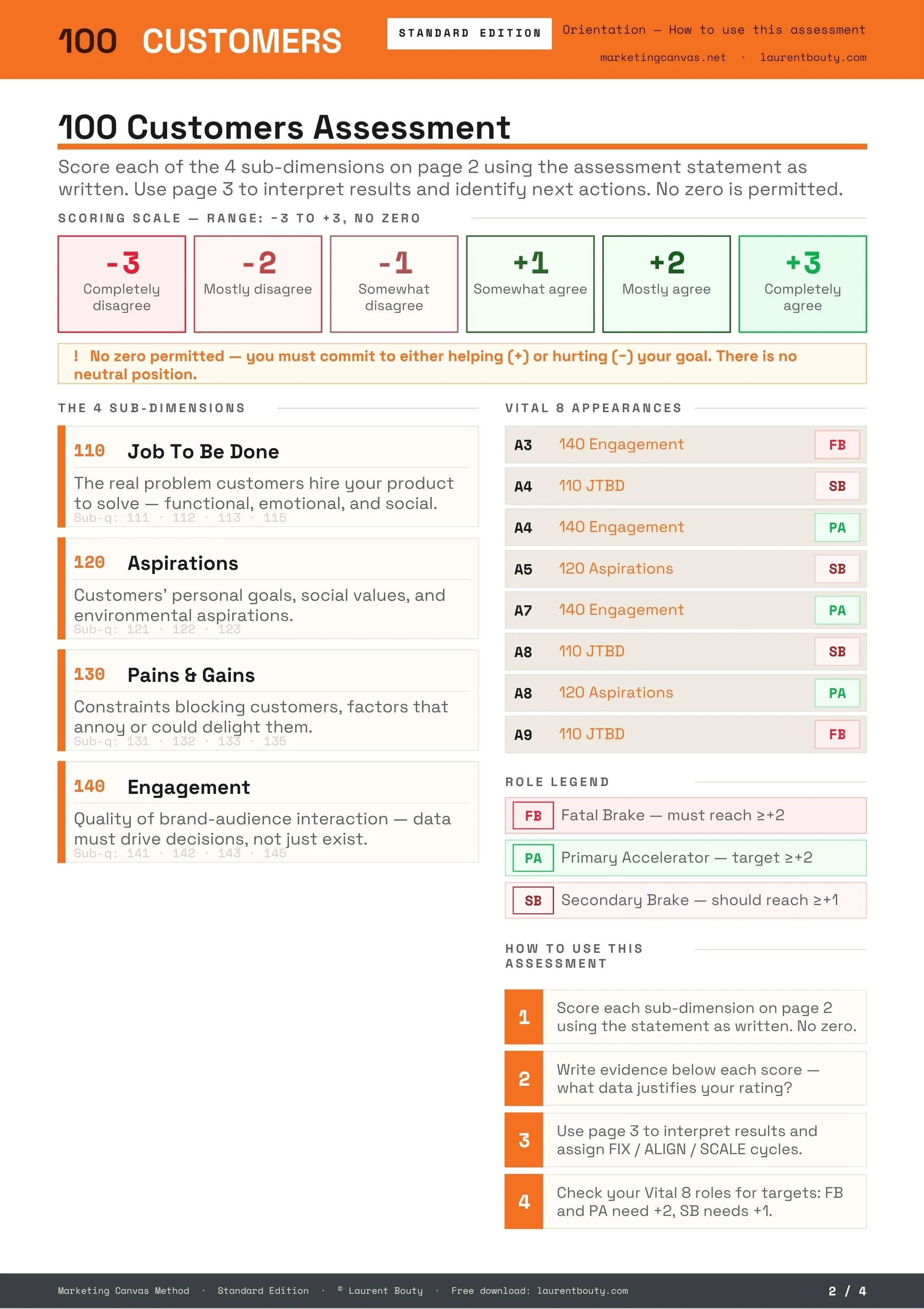
Score your customer understanding in 15 minutes. A free 3-page diagnostic that tells you whether your knowledge of customer jobs, aspirations, pains, and engagement is helping or hurting your marketing goals.
Most marketing strategies fail at the first step: they assume they know the customer. This assessment forces you to score what you actually know — not what you believe.
The 100 Customers Standard Assessment is a 3-page A4 diagnostic built on the Marketing Canvas Method. It covers the four sub-dimensions that define customer understanding: Job To Be Done (110), Aspirations (120), Pains & Gains (130), and Engagement (140).
For each sub-dimension, you score one canonical statement on a −3 to +3 scale. No zero is permitted — you commit to either helping or hurting your goal. The result is four scores that immediately show you where your customer knowledge is an asset and where it is a liability.
Use this if: You want a fast, honest audit of your customer understanding before investing in campaigns, positioning, or product decisions. Works as a team exercise or a solo self-assessment.
What you'll know after completing it:
Whether your customer research is deep enough to drive strategic decisions
Which customer sub-dimension is your weakest — and which archetype that gap affects
Whether to prioritise a FIX, ALIGN, or SCALE cycle in your next planning round
WHAT'S INCLUDED
4-page A4 portrait PDF
Page 1: Cover
Page 2: Orientation — scoring scale, 4 sub-dimensions, Vital 8 appearances, role legend
Page 3: Assessment Grid — one statement per sub-dimension, score boxes, evidence lines
Page 4: Interpretation Guide — score ranges, warning patterns, next steps
No results match your search. Try removing a few filters.