In a Nutshell — 210 Purpose
Purpose (Dimension 210) is the company's reason for existing beyond making money — the contribution that would be missed if the company disappeared tomorrow. Not a mission statement crafted by committee: a genuine answer to "What would your customers lose if we ceased to exist?" The test of authentic purpose is whether it constrains decisions. A purpose that permits everything is a slogan, not a compass. Patagonia's purpose forced "Don't Buy This Jacket." If no profitable action has been made strategically impossible by your purpose in the past year, the score cannot exceed −1. If a purpose doesn't change at least one decision per quarter, it is aspirational, not operational. Purpose is a Primary Accelerator for A3 (Brand Evangelist), A4 (Stagnant Leader), and A5 (Pivot Pioneer) — in all three, purpose is the "why" that anchors strategic decisions during periods of uncertainty.
"Purpose is the compass that makes certain profitable decisions strategically impossible." — Marketing Canvas Method
What purpose actually is
Purpose is not a tagline. It is not a sustainability pledge. It is not a Jim Collins "BHAG" reformatted for Instagram.
The test of authentic purpose is simple: does it constrain decisions?
A purpose that permits everything is a slogan, not a compass. Patagonia's purpose — "save our home planet" — forced them to run the "Don't Buy This Jacket" campaign, a full-page New York Times ad urging customers not to buy their products unless they truly needed them. No brand without genuine purpose could make that call. The purpose made certain profitable decisions strategically impossible. That is exactly what purpose is supposed to do.
Compare that to a generic purpose statement like "delivering value to stakeholders through innovative solutions." It permits everything. It constrains nothing. It is decoration, not direction.
Score negative if your purpose statement could be copy-pasted onto a competitor's website without anyone noticing. Score positive when purpose visibly drives product, hiring, and strategic decisions — and when customers can feel it in the experience without reading your About page.
Purpose in the Marketing Canvas
The canonical question
Why does your company exist beyond making money?
Purpose is a Primary Accelerator for three archetypes in the Marketing Canvas Method:
A3 — Brand Evangelist: Purpose is the belief system the tribe rallies around. Without it, you have customers, not a community. Evangelism has nothing to evangelize.
A4 — Stagnant Leader: Purpose provides the "why" that anchors strategic decisions during periods of decline or competitive pressure. Leaders who stagnate often find their purpose has quietly atrophied.
A5 — Pivot Pioneer: Transformation is disorienting. Purpose is the fixed point that makes pivots navigable — it tells you what to keep when everything else must change.
In the Step 5 Strategic Cycle Roadmap, Purpose (210) appears in Cycle 2 for both A3 and A5, and in Cycle 2 for A4. This placement is intentional: you cannot align strategy around purpose until core structural dimensions are stable. But once they are, purpose becomes the amplifier.

Patagonia Purpose
Purpose vs. mission: a practical distinction
These two terms are routinely conflated. In the Marketing Canvas they are distinct:
Mission is operational — what you do, how you do it, at what scale.
Purpose is existential — why doing it matters to the world.
Tesla's mission is to accelerate the world's transition to sustainable energy. That is the purpose too — but notice it operates above any specific product. It explains why Tesla would enter solar energy, battery storage, and freight trucks. The purpose contains the mission, not the other way around.
For smaller companies, the distinction matters equally. A regional accounting firm's mission might be "provide accurate, timely financial reporting for SMEs." Its purpose might be "help business owners sleep at night." The second formulation guides hiring, communication, pricing sensitivity, and client selection in ways the first never could.
The Stengel framework: what purpose delivers
Jim Stengel's research, published in Grow [2], analyzed 50,000 brands over a decade and identified five categories of brand ideal — the higher-order benefit that purpose-driven brands deliver:
Eliciting Joy: activating happiness, wonder, and possibility
Enabling Connection: enhancing meaningful connection between people and the world
Inspiring Exploration: helping people discover new horizons
Evoking Pride: giving people confidence, strength, and vitality
Impacting Society: challenging the status quo or redefining a category
The practical value of this framework is diagnostic, not decorative. If your purpose statement doesn't land in one of these five zones, it is probably a mission statement in disguise.
Why purpose matters in 2025
The commercial case for purpose has strengthened significantly. Research by WARC found that 78% of consumers feel a deeper connection to brands that communicate their mission and values authentically. This is not a Gen Z trend — it spans cohorts and sectors.
At the same time, the purpose conversation has matured past early enthusiasm. In 2025, "post-purpose" became a phrase in circulation after Unilever announced it would stop "force-fitting" purpose into its brands, with others following suit. This is not a signal that purpose is dead. It is a signal that performed purpose — purpose as marketing costume rather than operational reality — has lost its audience. Authentic purpose, the kind that actually constrains decisions, has never been more differentiated precisely because it is rarer.
More than half of consumers surveyed in 2024 actively seek out brands with more sustainable business practices. For purpose-driven brands that have done the hard work of integration, this represents a structural tailwind. For brands that bolt purpose onto a fundamentally unchanged operation, it represents a credibility trap.
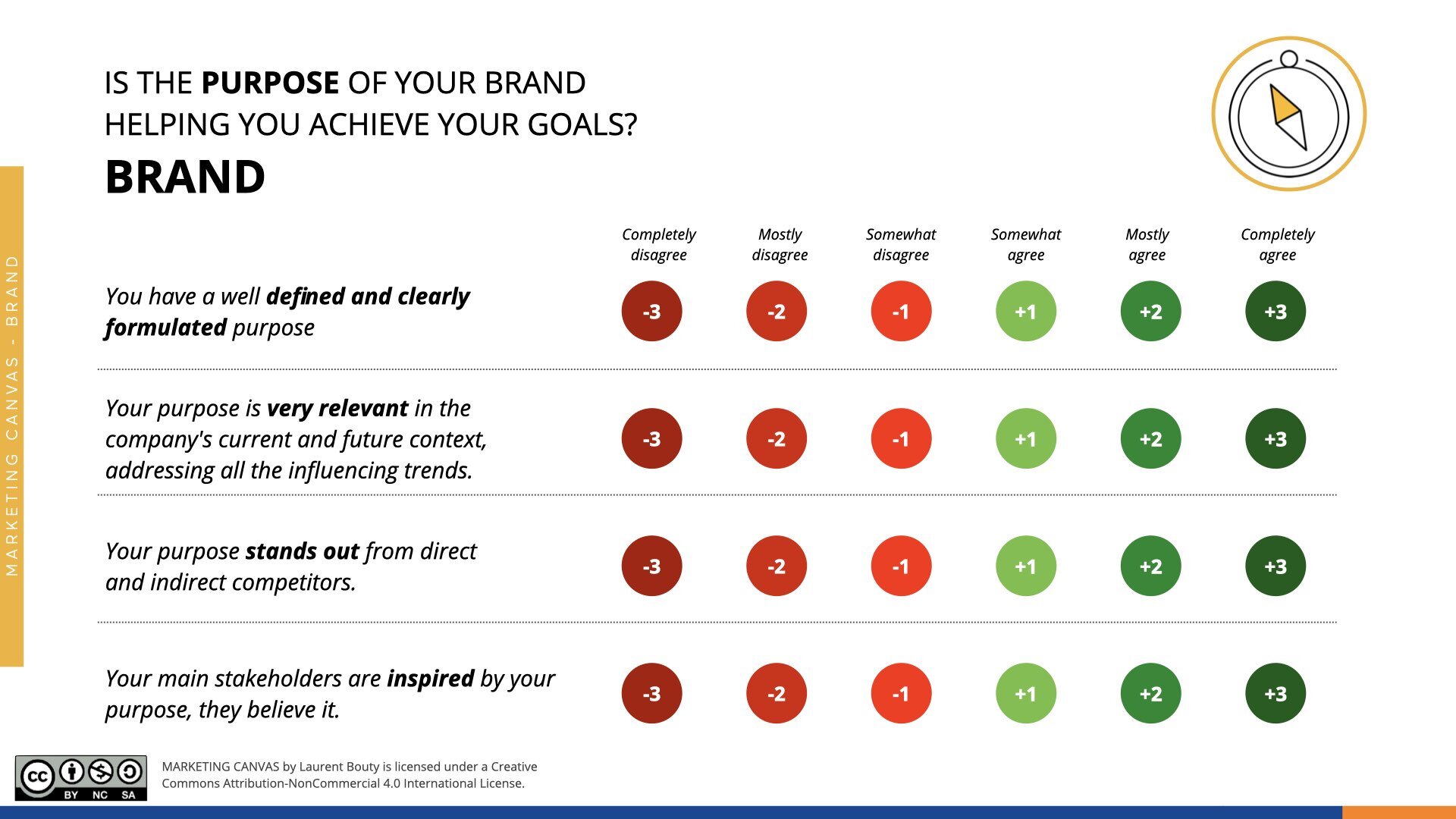
Statements for self-assessment
Rate your agreement on a scale from −3 (completely disagree) to +3 (completely agree). There is no zero — the Marketing Canvas forces a directional position on every dimension.
Note on Detailed Track scoring: if averaging sub-question scores produces a mathematical zero, the method rounds to −1. A split score means the dimension is not clearly helping your goal — and "not clearly helping" requires the same investigation as "hurting."
Interpreting your scores
Negative scores (−1 to −3): Your purpose lacks clarity, relevance, or stakeholder belief. The likely result: weak brand identity, no strategic filter for decisions, minimal differentiation from competitors. Purpose exists on paper. It does not drive behavior.
Positive scores (+1 to +3): Your purpose is defined, believed, and operational. Stakeholders can articulate it without reading a card. It visibly shapes decisions — including the ones you chose not to make. Purpose is functioning as a strategic compass, not a communications asset.
Case study: Green Clean
Green Clean is a fictional eco-friendly residential cleaning service used as the recurring worked example throughout the Marketing Canvas Method.
Score: −2 to −1 (Weak) Green Clean exists as "another eco-cleaning company." Their stated purpose — "promoting cleaner homes through greener products" — could belong to any of their three competitors. It describes what they sell, not why selling it matters. Internally, the team cannot articulate it without reading a card. Externally, customers experience no difference from EcoPure or NatureFresh. The purpose fails the constraint test: nothing in their operation would be different if the statement disappeared.
Score: +1 to +2 (Developing) Green Clean has moved toward "health-first home care." The job is partly named — protecting families from indoor toxins — but the purpose is not yet consistently embedded. Some decisions reflect it (proprietary non-toxic formula, B-Corp certification). Others don't (the Family Health Report is still in development; marketing still leads with "eco" language rather than "health" language). Purpose is present in the strategy but not yet felt in the experience.
Score: +2 to +3 (Strong) Green Clean's purpose — to eliminate indoor toxins and make genuinely healthy homes the standard — is specific, constraining, and felt. It explains why they developed a proprietary formula rather than reformulating a competitor's. It explains the Family Health Report: customers can see exactly what toxin load was avoided during each visit. It explains why they turned down a distribution partnership with a conventional cleaning brand. The purpose makes certain decisions strategically impossible. Customers encounter it before they read a word of copy.
Connected dimensions
Purpose does not operate in isolation. Four dimensions connect most directly:
110 — JTBD: Purpose should mirror the customer's deeper job. If customers hire you to protect their family's health, your purpose should speak to health, not cleaning.
220 — Positioning: Positioning must be consistent with purpose. A brand positioned as "premium" whose purpose is "accessible to all" has an internal contradiction that customers will eventually feel.
230 — Values: Values operationalize purpose day-to-day. Purpose is the why. Values are the how. Without values, purpose remains abstract.
320 — Emotions: Purpose creates emotional resonance. The strongest emotional connections customers form with brands are rooted in shared purpose — not in features.
Conclusion
A strong purpose does one thing features cannot: it makes the brand's choices legible. Customers who understand why you exist can predict what you will do next, trust that the experience will be consistent, and feel that they are buying from something that stands for something.
The diagnostic question is not "do we have a purpose statement?" Almost every company does. The question is: does it constrain decisions? If the answer is yes, purpose is functioning as strategy. If the answer is no, it is functioning as wallpaper.
Sources
Simon Sinek, Start With Why, Portfolio/Penguin, 2009 — simonsinek.com
Jim Stengel, Grow: How Ideals Power Growth and Profit at the World's Greatest Companies, Crown Business, 2011 — jimstengel.com/purpose
WARC, 2025 Global Consumer Engagement Report, 2025 — warc.com
Marketing Week, "What does brand purpose look like in 2025?", January 2025 — marketingweek.com
Marketing Canvas Method, Appendix E — Dimension 210: Purpose, Laurent Bouty, 2026
About this dimension
Dimension 210 — Purpose is part of the Brand meta-category (200) in the Marketing Canvas Method. The Brand meta-category contains four dimensions: Purpose (210), Positioning (220), Values (230), and Visual Identity (240).
The Marketing Canvas Method is a complete marketing strategy framework built around 6 meta-categories, 24 dimensions, and 9 strategic archetypes. Learn more at marketingcanvas.net or in the book Marketing Strategy, Programmed by Laurent Bouty.
Marketing Cavas - Purpose
