M1 + M2: How to Define Your Market and Identify What Customers Are Actually Buying
Every marketing strategy starts with a question so basic it is almost always answered too quickly: where do we compete, and what do customers care about?
M1 (Market Definition) and M2 (Key Expected Benefits) are the first two parameters of Step 1: Strategic Context Mapping. Together they define the arena and the rules of engagement before any scoring, goal-setting, or archetype selection begins.
Get these two right and the rest of Step 1 — competitive mapping, market sizing, external forces — snaps into place. Get them wrong and every subsequent analysis is built on a misidentified battlefield.
M1: Market Definition — Where the Battle Happens
In a Nutshell
M1 · Step 1 · Market DNAM1: Market Definition
"Where the battle happens."
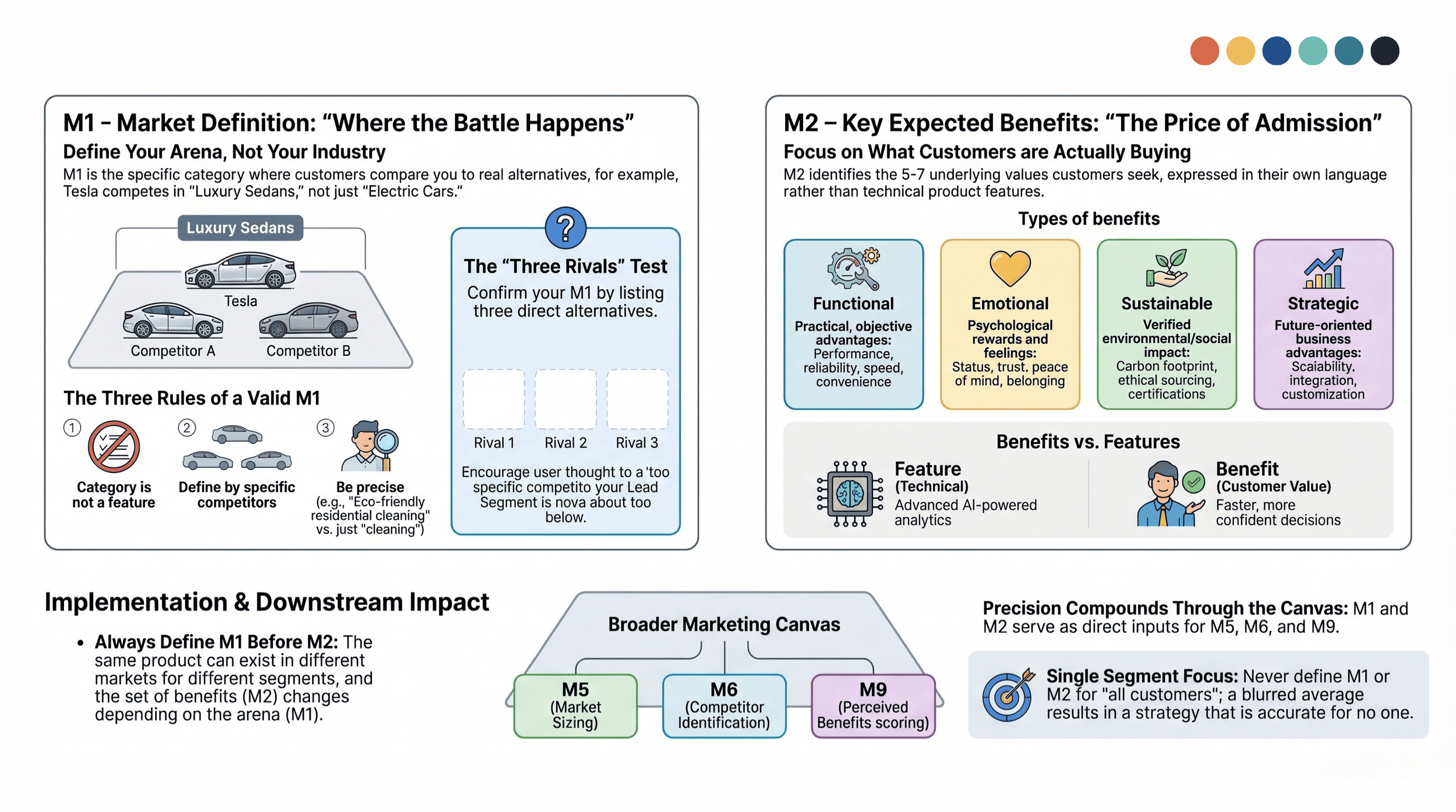
M1 identifies the specific category where your brand competes — your competitive arena, not your industry. It is the space where customers compare you to real alternatives and make a choice. M1 is always defined for one Lead Segment at a time.
M1 identifies the specific category where your brand competes. It is not your industry. It is not a description of your product. It is your competitive arena — the precise space where customers compare you to alternatives and make a choice.
The Three Rules of a Valid M1
The Marketing Canvas Method applies three tests to every market definition:
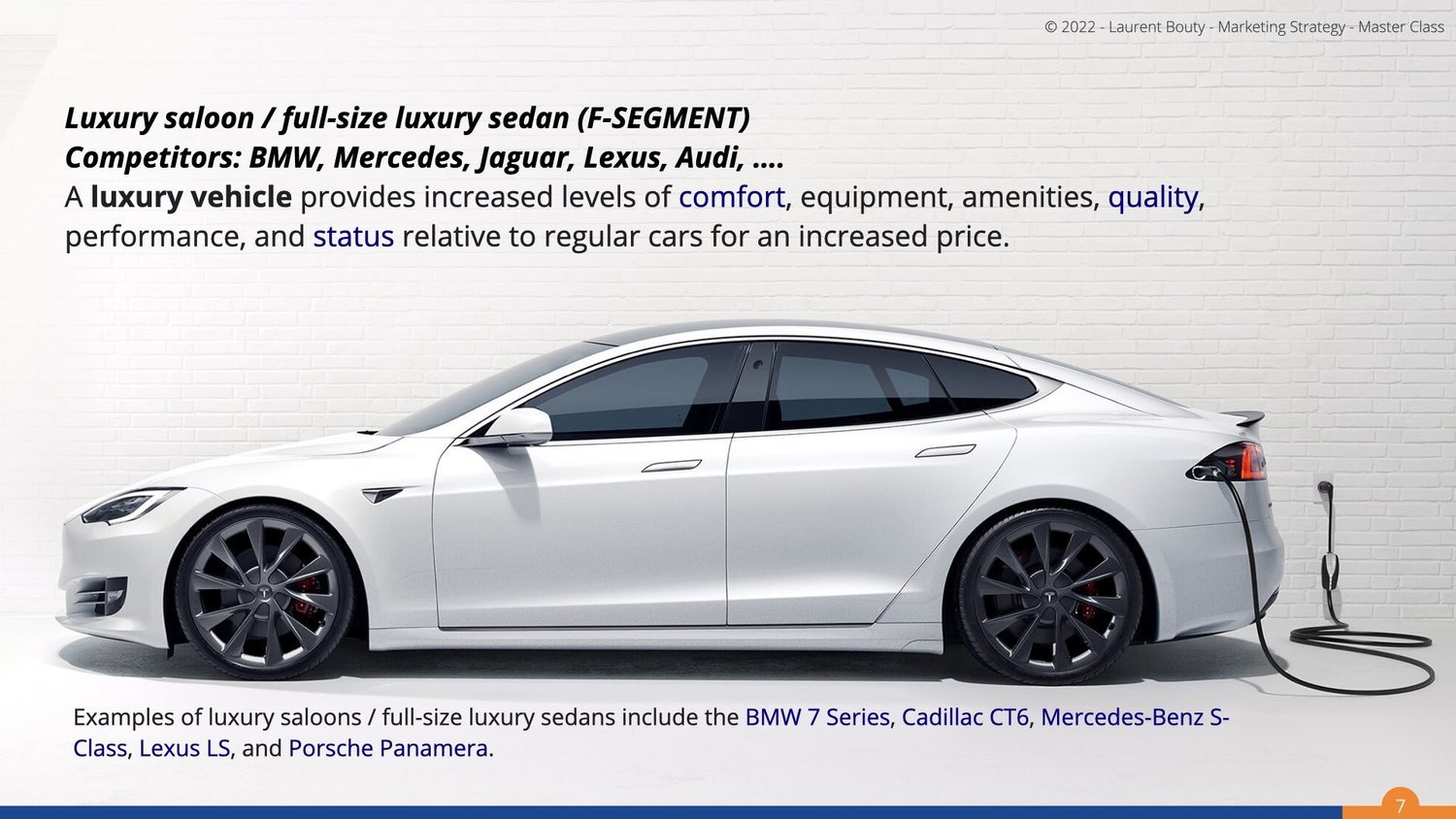
Rule 1 — Category is not a feature. A feature describes what your product does. A market describes who you compete against. "Electric cars" is a feature — a Toyota Prius and a Tesla Model S are both electric, but no one compares them before buying. Tesla Model S competes in the Luxury/Executive Sedan market, alongside the Porsche Taycan and BMW 5 Series. Being electric is how Tesla differentiates within that market — it is not the definition of the market itself.
Rule 2 — Define by your competitors. Your market is the space where customers consider you alongside alternatives. If you cannot name three competitors your Lead Segment would evaluate before choosing you, your M1 is too broad or too narrow. The right M1 puts you in a room with specific rivals.
Rule 3 — Be specific. "Cleaning products" is not a market. "Eco-friendly residential cleaning services for environmentally-conscious homeowners in a metro area" is a market. Specificity is not a constraint — it is the analytical precision that makes every downstream parameter meaningful.
The Common Error: Two Directions of Failure
M1 fails in two symmetrical directions. Defining too broadly — "we compete in the HR software market" — produces a category so large that M2 benefits, M6 competitors, and M9 perceived value scores become meaningless averages. Defining too narrowly — "we have no real competitors" — usually means the company has confused its unique positioning with an absence of competition. Both are wrong. Both are common.
Three Examples
| Company | Wrong M1 | Correct M1 |
|---|---|---|
| Tesla Model S | Electric cars | Luxury / Executive Sedans (E-segment) |
| Green Clean | Cleaning services | Eco-friendly residential cleaning services |
| Notion | Software | Collaborative workspace tools |
Notice that the correct M1 in each case immediately tells you who the real competitors are. That is the test: if your M1 does not immediately generate a specific competitive set, sharpen it.
One Additional Rule: M1 Is Segment-Specific
M1 is completed for your Lead Segment — the specific customer group identified in Step 0. The same company can operate in different markets for different segments. A B2B software company selling to enterprise IT directors and to small business owners is in two different markets: they evaluate different competitors, care about different benefits, and require different strategies. Defining a single M1 for "all customers" produces a blurred average that is accurate for no one.
M2: Key Expected Benefits — The Price of Admission
In a Nutshell
M2 · Step 1 · Market DNAM2: Key Expected Benefits
"The price of admission."
M2 identifies the 5–7 benefits customers in your M1 market evaluate when choosing between competitors. These are not product features — they are the underlying value customers seek, expressed in customer language. Every competitor must meet a minimum threshold on each M2 benefit to be considered.
M2 identifies the 5–7 benefits that customers in your market evaluate when choosing between competitors. These are not your product's features. They are what customers are buying — the underlying value they seek — expressed in customer language.
The phrase "price of admission" is precise. Every competitor in your market must deliver a minimum threshold on each M2 benefit to be considered at all. The competitive battle is fought over which benefits you deliver better than rivals, and by how much.
Four Benefit Types
The Marketing Canvas Method classifies benefits into four canonical types:
| Type | Definition | Examples |
|---|---|---|
| Functional | Practical, measurable advantages customers evaluate objectively | Performance, reliability, speed, convenience |
| Emotional | Psychological rewards — how the product makes customers feel | Status, trust, peace of mind, pride, belonging |
| Sustainable | Environmental and social responsibility benefits — distinct from Emotional | Carbon footprint, ethical sourcing, community impact, certifications |
| Strategic | Future-oriented business advantages — primarily in B2B contexts | Scalability, integration, future-proofing, customisation |
The critical correction: Sustainable benefits are not a sub-category of Emotional. A customer who chooses an eco-certified cleaning service because it aligns with their environmental values is experiencing an Emotional benefit. A customer who chooses the same service because it reduces their household's chemical exposure — a measurable, health-related outcome — is experiencing a Functional benefit. And a customer who specifically selects the provider with official eco-certification because that certification signals verified, third-party-validated environmental standards is responding to a Sustainable benefit. These are distinct, and misclassifying them leads to misaligned positioning.
How to Identify Your M2 Benefits
Four questions reliably surface the benefits that drive choice in your market:
What do customers ask about before buying?
What do reviews praise or criticise?
What do competitors emphasise in their marketing?
What would make a customer switch to a competitor?
Aim for 5 to 7 benefits. Fewer than 5 usually means some benefits are bundled incorrectly or the analysis is incomplete. More than 7 usually means you have mixed features with benefits, or have not forced yourself to prioritise what actually drives choice.
Applied: Green Clean
Green Clean is an eco-friendly residential cleaning service. Its Lead Segment is eco-conscious urban homeowners, dual-income, ages 35–55. Here is its M2:
| # | Benefit | Type |
|---|---|---|
| 1 | Effectiveness | Functional |
| 2 | Health | Functional |
| 3 | Convenience | Functional |
| 4 | Environmental | Sustainable |
| 5 | Trust | Emotional |
Environmental is Sustainable — not Emotional. It reflects verified eco-credentials, not a feeling.
Note that Environmental is classified as Sustainable, not Emotional. Green Clean's Lead Segment makes a deliberate choice based on verified environmental credentials — that is a Sustainable benefit. Trust is separate: it is the confidence that the brand delivers on its promises consistently — that is Emotional.
| # | Benefit | Type |
|---|---|---|
| 1 | Performance | Functional |
| 2 | Innovation / Technology | Functional |
| 3 | Sustainability | Sustainable |
| 4 | Prestige / Status | Emotional |
| 5 | Ownership Experience | Emotional |
Sustainability is Sustainable — Tesla buyers responding to environmental responsibility, not purely to how it makes them feel.
Applied: Tesla Model S (Luxury/Executive Sedan Market)
Tesla's Sustainability benefit is Sustainable — not Emotional. Buyers in the executive sedan market who factor in environmental impact are responding to a category-level signal about values and social responsibility, not purely to how it makes them feel. The distinction matters when you map M9 (Perceived Benefits) — misclassifying the type changes how you weight competitive performance.
Marketing Canvas Method: M1 (Market Definition) and M2 (Key Expected Benefits)
Why M1 and M2 Must Be Done Together
M1 and M2 are defined in sequence for a reason. M1 sets the arena. M2 describes the rules inside it.
The same product can sit in different markets for different segments — and the M2 benefit set changes with the market. A premium bottled water brand competing in the "health and wellness beverages" market has a completely different benefit set than the same brand competing in the "premium gift and hospitality" market. The product is identical. The competitive arena is different. The M2 benefits are different. The strategy is different.
This is why you never define M2 before M1. And why you never run Step 1 for "all customers" — you run it for one Lead Segment, one M1, one M2 set, at a time.
◆ Practitioner's Tip
The two questions that expose a wrong M1 in under two minutes
When a team presents their M1, I ask two questions in sequence. First: "Name three competitors your Lead Segment would seriously evaluate before choosing you." If they struggle — if the answer is "well, there are lots of indirect competitors" or "nobody really does what we do" — the M1 is wrong. Either it's too broad (generating a list of hundreds) or too narrow (generating a list of none). A valid M1 produces three to five specific rivals immediately.
Second question: "Which of these competitors would your Lead Segment consider a real alternative — not just a theoretical one?" This separates the market from the industry. Your industry includes everyone who makes a similar thing. Your market is the specific consideration set inside a specific customer's decision. Those are different lists.
On M2, the error I see most often is not listing too few benefits — it's listing features as benefits. "Advanced AI-powered analytics dashboard" is a feature. "Faster, more confident decisions" is the benefit it delivers. M2 must be written in the customer's language, describing what they gain — not what the product does. If your M2 list reads like a spec sheet, rewrite it from the customer's perspective before scoring anything.
M2 test: Does each benefit describe what the customer gains — in their language?
M1 and M2 as Inputs to the Rest of Step 1
M1 and M2 are not standalone exercises. They are the foundation every other Step 1 parameter builds on:
M3 (Growth Curve) measures the lifecycle stage of the M1 category — not your company
M5 (Market Sizing) calculates TAM and SAM for the M1 category using M2 customers as the target
M6 (Competitors) identifies rivals who compete on the same M2 benefits in the same M1 arena
M9 (Perceived Benefits) scores you and competitors on each M2 benefit on a −3 to +3 scale
If M1 is wrong, M5 sizing is wrong. If M2 is incomplete, M9 scoring is incomplete. The precision you invest here compounds through every subsequent step.
The Step 1 Sequence
M1 and M2 are the first two parameters of Step 1. The full parameter set:
Cluster 1 — Market DNA (M1–M5): Market Definition · Key Benefits · Growth Curve · Economic Value · Market Sizing
Cluster 2 — Competitive Mapping (M6–M9): Competitors · Price Per Unit · Perceived Price · Perceived Benefits
Cluster 3 — External Forces (M10):Tailwinds & Headwinds
M1 and M2 — along with M3 and M4 — feed directly into Archetype Selection. Before you can identify which of the 9 MCM Strategic Archetypes applies to your situation, you need to know precisely where you compete and what customers value in that space.
Run Your Own M1 and M2
The Quick Assessment starts with your market context — it will prompt you through M1 and M2 in a structured format and surface your initial Step 1 picture in under ten minutes.
For the full process with worked examples across five company types, Marketing Strategy, Programmed covers M1 and M2 in depth as part of the complete Step 1 walkthrough.
