M10: How to Read the Tailwinds and Headwinds Shaping Your Market
In a Nutshell
M10 · Step 1 · External ForcesM10: Market Trends — Tailwinds & Headwinds
"The forces outside your control that shape what's possible."
M10 captures the external market forces — technological, social, environmental, economic, and political — that will push or pull your category over your strategic cycle. You don't control these forces. But you must account for them before you set goals, select an archetype, or build a roadmap.
Every market has forces you don't control. A regulatory shift. A technology wave. A demographic swing. An economic shock. These forces don't care about your budget, your brand story, or your five-year plan. They push or pull your category whether you're ready or not.
M10 is where the Marketing Canvas Method names them, classifies them, and puts them to strategic use. It is the last parameter of Step 1: Strategic Context Mapping — and the one that most strategists skip, rush, or get wrong.
Getting M10 right doesn't take more data. It takes the right frame.
What M10 Is — and What It Isn't
M10 sits in Cluster 3 of Step 1, under the label External Forces. Its catchphrase is "Tailwinds and headwinds."
The definition is precise: external factors you don't control that will impact your strategy.
That last clause matters. M10 is not a SWOT. It is not a strengths-and-weaknesses inventory. You are not allowed to list your great team, your strong operational processes, or your proprietary technology here. Those are internal. M10 is strictly the outside world — forces that exist independently of what you do.
In MCM, we classify every M10 force into one of two types:
| Force type | MCM label | What it means for your strategy |
|---|---|---|
| Expands demand, creates opportunity, or aligns with your positioning | ▲ Tailwind | Lean into it. It makes your goals easier to reach. |
| Creates friction, raises costs, or threatens your model | ▼ Headwind | Mitigate it. Sequence a response before you scale. |
The common mistake: confusing M10 with the Vital 8 role labels. In the Marketing Canvas, "Accelerator" and "Brake" also describe the strategic roles of your 24 dimensions in Step 3. Those are different. Your M10 Tailwinds and Headwinds are external market forces. Your Vital 8 Accelerators and Brakes are internal performance priorities. Don't mix them.
How to Run M10: The Five-Category Scan
The fastest way to build a complete M10 picture is to scan five external categories and ask: what is changing here, and does it help or hurt my category?
| Category | What to look for |
|---|---|
| Technological | AI, automation, platform shifts, new delivery models |
| Social | Consumer behaviour changes, generational shifts, values evolution |
| Environmental | Sustainability expectations, climate regulations, resource costs |
| Economic | Inflation, interest rates, purchasing power, labour costs |
| Political & Regulatory | New laws, trade policy, certification requirements, geopolitical disruption |
Aim for 3 to 6 total forces — not ten. If you have ten, you're listing everything instead of identifying what matters. Force yourself to pick the forces that are both significant and directional for your specific segment.
The discipline is not in generating the list. It's in deciding which forces actually move the needle for your Lead Segment's category.
The Green Clean M10: A Worked Example
Green Clean is a mid-market eco-friendly residential cleaning service operating in a metro area. Its Lead Segment is eco-conscious urban homeowners, dual-income, 35–55 years old. Here is its M10 scan:
| Trend | Category | Classification | Strategic Impact |
|---|---|---|---|
| Growing eco-consciousness among consumers | Social | ▲ Tailwind | Increases demand for Green Clean's core offer; validates positioning |
| Remote work normalisation — more time at home | Social | ▲ Tailwind | Expands addressable market; more cleaning occasions per household |
| New eco-certification requirements in the industry | Regulatory | ▲ Tailwind | Validates differentiation; raises the bar for less-committed competitors |
| Inflation pressure on discretionary spending | Economic | ▼ Headwind | Price sensitivity rising; mid-market positioning faces squeeze |
| Labour shortages in the service industry | Economic | ▼ Headwind | Harder to hire; wage costs rising; scaling capacity is constrained |
| Net M10 Reading | 3 Tailwinds · 2 Headwinds | Favorable environment — positioning aligned with dominant market forces. Execution constraints must be resolved before scaling. | |
Net M10 reading: 3 Accelerators, 2 Brakes. The environment is fundamentally favorable — Green Clean's positioning is aligned with the biggest social and regulatory forces in play. But the brakes are real execution constraints that will require tactical responses before scaling is possible.
How M10 Connects to the Rest of the Method
M10 is context data, not scoring data. It doesn't generate a number that feeds automatically into Step 3. What it does is inform three critical judgment calls across the process:
1. Goal Calibration in Step 2
When you have strong Tailwinds aligned with your market position, Step 2 should reflect that. An Accelerator that directly drives demand for your category is a signal to set ambitious acquisition or growth targets — not conservative ones.
Conversely, a significant Brake — especially one that constrains your delivery capacity or erodes pricing power — is a signal to sequence carefully. You don't scale past a Brake you haven't addressed.
Green Clean application: The eco-consciousness Tailwind supports an ambitious Acquisition goal in Step 2. The labor shortage Brake signals that scaling service delivery should come before aggressive marketing spend. Fix the constraint first.
2. Initiative Prioritization in Step 4
In Step 4 (Strategic Action Engine), every initiative competes for resources. M10 Brakes are early warning signals: they tell you which constraints to resolve before you invest in growth. An Accelerator tells you which capabilities to build while the wind is at your back.
A Brake you ignore in Step 4 becomes a ceiling on what Step 5's roadmap can realistically deliver.
3. Archetype Signal
M10 carries one hard strategic signal. When you are dealing with a High Disruption Brake — a force that is fundamentally threatening your category, not just creating short-term friction — the MCM process sends an archetype signal toward A5 (Pivot Pioneer).
The logic: if the market's fundamentals are shifting under you (not just slowing down, but changing direction), the strategic response is not optimization. It's transformation. A5 exists precisely for this situation.
The combination that triggers the strongest A5 signal: M3 (Growth Curve) = Decline + M10 = High Disruption Brake pointing at your core value model. That combination means the existing strategy has an expiry date.
A Note on Tesla
Tesla's M10 at the point of its A1 (Disruptive Newcomer) phase illustrates what a dominant Tailwind environment looks like. The EV adoption curve, AI-powered autonomy development, and favorable ESG regulations were all Tailwinds aligned directly with Tesla's disruptive positioning. The Brakes — raw lithium costs, supply chain fragility — were real, but they were operational, not existential. The net M10 reading was: the external world is moving toward you. Move fast.
That net assessment is what justified Tesla's aggressive customer acquisition goals in Step 2, and the heavy investment in brand narrative (dimension 210) and channel build-out (dimension 420) in Step 4. M10 didn't make those decisions — but it gave them structural support.
The Three Mistakes to Avoid
Mistake 1: Listing internal strengths as Tailwinds. "Our strong sales team" is not an Accelerator. It is an internal asset. M10 is strictly external. If you cannot describe a force without referencing your company, it doesn't belong in M10.
Mistake 2: Running M10 for "all customers." M10 forces affect segments differently. Rising prices hurt price-sensitive buyers more than premium buyers. A regulatory shift may advantage your B2B segment while being irrelevant to your B2C segment. M10 should always be run for the specific Lead Segment identified in Step 0.
Mistake 3: Treating Brakes as reasons to lower ambition without investigation. A Brake is a signal to investigate and plan, not to immediately revise goals downward. Ask: does this Brake affect our core value delivery, or is it a cost and complexity issue? The answer determines whether the response is strategic (re-think the model) or tactical (build a mitigation initiative).
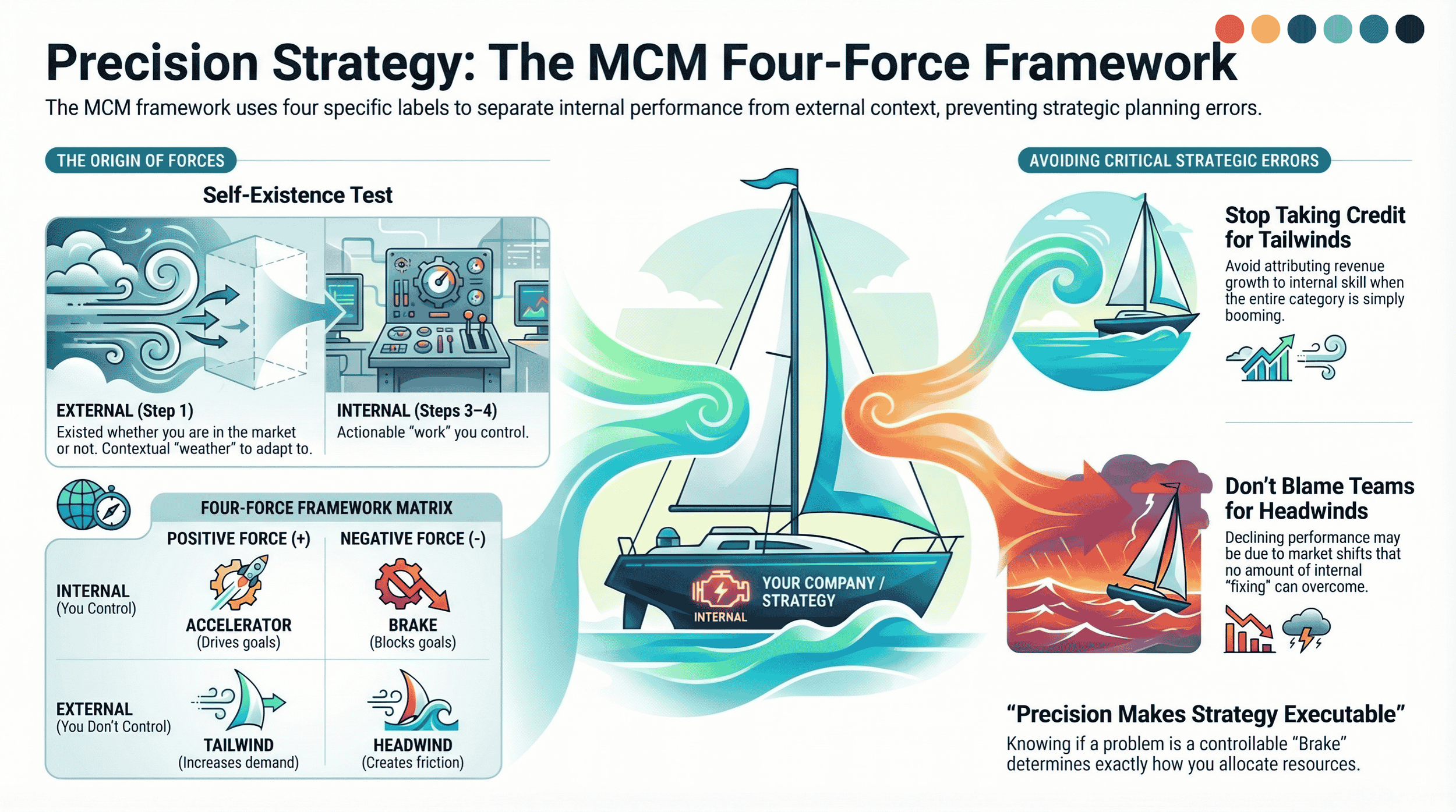
MCM (Marketing Canvas Method): The Four-Force Framework
What Good M10 Looks Like
A well-completed M10 delivers three things:
A named set of forces — 3 to 6 specific, external, directional trends that affect your Lead Segment's category
A classification — each force tagged as Accelerator or Brake, with a one-sentence statement of its strategic impact
A net reading — the ratio of Accelerators to Brakes and a plain-English conclusion: favorable environment, execution challenge, or market shift signal
That net reading travels with you through Steps 2 to 5. It is the background radiation of your strategy — not the loudest signal in the room, but always present when you are deciding how ambitious to be, what to fix first, and whether you are building or pivoting.
◆ Practitioner's Tip
The question that separates real M10 from a SWOT recycled
When I run Step 1 workshops, I ask teams to read their M10 list back to me with one filter: "Would this trend exist if your company didn't?" If the answer is no — if removing your company from the picture makes the trend disappear — it's not a market force. It's an internal asset, and it belongs somewhere else.
The most common error I see is teams listing their own capabilities as Tailwinds. "Our strong brand reputation is an Accelerator." No. Your reputation is a score you'll assign in Step 3 on dimension 210 (Brand Awareness). M10 is the outside world only.
The second most common error: treating every Brake as a ceiling on ambition. A labor shortage is real — but it constrains your delivery model, not your market opportunity. Separate the strategic signal from the operational response. Your Step 2 goal reflects the opportunity. Your Step 4 initiatives address the constraint.
If the force depends on what your company does → it belongs in Step 3 scoring.
Run Your Own M10
If you haven't mapped your M10 yet, the Quick Assessment is the fastest way to start. It surfaces your market positioning signals in under ten minutes — and gives you the context you need to build a complete Step 1 picture.
If you're ready to go deeper, Marketing Strategy, Programmed walks through the full M10 process with five additional company examples across different market stages.
