In a Nutshell — 640 Budget
Budget (Dimension 640) is the resource discipline dimension — not how much you spend, but how deliberately. The method scores four core properties:
- Allocation logic: Based on strategic goals and industry benchmarks, not "same as last year".
- Planning integration: Budget as a time-bound component of the overall strategic plan.
- Monitoring discipline: Continuous tracking with dynamic reallocation away from underperforming initiatives.
- Innovation reserve: A protected 10% dedicated exclusively to experimental approaches.
That 10% isn't a luxury — it's insurance against strategic rigidity. Budget also governs the 3-Cycle Roadmap: Cycle 1 commits 80% to fixing Fatal Brakes (a score below −1). Budget is a Fatal Brake for A6 (Value Harvester), where waste in a declining market is existential.
Introduction
Every initiative identified across the 23 preceding dimensions — every fix, every accelerator, every growth driver — competes for the same finite resource: the marketing budget. Budget is the dimension that determines which of those initiatives actually happen, in what sequence, and at what scale.
This is why the Marketing Canvas positions Budget as a discipline question, not a quantum question. The amount of budget available is a constraint. How that budget is allocated — against which priorities, in which cycle, with what monitoring — is the strategic choice. Two companies with identical budgets can produce radically different outcomes depending on whether their allocation logic follows strategic evidence or historical habit.
The most expensive budget decision a marketing team makes is the one it doesn't consciously make: replicating last year's allocation because changing it requires a conversation no one wants to have.
What the Marketing Canvas scores in Budget
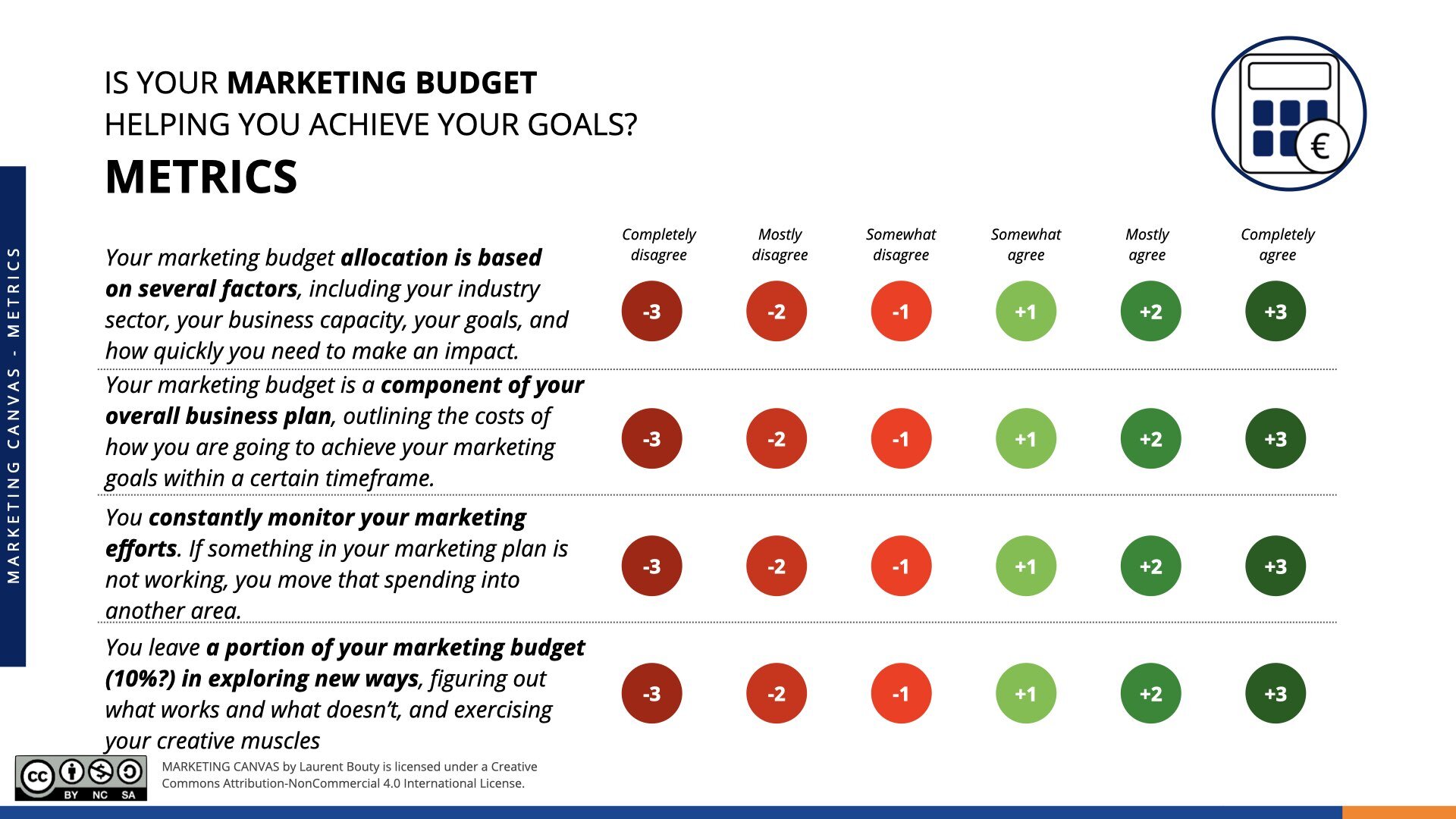
The dimension scores four properties — allocation logic, planning integration, monitoring discipline, and innovation reserve — each addressing a distinct layer of resource discipline.
Allocation logic — is the budget allocated based on multiple factors (industry benchmarks, business capacity, strategic goals, and urgency) rather than inertia? The canonical failure mode is the "same as last year" allocation: the prior year's budget is reproduced with a percentage adjustment, with no systematic re-examination of whether the distribution still reflects the strategic priorities. Allocation logic scores whether the budget follows the strategy or whether the strategy is reverse-engineered to justify the budget. A company in Cycle 1 of the Strategic Action Engine (fixing Fatal Brakes) should have a materially different allocation from the same company in Cycle 3 (scaling growth drivers). If the allocation doesn't shift as the strategy evolves, the budget is not serving the strategy — it is constraining it. Industry benchmarks provide the calibration reference: typically 6–12% of revenue for established businesses, up to 20% for growth-stage companies. The benchmark is not a target; it is a diagnostic.
Planning integration — is the marketing budget a component of the overall business plan, with defined costs linked to specific goals within a defined timeframe? Budget that exists as a standalone line item, detached from the strategic plan it is supposed to fund, produces the most common budget dysfunction: money is available, but there is no explicit connection between what is being bought and what outcome is expected. The chain of accountability the method scores runs from budget item to initiative (Step 4) to dimension score (Step 3) to strategic goal (Step 2). If any link is missing, the budget is partially floating.
Monitoring discipline — do you constantly monitor marketing performance and reallocate spending from underperforming initiatives to those that are working? The test is not whether performance is tracked — most marketing teams track something. The test is whether tracking produces reallocation. A team that reviews campaign performance monthly and continues funding underperforming initiatives for the remainder of the budget cycle because "it's already in the plan" does not have monitoring discipline; it has reporting. Monitoring without reallocation authority is observation without consequence.
Innovation reserve — do you protect a portion of the budget, typically 10%, for exploring new approaches, testing new channels, and discovering what the existing allocation misses? The 90/10 principle is the canonical structure: 90% on proven activities that are already demonstrably working; 10% on experimental approaches where the outcome is uncertain. The 10% is not a luxury allocation for when the primary budget is performing well — it is insurance against strategic rigidity. A company that allocates 100% to proven tactics has committed its entire resource base to yesterday's understanding of what works. The failure mode runs in both directions: below 5% for innovation protects the status quo at the cost of adaptability; above 25% starves the proven activities that generate current returns.
Budget and the 3-Cycle Roadmap
The most strategically significant connection in the Budget dimension is its relationship to the 3-Cycle Strategic Roadmap (Step 5). The canonical cycle allocations determine how the budget should be distributed across the three action streams — FIX, ALIGN, and SCALE — at each phase of strategy execution:
Cycle 1 — Foundation: 80% FIX (Fatal Brakes) / 10% ALIGN (Accelerators) / 10% SCALE (Growth Drivers)
The dominant allocation is repair. Fatal Brakes cannot be papered over with growth investment. A brand with a broken positioning (220) cannot be fixed by doubling the media budget (530). A product with weak features (310) cannot be rescued by an influencer campaign (540). In Cycle 1, the budget's primary function is to fund the foundational work that makes everything else possible. The 10% in ALIGN and SCALE is not wasted — it maintains momentum and tests the growth thesis — but it is not the primary investment.
Cycle 2 — Build: 20% FIX (maintenance) / 60% ALIGN / 20% SCALE
The Fatal Brakes have been addressed. The budget shifts to funding the accelerators — the dimensions that drive the archetype's primary mission. Brand positioning is being sharpened. The value proposition is being refined. The customer experience is being systematically improved. The FIX allocation drops to maintenance level because the structural problems have been resolved, not because they no longer need monitoring.
Cycle 3 — Scale: 10% FIX (maintenance) / 30% ALIGN / 60% SCALE
The budget now funds growth at scale. The Growth Drivers identified in the Vital Audit receive the majority of the investment. The risk in Cycle 3 is premature allocation: companies that skip Cycle 1 and move directly to Cycle 3 investment discover that growth spend on a broken foundation produces volume without compounding returns.
The Budget dimension (641) scores whether the company's actual allocation reflects the cycle it is in — or whether the allocation is driven by what is most visible, most politically comfortable, or most familiar.
Statements for self-assessment
Score each of the four sub-questions from −3 to +3 (no zero), then average for the dimension score. If the average is mathematically zero, round to −1.
Interpreting your scores
Negative scores (−1 to −3): Budget allocation is driven by inertia, prior year habit, or political comfort rather than strategic evidence. Planning integration is absent or superficial — the budget is not connected to specific initiatives with defined outcomes. Monitoring produces reporting but not reallocation. There is no innovation reserve, or it has been absorbed into existing line items. The budget is not serving the strategy; the strategy is being reverse-engineered to justify the budget.
Positive scores (+1 to +3): Allocation logic follows strategic priorities and cycle position. The budget is integrated into the business plan with traceable connections between spend, initiatives, dimensions, and goals. Monitoring has reallocation authority and exercises it. The 10% innovation reserve is protected and generating learning. The budget is an active strategic instrument, not a historical artefact.
Strategic Role
Fatal Brake for A6 (Value Harvester): In a declining market, every euro of marketing spend must demonstrate return. There is no budget slack to absorb misallocation — the market contraction is simultaneously compressing the revenue base from which the budget is drawn and raising the pressure on each remaining customer relationship. A Value Harvester with weak budget discipline is compounding the market problem with a spending problem. Waste is not a nuisance in A6; it is existential. The 641 score — allocation based on strategic evidence rather than inertia — is the most critical sub-question for A6.
Secondary Accelerator for A2 (Efficiency Machine): The Efficiency Machine archetype wins on cost structure and operational discipline. Budget discipline in A2 is not just a financial governance function — it is a strategic signal. A marketing team that cannot maintain budget discipline while the operations team is optimising every cost line sends a structural contradiction to the organisation. A2 companies with strong budget scores reinforce the operational excellence narrative; A2 companies with weak budget scores undermine it from within marketing.
Growth Driver for A2 (Margin Extraction): When the Efficiency Machine deploys the Margin Extraction growth driver, budget discipline is the mechanism. Reducing marketing spend on activities that produce low marginal return — while protecting spend on activities that generate efficient acquisition and retention — directly improves margin without reducing commercial output. The 643 score (monitoring and reallocation discipline) is the specific property that makes Margin Extraction possible: you can only reallocate away from low-return activities if you know which activities are low-return.
In most other archetypes, Budget operates as a constraint discipline rather than a strategic lever — necessary hygiene, but not the dimension that defines the archetype's strategy. The exception is A6, where budget discipline is survival, and A2, where it is a competitive differentiator.
Case study: Green Clean
Green Clean is a fictional eco-friendly residential cleaning service used as the recurring worked example throughout the Marketing Canvas Method.
Score: −2 to −1 (Weak) Green Clean's marketing budget for the current year is €18,000 — approximately 7.2% of revenue, within the benchmark range for a service business at this stage. The allocation was set by the founder in January by reviewing the prior year's spend and making minor adjustments based on what felt underfunded. No benchmark comparison was conducted. No connection was made between the budget allocation and the strategic priorities identified from the dimension scores. The largest line item (€7,200, 40%) is paid social advertising — the same proportion as last year — despite the fact that the acquisition analysis (610) has shown paid social produces the highest CAC and the lowest customer lifetime of any channel. The budget has not been connected to the decision to build the owned media foundation first (530). Monitoring is monthly in theory; in practice, the budget is reviewed when campaigns end. There is no reallocation mechanism — budget is committed to campaigns at the start of the quarter and not adjusted. There is no innovation reserve. The 10% that would fund channel experiments is absorbed into the paid social budget by default.
Score: +1 to +2 (Developing) Green Clean has restructured its budget allocation for the first time using strategic evidence. Following the Vital Audit, the budget has been connected to the three action streams: €10,800 (60%) allocated to Cycle 1 FIX and ALIGN priorities — primarily the owned media content infrastructure, the subscription model architecture, and the Family Health Report development; €5,400 (30%) to proven acquisition and retention activities; €1,800 (10%) protected as an innovation reserve to test two new channel hypotheses (a partnership with a paediatric clinic network and a podcast sponsorship in the indoor health category). The allocation has been formally documented in the business plan with expected outcomes for each stream. Monitoring is now monthly with a defined reallocation trigger: any initiative performing below 70% of its target for two consecutive months is paused and the budget redirected. The innovation reserve has already produced one useful finding: the clinic partnership generated a cost-per-lead 40% below the paid social benchmark. The 10% is earning its place.
Score: +2 to +3 (Strong) Green Clean's budget management operates at the cycle level with quarterly allocation reviews. The company is in Cycle 2 of its Strategic Action Engine: the 20/60/20 split is in effect, with 20% on FIX maintenance (ongoing content production, subscription system upkeep), 60% on ALIGN (deepening the Family Health Report as a differentiation asset, building the referral programme, strengthening the earned media infrastructure), and 20% on SCALE (amplifying the indoor health category narrative through paid media targeted to lookalike audiences of the referral cohort). The 10% innovation reserve — now a protected line that is not subject to reallocation pressure — has cycled through six experiments in 18 months. Three have been discontinued after failing to outperform the control. Two have been graduated into the main budget after demonstrating positive ROI. One is in its second testing cycle. The 641 allocation logic is explicitly benchmarked against Gartner CMO survey data for comparable service businesses annually, with a documented rationale for any deviation. The budget is not a constraint on the strategy — it is an expression of it.
Connected dimensions
Budget connects to every dimension in the Marketing Canvas through resource allocation — every initiative in the 15-slot Strategic Action Engine draws on budget. Four connections are most direct:
610 — Acquisition: Budget funds acquisition. The size and composition of the acquisition budget determines CAC, channel mix, and the rate at which new customers enter the base. A weak 641 allocation that over-invests in high-CAC channels while under-investing in owned media infrastructure is a budget problem expressed as an acquisition problem.
620 — ARPU: Budget funds Stimulation initiatives. The upsell programmes, subscription architecture, and loyalty mechanics that improve purchase frequency and transaction value all require investment. An ARPU strategy without a budget line is a goal without a mechanism.
630 — Lifetime: Budget funds retention. The CRC component of the 634 sub-question is a budget allocation question: how much of the marketing budget is being directed toward keeping customers versus finding new ones? An under-funded retention programme produces the churn consequences that 630 measures.
All 24 dimensions: Budget is the dimension that determines which of the other 23 dimensions receive attention in the current strategic cycle. A dimension that scores −2 in the Vital Audit but receives no budget allocation in the Action Engine plan will still score −2 in the next cycle. The budget is the bridge between the diagnosis and the improvement.
Conclusion
Budget is the dimension that closes the Marketing Canvas cycle. Every insight generated across the other 23 dimensions — every job definition, every positioning choice, every experience design decision, every channel strategy — ultimately requires a budget allocation to move from understanding to action.
The strategic discipline the method requires is not about the size of the budget. It is about the clarity of its connection to strategy. A small budget allocated with precision against the right priorities at the right cycle stage will outperform a large budget allocated by inertia. The 90/10 principle is the practical expression of this: fund what is proven at 90%, fund the discovery of what comes next at 10%, and have the monitoring discipline to know which is which.
The test that closes the review: open the current year's marketing budget. For each line item, identify which dimension score it is designed to improve, which initiative in the Action Engine it funds, and what outcome improvement it is expected to produce. If any line item cannot be traced to a specific strategic purpose — it is funding inertia, not strategy. That is where 641 improvement begins.
Sources
Gartner CMO Spend and Strategy Survey, annual — gartner.com (benchmark reference for marketing spend as % of revenue by industry)
Christine Moorman, The CMO Survey: Highlights and Insights, Deloitte/Duke Fuqua/AMA, annual — cmosurvey.org
Marketing Canvas Method, Appendix E — Dimension 640: Budget, Laurent Bouty, 2026
About this dimension
Dimension 640 — Budget is the final dimension of the Metrics meta-category (600) and the 24th dimension of the Marketing Canvas Method. The Metrics meta-category contains four dimensions: Acquisition (610), ARPU (620), User Lifetime (630), and Budget (640).
The Marketing Canvas Method is a complete marketing strategy framework built around 6 meta-categories, 24 dimensions, and 9 strategic archetypes. Learn more at marketingcanvas.net or in the book Marketing Strategy, Programmed by Laurent Bouty.
Marketing Canvas Method - Question - Marketing Budget
