How to Tell If a Brand Is Truly Sustainable or Just Claiming (3/7)
Here is a situation you will encounter more and more often in your career: a company wants to talk about its sustainability story. It has a campaign ready. It has talking points. It has a chief sustainability officer who has been briefed. And when you look at what the company actually does — its product, its pricing, its supply chain, how it treats customers who try to behave sustainably — the story and the reality do not quite line up.
You will need a way to see that gap quickly. Not to embarrass anyone, but because the gap is exactly what gets companies into trouble. And if you are the person in the room who can name it clearly, you become more useful.
The framework in this article gives you that lens.
Two numbers, not one
Most conversations about sustainability in marketing focus on the sustainability side: how green is the product, how honest is the communication, how credible is the certification. What they miss is that sustainability and commercial performance are two independent things. A company can be excellent at sustainability and commercially fragile. It can be commercially strong and sustainability-thin. And crucially, it can appear excellent at sustainability while actually being neither.
Seeing these as separate — rather than assuming they move together — is the core shift.
The framework we use across this series separates every company's marketing position into two independent scores. The first measures how effectively the company manages its core marketing levers across six areas — who it serves and what those customers are trying to accomplish (Customers), what the brand stands for in terms of purpose, positioning, values, and identity (Brand), why customers should choose it over alternatives through features, emotions, pricing, and proof (Value Proposition), what customers actually experience at every moment before, during, and after purchase (Journey), how the company communicates through listening, content, media, and influencers (Conversation), and whether the strategy is working through acquisition, revenue per user, customer lifetime, and budget discipline (Metrics). This is the commercial side. The second measures how deeply sustainability is embedded across those same six areas — not what the company says about sustainability, but what it actually does. These two scores sit on two axes of a map. Where the company lands on that map tells you what kind of company it actually is.
What you should do: Next time you are reviewing a company's sustainability positioning — your own employer's or a competitor's — resist the instinct to evaluate it purely on communication quality. Ask both questions separately. How strong is the commercial marketing engine? And how embedded is sustainability in what they actually do — not just what they say? Those are different questions with different answers. Getting both is the diagnostic.
Four positions on the map
Where a company lands on the two-axis map tells a specific story. There are four positions.
The first is the company that scores well on both axes. Its commercial marketing is strong and its sustainability is genuinely embedded — in the product, the customer journey, the way it talks to customers, the influencers it works with. These companies have earned the right to lead the sustainability narrative in their category. They are not just claiming it. Historically, companies that reach this position in major market transformations — quality in the 1980s, digital in the 1990s and 2000s — tend to hold competitive advantage for a decade or more, though not automatically: the ones that stop innovating eventually get caught.
The second position is a company with real sustainability commitment but a fragile commercial engine. It may have made genuine trade-offs — refusing to scale too fast, using materials that are more expensive, pricing in a way that reflects the true cost of sustainability rather than what the market expects to pay. The sustainability is real. The commercial model is not yet working. This is the position that carries the highest risk of unintentional greenwashing: good intent, visible claims, and not enough delivery to back them up. The resolution is almost always the same — fix the commercial mechanics first, without dismantling the sustainability architecture.
The third position is a company with a strong commercial machine and little genuine sustainability integration. The brand may be communicating about sustainability, perhaps heavily. The reality underneath the communication is thin. This is where regulatory pressure, customer scrutiny, and supply chain exposure tend to converge without warning. The companies that manage this position well are the ones that are honest about it internally — they know they are not sustainability leaders, they are tracking the gap, and they have a plan. The ones that manage it badly are the ones where the communication has drifted far ahead of the reality.
The fourth position is the company that is struggling commercially and has not built any meaningful sustainability foundation. The most dangerous move available from here is to reach for a sustainability narrative as a commercial rescue strategy. It is tempting. It is also the trap. Overlay a sustainability claim on a weak commercial base and you compound both problems.
What you should do: Practice placing companies on this map when you read the news, when you attend a client meeting, when you look at competitors in a category review. You do not need the full diagnostic to form a rough read. Ask: is the commercial model working? And is the sustainability embedded in what the company actually does, or primarily in what it says? Over time this becomes instinctive — and it is a skill that very few marketers have.
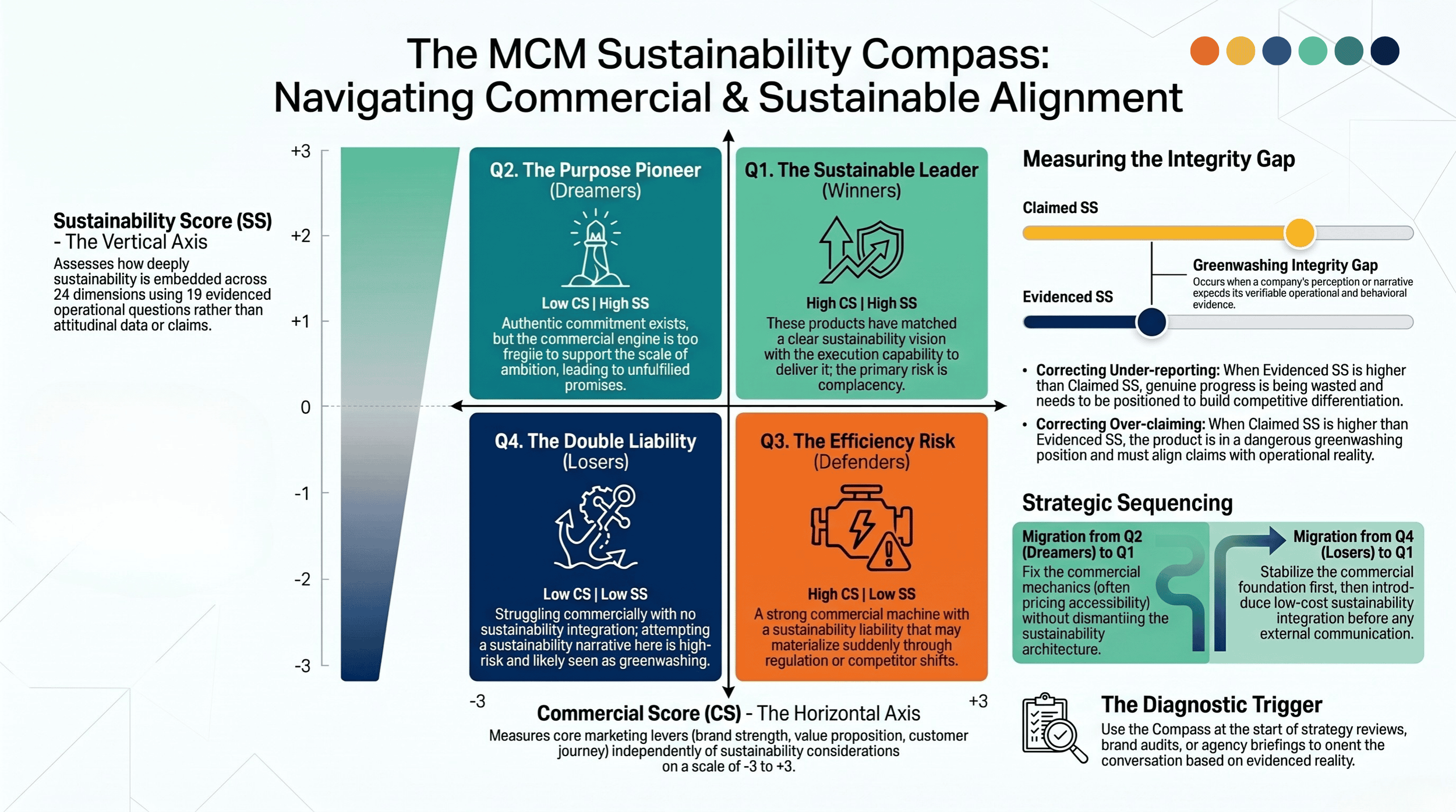
The MCM Sustainability Compass: Navigating Commercial & Sustainable Alignment
What this means for the work you do
Understanding that these two dimensions are separate changes how you approach sustainability briefs, reviews, and conversations in your daily work.
It means the right question at the start of a sustainability campaign brief is not "how do we make our sustainability story more compelling?" but "what is our actual sustainability position on both dimensions — and is the story we are about to tell consistent with that position?" A company in the third position running a heavy sustainability campaign is not a communications win. It is a liability in formation.
It means when you are evaluating the success of a sustainability initiative, you track both dimensions. Did this improve how genuinely embedded sustainability is in our marketing — or did it just improve how sustainability is communicated? These are not the same thing, and conflating them is how good marketing teams produce bad outcomes for good-faith companies.
It also means that when you spot the gap between what a company claims and what it does, you have a way to name it that is precise and useful. The gap between the claimed position and the real position is the risk. Naming it clearly, early, with evidence, is one of the most valuable contributions an earlier-career marketer can make in a room full of people whose instinct is to polish the narrative.
The framework that structures this across all 24 marketing dimensions — the Marketing Canvas Method — calls this the Sustainability Score and the Commercial Score. In the next article in this series, we will go through the 19 specific questions that make up the Sustainability Score, what they test, and why they require evidence rather than answers.
What you should do: Before your next sustainability-related meeting or review, write down what you believe the company's position on both dimensions actually is — separate from what the brief or the slide deck claims. Use the two questions: how strong is the commercial engine? How embedded is the sustainability? Bring that read into the room. See if it changes the conversation.
This is part of the series: Sustainability in Your Marketing Strategy.← Previous: Why your sustainability marketing isn't working→ Next: The 19 questions [coming soon]
For the strategy-level version of this article — with the full framework, quadrant diagnostics, and FIX/ALIGN/SCALE implications — read the companion piece for marketing and strategy leaders here.
Want to map your company's position on both axes? Book a session →
