The MCM Sustainability Compass: A Two-Axis Diagnostic Framework (3/7)
The most common strategic error in sustainability marketing is treating sustainability performance and commercial marketing performance as a single dimension. Companies report them together, benchmark them together, and improve them together — which means they almost never see the cases where they are pulling in opposite directions.
A company can have exceptional sustainability embedding and a fragile commercial engine. It can have an excellent commercial machine and almost no genuine sustainability integration. And it can present — externally and internally — as though these two things are moving in alignment when they are not. Seeing them as independent is not a theoretical nicety. It is the precondition for an honest diagnostic.
The MCM Sustainability Compass is designed to make that independence visible.
The two axes
The Compass maps every company on two independent dimensions.
The Commercial Score (CS) measures how effectively the company manages its core marketing levers — customer understanding, brand strength, value proposition quality, customer journey, conversation strategy, and commercial metrics. In the full Marketing Canvas Method, this is derived from the Vital Audit: the scored assessment of the 24 marketing sub-dimensions. In the context of sustainability analysis, the CS represents the company's baseline marketing execution capability, measured entirely independently of any sustainability considerations.
The Sustainability Score (SS) measures how deeply sustainability is embedded across those same 24 dimensions — not through communication claims but through 19 evidenced questions that assess integration at the level of the Job To Be Done, the brand's values and visual identity, the product's functional and emotional benefits, the pricing architecture, the channel design, the conversation strategy, and the influencer relationships. The SS is built from behavioural and operational evidence, not attitudinal data. As established in Article 1, stated intent is not evidence of sustainability integration.
The CS and SS are scored on the same Likert scale (−3 to +3). The Compass plots CS on the horizontal axis and SS on the vertical. The resulting quadrant is not a grade — it is a strategic position that implies a specific set of challenges and a specific sequencing of action.
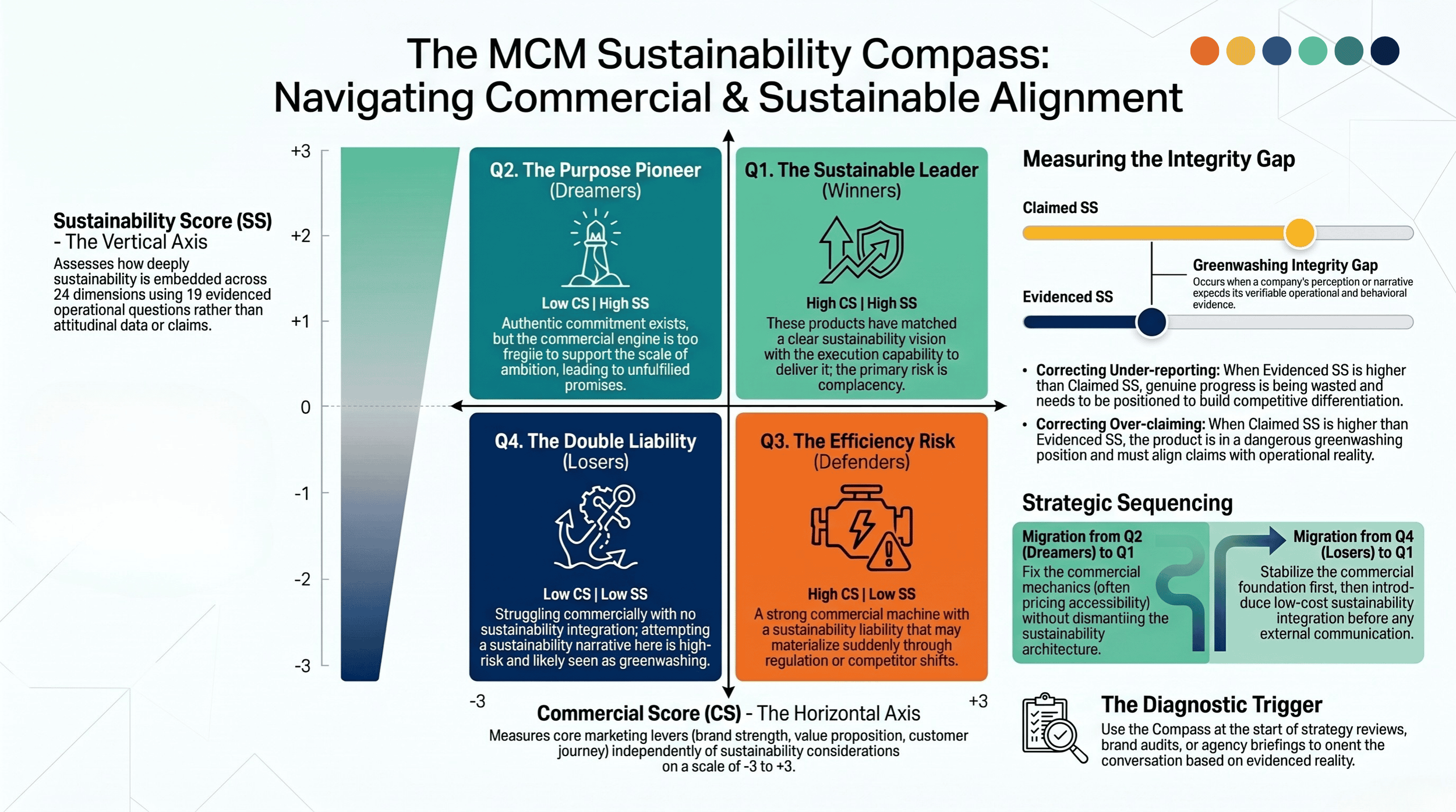
MCM Sustainability Compass: Navigating Commercial & Sustainable Alignment
The four positions
Q1 — The Sustainable Leader (Winners) High CS | High SS
This company has built commercial strength and genuine sustainability integration simultaneously. Its sustainability claims are backed by evidence across the full value chain — from the compatibility of its core Job To Be Done with sustainability (question 115) to the verifiable behaviour of the influencers it works with (question 545). In the sustainability megatrend typology developed by Lubin and Esty, these are the Winners — companies that matched a clear sustainability vision with the execution capability to deliver on it.
The strategic risk here is not greenwashing but complacency. Early leaders in major megatrends are not guaranteed enduring advantage. First-mover position requires continued innovation to hold. The Proof dimension (345) is the leading indicator to monitor: when a company stops gathering new sustainability evidence and relies on existing credentials, the gap between claimed position and real position begins to open.
Q2 — The Purpose Pioneer (Dreamers) Low CS | High SS
This company has genuine sustainability commitment — often demonstrated through real operational trade-offs — but a commercial engine that cannot yet support the scale of the sustainability ambition. The sustainability credentials are real. The commercial model is fragile. Lubin and Esty's typology calls this the Dreamer position, and the label carries a precise warning: when sustainability vision outpaces execution capability, companies make promises they cannot keep. Even with authentic intent, unfulfilled commitments produce greenwashing accusations and the reputational damage that accompanies them. The Ford Motor Company under Bill Ford is the instructive case — sustainability vision deployed before the management team had the capability to execute led to backlash from environmental groups and shareholders alike.
The migration path from Q2 to Q1 is not to pull back on the sustainability commitment. It is to fix the commercial mechanics without dismantling the sustainability architecture — an inherently ambidextrous challenge. The pricing dimension (335) is most frequently the constraint: Purpose Pioneers that price sustainably but inaccessibly are sustaining the commercial fragility that keeps them in Q2.
Q3 — The Efficiency Risk (Defenders) High CS | Low SS
This company has built an effective commercial marketing machine and has either not engaged seriously with sustainability integration or has allowed communication to drift significantly ahead of operational reality. The commercial strength is real. The sustainability liability is a slow-moving risk that tends to materialise suddenly — through regulatory action, a supply chain disclosure, a credibility challenge from a better-informed competitor, or a shift in customer expectation that the company's intelligence system never detected.
An important distinction applies here. Not all Q3 positions carry equal risk. Deliberate Defenders — companies that have made a considered strategic choice to maintain a go-slow sustainability position because their industry structure, competitive dynamics, or regulatory environment make it rational — are in a categorically different situation from unconscious Defenders, who are simply unaware of their exposure. A deliberate Defender that understands its position, monitors the gap, and has a sequenced plan is managing a risk. An unconscious Defender is accumulating one.
The most dangerous variant of Q3 is the company that simultaneously has a low SS and heavily communicates about sustainability. This is where the Greenwashing Integrity Gap is widest and where reputational exposure is highest.
Q4 — The Double Liability (Losers) Low CS | Low SS
This company is struggling commercially and has not built meaningful sustainability integration. The strategic temptation — to reach for a sustainability narrative as a commercial rescue mechanism — is also the highest-risk move available from this position. Overlaying a sustainability claim on a weak commercial foundation compounds both problems: the commercial weakness remains unaddressed while greenwashing exposure is added. In the sustainability megatrend typology, these are the Losers, and the historical precedent from previous megatrends is unambiguous — companies that fail to adapt to a structural market transformation do not recover by communicating their way into it.
The correct sequencing from Q4 is to stabilise the commercial foundation first, then introduce sustainability integration at the points of lowest cost and highest credibility, before any external sustainability communication.
The Integrity Gap
The Compass position is only as useful as the evidence quality behind each score. This is the function of the Greenwashing Integrity Check — scoring the SS twice: once based on the company's own perception and narrative (Claimed SS), once based on verifiable operational and behavioural evidence (Evidenced SS).
The gap between Claimed SS and Evidenced SS runs in two directions, both of which require action.
When Claimed SS exceeds Evidenced SS, the company is communicating sustainability it cannot substantiate. This is greenwashing in its most structurally dangerous form — not necessarily cynical, often the result of an assessment system that relies on attitudinal data. The participation cluster questions (145, 445, 515, 525, 535, 545) are where this gap most commonly occurs.
When Evidenced SS exceeds Claimed SS, the company has genuine sustainability progress that is not captured in its external marketing posture. This is the under-reporting scenario — a strategic failure of a different kind. Sustainability value that is not measured, communicated, and positioned does not build competitive differentiation or stakeholder confidence. Both directions of the gap require correction.
Using the Compass in practice
The Compass is most useful as a diagnostic at the start of a sustainability strategy review, a brand audit, or an agency briefing — not as a final score but as a starting position that orients the strategic conversation.
The first question is: where is the company actually positioned, and does the internal perception match the evidenced reality? The second is: what is the intended migration path, and over what time frame? The third is: given the current quadrant, what is the correct sequencing — FIX the commercial foundation before investing in sustainability communication, ALIGN the sustainability claims with the operational evidence, or SCALE the genuine sustainability strengths that are already present but under-leveraged?
The next article in this series maps the 19 specific questions that make up the SS — what each tests, how it should be evidenced, and the common scoring errors that shift the Compass reading without moving the underlying reality.
This is part of the series: Sustainability in Your Marketing Strategy.← Previous: The sustainability intention-action gap: a measurement failure→ Next: The 19 questions
For the earlier-career version of this article — focused on building the instinct to read a company's real sustainability position — read the companion piece here.
Ready to map your company's Compass position with evidence? Book a session →
