
BLOG
A collection of article and ideas that help Smart Marketers to become Smarter

Questions you should ask with the Marketing Canvas
Marketing canvas is an easy yet powerful tool you can use for assessing your Marketing Strategy. It works for small and very large companies. It can be used by novices or experts. A list of key questions to be asked can be found in this article. Enjoy!
Below you will find a list of questions that will help you during the assessment of your marketing strategy with the Marketing Canvas. How does it work? You take the Canvas and go through all dimensions (after having defined your ambition - see article) asking all questions. You can have 2 potential answers for each question:
- I don't know or No then it is playing against your ambition. It is a Brake and the colour is RED. This is something you should improve or change if you want to achieve your ambition.
- Yes then it is playing in favour of your ambition. It is an Accelerator and the colour is GREEN. This is something you can leverage for achieving your ambition.

Customer Life Time Value
- Is your MARKET growing? The market situation plays an important role when you are trying to grow. A saturated market will play against you while a new and growing market will play for you. Understanding this will help you when building your marketing strategy.
- Is it easy and/or cheap to attract new USER ? Getting new customers has a price and could take time. If your customer acquisition is cheap and easy it will most probably play for you while if it takes time and/or it is expensive it will play against you when building your marketing strategy.
- Are you maximizing the ARPU of your user? ARPU stands for Average Revenue Per User. It is a combination of transactions (how frequent people buy products/services) and prices (how much they pay when they buy something). If you believe you are maximizing the ARPU of your users, it will play for you. If not (or worst if it will decrease), it will play against you.
- Is it easy to extend the LIFETIME (reduce churn) of your user? Keeping your users will generally play an important role in your financials. The more users you have, the more revenues are at stake. If keeping your users is expensive and difficult, it will play against you. If it is easy and/or cheap, it will play for you.
Human
- Is your current understanding of the JOB TO BE DONE of your users helping you to achieve your ambition? Knowing the Job To Be Done of your future and existing users is fundamental. This might help you to identify the untapped area or new insights that you could leverage. Could you leverage it for your ambition? If yes, it means that you can create value by addressing the job to be done.
- Is your current understanding of the ASPIRATIONS of your users helping you to achieve your ambition? Knowing the aspirations of your future and existing users will help you to offer more than products or services and contribute to their lives. Do you know them? Can you leverage it?
- Is your current understanding of the PAINS & GAINS of your users helping you to achieve your ambition? Getting the Job The Done has some pains (negative emotions) but also gains (positive emotions). If you have identified them and you are capable to leverage it, it will play for you. Otherwise, it will play against you.
- Is the ENGAGEMENT of your users helping you to achieve your ambition? Knowing how much your users are engaged (NPS could help you) and being able to leverage it will certainly play in your favor.
Brand
- Is the PURPOSE of your Brand helping you to achieve your ambition? Having a purpose is probably the most important asset for your long-term business. Great companies are crystal clear about why they exist! Do you know your purpose? Is it robust enough and clear enough? Can you leverage it further for creating value? Not knowing or having a weak purpose will certainly play against your ambition. A strong purpose will help you when looking for extra value!
- Is the POSITIONING of your Brand helping you to achieve your ambition? How to address your category will help you make choices and clarify how to stand out from the competition. Are you a leader (setting the standards), are you a challenger (playing the leader game but challenging it) or are you a game changer (redefining the game)? Can you leverage your positioning further (be more leader, challenger or game changer)? Not knowing this or answering no means that you need to revisit your current positioning for creating value.
- Are the VALUES of your Brand helping you to achieve your ambition? Your values are your translation of your purpose into key behaviors. Most of the commercial activities are delivered through behaviors (from people or from systems). Do you know your values? Are they helping you for creating more value?
- Is the IDENTITY of your Brand helping you to achieve your ambition? Your identity is how you translate your purpose into an image. Not having a clear identity or having an identity that couldn't be leveraged will block you when trying to create more value.
Value Proposition
- Are the FEATURES of your Value Proposition helping you to achieve your ambition? Do you address the right functional features? are they aligned with your humans? Can you answer this question? Can you become more unique and different from the competitions? Not knowing if your features (functional characteristics of your products and services) could help you to create more value or answering no means that it will not help you when you will look for extra value.
- Are the EMOTIONS of your Value Proposition helping you to achieve your ambition? Today, differentiation comes through emotions and not functional features. Do you know if you deliver the right emotional features? Can you leverage more the emotional dimensions in your value proposition for creating value? Answering yes means that you can create extra value through the emotional dimension of your value proposition.
- Are the PRICES of your Value Proposition helping you to achieve your ambition? Your pricing can be a strong brake for creating extra value or a strong enabler. Do you know where your current pricing is creating value? Can you leverage it further? Being able to leverage your pricing for creating new value is a key asset for your future.
- Are the PROOFS of your Value Proposition helping you to achieve your ambition? Do you have enough evidence that helps people understanding the value you create with your value proposition? Can you leverage your value proposition with more or better proofs?
Journey
- Are the MOMENTS of your user journey helping you to achieve your ambition? Moments are the different steps a user is going through when he is trying to solve his problem. When using Mental Models, we can identify all key moments a user is going through and try to formulate the best brand experience possible. Do you know all moments of your users? Can you capture more value through these moments?
- Is the EXPERIENCE of your user's journey helping you to achieve your ambition? As a Brand, you need to formulate a clear and articulated answer at each moment. These answers should reflect customer identity, satisfy the objectives and meet expectation. Do you have orchestrated answer (or is it random)? Can you capture more value through the experience of your user's journey?
- Are the CHANNELS of your user journey helping you to achieve your ambition? The number of channels that can be used for transacting with a brand is growing. And each user is free to use channel(s) of his choice. Do you have an answer for all potential channels? Do you orchestrate these channels? Can you capture more value through these channels?
- Are the MOMENTS OF TRUTH of your user journey helping you to achieve your ambition? Providing an orchestrated experience is already a great achievement. Next step is to transform some moments into Moments of Truth (also referred as like moments or wow moments). Do you know if you offer Moments of Truth? Can you capture more value through these moments of truth?
Conversation
- Is the way you are currently LISTENING TO your users helping you to achieve your ambition? How can you have great conversations with your users if you don't listen to their voices? Do you systematically capture the voice of your users? Do you capture more value by listening to your users?
- Are your CONTENT & STORIES for your users helping you to achieve your ambition? Monologues are no more working for engaging users with your brand. Should you have contents and stories? Do you know if you have content & stories? Do you capture as much as you can value through content & stories?
- Is the current use of your MEDIA helping you to achieve your ambition? You can place your content & stories through different media: Paid, Owned, Earned or Shared? Do you know which media you are using? Do you capture as much as you can value through your media?
- Are your INFLUENCERS helping you to achieve your ambition? People are trusting people. Do you know if you are using influencers? Do you capture as much as you can value through influencers?
Budget
- Is your budget for Marketing FEES helping you to achieve your ambition? If you want to propagate your content, stories, and offers, you should balance your media investment between Owned, Paid, Earned and Shared. Have you well balanced your investments amongst these media? Is it enough for your ambition (have you compared this investment with your competitors) ?
- Is your budget for Marketing PEOPLE (internal & external) helping you to achieve your ambition? To make things happening, you need a team (either insourced or outsourced). Do you have enough people for achieving your ambition?
- Is your budget for Marketing KNOWLEDGE helping you to achieve your ambition? It is important to collect systematically enough knowledge through research, training, bootcamp or even consulting projects for achieving your target. Do you have properly invest in these topics for your ambition.
- Is your budget for Marketing CAPABILITIES helping you to achieve your ambition? More and more marketers have a leading role when defining the technical roadmap of the company because of the impact on the customers (web site, mobile applications, automation, CRM and lead generation software, database, ...) Do you have invested enough in these topics for your ambition?
Why you need a bold question for your Marketing Strategy?
What is the best way to start defining the marketing strategy of your company, business or activity? My proposal is to start with a bold strategic question! Why?
What is the best way to start defining the marketing strategy of your company, business or activity? My proposal is to start with a bold strategic question! Why?
Because the objective of your strategy is to achieve an ambition and most probably a financial ambition. Whether you are a startup or a stock listed company, you have to achieve a financial ambition if you want to stay in business. Thus first hypothesis is to have a financial ambition and preferably S.M.A.R.T. one.

Financial Ambition of Your Strategy
Then let's imagine, you don't do any strategy and you let the business in free wheel (no plan). Most probably you will face problems and situations (external or internal) that will block you to achieve your ambition. I suggest that you highlight the biggest problem, your #1 fear for your business. Thus second hypothesis is that you need to define your biggest fear as the context where you will do your strategy.

Biggest commercial fear you have
Question
HOW CAN I (FINANCIAL AMBITION) IN (TOP #1 FEAR) ?
Examples
HOW CAN I GROWTH MY REVENUE BY 5% IN AN AUTOMATED AND DIGITAL ENVIRONMENT? (Shoe Store)
HOW CAN I PROTECT MY REVENUE NEXT YEAR IN A MARKET WHERE UBER IS ARRIVING? (Taxi company)
HOW CAN I BE PROFITABLE AFTER 1 YEAR IN A MARKET WHERE NOBODY KNOWS ME YET ? (Startup company)
Quote

Marketing Strategy should start with a bold question

Marketing Canvas - Job To Be Done
Unlock success in marketing with a deeper understanding of the 'Job to be Done' concept. Explore its principles, application, evaluation, and a real-world Green Clean use case.
Last update: 16/10/2024
I have introduced a new evaluation framework for assessing Jobs to Be Done (JTBD) with a focus on sustainability. This topic is now integrated into the comprehensive marketing strategy assessment.
In a nutshell
"Job to be Done" (JTBD) is a pivotal concept in the Marketing Canvas, helping businesses to understand their customers' needs more precisely. The JTBD concept posits that customers buy products or services to fulfill a specific job or objective that goes beyond mere product functionality, including emotional and social aspects. Businesses must focus not on the product they sell, but on the job that their product is hired to do. A deep understanding of the customer's job can make marketing more effective and innovation more predictable. The JTBD framework involves identifying customers' unmet goals, constraints, and catalysts, which can lead to innovative and unique solutions.
A practical example is Green Clean, an eco-friendly cleaning company. Their customers' JTBD might not just be "getting a clean house," but also "maintaining a safe and healthy home environment," "reducing their carbon footprint," or "setting a positive example for their children about environmental responsibility." By understanding these broader jobs, Green Clean can tailor their services and marketing strategies more effectively.Introduction
In the Marketing Canvas
The Marketing Canvas is a powerful tool for entrepreneurs and non-marketers to build a robust marketing strategy. It consists of six meta-dimensions, each with four sub-dimensions, for a total of 24 sub-dimensions defining your Marketing Strategy. One of these sub-dimensions is JOB TO BE DONE (JTBD), which falls under the CUSTOMER meta-category
Introduction
"Job to be Done" is the inaugural concept in the Marketing Canvas, positioned under the Customer category. It serves as a litmus test to gauge your understanding of the people who buy, use, or may potentially purchase your products and services. Originating from the realms of Innovation and Entrepreneurship, this concept was first broached by Theodore Levitt in his ground-breaking article, "Marketing Myopia". He famously asserted, "People don't want a quarter-inch drill, they want a quarter-inch hole" (HBR, 1960).

Marketing Canvas by Laurent Bouty - Job To Be Done
What is Job To Be Done?
When devising your commercial strategy, it's paramount to understand the problems your customers are trying to solve or what they aim to achieve. This is where "Job-to-be-done" (JTBD) comes into play. Simply put, JTBD is the ultimate objective that inspires customers to buy products, services, or solutions.
The JTBD framework functions as a lens through which you can scrutinize the circumstances or problems that trigger customers to make purchase decisions. Customers are seldom swayed by what an "average" customer might do. Instead, they are more likely to buy products or services that can address a specific problem they are facing. Knowing the "job" that your customers are "hiring" a product or service for enables you to design and market products that precisely meet their needs.
A crucial aspect to remember is that JTBD is not an activity or a task (like listening to music). Rather, it encapsulates the broader purpose for which customers use a product or service.

Job To Be Done
JTBD: An In-Depth Perspective
Imagine a consumer progressing through life as they know it. Then, an opportunity for self-betterment presents itself, a chance to grow. If they find a product that helps them seize this opportunity, they can evolve into a better version of themselves. As Alan Klement puts it, "A Job To Be Done is the process a consumer goes through whenever she aims to transform her existing life-situation into a preferred one."
Thus, JTBD is about comprehending our inherent desire to evolve. This motivation changes slowly, and consequently, Jobs change slowly. However, products constantly evolve due to technological advancements that facilitate better solutions for our Jobs. Therefore, the focus should be on the JTBD and not the product itself or what the product does.
Tony Ulwick, who developed the JTBD concept, lays down nine key principles that govern the JTBD:
People buy products and services to get a “job” done.
Jobs have functional, emotional, and social aspects.
A Job-to-be-Done is consistent over time.
A Job-to-be-Done is independent of any particular solution.
Making the “job”, rather than the product or the customer, the unit of analysis leads to success.
Understanding the customer’s “job” makes marketing more effective and innovation more predictable.
People want products and services that help them get a job done better and/or more cheaply.
People prefer products and services that enable them to get the entire job done on a single platform.
Tying customer needs to the job-to-be-done makes innovation predictable.
A consumer goes along his life as he’s come to know it. Then things change. He is presented with an opportunity for self-betterment — that is, make changes so he can grow. When or if he finds a product that helps him realize that growth opportunity, he can evolve to that better version of himself he had imagined.
“A Job To Be Done is the process a consumer goes through whenever she aims to transform her existing life-situation into a preferred one.”
Translating JTBD into Action
You must focus not on the product or solution you sell but on the job your customer has hired it for. The product or service they are using today might be satisfactory, but other alternatives could provide a better solution to their job tomorrow.
By observing your (potential) customer, strive to understand the problem they are trying to solve with the product (yours or an alternative). The more critical the job is to the customer, the more value you could potentially add with your solution.
The "Jobs-As-Progress" concept can
help answer several questions such as:
What triggers someone to buy a product for the first time?
How do consumers use markets to adapt in a changing world?
How do consumers shop and switch between products?
Understanding the 'why' behind their behavior can lead to innovative and unique solutions to their problems.
Tool(s) for JTBD
When mapping the key elements of JTBD, it's useful to separate functional outcomes and aspirations. Functional outcomes are tangible and measurable deliverables of a product or service, whereas aspirations carry significant personal value. For example, consider selling drinkable water. Evian promotes life-changing aspirations (live young) as part of their JTBD solution. So, the customer isn't drinking water just because they're thirsty, but because they want to stay young, with quenching thirst being a functional outcome.
In JTBD, we identify:
Unmet Goals: Future experiences a consumer desires but cannot currently attain. These could be functional, emotional personal, or emotional social.
Constraints: Factors that prevent consumers from progressing towards their unmet goals.
Catalysts: Events that create or affect an unmet goal, constraint, or choice set.
Harvard Business School professor Clayton Christensen encapsulates it well, “Jobs aren’t just about function—they have powerful social and emotional dimensions."
Clayton Christensen, professor at Harvard Business School talks about the job to be done.
“When you start to understand the why, your mind is then open to think of creative and original ways to solve the problem.”

Marketing Canvas - Job To Be Done
“Jobs aren’t just about function—they have powerful social and emotional dimensions.”
Statements for Self-Assessment
For a comprehensive evaluation of your understanding and application of the "Job to be Done" concept, rate your agreement with the following statements on a scale from -3 (completely disagree) to +3 (completely agree):
You have clearly identified functional unmet goals and feel confident in addressing them.
You have clearly identified emotional personal unmet goals and feel confident in addressing them.
You have clearly identified emotional social unmet goals and feel confident in addressing them.
Your Job To Be Done is compatible with the concept of sustainability. (!!NEW!!)
Marketing Canvas Method - Assessment - JTBD
Interpretation of the scores:
Negative ccores (-1 to -3): These scores indicate that you disagree or strongly disagree with the statement, meaning you lack confidence in your understanding of the given dimension (whether functional, emotional, or sustainability-related). This suggests a significant gap in comprehending your customers' JTBD, potentially leading to missed opportunities for better alignment with their needs and expectations. A thorough reassessment is necessary to improve your understanding of these dimensions and adjust your strategies accordingly.
Score of zero (0): A neutral score suggests that you are uncertain or only partially aware of your customers’ unmet goals in the specified area. While you may have a surface-level understanding, it lacks depth or clarity. This indicates a need for further research and analysis to enhance your understanding of how your customers' JTBD is evolving.
Positive scores (+1 to +3): Positive scores indicate that you agree or strongly agree with the statement, meaning you have a clear and confident understanding of your customers' functional, emotional, or sustainability-related unmet goals. Higher scores demonstrate a well-developed knowledge, enabling you to tailor your products and marketing strategies effectively to resonate with your customers' JTBD.

The Green Clean use case
Imagine an eco-friendly cleaning company, Green Clean. The JTBD for Green Clean's customers extends beyond "getting a clean house." It might also include emotional and social goals, such as "maintaining a safe and healthy home environment," "reducing their carbon footprint," or "setting a positive example for their children about environmental responsibility." Understanding these broader jobs helps Green Clean more effectively align its services and marketing strategies with their customers' needs.
Misaligned understanding (-3, -2, -1): A negative score reflects disagreement with the statement that Green Clean understands how sustainability fits into their customers' JTBD. If Green Clean focuses solely on the functional aspect of cleaning and fails to recognize the importance of environmental concerns, it shows a significant disconnect from the broader aspirations of its customers. This lack of understanding limits their ability to connect with eco-conscious consumers and may lead to missed opportunities in marketing and service development.
Surface understanding (0): A neutral score indicates uncertainty or a limited grasp of how sustainability factors into their customers’ JTBD. Green Clean may recognize that some customers care about sustainability but does not fully understand how central this is to their decision-making. For example, the company might be aware that environmental responsibility is part of their customers' goals but fails to grasp the emotional and social significance of this aspect. As a result, their understanding of how deeply customers prioritize sustainability remains superficial, causing them to miss out on fully resonating with their audience’s aspirations.
Deep understanding (+1, +2, +3): A positive score indicates agreement with the statement that Green Clean has a clear and deep understanding of the sustainability-driven goals in their customers' JTBD. Green Clean recognizes that sustainability is not just a peripheral concern but a core driver of their customers' decisions. The company understands that their customers seek to make environmentally responsible choices that align with broader personal values, such as reducing waste and contributing to a greener future. This deep understanding allows Green Clean to align their business with the emotional and social drivers behind their customers' JTBD, fostering loyalty and trust.
Sources
JBTD - Alan Klement (www.alanklement.com)
The Fundamentals of Jobs-to-be-Done Theory (customerthink)
Know the Two — Very — Different Interpretations of Jobs to be Done
More on Marketing Canvas Method






















How To Define Your Commercial Plan for Your Startup with Marketing Canvas?
When you work on your commercial strategy for your startup, you can facilitate this conversation with using the Marketing Canvas (more on the canvas here). Please find below 10 steps you should follow:

KEY QUESTIONS TO BE ASKED
What is your goal? Big Idea? Define a question that will clarify your projected future like How can we achieve 1M€ after one year of operation? How can we generate 5% growth next year? How can we differentiate our brand in a digital world where predictive technologies driven by AI will become a standard?
What is the problem you are trying to solve? Clarify the job to be done for your customers.
Who is our buyer and user? Define your persona.
If not you who else? Define the category where you are playing and what are the alternatives for your buyer.
How do you want to be remembered? What people will say about you? Your BRAND
What is your answer to the problem your buyer has? What is your value proposition? Do you have USP, ESP, Clear Pricing and Proofs?
What experience people will have with you? Will it generate sales and engagement? JOURNEY
How do you discuss with your buyer? Do you have conversations? Do you listen? Do you have content, stories, influencers? Which media do you use?
Does it make any financial sense? What is your Marketing Budget and Revenue?
If you don't think it all works, iterate one more time
PROCESS FOR ZERO APPROACH
As a startup, you should define your strategic hypothesis. It is slightly different than an existing business because you are starting from a white page.
Part 1- Target, Positioning
Define your key customer target (JTBD, ASPIRATION, PAINS & GAINS). As you are starting your business, you have no information on ENGAGEMENT.
Define your Brand strategy (PURPOSE and POSITIONING) and explain how you will differentiate your brand versus competitors. Explain what could be the VALUES of this brand and your IDENTITY strategy.
Define your Value Proposition (FEATURES, EMOTIONS and PRICING). Describe core, differentiated and unique features/emotions to support your Brand Strategy, matching your customer target and helping you to achieve your financial objectives. Do you have any PROOFS supporting your value proposition?
Part 2- Go To Market
Define your go to market approach and more specifically: Describe funnel journey (pre and post purchase) for your go to market: MOMENTS, EXPERIENCE, CHANNEL and MAGIC. Don't forget to align this with your brand strategy.
Describe your conversation strategy for your go to market. LISTENING, CONTENT, MEDIA and INFLUENCERS if any.
Part 3 - Metrics
Define your hypothesis in terms of metrics for your business: ACQUISITION (speed of acquisition), ARPU (average spending for each customer on the 12 months), LIFETIME (your churn assumption) and BUDGET (amount of € needed for supporting your strategy).

ASSESS YOUR ZERO APPROACH WITH YOUR TEAMS
Use the canvas and answer to these questions using all dimension while asking the same question:
Will my .... help me to achieve my goal?
RED: Not at all; GREEN: Definitely
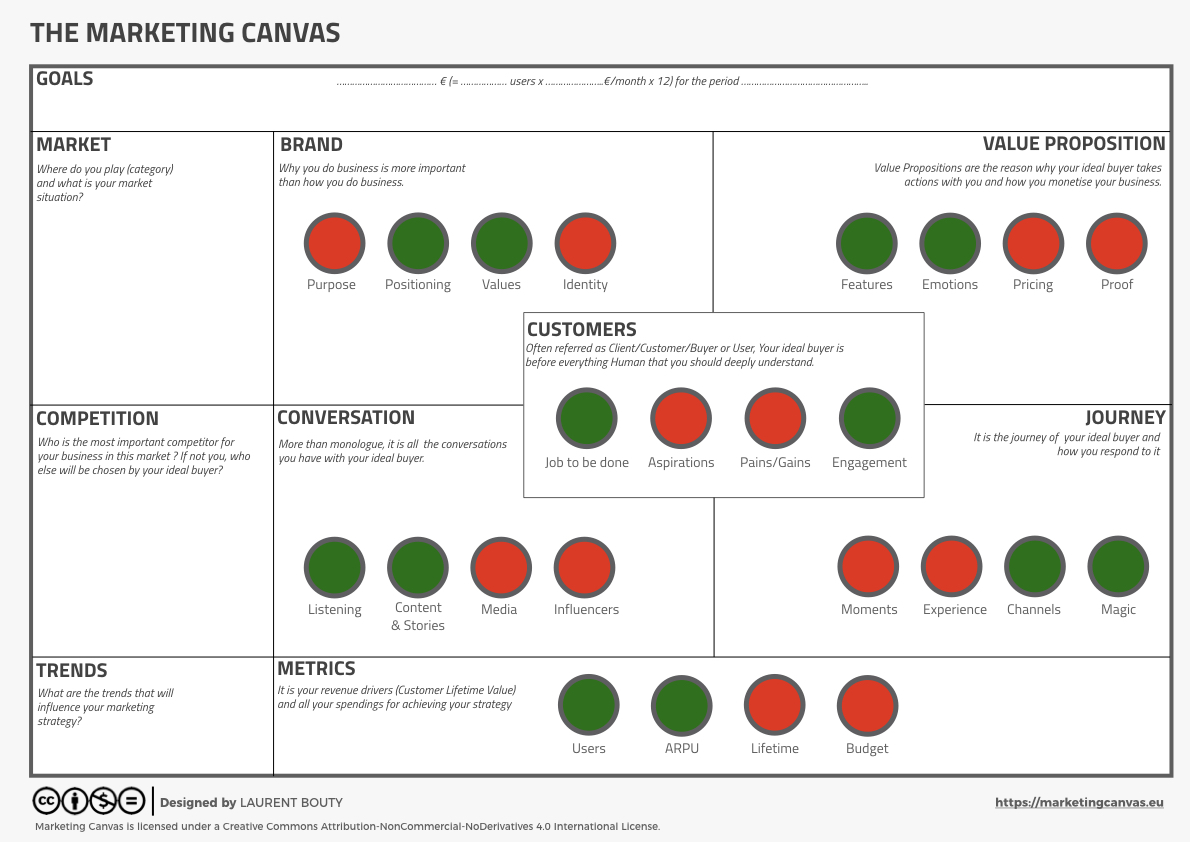
Visualise your Commercial Strategy on Marketing Canvas
RED dimension must be reviewed or mitigated because that are not helping you to achieve your goal.
Interested in the Marketing Canvas, you can find more information here.
Resources
Startup Failure Rate Statistics To Take In [2020] - https://hustlelife.net/startup-failure-rate-statistics/
Steve Blank - Startup Tools - https://steveblank.com/tools-and-blogs-for-entrepreneurs/
How to Assess your Marketing Situation With the Marketing Canvas?
One clear objective of the Marketing Canvas is to facilitate debate and discussion around a clear strategic challenge question. Most of the specialists of the leadership topic agree that one of the key reason why strategy is failing is because the decision that has to be made is unclear! When you do the strategic marketing exercise, you need to be crystal clear about which question you are trying to answer.
One objective of the Marketing Canvas is to facilitate debate and discussion around a clear strategic challenge question. Most of the specialists of the leadership topic agree that one of the key reason why strategy exercise fails is because the decision that has to be made is unclear! When you do the strategic marketing exercise, you need to be crystal clear about which question you are trying to answer.
A second reason why strategy exercise is failing is because there is no alignment neither consensus around the causes and the solutions.
The Marketing Canvas is before everything a framework for facilitating the debate, the co-creation and the alignment of the leadership team. To make it happen, the process for assessing the situation is as follow:
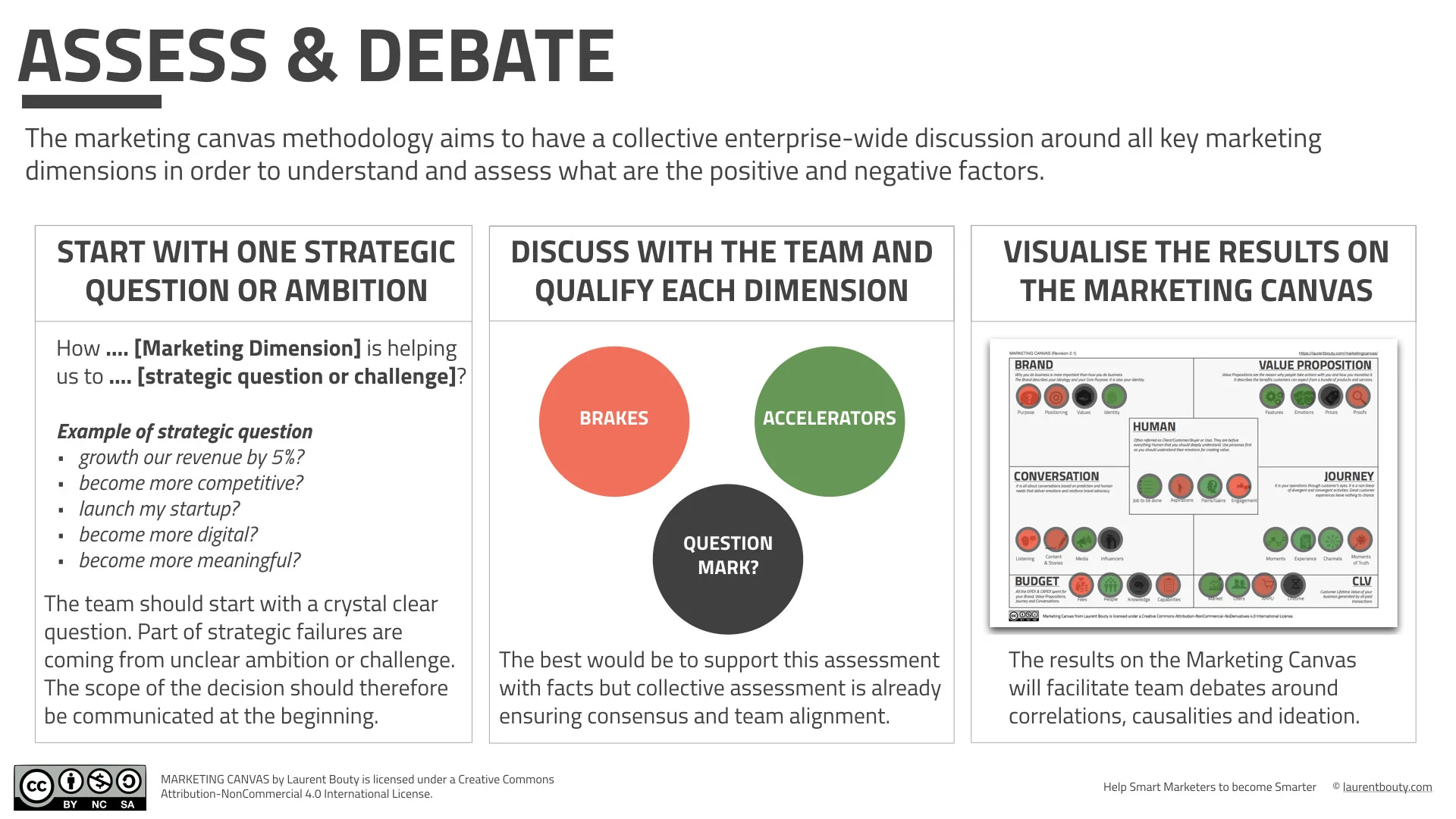
Start with one strategic question or ambition
Start the Marketing Canvas Process with a simple and crystal clear question structured as this:
How …. [Marketing Dimension] is helping us to …. [strategic question or challenge]?
The strategic question or challenge is the trigger for the strategic exercise. Example of strategic question could be:
- Growth our revenue by 5%?
- Become more competitive?
- Launch my startup, my new product or service?
- Increase my market share?
- Improve our ranking in the Meaningful Brand Index?
Having set your Strategic Question, you can systematically discuss each Marketing Dimension with the above question.
Example:
- How our Purpose is helping us to become more competitive?
- How the Job to be done of our customer is helping us to growth our revenue by 5%?
- How our Brand Experience is helping us to increase our Market Share?
- How our Brand identity is helping us to launch our startup?
Discuss with the team and qualify each dimension
For each question, you should assess the situation. Ideally, you have facts and analysis helping you to do this exercise however with a team of internal expert, the consensus and alignment provide usually a rather good qualitative assessment (we should only be careful about not being biased. This could be solved with an external facilitator challenging the obvious).
When asking the question (How …. [Marketing Dimension] is helping us to …. [strategic question or challenge]?), you can have 3 answers:
- RED: This dimension is definitely not helping you. It is a strong negative factor that you will certainly have to tackle in your potential solution. It is a negative factor and might play against your ambition. You will have also to mitigate it.
- GREEN: This dimension is helping you. It is a positive factor and you should leverage it more. This dimension is one of your core asset for this challenge. You should definitely leverage it and it is a key positive factor for your ambition.
- BLACK: You don't know. You have not enough information for answering this question.
Negative factors are referred as Brakes and positive factors are referred as Accelerators.
Visualise the results on the Marketing Canvas
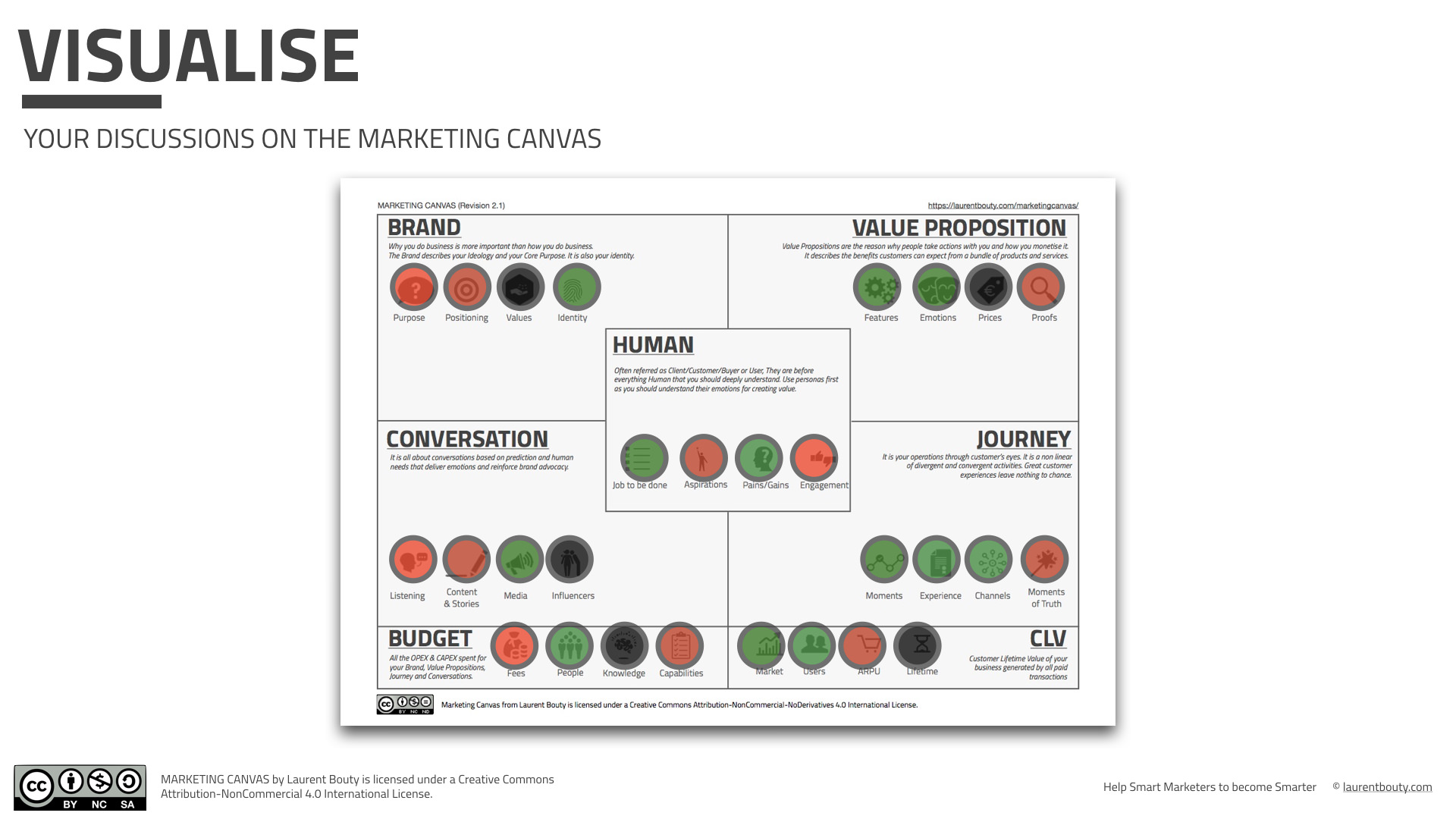
Having answered all questions, you can visualise your results on the Marketing Canvas. The results on the Marketing Canvas will facilitate team debates around correlations, causalities and ideation.
Summary

Assessment methodology with the Marketing Canvas
Infographic on the Marketing Canvas Process
The tool has been designed for facilitating the discussion when designing your strategy.
High-level process is:
- You start from an ambition/question (like increase revenue by 5%, have more digital transactions, be more meaningful, ...)
- You discuss using the 28 dimensions asking:
- What's blocking you to achieve your ambition? (brakes)
- What's helping you (Accelerator)?
- You can support this rating using any information, knowledge you have but it works also if you only rely on qualitative information.
- Then you map your answer on the Canvas. Red are brakes; Green are accelerators.
- Then you try to analyse these brakes/accelerators and understands what cause them, what are the correlation.
- Then you start ideating (brain-writing, co-create, ...), find crazy or impossible ideas) on what you could do (magic diamond, do things better, do different things).
- Then you prioritise your ideas.
- If you can you test it.
- Then you have your action plan.

Infographic Marketing Canvas
Marketing Canvas 2.1 (New version)
The Marketing Canvas is evolving. We have changed 2 main dimensions as it reflects more the Marketing reality.
“Hello Everyone, we are now at version 4.0 of the Canvas. You can find the canvas and other resources on laurentbouty.com/marketingcanvas.
Enjoy the reading and don’t forget to share your experiences with the canvas.”
canvas 4.0: click here https://laurentbouty.com/marketing-canvas-structure
Hello,
After having applied the methodology to several companies, we have collected a lot of insights about what's working very well and what could be improved. We realised that the dimensions COSTS and REVENUES might not be specific enough to the marketing/commercial strategy and we could use better terminology. We have decided to
HUMAN dimension is the most impacted because it wasn't enough customer centric in my point of view. I leveraged more the Value Proposition Canvas as it is a practical and beautiful tool (Job to be done and Pains/Gains) and I added Aspiration because it is key for Meaningful Brands and Engagement in line with NPS approach (Promoters/Detractors).
Replace COSTS by BUDGET which is what a CMO is really managing for achieving his/her objectives. We are keeping the sub-dimensions (FEES, PEOPLE, KNOWLEDGE, CAPABILITIES).
Replace REVENUES by CLV (Customer Lifetime Value). By doing so, we are reinforcing the customer centricity of our model and we integrate the cost of acquisition and cost of retention in the financial analysis.
Replace the word SLA in JOURNEY by Experience as it better reflects what the brand should do.
Update CONVERSATION by replacing Touchpoint by Media and Fans by Influencers as Fans are more for Customers (Human/engagement)than conversation.
Please find below the updated version of the Canvas (2.1). Hope you are enjoying it and feel free to share your feedback.

Marketing Canvas 2.1

Marketing Budget in the Marketing Canvas
Long story short, you should as a marketing leader be mastering the budgeting exercise. I am saying Mastering on purpose because it has a tremendous impact on your professional daily life! Not easy! Scared! Don't know where to start. This article might help you.
When interviewing a marketer for a job, I usually asked him (or her) what he would do the first day of the job. This simple question is nicely helping you to understand personal and professional skills and behaviours of the person. If the interviewee is not coming quickly with the word budget, I will probably not hire him. Why? because at the end, you should start from your budget and finish with it.
Long story short, you should as a marketing leader be mastering the budgeting exercise. I am saying Mastering on purpose because it has a tremendous impact on your professional daily life! Not easy! Scared! Don't know where to start. This article might help you.

Marketing Budget in Marketing Canvas
Some facts
Marketing expense budget is 7% of revenue in 2017.
In 79% of companies, marketing has a budget for capital expenditures — primarily, for infrastructure and software
Marketers are managing a P&L and generating revenue from digital advertising, digital commerce and sale of data

Some Guidelines
Please find some guidelines that could help you when you are working on your budget:
The budget is your main Tool for managing your activities and your team. Each action of your Marketing Plan is linked with your budget which is linked with the company financial plan. If the link is wrong or worst if there is no link, you have a high risk of not delivering what you should (and it could cost you your job).
The budget is your Story! You will have to explain it, justify it, defend it! Thus be ready to make it solid-proofed and robust! Some questions like where can we cut? why do we need this? will certainly be asked.
The budget is supporting your Strategy. You should keep and magnify what contributes to your objectives and eliminate what is not effective. You might receive a budget based on historical trends (like we always spent 25% of our OPEX on TV, thus we have planned 25% for TV next year). While history is important, future will probably be different, therefore you should challenge each line. As said in the WSJ article:
It’s time to retire the age-old process of building marketing budgets by tweaking last year’s plan up or down a few points. Start with clear objectives, an aggregate affordable investment number and a blank sheet of paper. Challenge your team to create channel-agnostic budget allocations that give you the best chance of hitting goals while challenging assumptions of causation that rely on historical models of customer behavior. Be careful that this process is used for optimizing marketing investment allocation rather than as merely a cost-cutting exercise, which has happened at more than a few corporations.
The total budget is based on Real market assumptions. The simple test is MKT OPEX/REV and compare this ratio with industry and competitive benchmarks. The starting point for this ratio could be 3% but you should really check your case.
The budget is Organised. Why did you put this amount for this campaign and that amount for that one? One way to do that is to create categories of action having each a specific budget and allocate each action under the right category. Have a look below (Some definitions) and you will see that you should organised your budget in Paid, Owned and Earned Media for each action.
The budget is Seasonal. If there is 28 days in the month, it is not the same as 31 days. July is not March!
The budget is Managed. Each spending has to be tracked and compared to your plan. If you underspent, you should decide what you will do with the extra OPEX.
The budget is Communicated. Each corporate culture is different but my advice is to start with aggregate numbers (like total advertising) and not giving all the tiny details at the start. Why? The more you give, the more questions you get!!!
The budget is Finalised. If your target date is September 24 at 8 PM, Deliver it September 24 at 7.59 PM Why? If you deliver it before, most probably you will have to adapt it because you will receive questions ;-). This is assuming that you have fully respected the original guidances and that your budget is respecting all previous points.
AND FINAL RECOMMENDATION: You should SPEND all your budget! unless a budget revision asked you not to do so.

Nice Marketing Budget Infographic from Nuanced Media
source: http://www.wordstream.com/blog/ws/2016/10/26/marketing-budget
Some Questions
Fees - Budget for Media, Content and Discount
Do you know how much you have to spend on Paid non-digital media (off-line)?
Do you know how much you have to spend on Paid digital media (on-line)?
Do you know how much you have to spend on Earned media?
Do you know how much you have to spend on Content?
Do you know how much have to spend on Acquisition Costs, Stimulation Costs and Retention Costs (Promotion, Discount on Price, Giveaways) ?
PEOPLE - BUDGET FOR PEOPLE
Do you know how much employees you need in your team for delivering your revenues objectives (short-term, long-term)?
Do you know how much you plan to spend for outsourcing your strategic & creative work?
Do you know how much you plan to spend for outsourcing your product development?
Do you know how much you plan to spend for outsourcing your operations?
Do you know how much you plan to spend on rewarding your staff ?
KNOWLEDGE - BUDGET YOU SPEND FOR INCREASING YOUR KNOWLEDGE
Do you plan to invest in Marketing Training ? How much?
Do you plan to invest in Marketing Research & Intelligence (User testing, Survey, Focus Group, Reports, Seminars, Competitive analysis)? How much?
Do you plan to spend on creative exploration (Workshop, ideation lab , Fab lab)? How much?
CAPABILITIES - BUDGET YOU SPEND ON MARKETING TECHNOLOGIES
How much do you plan to invest in Data and Analytic tools?
How much do you plan to invest in Customer relationship tools?
How much do you plan to spend in Commerce & Sales management tools?
How much do you plan to invest in Content and Experience management tools?
How much do you plan to invest in Adtech & Social tools?
Some definitions
Paid media
Quite simply, it’s all the advertising you pay for. Basically anything that you’ve paid for in order to drive traffic to your ‘owned media’ properties. The audience for paid media is generally made up of strangers to brand and its services. This includes amongst other things:
Print ads
TV ads
Display ads
Paid search
Promoted posts on Facebook
Sponsored tweets
Owned media
All the cool properties that belong to your brand which you control. It’s down to the strength (quality, persuasiveness, relevance) of these properties to determine whether the strangers driven to your owned media by paid media will become customers. This includes amongst other things::
Your website
Mobile site
Retail stores (online and offline)
Blogs
Social media channels
Apps
Magazines
Brochures
The strength of these owned media experiences will also determine whether your customers will then become fans of yours. Fans drive ‘earned media’.
Earned media
It’s the free publicity generated by your fans. You didn’t pay for it, because you earned it… Good work! Either your hilarious online video, your superior ecommerce experience or your constantly engaging Twitter account has been good enough for someone to create a positive piece of content for you or share your original content further. This can include:
Retweets
Facebook Likes
YouTube comments
Shares
Revines
Bloggers writing about your product
Online reviews
Word of mouth
If a video ad that you paid to make is shared by someone on social media this ‘sharing’ is still called earned media.
Unlike paid or owned media, you can’t really control the above examples (no matter how hard you wish to try). It’s in the hands of your ‘fans’. However earned media is how your brand may become wildly popular, so if you trust your own brand and products than you should trust in earned media.
Some readings
Facts, Gartner, CMO Spend Survey 2016-2017: https://www.gartner.com/smarterwithgartner/gartner-cmo-spend-survey-2016-2017-shows-marketing-budgets-continue-to-climb/
The CMO Survey, August 2017, https://cmosurvey.org/results/august-2017/
Forbes, Three Steps To A Solid Marketing Budget, http://www.forbes.com/sites/davelavinsky/2013/06/07/three-steps-to-a-solid-marketing-budget/
HBR, How CMOs Can Get CFOs on Their Side, https://hbr.org/2013/11/how-cmos-can-get-cfos-on-their-side/
WSJ, Outside Voices: Marketers Need To Modernize, Not Just Switch Their Agencies, http://blogs.wsj.com/cmo/2015/08/21/outside-voices-marketers-need-to-modernize-not-just-switch-their-agencies/
Forrester, Defining Earned, Owned And Paid Media, http://blogs.forrester.com/interactive_marketing/2009/12/defining-earned-owned-and-paid-media.html
Budget-Friendly Ideas to Promote Your Small Business and How to do it (2019 Guide) https://www.customlogocases.com/blog/budget-friendly-business-promotion/
Listening in the Marketing Canvas
Listening is the first and certainly the most important component of the Conversation in the Marketing Canvas. Before talking, you should first systematically listen to your customers and prospects? Are you doing it? Actively?
Listening is one of the four key dimensions of CONVERSATION in the Marketing Canvas.
Interesting article from Interbrand about listening: Why listening and understanding people is so important
“There’s a missing element that marketers and advertisers aren’t thinking about when it comes to technology: the human element. Achieving true brand and business growth in our ever-evolving digital world will come down to better understanding people. This requires business leaders to adopt a culture that is based on listening to the communities they aspire to reach.
Ryan Holmes, CEO of social publishing tool Hootsuite, made the important point in a recent op-ed that the future of online content and brand engagement is authenticity. Right now is the moment in which brands must decide to establish ongoing and more personal relationships with their customers and fans.
While marketing has always aimed to speak to audiences, the tides are now changing. The Best Global Brands do more listening than talking.
What people have to say about you, themselves, their needs, your industry, and your competitors, offers a deeper look at the customers and brand loyalists we’re looking for. This information provides a qualitative case study into how brands can nurture the necessary relationships with the right people.
Businesses need to utilize this information in more imaginative ways if they intend on growing their customer bases.”

Listening in the Marketing Canvas (CONVERSATION)
4 Questions for Your Brand in Marketing Canvas
Why you do business is more important than how you do business.
The Brand describes your Ideology and your Core Purpose. It is also your identity.
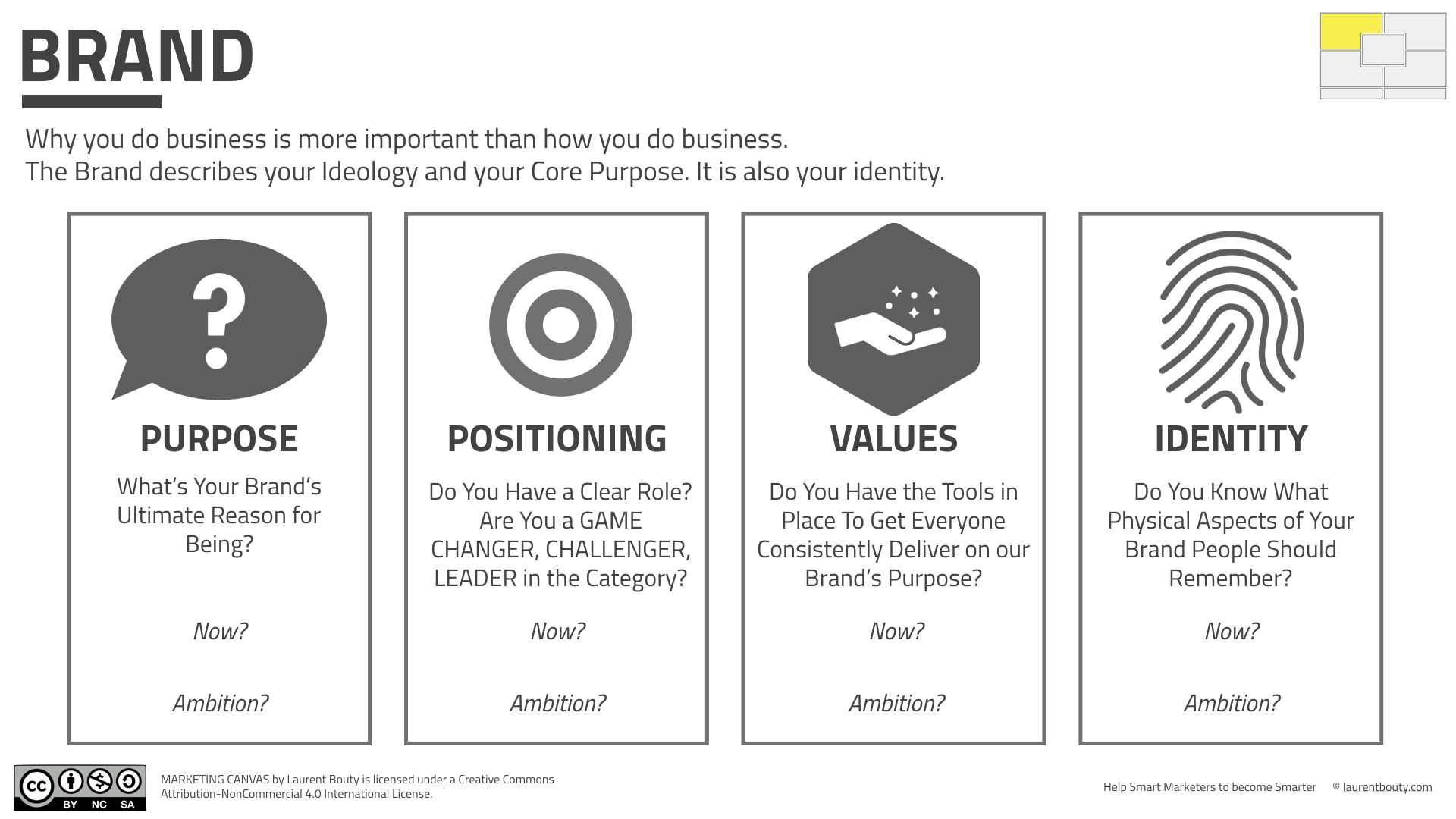
4 Questions for your BRAND in the Marketing Canvas
Marketing Strategy in Context
If you want to design the marketing strategy for your business, you should first start to analyse where you will play. What does it mean? It means that your product/service will be associated by consumers/buyers with other alternatives they have on the market (maybe no alternative exists which means that you creating a new category also referred as a blue ocean).
If you want to design the marketing strategy for your business, you should first start to analyse where you will play. What does it mean? It means that your product/service will be associated by consumers/buyers with other alternatives they have on the market (maybe no alternative exists which means that you creating a new category also referred as a blue ocean).
The Context of your Marketing strategy is the first element you analysed with the Marketing Canvas Method. It is composed by 3 distinctive elements: Category, Competitors and Trends (questions 1 & 3).
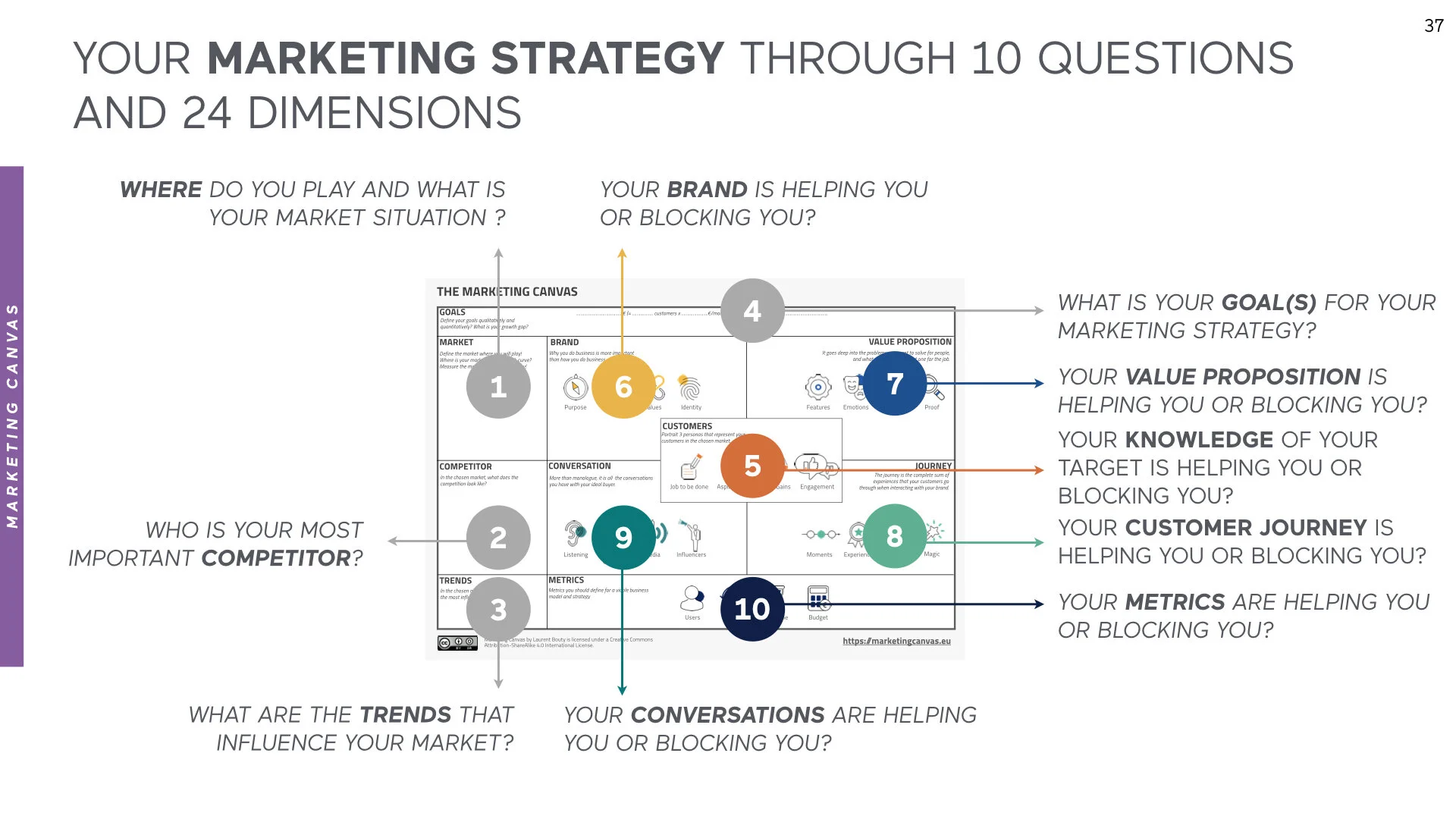
Marketing Canvas Method in 10 questions
The key questions you should ask yourself before you investigate what might be your scenarios for your strategy.
Identify the strategy where you would like to play. TESLA could have chosen the category where most of the electrical car offers where made. TESLA decided to enter the Segment F (Luxury saloon / full-size luxury sedan).
Key needs. What are the identified needs that customers/buyers are addressing when buying products/services in this category (pains/gains/functional needs).
Competitors. If not you, you else? It could be a competitor or a substitute. In the segment F, key competitors of TESLA are: BMW, Mercedes, Jaguar, Lexus, Audi, Porsche….
Rules of the category like average price, core features and add-ons, payment scheme/subscription model, buyer power. Price of a Porsche is around 100k€ which is the starting price point where TESLA positioned itself.
Category dynamic. What is the state of the category (few buyers/consumers or the market is saturated).
Marketing Strategy in Context
Examples:
Tesla has decided to enter the luxury segment where no real electrical car offer did exist (key needs were speed, design, social recognition).
Dove entered the cosmetic category where many alternatives existed
Apple entered the portable music device (with iPod) where the current offers where based on features and technologies but latent motives existed (social recognition, design and simplicity).
So before you investigate which options you should follow, you need first to answer these questions because it will set the scene. Then you can start investigating your scenarios using the Marketing Canvas Method.
What is Revenues in the Marketing Canvas?
In the Marketing Canvas, we have the REVENUES dimension. Usually, I recommend to start from there because it is the global constraint of the Marketing Strategy exercise. This is what you will have to deliver!
When you start working on your Marketing Strategy, I recommend that you first discuss the REVENUES. Why? At the end of your exercise, your actions and recommendations aim to support and justify your budget. In simple word, the business world cares about the numbers and the role of the strategy is to give enough confidence that the organisation will deliver it. Thus let's start this exercise from the REVENUES.

Short Term Revenues in Marketing Canvas
When you build a strategy, it would be a big mistake to work only for tomorrow. You have to prepare your futur. Think ahead. Long term like 10 years and ask yourself what your business could look like. Start from there and identify also the revenues risk (e.g. robots will replace functional workers and we have a business of job placement, what does it mean?).

Long Term Revenues in Marketing Canvas
Your revenues are also influenced by the Total Experience you give to your customers/clients. By Total Experience, I mean Customer Interactions, Conversations you have with them, the Purpose of your Brand. The more your Total Experience is strong, the most revenues you can generate (if you monetise it properly)
In the MARKETING CANVAS (if you don't know the Marketing Canvas, just click here), we have 4 main elements driving REVENUES:
- USERS: How much people/person are effectively paying for your products and services? you might have 1,000 persons or 100,000. It is quite different. Not all companies are capable to answer this question!! Example: some brands in the retail have no clue who purchase their products because they have no relationship with them.
- ARPU: ARPU means Average Revenue Per User. The idea behind this acronym is to identify how on average your paid users/customers are spending with you (on a monthly or yearly basis). Example: they all pay a subscription to the gym (20€ per month) and they all drink on average 5 energetic drinks a month @ 1€), so the ARPU is 20€+10€=30€. If only 50% of the paid users are drinking 5 energetic drinks and the other 50% are not, then the ARPU is 50% of 20€ + 50% of 30€= 25€ (getting more complex, hope you are following ;-)
- LIFETIME: Imagine you lose all your paid users after 1 year (they don't buy anymore), then their lifetime is 1 year. If you lose 50% of your customers each year, their lifetime is 2 years. The lifetime is critical because it defines your recurrent revenues (sometimes called cash cow or matelas business). Not all customers are equal). If you lose high value customers (big spenders) faster then low value, you lose more money.
- GROWTH: It gives you an idea about how the Market is growing. It is the external factor. It is easier to work in growing category than in a declining. Therefore you should deeply understand where you play and prepare yourself to enter new growing categories when you feel that the ones where you are currently playing are declining soon.
When you review these elements, the question you should have is:

List of questions for assessing your revenues situation using the Customer Lifetime Value

4 questions for your REVENUES in Marketing Canvas
MARKET
- Do you know if you are in a growing category?
- Do you know how to increase your market share in your category?
- Do you know what are your top 3 revenue drivers tomorrow?
- Do you know what are your top 3 promising revenue drivers in the next 10 years?
- Do you know how to prepare new revenue drivers for your category?
- Do you know if you should find a new category for the future?
USERS
- Are you capable to calculate your revenues per customers/users instead of products ? How much users/customers do you have ?
- Do you know how to convert visitors into free users?
- Do you know how to convert more free users to paid users?
- Do you know how to accelerate your customer acquisition (traction, velocity) ?
- Do you know these numbers by customer based percentile ?
ARPU (Average Revenue Per User)
- Do you know the ARPU of your business activity?
- Do you know the contribution of each value proposition in this ARPU?
- Do you know how to increase the number of paid transactions made by your users on a yearly and monthly basis? More cross-sell? More up-sell?
- Do you know how to protect/increase the average paid price for each transaction ? more premium products? less promotions/discounts ?
LIFETIME
- Do you know what is the average lifetime of your users? per percentile?
- Do you know how you can secure & extend the lifetime of your TOP 1% users ?
- Do you know the churn level of your users? per percentile ?
- Do you know what are the drivers of the churn? are you capable to act on them for reducing your churn?