In a Nutshell — 340 Proofs
Proofs (Dimension 340) is the evidence layer that makes claims credible — scored across four types: demonstration (showing the product working in a real context), logical explanation (clarifying how and why it works), endorsement (third-party validation: certifications, awards, analyst placement), and reputation (established credibility that precedes any specific claim). The critical distinction: proofs are not claims. Saying "we're the best" is a claim. Showing a customer saying "they changed how I think about this problem" is proof. In B2B, proofs often determine whether you make the shortlist — Gartner placements, ISO certifications, and named client case studies function as purchase prerequisites. The deal never begins without them. Proofs is a Primary Accelerator for A8 (Niche Expert), where expert authority must be demonstrable not claimed, and a Secondary Brake for A3 (Brand Evangelist), A4 (Stagnant Leader), and A9 (Category Creator) — in all three, credibility gaps erode strategy from underneath.
Claims vs. proof: the foundational distinction
Every brand makes claims. Few build proof systems.
A claim is a statement the brand makes about itself. Proof is evidence that exists independently of the brand's desire to be believed. The gap between them is the gap between what a brand says and what a prospect believes — and in most markets, that gap is large and widening.
The reason: customers have become systematically sceptical of self-assertion, particularly around sustainability, quality, and expertise claims. "Award-winning," "industry-leading," "eco-friendly," "best-in-class" — these phrases have been used so frequently, by brands of such varying quality, that they carry almost no credibility signal. They are the background noise of value proposition communication.
What breaks through is evidence that exists independently of the brand making the claim: a third party that validated it, a customer who confirmed it, a before/after result that demonstrated it, a mechanism that explains how it works. That is proof. And the dimension that scores whether your value proposition has it is 340.
Score negative if claims are unsupported or if proof relies entirely on self-assertion. Score positive when multiple proof types reinforce each other and customers cite specific evidence when recommending the brand.
The four canonical proof types
The Marketing Canvas identifies four types of proof. The most effective strategies use all four — each type covers a different dimension of credibility, and they stack:
Demonstration — showing the product working in a real context. Not a polished commercial. A before/after air quality result. A live installation. A customer tour. A product in use under realistic conditions. Demonstration answers "does it actually work?" It is the most visceral form of proof because it bypasses scepticism about the brand's motives — the outcome is visible.
Logical explanation — clarifying how and why it works. The mechanism. Why is this formula non-toxic? Because it uses X chemistry instead of Y. How does it eliminate toxins? Here is the molecular process. Why does this hold up better than alternatives? Here is the engineering rationale. Logical explanation answers "can I understand why it works?" It converts the sceptical-but-open prospect — the one who wants to believe but needs a reason — into a convinced one.
Endorsement — third-party validation. Certifications, awards, analyst recognition, celebrity ambassadors, peer recommendations. In B2C: certifications like B-Corp or EcoCert, customer reviews, media coverage, social proof numbers ("550 families served"). In B2B: Gartner Magic Quadrant placement, ISO certifications, named client case studies, analyst endorsements. Endorsement answers "who else believes this?" It transfers credibility from a trusted external source to the brand.
Reputation — established credibility that precedes any specific claim. Years in business. Volume of customers served. Industry recognition over time. The credibility that arrives before a prospect reads a single word of marketing. Reputation answers "can I trust this brand in general?" It is the slowest proof type to build and the most durable once established.
Stacking: why one proof type is never enough
Each proof type addresses a different dimension of credibility. A single proof type is credible on one dimension and silent on the others — leaving gaps a sceptical prospect will fill with doubt.
A brand that has only endorsement (certified, award-winning) but no demonstration (show me it works) can be dismissed as buying certifications. A brand with strong demonstration but no logical explanation raises the question "yes, but how?" A brand with deep reputation but no current endorsement is vulnerable to the claim that past performance is no longer relevant.
The proof stack that makes a category claim genuinely credible combines all four:
Here is what it does (demonstration)
Here is why it works (logical explanation)
Here is who else validates it (endorsement)
Here is the track record behind us (reputation)
For Green Clean as an A9 Category Creator — a company asking the market to believe in a category that didn't previously exist — the stacking principle is existential. The burden of proof for creating a new category is ten times higher than for competing within one. Every claim they make is unfamiliar. Every endorsement they earn legitimises the category, not just the company. Every demonstration they run teaches the market that the job is real.
Laurent Bouty - Marketing Canvas Method - Proofs
B2B and B2C: proof types work differently
The four proof types apply universally but manifest differently by context.
In B2B, proof often determines whether you make the shortlist before any sales conversation begins. Gartner Magic Quadrant placement, ISO certifications, named client case studies with verifiable outcomes, and analyst endorsements function as purchase prerequisites — the deal never begins without them. A B2B buyer who cannot show their CFO a Gartner ranking or a named enterprise reference cannot internally justify the purchase, regardless of the product's quality. Proof here is a gatekeeping mechanism, not just a persuasion tool.
In B2C, proof works through different channels. Customer reviews (demonstration by proxy), before/after results (direct demonstration), media coverage (earned endorsement), social proof numbers ("over 1 million families have switched"), and visible certifications on packaging all contribute to the credibility system. The scale of endorsement matters differently: a single enterprise case study moves a B2B deal; 500 five-star reviews move a B2C conversion. The mechanism is the same — independent validation — but the format and threshold differ.
The implication for scoring: a B2B company that scores its proof stack against B2C norms (focusing on reviews and social media rather than analyst coverage and certifications) will systematically misdiagnose the dimension.
Proof in the Marketing Canvas
The canonical question
Why should customers believe your claims?
Proof appears in the Vital 8 of four archetypes — spanning a wide range of strategic urgency:
Primary Accelerator for A8 (Niche Expert): Expert authority must be demonstrable, not claimed. A niche expert whose expertise cannot be independently verified is simply a specialist with good self-confidence. The proof stack — certifications, published work, client outcomes, peer recognition — is the mechanism that converts internal confidence into external authority. For A8, Proof is the dimension that transforms "we know this space deeply" into "the market knows we know this space deeply." Hermès' resale values (Birkin bags appreciating faster than gold) are a form of proof: independent market validation that the quality claim is real.
Secondary Brake for A3 (Brand Evangelist): Tribal trust is built on values and shared belief — but it is sustained by proof that the brand lives what it claims. Patagonia's "Don't Buy This Jacket" campaign worked because the proof of environmental commitment was already established through decade of verified actions: 1% for the Planet donations (independently tracked), Worn Wear repairs data (published), B-Corp certification (audited). Without the proof stack underneath, the campaign would have been dismissed as marketing theatre. For A3, credibility gaps erode tribal trust faster than any competitive threat.
Secondary Brake for A4 (Stagnant Leader): A stagnant leader's most valuable asset is the credibility accumulated over years of market presence. When that credibility starts to decay — when proof points become dated, when case studies reference old products, when certifications lapse — the legacy position that was the primary competitive defence begins to dissolve. Proof maintenance is as important as proof creation for A4.
Secondary Brake for A9 (Category Creator): The unique challenge here is proving something works in a category that doesn't exist yet. Green Clean cannot reference ten years of "health-first home care" competitors because the category is new. Every proof point they build — the university formula validation, the B-Corp certification, the Family Health Report, the air quality before/after results — is simultaneously proving the company and defining the standards of the category. For A9, Proof is the physical evidence that the new category is real, not just a repositioning exercise.
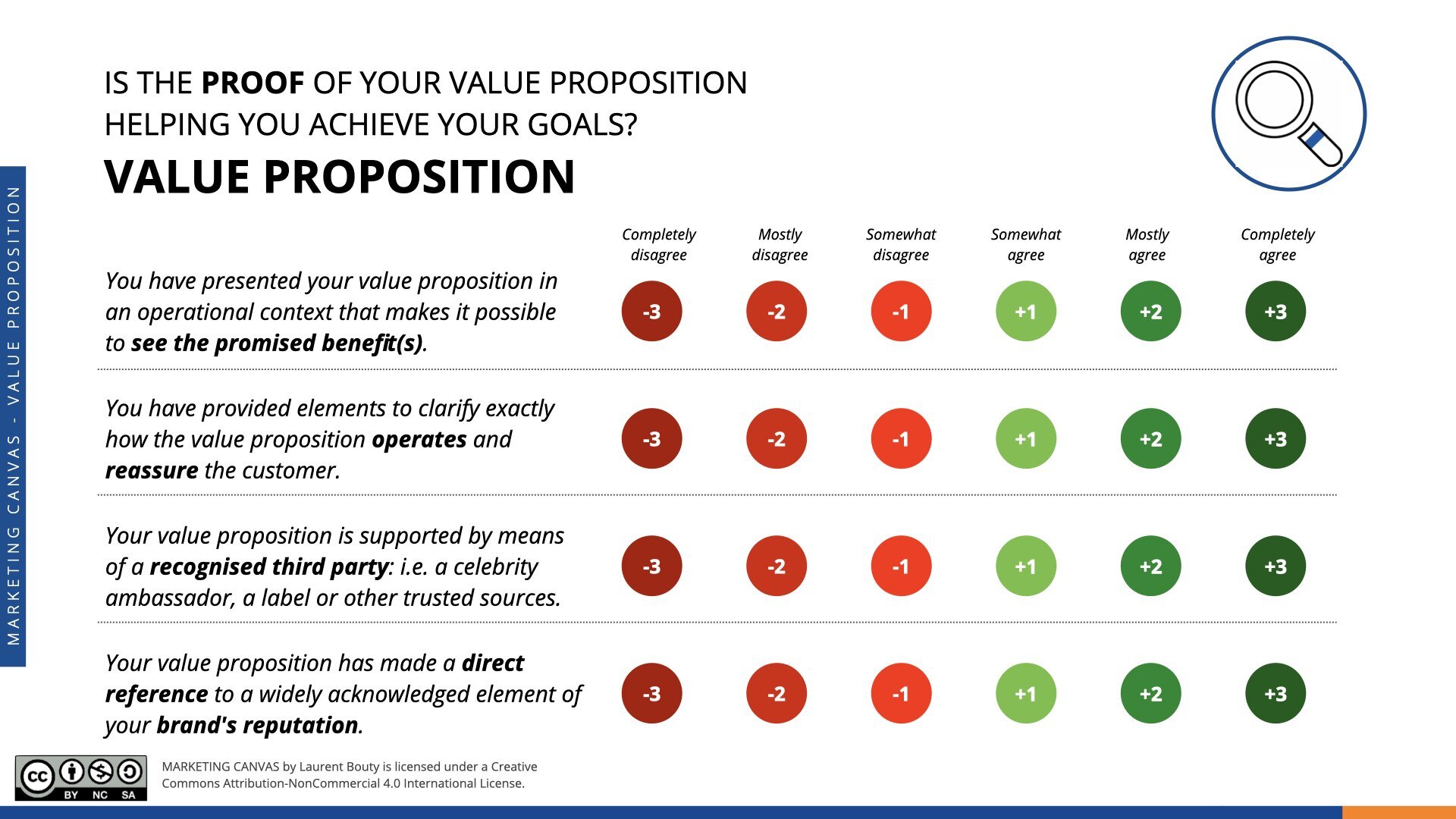
Statements for self-assessment
Rate your agreement on a scale from −3 (completely disagree) to +3 (completely agree). There is no zero — the Marketing Canvas forces a directional position on every dimension.
Note on Detailed Track scoring: if averaging sub-question scores produces a mathematical zero, the method rounds to −1. A split score means the dimension is not clearly helping your goal — and "not clearly helping" requires the same investigation as "hurting."
Interpreting your scores
Negative scores (−1 to −3): Claims are unsupported or rely entirely on self-assertion. Proof types are absent or single-layer. Sceptical prospects — particularly in categories where greenwashing is common — have no independent reason to believe the value proposition. Conversion rates are lower than the product quality justifies. For archetypes where Proof is a Strategic Brake, a negative score here explains why the strategy is not generating the expected traction.
Positive scores (+1 to +3): Multiple proof types reinforce each other. Demonstration, explanation, endorsement, and reputation are all present and deployed at the moments in the customer journey where scepticism is highest. Customers cite specific evidence when recommending the brand — not because they were asked to, but because the proof is memorable and specific enough to pass on.
Case study: Green Clean
Green Clean is a fictional eco-friendly residential cleaning service used as the recurring worked example throughout the Marketing Canvas Method.
Score: −2 to −1 (Weak) Green Clean's proof system is entirely self-asserted. The website states "non-toxic cleaning you can trust" and "safe for your family." No demonstration: no before/after air quality data, no ingredient testing results, no customer outcome evidence. No logical explanation: the website says the formula is "plant-based" but does not explain what that means for toxin elimination or why it is safer than conventional products. No endorsement: no certifications, no third-party validation, no named customer testimonials. No reputation: Green Clean is four years old and has not systematically built a credibility track record. When health-conscious parents research the brand, they find claims that every competitor also makes. There is nothing that distinguishes a Green Clean claim from an EcoPure claim from a NatureFresh claim. The proof gap is the primary barrier to conversion for the Early Believer segment — the very customers who care most about evidence.
Score: +1 to +2 (Developing) Green Clean has begun building a proof stack. The B-Corp certification (first in the region for cleaning services) is the strongest endorsement they have — it is independently audited and competitively rare. The university partnership behind the formula is publicly referenced but not yet explained: the website says "developed with a university chemistry department" without specifying the institution, the testing methodology, or what the validation showed. Customer testimonials are present but anonymous — "a satisfied parent in [city]" — which reduces their credibility impact. The Family Health Report exists and provides per-visit demonstration data but is only seen by existing customers, not by prospects during the research phase. The proof stack is forming but is not yet deployed at the moments that matter most: the first three minutes of a prospect's research.
Score: +2 to +3 (Strong) Green Clean's proof stack covers all four types and is deployed at the right journey stages. Demonstration: the Family Health Report excerpt (average toxin load reduction across 550 customer visits) is visible on the website homepage before any sales conversation. A before/after air quality result from a real customer home (anonymised but with verifiable methodology) appears on the booking page. Logical explanation: a plain-language technical summary explains precisely why the university-validated formula eliminates specific chemical classes that conventional eco-cleaning products do not address. Endorsement: B-Corp certification displayed prominently; EcoCert certification in process; 127 named customer testimonials with full first name and suburb; local health journalist coverage. Reputation: four years of service data, 550 active customers, 35% referral rate cited explicitly as a trust signal. When a prospect asks "why should I believe you over EcoPure?" — the answer is specific, layered, and independently verifiable at every level.
Connected dimensions
Proof does not operate in isolation. Four dimensions connect most directly:
310 — Features: Proofs demonstrate features work. The unique feature (the university-validated formula) is only as strong as the evidence behind it. Without the proof, the formula is a claim like every competitor's. With the proof, it is a category-defining differentiator.
330 — Prices: Proofs justify premium pricing. A customer who has encountered the full proof stack — demonstration data, logical explanation, B-Corp endorsement, reputation track record — is less price-sensitive than one who has not. Proof shifts perceived value upward and expands the WTP range.
520 — Stories: Stories are the delivery vehicle for proof. A case study is a story with demonstration. A customer testimonial is a story with endorsement. A founder origin narrative is a story with reputation. Proof is the evidence; Stories (520) is the format that makes evidence compelling and memorable.
530 — Media: Earned media is a form of proof. A journalist covering Green Clean's health-first positioning in a local parenting publication is providing endorsement at scale — more credible than any paid placement because the editorial decision is independent. Media strategy and proof strategy should be planned together.
Conclusion
The gap between a brand that has good features and a brand that is believed to have good features is exactly the width of dimension 340.
The most capable product in the market cannot sell itself if prospective customers have no independent reason to trust the claims made about it. Every market has category-level scepticism built up by years of overclaimed marketing — "eco-friendly," "expert," "world-class" — that has trained buyers to discount self-assertion reflexively.
The proof stack is the mechanism that breaks through that scepticism. Demonstration shows. Explanation clarifies. Endorsement validates. Reputation precedes. Together, they convert claims into credibility — and credibility into the willingness to buy, recommend, and pay a premium.
Sources
Robert Cialdini, Influence: The Psychology of Persuasion, Harper Business, revised edition 2021
Nielsen, Trust in Advertising, Nielsen Consumer Research, 2023 — nielsen.com
Marketing Canvas Method, Appendix E — Dimension 340: Proof, Laurent Bouty, 2026
About this dimension
Dimension 340 — Proof is part of the Value Proposition meta-category (300) in the Marketing Canvas Method. The Value Proposition meta-category contains four dimensions: Features (310), Emotions (320), Prices (330), and Proof (340).
The Marketing Canvas Method is a complete marketing strategy framework built around 6 meta-categories, 24 dimensions, and 9 strategic archetypes. Learn more at marketingcanvas.net or in the book Marketing Strategy, Programmed by Laurent Bouty.