Marketing Canvas - Pricing
In a Nutshell — 330 Prices
Prices (Dimension 330) treats pricing as a strategic dimension, not a finance function — scored on alignment with positioning, anchoring to customer willingness to pay, and sustainability relative to cost structure. The foundational question is not "is the price low?" but "does the customer perceive more value than the price asks, relative to alternatives?" Pricing errors run in both directions: underpricing signals low quality and leaves margin on the table; overpricing creates a gap that strong features alone cannot bridge. The method connects Dimension 330 directly to M8 (Perceived Price) in the Context Map — the Step 1 parameter that locates your brand on the customer's mental price scale. A premium position with discount pricing creates cognitive dissonance. A value position with premium pricing creates resentment. The price must match the promise. Prices is a Primary Accelerator for A6 (Value Harvester) and a Growth Driver for A2 and A8 — where the ability to raise prices proves that expertise is real.
Pricing errors run in both directions
The most common framing of a pricing problem is "our price is too high." The canonical view is more demanding: pricing errors run symmetrically in both directions, and both are strategically damaging.
Overpricing creates a gap between perceived value and cost that even strong features cannot bridge. When price exceeds what customers perceive as justified by the value, the result is not premium positioning — it is resentment, abandoned trials, and word-of-mouth that damages rather than builds.
Underpricing is equally problematic and more often overlooked. A price that is too low signals low quality and leaves margin on the table. It undermines positioning — a brand that claims "indoor health protection" at commodity pricing sends a contradictory signal. Customers use price as a quality heuristic. A low price says: "we don't fully believe in what we built either."
The diagnostic question is not where the price sits in absolute terms. It is whether the customer perceives more value than the price asks, compared to every alternative they are considering. A €15 artisanal coffee is not expensive if the customer perceives it as worth €20. A €5 coffee is overpriced if the customer sees it as worth €3.
Score negative if pricing is set by finance without customer input, or if there is a disconnect between price and positioning. Score positive when pricing actively supports the strategic position and customers perceive fair value — not cheap, not resentment-inducing, but justified.
The price/positioning test
The sharpest diagnostic in dimension 330 is also the simplest:
A premium position with discount pricing creates cognitive dissonance. A value position with premium pricing creates resentment. The price must match the promise.
This test catches misalignments that are obvious once named but invisible in day-to-day operations. A B2B software company that positions itself as "enterprise-grade" but prices below mid-market confuses the procurement team — the price contradicts the claim. A cleaning service that positions itself as health-protection specialists but prices below the eco-follower in the market undermines its own differentiation before a customer conversation begins.
Run the test against your own positioning: if a prospect saw only your price — before any marketing, any features list, any proof — would the price itself reinforce or contradict your positioning? If it contradicts, dimension 330 requires attention regardless of what the rest of the value proposition delivers.
M8 and dimension 330: diagnosis vs. strategy
In the Marketing Canvas Method, pricing is measured twice — at different points in the process, for different purposes.
M8 (Perceived Price) is calculated in Step 1 (Strategic Context Mapping). It normalises your actual price per unit relative to the highest and lowest prices in your competitive set, producing a score from −12 (feels very cheap) to +12 (feels very expensive). M8 is the diagnosis: it shows where your brand sits on the customer's mental price scale before any strategic decisions are made.
Dimension 330 is scored in Step 3 (the Vital Audit). It scores whether your pricing strategy — how you set, communicate, and manage price — actively serves your Step 2 goal. M8 is the starting position. Dimension 330 is the question: are you managing it intentionally?
For Green Clean, M8 is +3.0 — slightly above mid-market, well below EcoPure at +12.0. That is a deliberate positioning choice: accessible enough to attract health-conscious families who cannot justify the premium leader, differentiated enough that "eco-follower" NatureFresh at −6.0 cannot compete on the same terms. Dimension 330 scores whether Green Clean has made that a strategic choice — informed by customer WTP research, aligned with their health-first positioning, and sustainable relative to their cost structure — or whether +3.0 is simply where they ended up.
The four pricing anchors
The Marketing Canvas scores dimension 330 against four sub-questions that together define whether pricing is strategic or accidental:
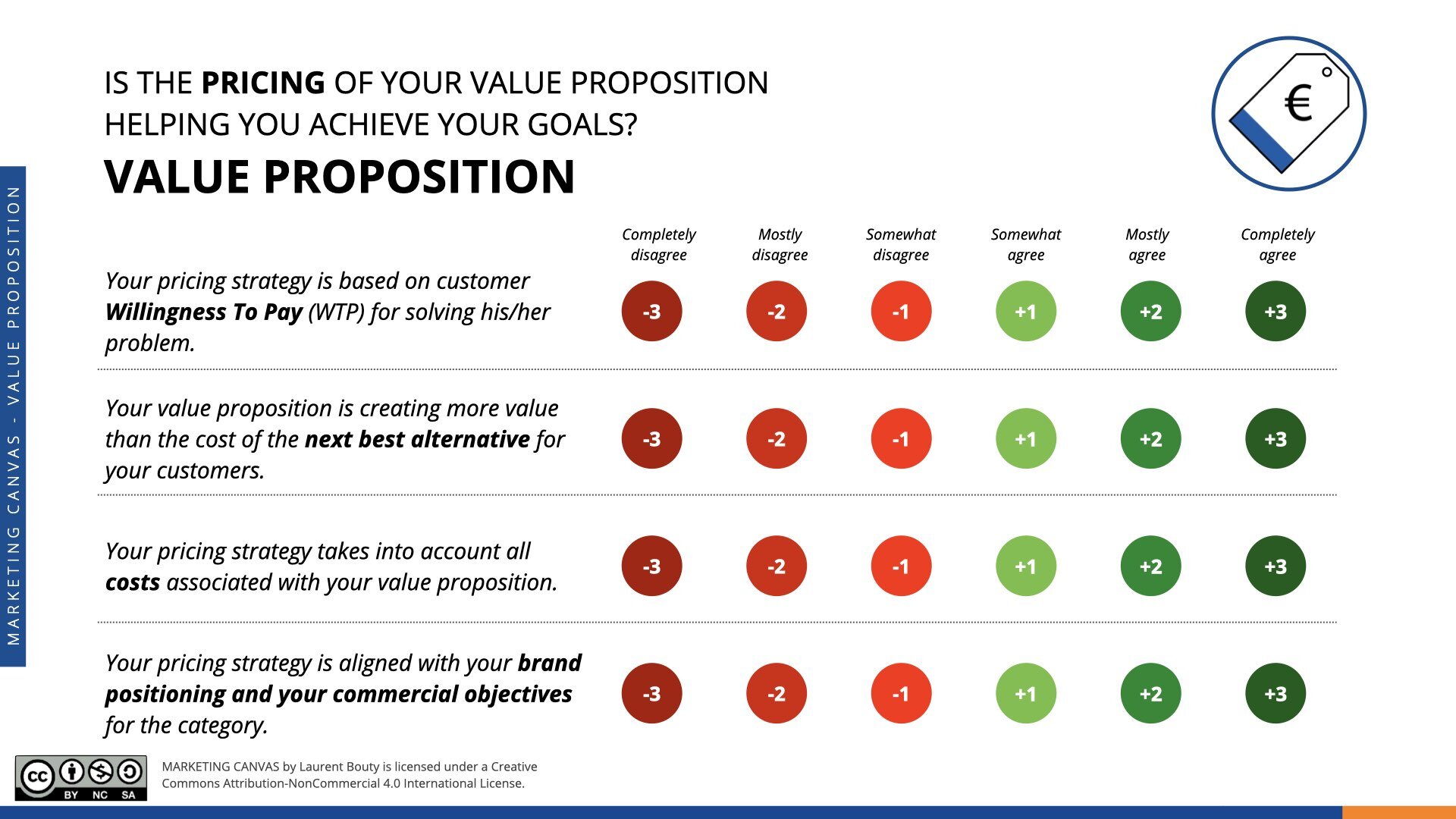
Value vs. alternatives (331): Does the customer perceive more value than the price asks, compared to the next best alternative? This is the core question. It requires knowing both your own perceived value (M9) and your competitors' — and understanding whether the price premium or discount relative to alternatives is perceived as justified.
Willingness to pay (332): Is the pricing strategy grounded in customer WTP research, not internal cost-plus assumptions? WTP is not what customers say they would pay in a survey. It is the revealed willingness — what they actually pay, what they pay for competitors, and where the price sensitivity curve breaks. WTP research requires customer interviews, competitive analysis, and price sensitivity testing. Without it, dimension 330 cannot score above +1.
Cost coverage (333): Does the price account for all costs associated with delivering the value proposition — including the hidden costs of service, support, onboarding, and relationship management that are routinely underestimated? A price that does not cover full costs is not a strategic choice. It is a delayed crisis.
Positioning alignment (334): Is the price consistent with brand positioning and category goals? This is the price/positioning test applied systematically. Premium positioning requires premium-range pricing. Value positioning requires price-accessible pricing. Misalignment here is not a pricing problem — it is a brand architecture problem that dimension 330 surfaces.
Prices in the Marketing Canvas
The canonical question
Does your pricing strategy reflect the value you deliver, align with customer willingness to pay, and support your positioning?
Prices appears in the Vital 8 of three archetypes in roles that reflect its strategic weight:
Primary Accelerator for A6 (Value Harvester): The Value Harvester is extracting maximum cash flow from an existing customer base. Pricing power — the ability to raise prices, introduce premium tiers, and increase ARPU without triggering churn — is the primary growth mechanism. For A6, dimension 330 is not defensive. It is the offensive lever. Every pricing improvement directly converts to margin.
Secondary Brake for A2 (Efficiency Machine): An Efficiency Machine competes on cost leadership. The pricing risk is margin erosion — the downward pressure of competitive price-matching that can turn cost leadership into a race to zero. Dimension 330 scores whether the pricing strategy protects the margin structure that makes efficiency sustainable. For A2, price must be low enough to win volume without being so low that the cost model collapses.
Secondary Brake for A8 (Niche Expert): For the Niche Expert, the ability to raise prices is the proof that expertise is real. A niche authority that charges the same as a generalist is signalling that the niche does not command a premium — which undermines the authority itself. Hermès raises prices 5–8% annually and the market absorbs it. That is not arrogance. That is a dimension 330 score of +3 demonstrating that the niche position is genuine.
Growth Driver for A2 and A8: In both, pricing optimisation — raising prices toward the WTP ceiling, introducing tiered offerings, or expanding into premium segments — is a direct revenue lever that does not require new customer acquisition.
Statements for self-assessment
Rate your agreement on a scale from −3 (completely disagree) to +3 (completely agree). There is no zero — the Marketing Canvas forces a directional position on every dimension.
Note on Detailed Track scoring: if averaging sub-question scores produces a mathematical zero, the method rounds to −1. A split score means the dimension is not clearly helping your goal — and "not clearly helping" requires the same investigation as "hurting."
Interpreting your scores
Negative scores (−1 to −3): Pricing is misaligned with customer WTP, disconnected from positioning, or set by cost and competitive reference alone. The likely result: either margin erosion (underpricing) or purchase friction and resentment (overpricing). Pricing is not functioning as a strategic asset.
Positive scores (+1 to +3): Pricing is grounded in WTP research, consistent with positioning, covers full costs, and actively reinforces the value proposition rather than contradicting it. Customers perceive the price as justified. The price/positioning test passes without qualification.
Case study: Green Clean
Green Clean is a fictional eco-friendly residential cleaning service used as the recurring worked example throughout the Marketing Canvas Method.
Score: −2 to −1 (Weak) Green Clean's price of $200 per visit was set by looking at EcoPure ($260) and splitting the difference with NatureFresh ($140). No WTP research was conducted. No customer was asked what they would pay for a service that could verifiably protect indoor health rather than just clean with eco products. The price covers costs — just. But it does not reflect the value premium Green Clean is attempting to claim. The health-first positioning demands a price signal that says "this is a specialist service, not a cleaning commodity." At $200 in a market where the eco-follower charges $140, the $60 premium is too modest to reinforce the category distinction and too large to be dismissed as rounding error. The price is caught between value and premium without committing to either. Pricing is set by cost and competitive reference, not by customer WTP or positioning logic.
Score: +1 to +2 (Developing) Green Clean has conducted basic WTP research — six customer interviews and a price sensitivity survey of 40 existing customers. The data suggests that health-conscious parents with children under 10 have a WTP ceiling of approximately $230 for a verified health-protection service, compared to $170 for a standard eco-cleaning service. This validates a $200 entry price as accessible to the primary segment. But the full pricing architecture is incomplete: there is no premium tier for customers who want quarterly indoor air quality testing, no subscription discount structure that rewards commitment, and no articulated reason in the sales conversation for why $200 reflects value rather than cost. The price is in the right zone. The strategy around it is not yet complete.
Score: +2 to +3 (Strong) Green Clean's pricing architecture is fully aligned with positioning and WTP evidence. The standard service at $200 is priced as the accessible entry to health-first home care — above the eco-follower (NatureFresh at $140) to reinforce the quality signal, below the premium leader (EcoPure at $260) to remain accessible to the early believer segment. A premium tier at $240 includes quarterly indoor air quality baseline testing — a feature that translates health-first positioning into a tangible deliverable and captures WTP from the highest-intent segment. An annual subscription at $185/visit rewards commitment while improving LTV. The sales conversation anchors the $200 price to the university-validated formula and third-party certifications — making the price a consequence of quality, not a financial decision. Customers who ask "why not NatureFresh for $140?" receive a specific answer about what the $60 buys. Churn is lower in the premium tier than in the standard tier — confirming that the pricing architecture is reinforcing, not diluting, loyalty.
Connected dimensions
Prices does not operate in isolation. Four dimensions connect most directly:
310 — Features: Features justify the price. A unique functional benefit — the only independently validated non-toxic formula in the region — is the justification for a price premium. Without a unique feature, premium pricing is a claim without a foundation.
220 — Positioning: Price must match position. The price/positioning test is the most direct connection between these two dimensions. Positioning defines the promise. Prices either confirms or contradicts it at the first moment of commercial truth.
340 — Proof: Proofs reduce price sensitivity. A customer who has seen the university validation data, the B-Corp certification, and the Family Health Report is less price-sensitive than one who hasn't. Proof shifts the perceived value upward, which expands the WTP range and makes the price feel justified rather than expensive.
620 — ARPU: Pricing directly drives revenue per user. Every pricing decision — entry price, premium tier, subscription structure, annual increase — translates directly into ARPU. Dimension 330 and dimension 620 should be reviewed together: the pricing architecture is the primary lever for ARPU improvement without requiring new customer acquisition.
Conclusion
Prices is the dimension that either validates or undermines everything else in the value proposition. A product can have a unique feature, a designed emotional benefit, and a compelling purpose — and a price that signals none of it is real.
The strategic discipline is not to price low enough to be accessible or high enough to be premium. It is to price at the level where the customer perceives the value as justified relative to alternatives — and to ensure that perception is managed actively, not left to whatever the market average happens to be.
The price/positioning test is the fastest audit available: premium position + discount price = cognitive dissonance. Value position + premium price = resentment. When the price matches the promise, dimension 330 is working. When it doesn't, everything upstream is harder.
Sources
Thomas Nagle, Georg Müller, The Strategy and Tactics of Pricing, Routledge, 6th edition, 2018
Hermann Simon, Confessions of the Pricing Man, Springer, 2015
Marketing Canvas Method, Appendix E — Dimension 330: Prices, Laurent Bouty, 2026
About this dimension
Dimension 330 — Prices is part of the Value Proposition meta-category (300) in the Marketing Canvas Method. The Value Proposition meta-category contains four dimensions: Features (310), Emotions (320), Prices (330), and Proof (340).
The Marketing Canvas Method is a complete marketing strategy framework built around 6 meta-categories, 24 dimensions, and 9 strategic archetypes. Learn more at marketingcanvas.net or in the book Marketing Strategy, Programmed by Laurent Bouty.